-
-
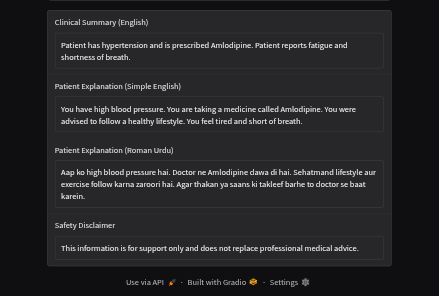
Live demo showing conversion of clinical notes into patient-safe explanations
-
Clinical Co-Pilot AI – Safe patient-friendly medical explanations
Inspiration
Clinical notes are written for healthcare professionals, not patients. In many regions, especially low-resource and multilingual settings, patients struggle to understand what doctors write about their condition, medications, and next steps. This communication gap often leads to confusion, anxiety, and poor adherence to treatment.
What it does
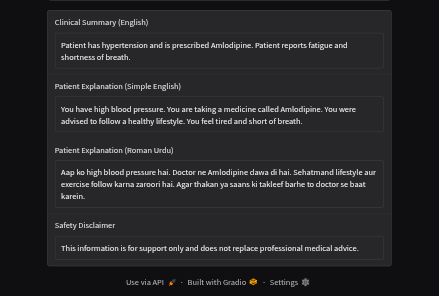
Clinical Co-Pilot AI converts complex doctor notes into:
- A concise clinical summary (English)
- A patient-friendly explanation in simple English
- A patient explanation in Roman Urdu
- A clear medical safety disclaimer
The goal is to improve patient understanding without replacing professional medical advice.
How we built it
The system is built using Google Gemini for reasoning and language understanding. A structured prompt pipeline ensures:
- Medical context preservation
- Patient-safe, non-diagnostic language
- Clear separation between clinical information and patient explanation
A Gradio-based interface allows users to paste doctor notes and instantly receive safe explanations.
Challenges we ran into
Clinical notes are often unstructured, abbreviated, and inconsistent. Ensuring safety, avoiding hallucinations, and keeping explanations simple yet accurate required careful prompt design and strict output constraints.
Accomplishments that we're proud of
- Clear separation between clinical information and patient explanation
- Roman Urdu support for accessibility
- Strong safety framing aligned with real clinical workflows
What we learned
Human-centered AI in healthcare requires clarity, restraint, and trust. Accuracy alone is not enough — communication and safety matter equally.
What's next
Future work includes support for scanned handwritten notes, multilingual expansion, and integration into hospital systems as an assistive, offline-friendly tool.
Built With
- generative-ai
- google-gemini
- healthcare-ai
- machine-learning
- python

Log in or sign up for Devpost to join the conversation.