Inspiration Bryan Johnson's "Don't Die" movement made us ask: what if the most advanced clinical reasoning wasn't locked behind expensive concierge doctors, but available to anyone through a WhatsApp message? We were frustrated that preventive medicine -- the kind that actually stops disease before it starts -- is reactive, fragmented, and inaccessible. We wanted to build an autonomous medical team that never sleeps, never forgets your history, and is grounded in real clinical evidence.
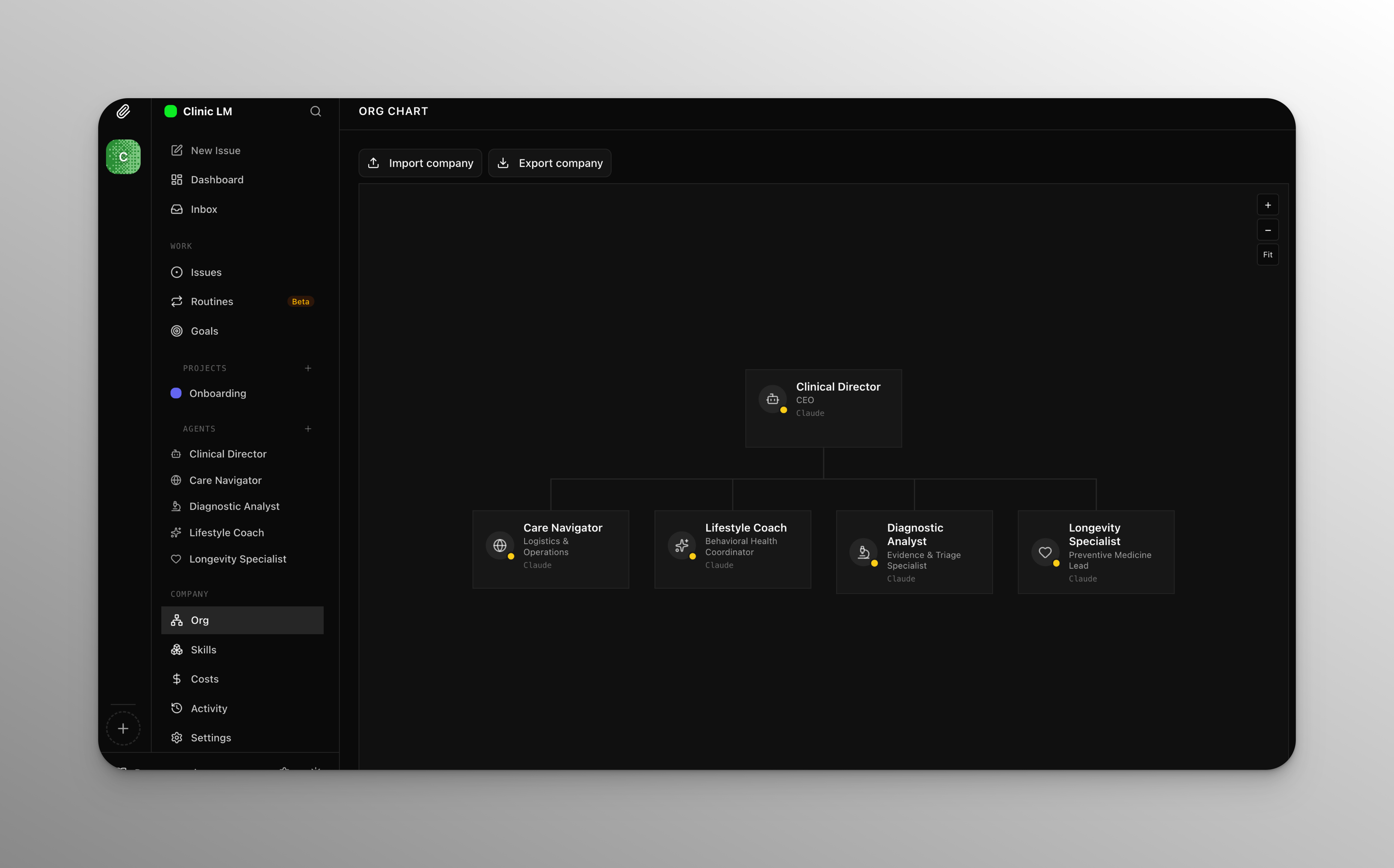
What it does ClinicLM is a multi-agent AI system that acts as a patient's personal clinical team, accessible entirely through WhatsApp. A Clinical Director agent orchestrates specialized sub-agents -- a Diagnostic Analyst, a Longevity & Biomarker Specialist, a Lifestyle & Nutrition Coach, and a Care Navigator -- to deliver comprehensive, evidence-based medical guidance. It can cross-reference symptoms against medical literature, track biomarkers over time, generate actionable health plans, and even schedule appointments at nearby clinics.
How we built it The system runs on a Hetzner cloud server (Ubuntu, 32GB RAM) with Claude Code as the AI backbone -- Sonnet for fast conversational responses and Opus for deep clinical reasoning. We use Paperclip as the multi-agent orchestration layer, with each sub-agent having its own model tier and tool set. The WhatsApp interface is built with Baileys and the Vercel Chat SDK. Patient data is stored in Supabase PostgreSQL, the network is secured with Tailscale Funnel for auto-TLS, and the landing page is a Next.js + Tailwind + Framer Motion site deployed on Vercel.
Challenges we ran into Getting a reliable WhatsApp bot running headlessly on a remote server was harder than expected -- session persistence, QR re-authentication, and message queue timing were constant issues. Orchestrating multiple AI agents with different model tiers while keeping response latency under 10 seconds required careful routing logic. We also had to be very deliberate about grounding: making sure agents cite real clinical evidence rather than hallucinating medical advice, which is a domain where accuracy is non-negotiable.
Accomplishments that we're proud of We have a working end-to-end system where a real patient can message a WhatsApp number and receive clinically grounded, multi-agent-synthesized health guidance within seconds. The architecture cleanly separates concerns -- the Clinical Director never does raw data parsing, and the Care Navigator never does clinical reasoning. We're also proud of the landing page: a minimalist, animated experience that communicates the gravity of the mission without visual noise.
What we learned We learned that multi-agent orchestration is as much about what you don't delegate as what you do. Giving each agent a clear, narrow mandate with the right model tier (powerful for clinical reasoning, lightweight for logistics) was the key insight. We also learned that building for healthcare requires a different engineering mindset -- every output needs to be traceable to evidence, and "good enough" isn't acceptable when someone's health is on the line.
What's next for ClinicLM Next, we're building multimodal video examinations -- patients will be able to show symptoms via camera and receive structured clinical assessments. We're adding longitudinal biomarker tracking with lab result ingestion (PDFs, images, CSVs), browser automation for checking appointment availability and insurance networks, and calendar integration for medication reminders and follow-ups. The long-term vision is a system where ClinicLM knows your health better than you do and acts proactively before problems become diagnoses.
Built With
- accessible-via-whatsapp-(baileys/chat-sdk)-and-email-(resend)
- postgresql
- powered-by-claude-code-cli-(sonnet-+-opus)-orchestrated-through-paperclip
- running-on-a-hetzner-vps-behind-tailscale-funnel
- supabase
- typescript-on-node.js
