-
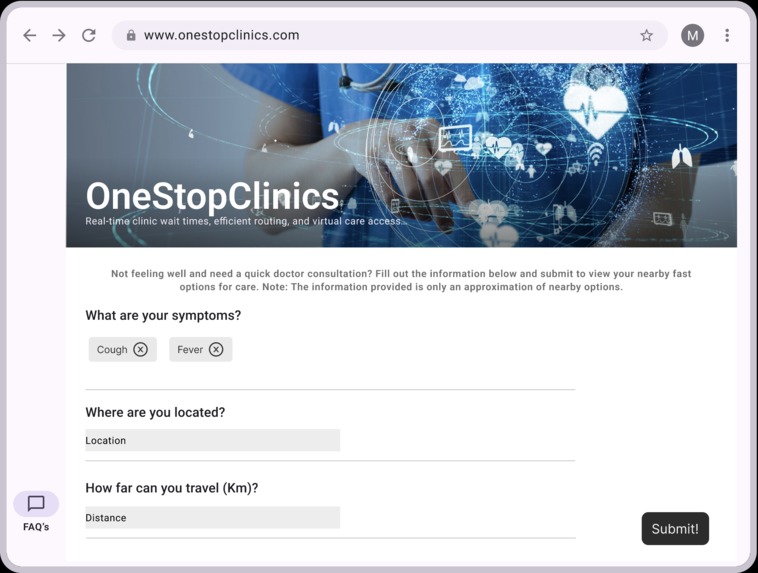
Main Page of OneStopClinics
-
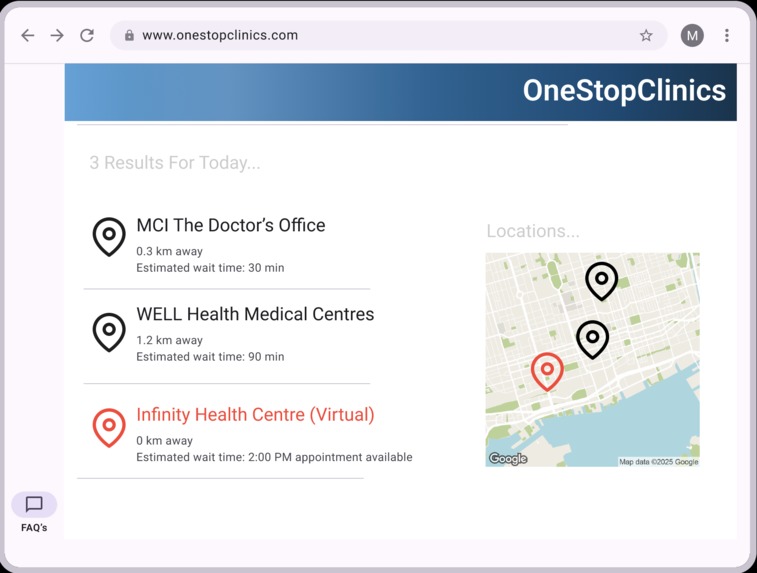
Results Page of OneStopClinics
Inspiration: Seeing Toronto’s overwhelmed clinics and ERs, we wanted to create a smart, equitable solution to simplify healthcare access, especially for low-income patients without family doctors.
What it does: OneStopClinic (OSC) optimizes healthcare accessibility by dynamically predicting and displaying real-time wait times at local clinics. It utilizes advanced A* pathfinding algorithms to calculate and recommend the fastest clinic wait times based on live data. It also integrates a severity assessment that analyzes patient-reported symptoms, recommending virtual appointments when appropriate, which reduces unnecessary physical clinic visits.
Dynamic Routing & Wait-Time Predictions: Patients enter their current location, and OSC uses real-time data combined with geographic pathfinding algorithms to pinpoint clinics with the shortest total wait and travel times.
Severity Assessment & Care Recommendations: Users input symptoms anonymously into our condition-severity model, which classifies urgency levels and recommends in-person or virtual appointments, reducing strain on crowded clinics.
Privacy & Accessibility: The platform allows anonymous usage, enabling patients to choose whether to store personal information or health histories. It also supports queue entry remotely, minimizing physical attendance.
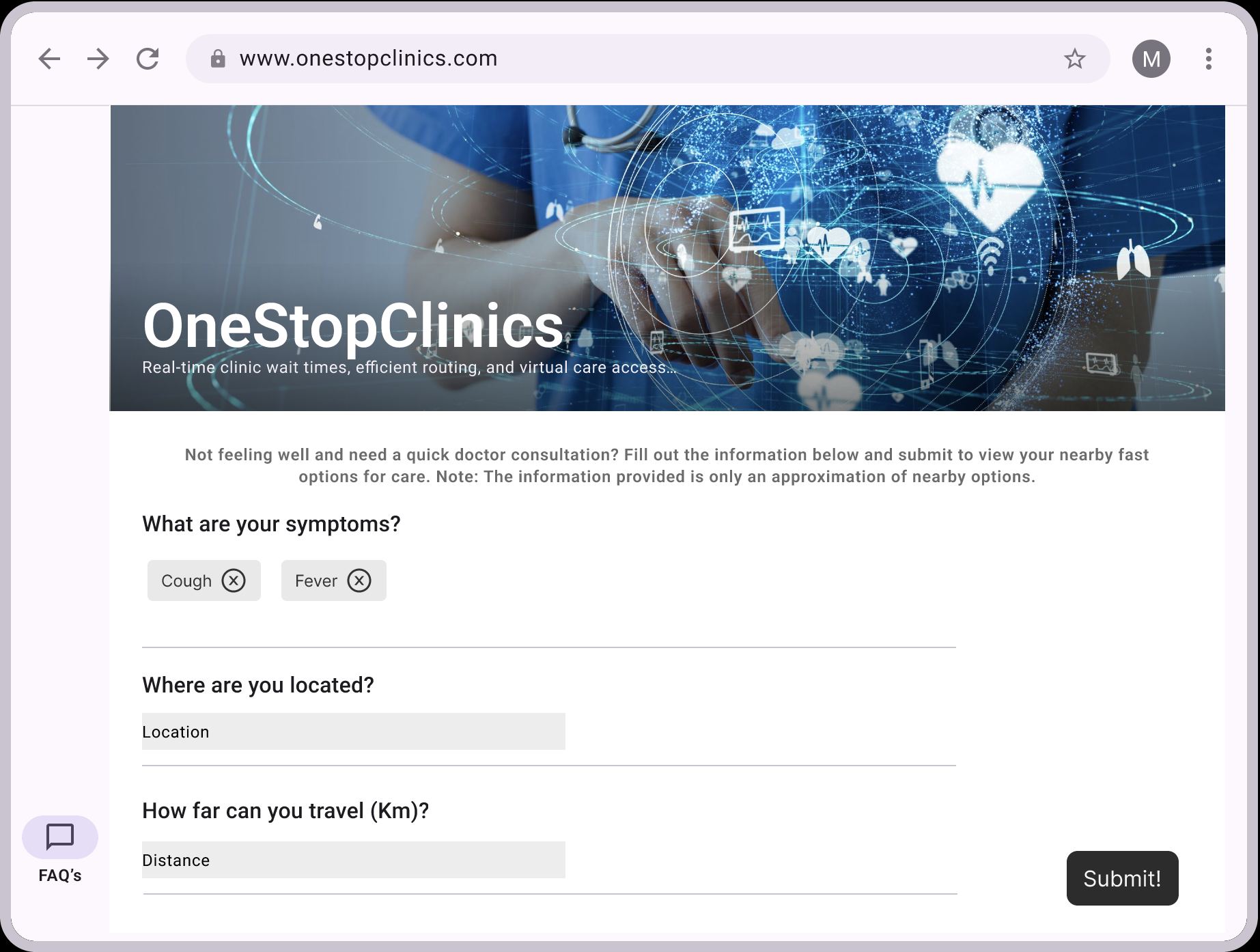
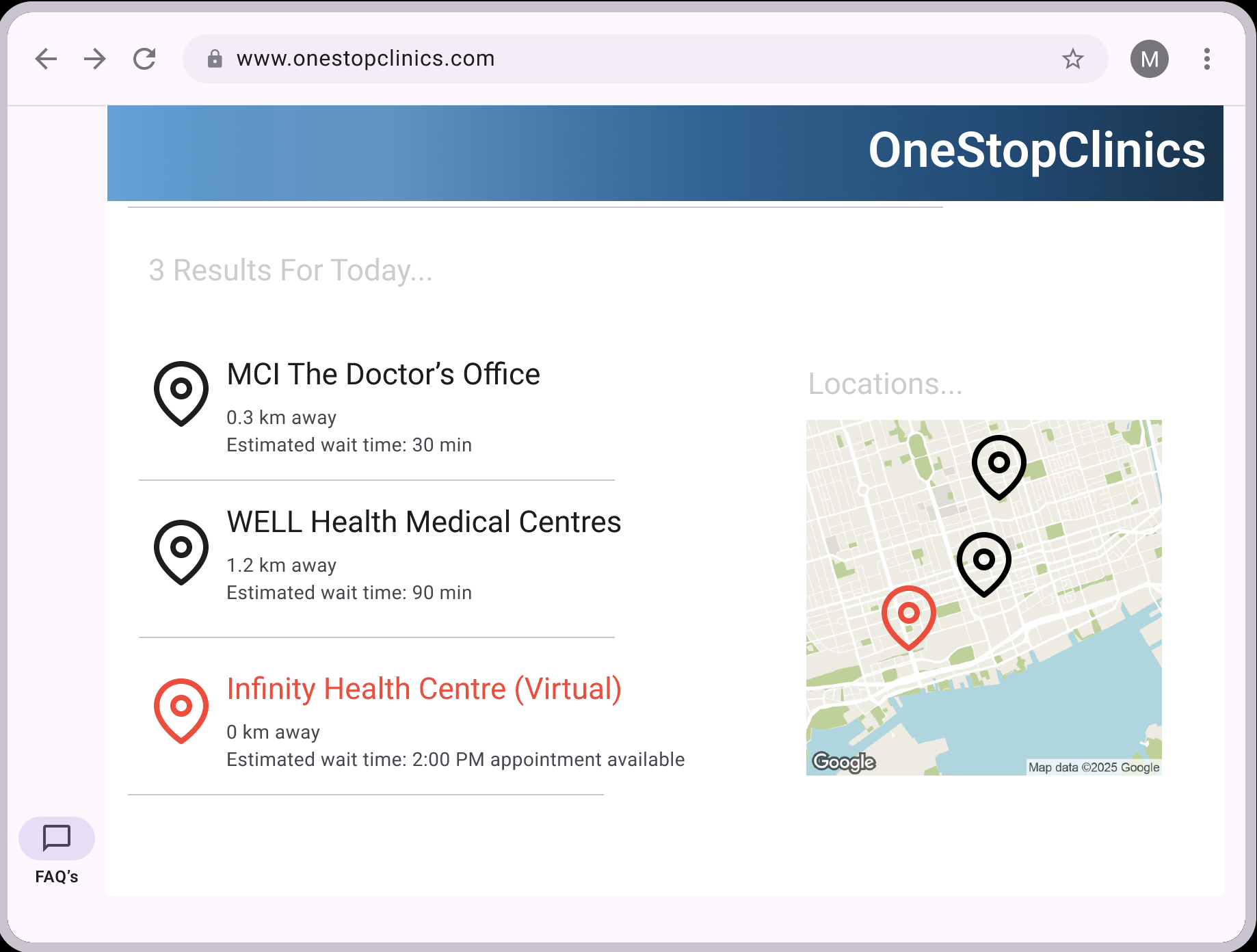
To visualize the technical solution, we developed a detailed Figma prototype demonstrating user interactions, severity assessments, dynamic routing, and the interface for virtual appointment bookings.
How we built it: We adapted an existing GitHub repository to match our project's requirements. Modifications include updating the code from handling single-location coordinates to supporting multiple locations near a selected point, utilizing the A* algorithm. This documentation also outlines key concepts underlying the functionality of the code.
Challenges we ran into: Integrating real-time data from multiple sources posed significant challenges, particularly ensuring accuracy and synchronization of clinic wait-time updates. Calibrating the severity assessment required substantial refinement to achieve reliable virtual vs. in-person care recommendations. Additionally, implementing secure yet anonymous access demanded careful consideration to balance user privacy with the effectiveness of predictive features.
We successfully overcame the data synchronization and severity classification challenges within our development timeframe. However, expanding the anonymous user functionality to retain accuracy across multiple sessions remains an ongoing challenge due to limited development time.
Accomplishments: Successfully implemented an efficient dynamic routing algorithm (INSERT ALGO HERE) to actively redistribute patient load, significantly reducing anticipated wait times. Developed a reliable symptom-severity classification model guiding patients effectively toward virtual care when appropriate. Created a privacy-centric platform allowing anonymous usage without sacrificing functional performance or accuracy.
What we learned: Through this project, our team learned extensively about applying pathfinding algorithms and real-time predictive analytics within the complex domain of healthcare. We gained valuable insights into balancing algorithmic accuracy with user privacy considerations. Additionally, navigating the technical integration of front and backend services improved our skills in full-stack development and systems integration.
What's next for OneStopClinics: Immediate Technical Improvements: Further refinement of severity assessment by implementing machine learning techniques to personalize care recommendations more precisely. Enhanced multilingual support to increase usability for Toronto’s diverse population. Scalability and Adoption (Long-Term): Collaboration with healthcare providers and clinics to seamlessly integrate OSC directly into clinic operations, automating data updates and patient management workflows. Strategic partnership with government health authorities to scale OSC provincially, providing widespread healthcare access improvements and enabling real-time health system analytics.
These improvements are technically feasible and would significantly amplify OSC’s impact, scalability, and patient adoption, effectively transforming the way underserved populations access healthcare services.
Built With
- figma
- javascript


Log in or sign up for Devpost to join the conversation.