Inspiration
Climbing is both a physical and mental activity. However, most finger strength training tools used by climbers today are repetitive and disconnected from the experience of actually climbing a route. Training often involves squeezing static devices with little feedback, narrative, or variation, which makes it difficult to stay engaged over time.
Our team wanted to explore whether grip training could become a more immersive and meaningful experience. We were inspired by the idea of turning a simple physical training exercise into an interactive adventure. Instead of treating grip training as a purely mechanical task, we imagined a system where every grip, pause, and movement could influence a climbing journey.
This led us to design a handheld climbing device that functions both as a training tool and as the controller for an AI-powered climbing game. By combining tangible interaction, sensor input, and AI-generated story events, we aimed to transform repetitive grip training into a dynamic and personal climbing experience.
What it does
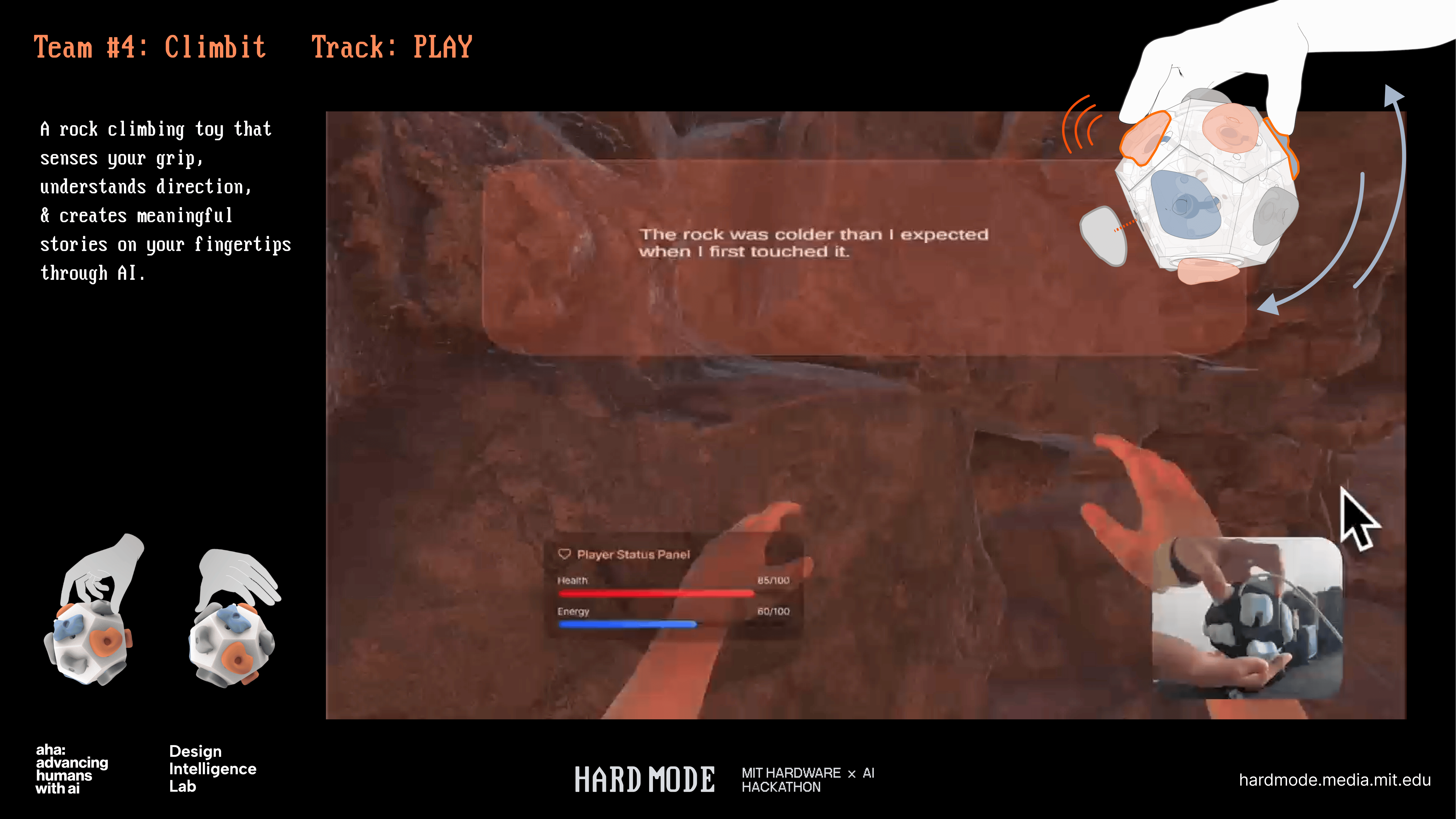
Climbit is a handheld climbing controller that turns finger grip training into an AI-powered climbing adventure.
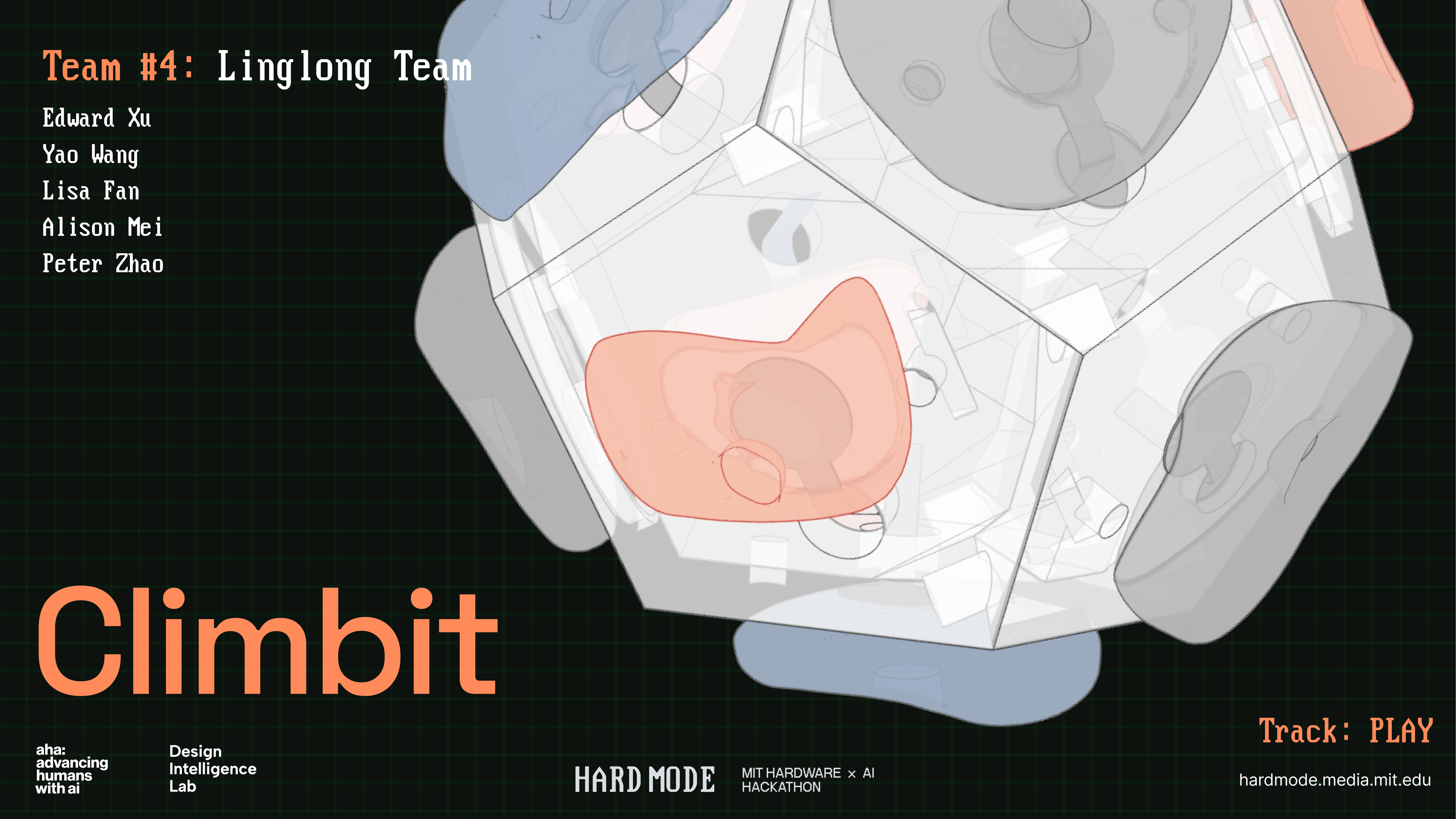
The device is a dodecahedron-shaped handheld object designed to simulate the feeling of grabbing climbing holds. Pressure sensors placed between the holds detect where and how strongly the player grips the device. These inputs control a first-person climbing game in real time.
As players move their fingers from hold to hold, they climb a virtual mountain of their choice. The system tracks grip timing, pressure, and movement patterns. When the player pauses or changes rhythm, the AI generates personalized events and short story missions, such as discovering hidden routes or encountering unexpected situations during the climb.
By combining physical grip training with interactive storytelling, Climbit transforms repetitive finger exercises into a more engaging and immersive experience.
How we built it
We designed and fabricated a handheld device using 3D printing. The main body is a dodecahedron printed in PLA, while the climbing holds on the surface are printed in TPU to create a softer and more tactile grip.
Pressure sensors were embedded between the holds to detect finger positions and grip force. The signals are read by a microcontroller and sent to the game system. A vibration motor placed at the center of the device provides haptic feedback during gameplay.
On the software side, we built a climbing game environment in Unity that visualizes the player's climbing progress in real time. The game responds dynamically to grip inputs. Using the Claude API, the system generates contextual story events and missions based on the player's grip patterns, timing, and behavior, adding unpredictability and personalization to the climbing experience.
Challenges we ran into
One of the main challenges was integrating the hardware and software systems within the short time frame of a hackathon. Reading stable pressure sensor data and mapping it to meaningful climbing interactions required several rounds of tuning.
We also encountered difficulties in building a reliable communication pipeline between the hardware device and the Unity game. Ensuring that sensor data could be transmitted and interpreted in real time required debugging both the microcontroller output and the Unity input system.
Another challenge was designing a handheld form that felt natural to grip while still allowing space for sensors and electronics. Balancing physical ergonomics with internal hardware placement required multiple design iterations.
Finally, we spent time refining the relationship between the physical training and the game mechanics. Our goal was to ensure that grip patterns, strength, and pauses during training directly influenced in-game events, so the experience felt like climbing rather than simply controlling a game with a device.
Accomplishments that we're proud of
We are proud that we were able to build a working prototype that combines tangible hardware interaction, real-time gameplay, and AI-generated storytelling.
The physical device successfully detects grip patterns and controls the climbing game in real time. The integration of haptic feedback also helped make the interaction feel more embodied and immersive.
Most importantly, we demonstrated a new way to rethink training tools by turning a repetitive physical exercise into a playful and narrative-driven experience.
What we learned
This project taught us a lot about the challenges of building hybrid physical–digital interaction systems.
We learned how sensitive grip sensors are to placement and calibration, and how important the physical form factor is for user comfort. On the software side, we explored how AI-generated content can add unpredictability and personalization to otherwise repetitive activities.
The project also highlighted how tangible interfaces can create a stronger connection between physical movement and digital experiences.
What's next for Climbit - Team 4
In the future, we want to further develop the device into a more complete climbing training system.
We plan to improve the hardware design by adding more sensors and refining the grip layout to better mimic real climbing holds. We are also interested in expanding the AI system so that it can generate richer story events and adaptive challenges based on the player's performance.
Ultimately, we hope Climbit could become both a training tool for climbers and a playful interface that introduces new users to the experience of climbing.


Log in or sign up for Devpost to join the conversation.