Inspiration
Climate action depends on data people can trust. An unusual environmental reading could signal pollution, a faulty sensor, or a changed record. Communities and researchers need tools that help them investigate these possibilities.
ClimateProof was inspired by a simple question: How can we make environmental data easier to review and harder to alter unnoticed?
What it does
ClimateProof is a proposed tool for the Climate Data & Environmental Monitoring track. It combines AI anomaly detection with blockchain-based record verification.
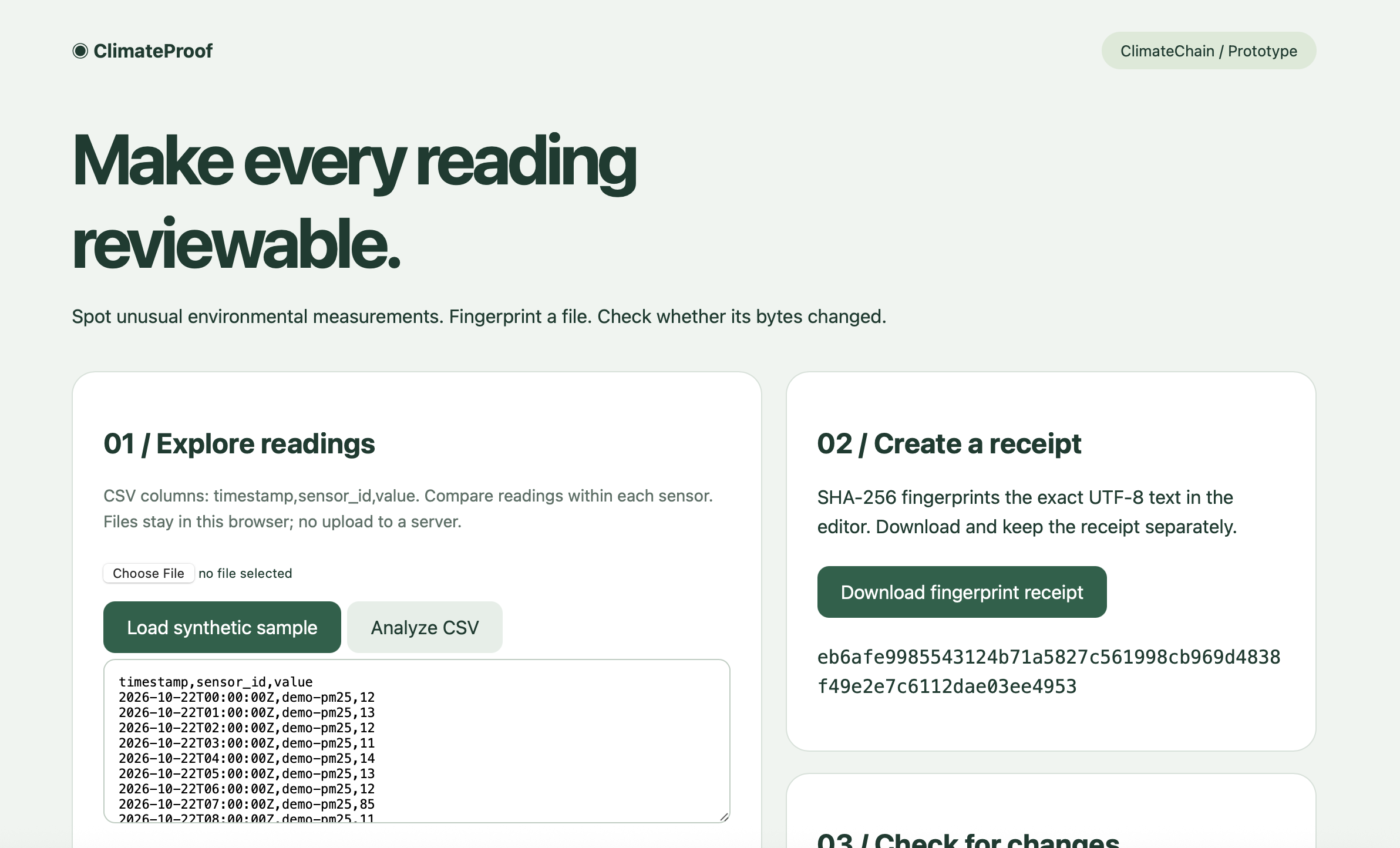
The planned workflow lets users upload environmental readings, identify unusual patterns, and record a digital fingerprint of a dataset on a blockchain. Users can later compare a file against that fingerprint to check whether it has changed.
AI flags readings for human review. Blockchain provides evidence of record integrity. Neither guarantees that the original sensor measurement was accurate.
How we built it
We are currently at the project design stage. Our planned prototype has three components:
- A dashboard for uploading CSV files and reviewing readings.
- An AI anomaly-detection model that highlights unusual measurements.
- A verification component that calculates a SHA-256 fingerprint and records it through a blockchain smart contract.
The initial demonstration will use clearly labeled synthetic data. It will show an unusual reading being flagged, a dataset being fingerprinted, and a modified file failing verification.
Challenges we ran into
The main design challenge has been separating unusual data from inaccurate data. A sudden spike could represent a real environmental event, so automatically labeling it as false would be misleading.
Another challenge has been defining a useful role for blockchain. Our approach is to store dataset fingerprints rather than entire datasets, keeping the verification record small while leaving the underlying data off-chain.
Accomplishments that we're proud of
Our main accomplishment so far is defining a focused, testable workflow that connects anomaly detection with record verification.
We have also established clear limits for the project: flags require investigation, integrity checks do not establish measurement accuracy, and environmental benefits must be evaluated rather than assumed.
What we learned
Designing ClimateProof has highlighted that trustworthy environmental monitoring involves several separate questions: Is a reading unusual? Has the record changed? Was the sensor working correctly?
Different tools answer different questions. Combining them responsibly means explaining their limits and keeping human judgment part of the process.
What's next for ClimateProof
Our next step is to build and test the upload, anomaly-detection, and verification workflow. We then plan to deploy the smart contract to a test network and record a complete demonstration.
Future work includes evaluating the model on documented environmental datasets, measuring false-positive rates, supporting multiple sensors, and gathering feedback from potential users.
Our goal is to help communities and researchers investigate environmental data with clearer evidence and greater accountability.
Built With
- ethereum
- pandas
- python
- scikit-learn
- solidity
- streamlit
- web3.py

Log in or sign up for Devpost to join the conversation.