-
-
Project Overview
-
Dataset Loaded
-
Temperature Distribution
-
Temperature vs Humidity
-
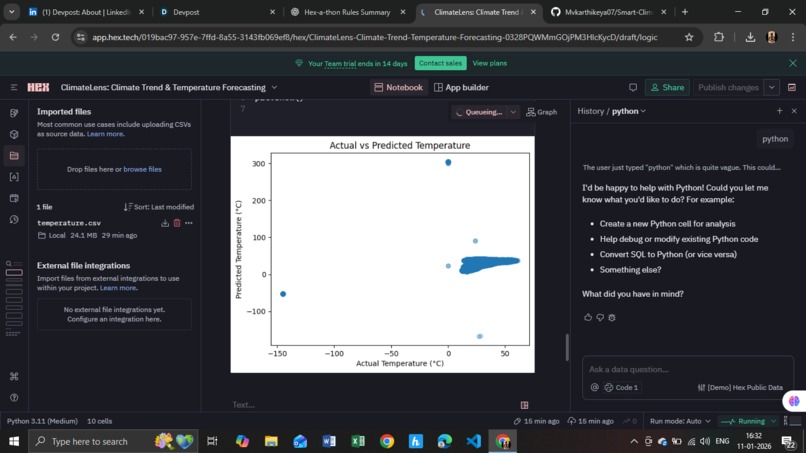
Actual vs Predicted Temperature


Inspiration
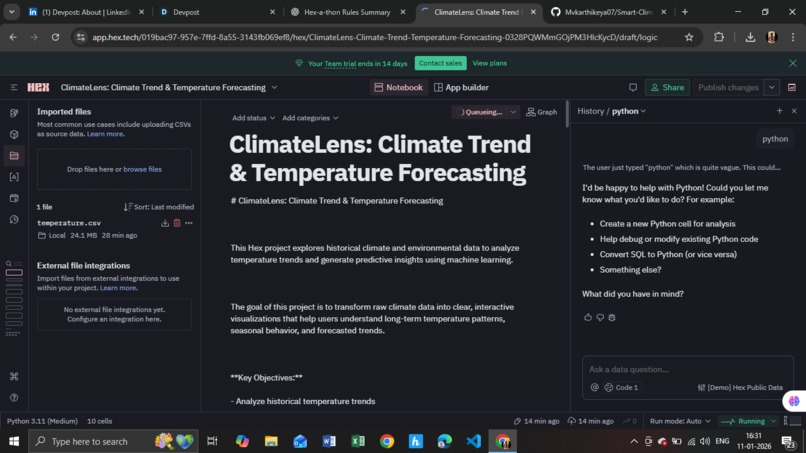
Rising temperature variability has direct implications for agriculture, urban environments, and climate awareness. However, large climate datasets are often difficult to interpret without technical expertise. This project was inspired by the idea of using interactive analytics to transform raw environmental sensor data into clear, understandable insights that highlight temperature patterns and relationships.
What it does
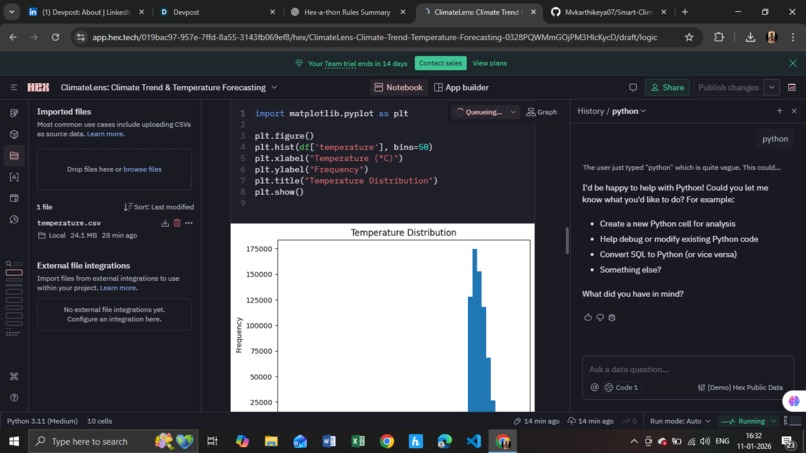
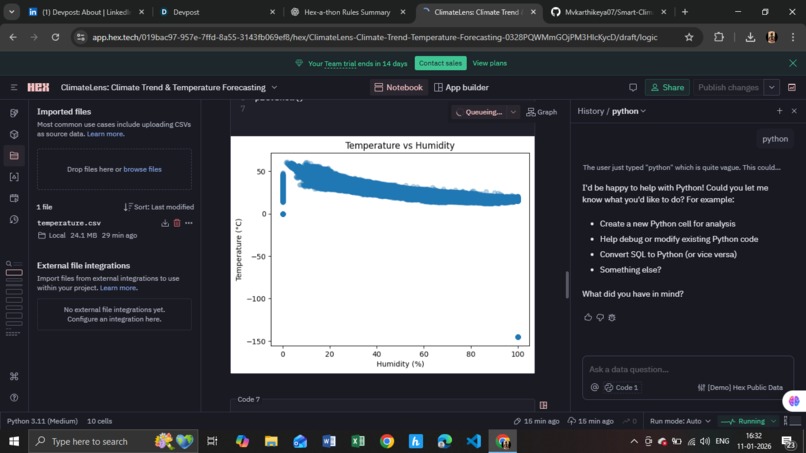
ClimateLens is an interactive climate analytics project built in Hex that explores historical environmental sensor data and analyzes temperature behavior using data visualization and machine learning. The project allows users to examine temperature distributions, understand relationships between temperature and atmospheric variables such as humidity and pressure, and evaluate machine learning–based temperature predictions.
How we built it
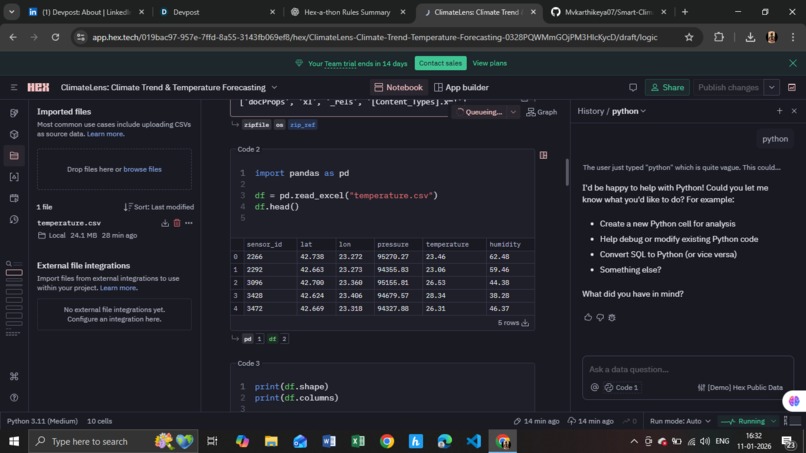
The project was developed entirely within the Hex analytics platform. Publicly available environmental sensor data was loaded and processed using Python. Data cleaning and exploratory analysis were performed using Pandas and Matplotlib. A supervised machine learning regression model was trained to predict temperature based on geographic and atmospheric features, and the results were visualized directly within Hex to support data-driven insights.
Challenges we ran into
Handling a large real-world dataset required careful data cleaning to address missing and inconsistent values. Another challenge was ensuring that the machine learning model remained interpretable while still capturing meaningful temperature patterns. Presenting analytical results clearly within a notebook-style interactive environment also required thoughtful visualization choices.
Accomplishments that we're proud of
We successfully built an end-to-end climate analytics workflow in Hex, from raw data ingestion to machine learning prediction and visualization. The project demonstrates how environmental sensor data can be transformed into actionable insights through interactive analysis rather than static reporting.
What we learned
This project strengthened our understanding of working with large-scale climate datasets, exploratory data analysis, and regression-based machine learning. We also learned how Hex enables rapid development of interactive analytics workflows that combine code, visualization, and narrative insight in a single environment.
What's next for ClimateLens: Climate Trend & Temperature Forecasting
Future enhancements could include incorporating additional environmental variables, experimenting with more advanced regression models, and adding interactive controls within Hex to allow users to explore temperature behavior under different atmospheric conditions.
Built With
- data
- hex
- numpy
- pandas
- public-climate-datasets
- python
- scikit-learn

Log in or sign up for Devpost to join the conversation.