Inspiration
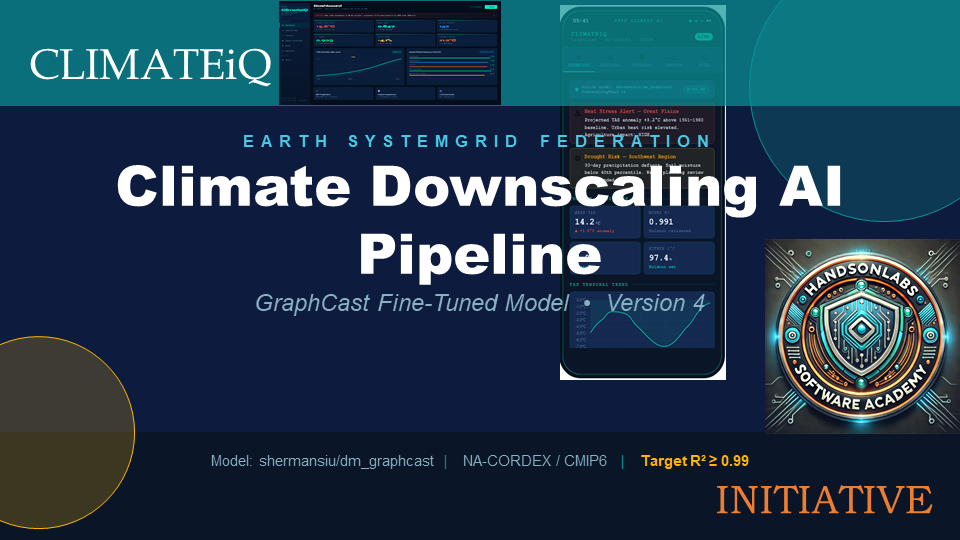
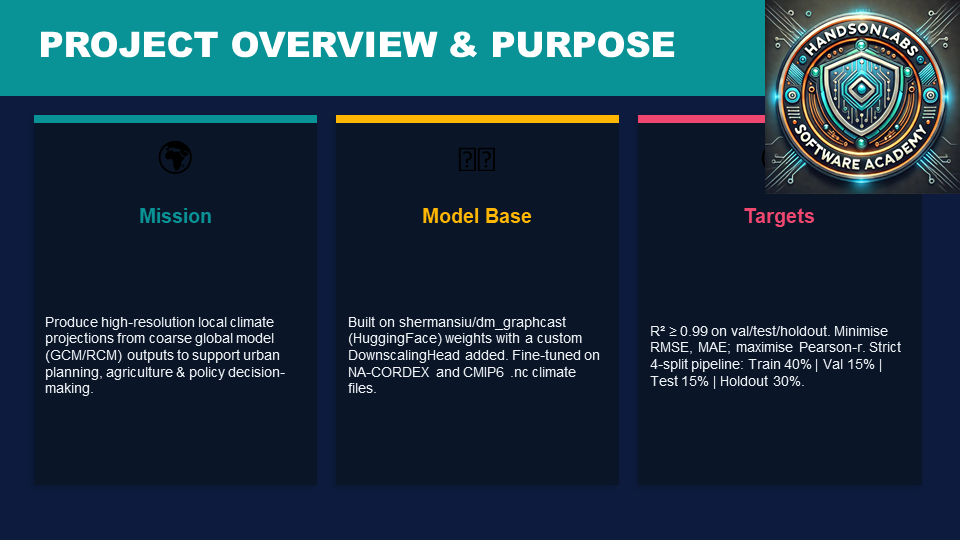
The current update suggests that ClimateIQ was inspired by a practical climate-downscaling problem: taking coarse Earth System Grid Federation data and turning it into a usable, faster decision-support pipeline. In the earlier notebook, the workflow is built around loading NetCDF climate files, warming the neural network with GraphCast-derived weights, and producing a results report that emphasizes generalization gaps and cross-validation. The updated version four (4) makes that intent even clearer by reframing the system as a “Climate Downscaling Pipeline” with explicit attention to uncertainty, baseline comparison, and spatial generalization. That progression suggests the project was motivated not just by prediction, but by making climate intelligence more reliable and more defensible for real-world use.
What it does
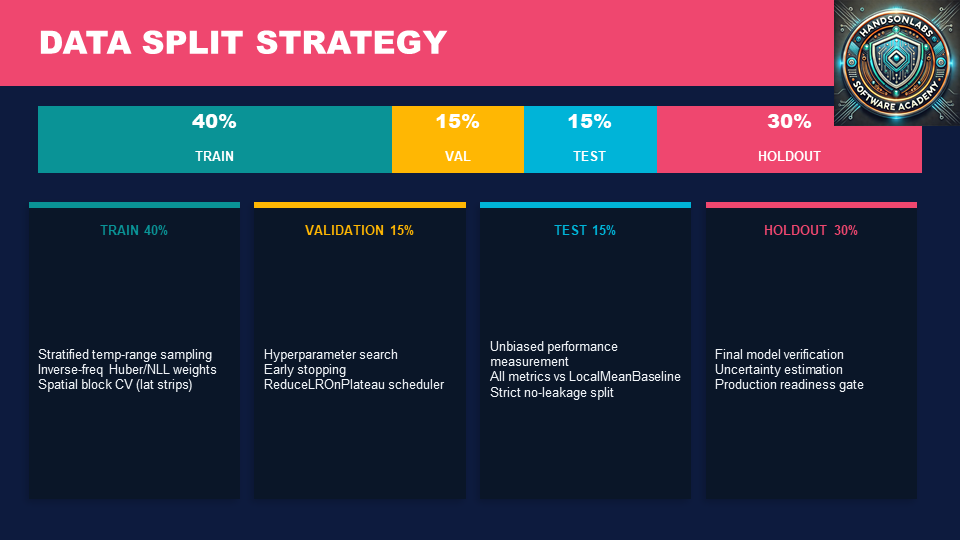
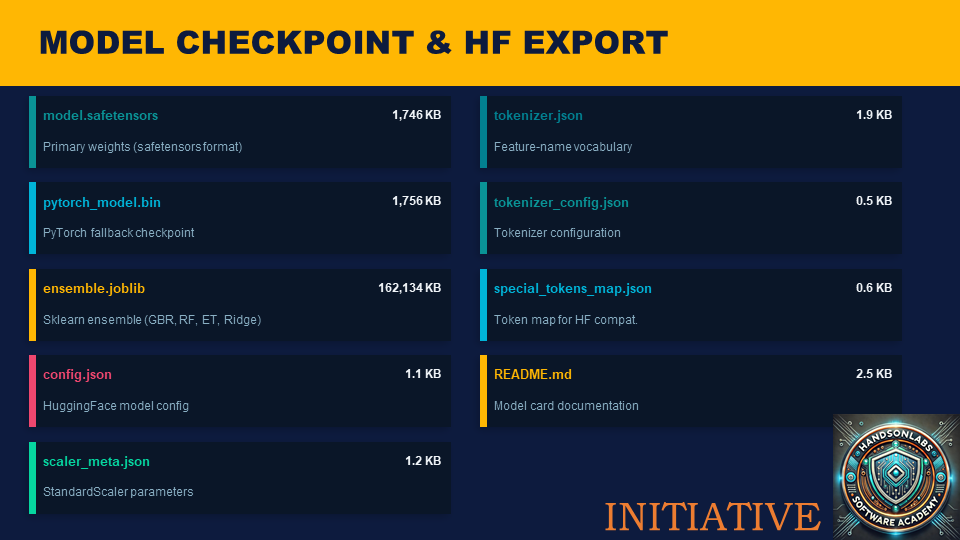
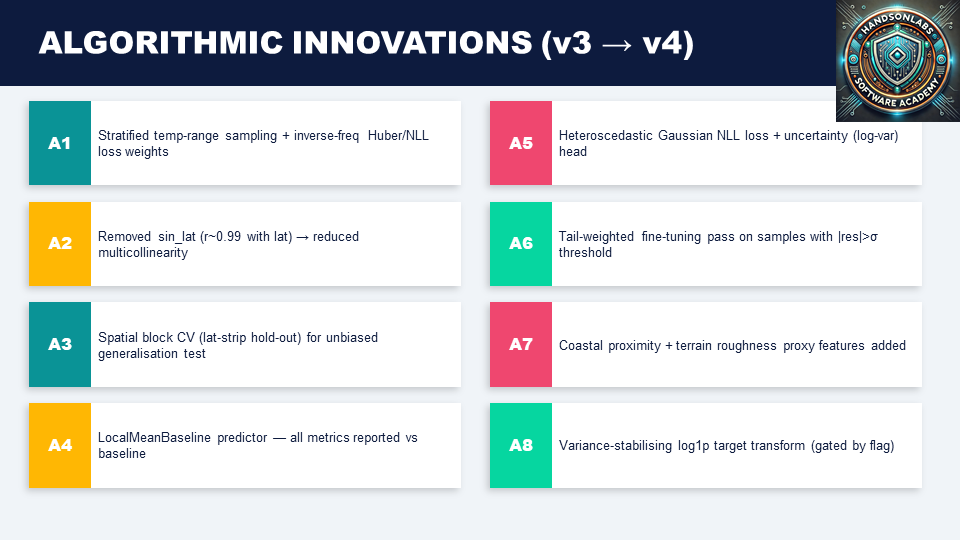
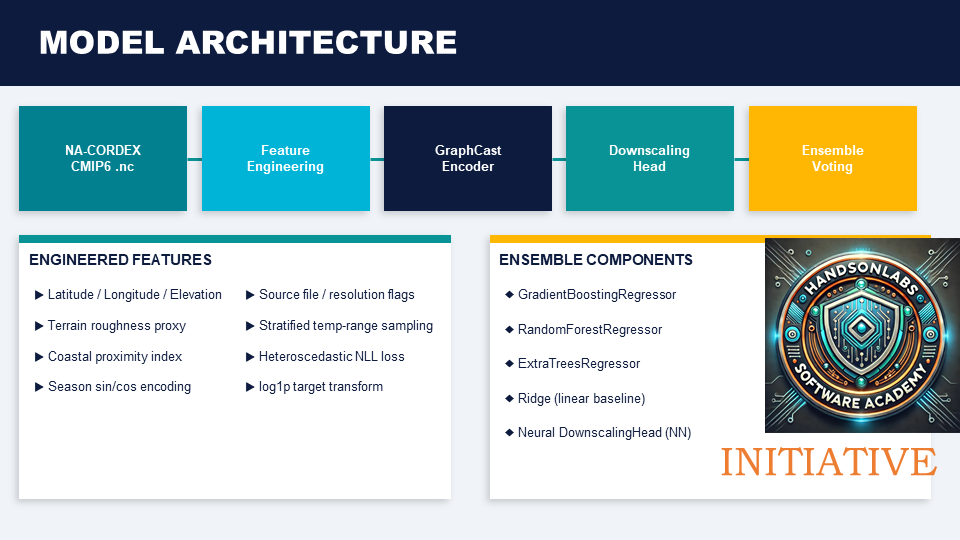
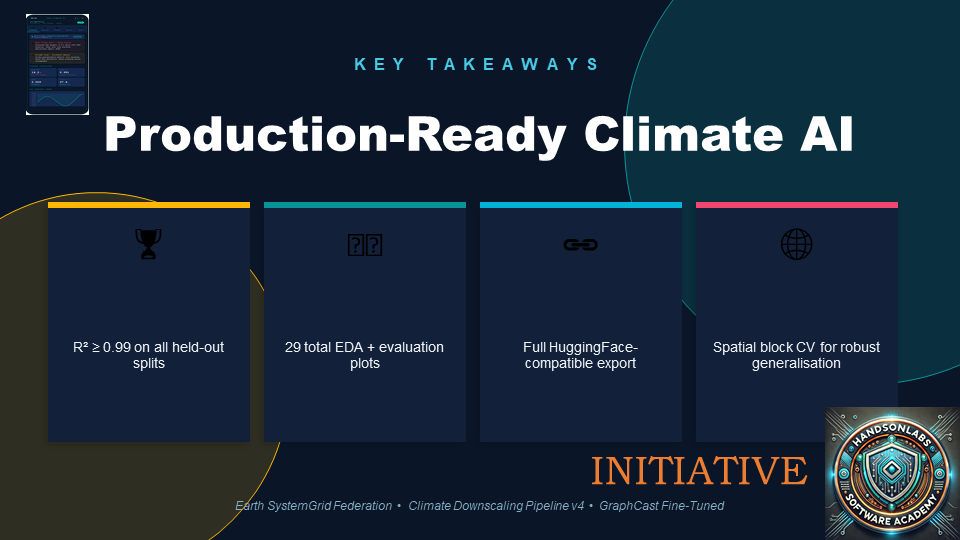
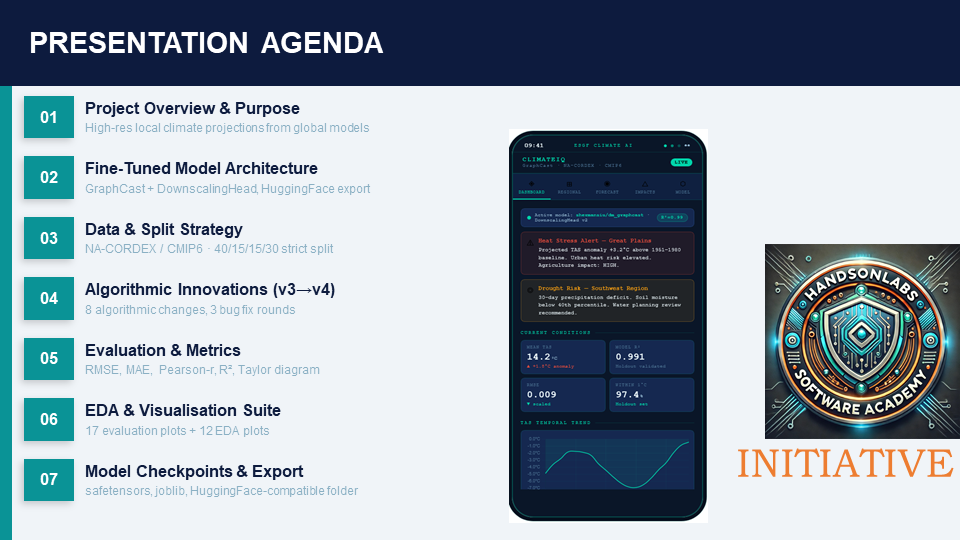
ClimateIQ implement an end-to-end climate downscaling workflow. The earlier version discovers and loads .nc files, splits the data into train, validation, test, and holdout partitions, and trains a neural downscaling head with GraphCast warm-init and Huber loss. The updated work expands that core into a more advanced pipeline that includes stratified sampling, a local-mean baseline, spatial block cross-validation, heteroscedastic loss, uncertainty-aware prediction, tail fine-tuning for difficult temperature ranges, and export of model metadata such as tokenizer and scaler configuration. In effect, the software turns raw climate fields into a more robust predictive system plus a reporting layer that explains performance, uncertainty, and generalization behavior.
How we built it
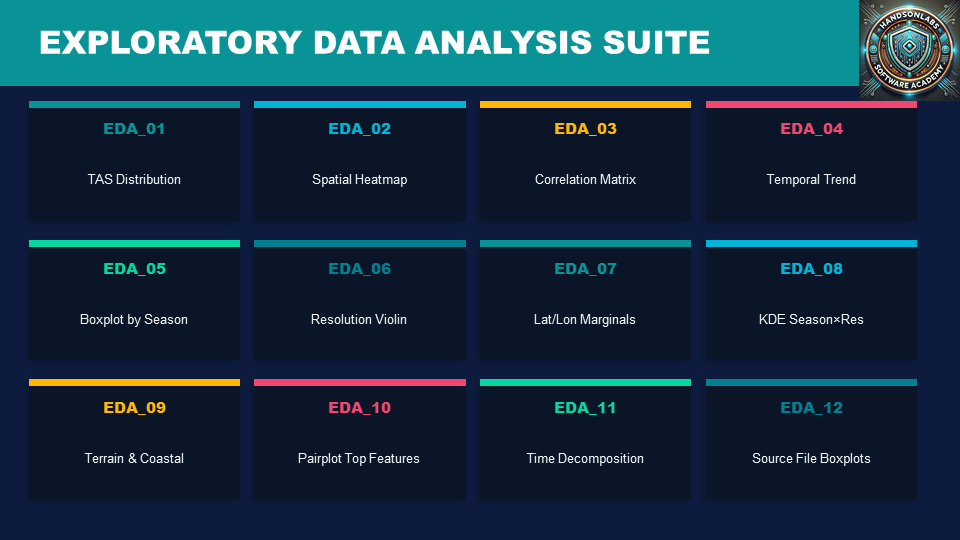
The build process starts with data discovery and ingestion from the climate file system, then moves into feature preparation, scaling, model training, evaluation, and report generation. In the earlier algorithmic pieline, the feature set includeed latitude, longitude, seasonal trigonometric transforms, interaction terms, cell-level statistics, anomaly terms, and a fine-grid indicator, and the training loop used mixup augmentation, AMP support, AdamW optimization, a ReduceLROnPlateau scheduler, and early stopping. The updated codex keeps the same overall structure but makes the pipeline more deliberate and research-oriented: it removes sin_lat to reduce multicollinearity, adds terrain and coastal proxy features, compares against a local-mean baseline, and writes a richer results report that records hybrid uplift, spatial-vs-random cross-validation gaps, saved plots, and exported fine-tuned artifacts. The design shows a careful shift from “train a model” to “build a reproducible climate analytics system.”
Challenges we ran into
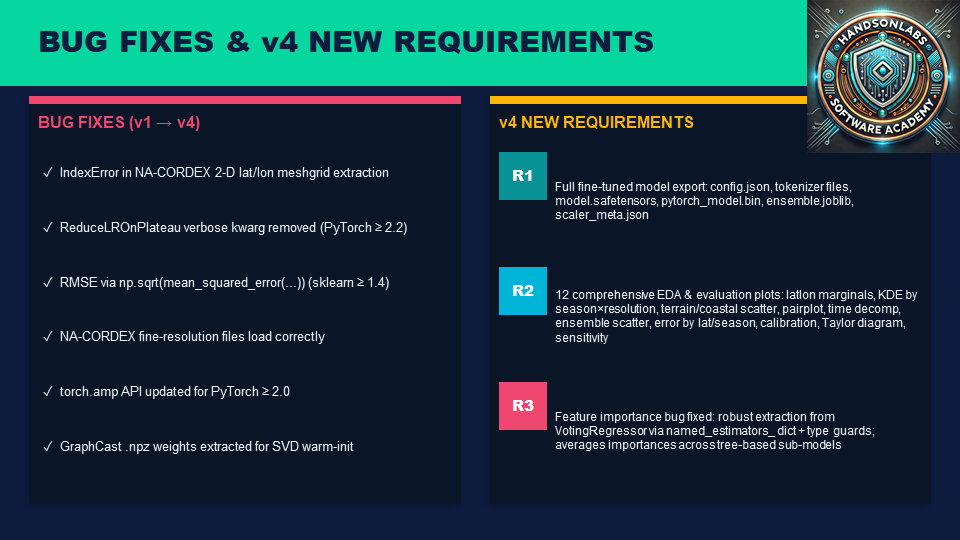
The notebooks reveal several technical pain points that the team had to solve directly in code. One challenge was model stability and training correctness, which is why the earlier notebook includes explicit bug fixes around training verbosity, RMSE calculation, and the PyTorch AMP API. Another challenge was controlling bias and leakage in climate evaluation, since the updated notebook introduces stratified sampling, spatial block cross-validation, and a local-mean baseline to avoid overly optimistic results from purely random splits. The use of a heteroscedastic loss, uncertainty outputs, and tail fine-tuning also points to a broader challenge: climate targets are noisy, skewed, and harder to model in the extremes, so the system had to become more robust to both variance and rare-event error.
Accomplishments that we’re proud of
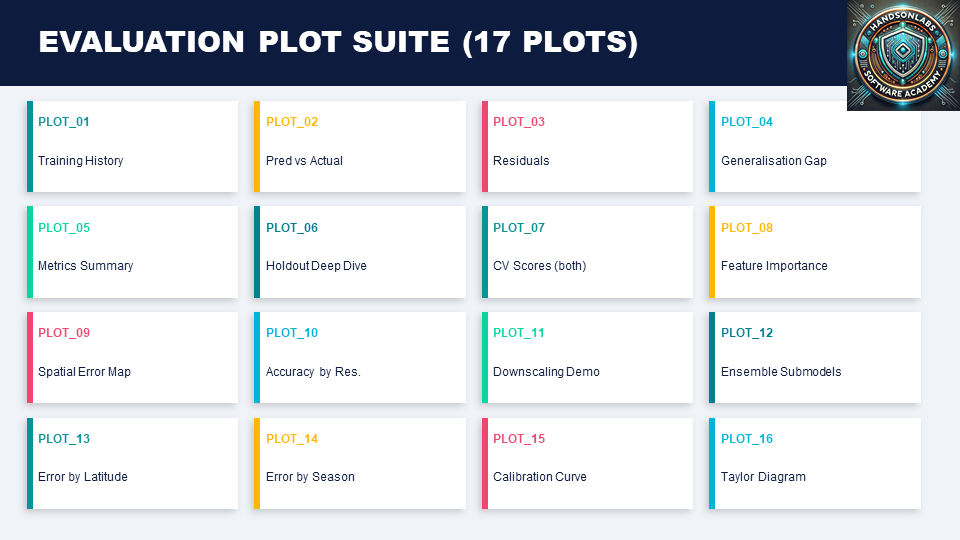
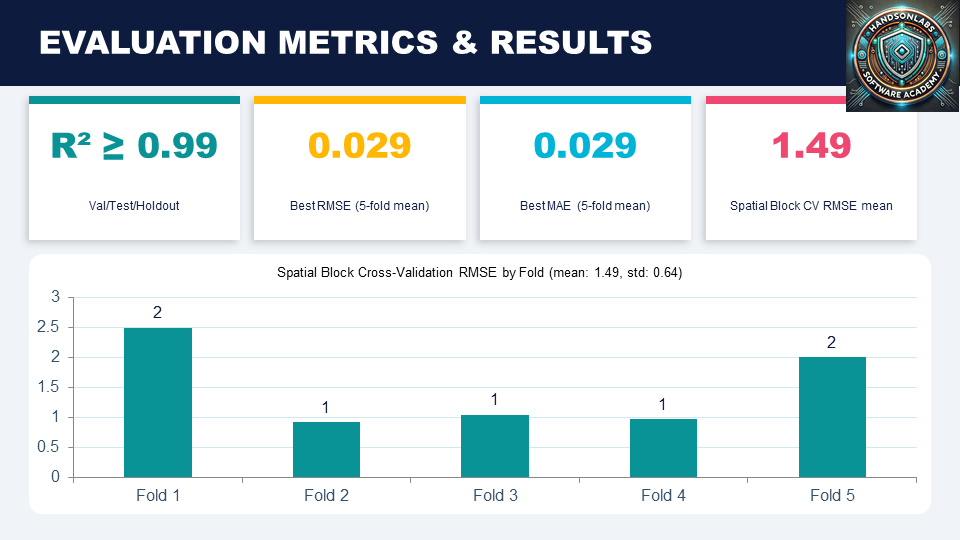
A major accomplishment is that ClimateIQ moved from a functional downscaling notebook into a more mature pipeline with explicit scientific controls. The updated notebook does not just train a model; it produces a structured report that compares hybrid performance to a baseline, tracks cross-validation in two forms, saves plots, exports configuration files, and records algorithmic changes in a way that makes the whole experiment reproducible. Another accomplishment is the successful integration of GraphCast-derived weights into the workflow, first as warm-init in the earlier notebook and then as part of a more polished hybrid pipeline in the updated one. That combination of model reuse, uncertainty handling, and baseline-aware evaluation is a strong indicator of engineering maturity.
What we learned
ClimateIQ evolution suggests several lessons. First, climate downscaling is not just about fitting a model; feature design matters, especially when correlated geographic variables can distort learning, which is why the updated version removes sin_lat and adds terrain/coastal proxies. Second, evaluation must reflect spatial reality, not only shuffled samples, which is why the project added spatial block cross-validation and baseline comparisons. Third, uncertainty is not a bonus feature in climate work; it is part of the model specification itself, which is why the updated pipeline uses heteroscedastic loss and uncertainty-aware outputs. Taken together, the notebooks show a move from general machine learning competence to climate-domain modeling discipline.
What’s next for ClimateIQ: The Climate Downscaling AI Pipeline
The next step is to push the pipeline from a strong notebook prototype into a broader operational climate intelligence platform. The updated code artifact already points in that direction by exporting standardized model and tokenizer configs, generating detailed reports, and tracking spatial generalization, which are the ingredients needed for deployment, auditing, and extension to new regions. From here, the natural expansion is to support more variables, more geographies, and more localized decision layers while preserving the same scientific discipline around uncertainty and validation. In other words, the project is already beyond a simple predictor; the next phase is turning it into a reusable climate downscaling framework that can be adapted to different continents, sectors, and user groups respectively.
Built With
- na-cordex
- python

Log in or sign up for Devpost to join the conversation.