Inspiration
Mitigating climate risk requires more than just data; it requires understanding and action at a local level. While datasets like the FEMA National Risk Index or NOAA weather data exist, they can be extremely hard to read or interpret, making it impractical for everyday users to apply them to real decisions.
We wanted to transform how people interact with climate risk, seeing it from a whole new perspective. Instead of static reports, we built a system that helps users explore, understand, and act on climate change in their own counties through an interface that provides insights, recommendations, and comparisons.
In the end, our goal is to shift climate awareness from passive observation to informed, actionable decision-making.
What it does
Climate Risk Advisor is an interactive platform that allows users to explore county-level climate risk across the United States.
Users can:
- Navigate an interactive map of U.S. counties
- View risk levels for heat, flood, and wildfire hazards
- Analyze detailed county statistics and rankings
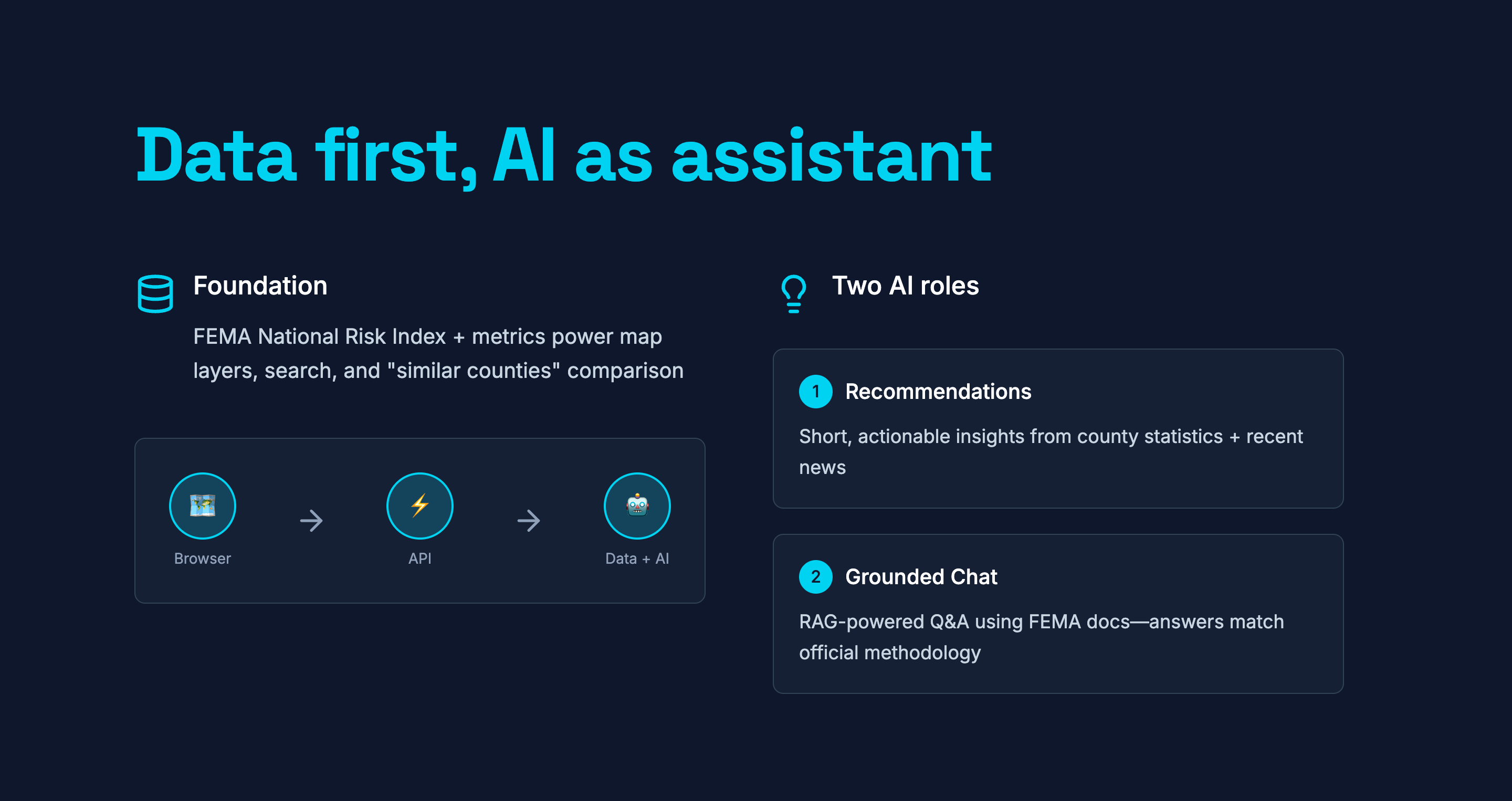
- Receive AI-generated recommendations grounded in real data and news
- Ask questions through a chatbot powered by FEMA methodology and county data
How we built it
Full-stack system
- Frontend: React + Vite, Mapbox for geospatial visualization of all counties, Tailwind + Recharts
- Backend: FastAPI serving recommendations and chatbot APIs
Data + AI pipeline
- FEMA National Risk Index dataset
- County-level weather and geographic data
- Event Registry API for real-world news context towards our recommendation algorithm
RAG + AI architecture
- FAISS vector database for similarity search via cosine similarity and document retrieval
- Gemini embeddings + generation for chatbot responses
- OpenAI (via Lava proxy) for recommendation generation
Challenges we ran into
Climate data is large, multi-dimensional, and messy, requiring extensive preprocessing and merging. This posed as one of our biggest challenges, as we had to find a way to seamlessly filter and merge two datasets containing the climate data and the risk scores. The FIPS index was our main source of identification for counties, but states like Connecticut have updated FIPS codes that would not match both our datasets.
Our system relies on multiple external APIs (LLMs, embeddings, news data), which introduced challenges around latency, rate limits, and reliability. Ensuring consistent outputs across different AI providers also added complexity to the system design.
Since this was our first time building a retrieval-augmented generation (RAG) system, we had to learn how to properly structure, chunk, and retrieve relevant context from multiple data sources. We wanted to ensure the model produced accurate, grounded responses instead of hallucinations from other data sources.
Accomplishments we're proud of
- Built a complete end-to-end climate intelligence platform
- Designed a working RAG system grounded in real-world data
- Integrated real-time news into AI recommendations
- Created an intuitive map-based user experience for complex data
- Successfully combined multiple AI systems into a cohesive workflow
What we learned
We gained experience across both technical and domain areas:
- Designing and implementing RAG pipelines with multiple data sources
- Working with geospatial and climate risk datasets
- Integrating AI systems into real-time applications
- Understanding how to make AI outputs more interpretable and trustworthy
- Learning how climate risk is calculated and communicated through FEMA methodology
What's next for Climate Risk Advisor
- We plan to add a prediction model for each of the counties, which would allow users to simulate changes in risk following certain recommendations or plans.
- Expand on the dataset itself, including more predictors and even including more data points spread across different time frames.
- We can implement real-time risk updates that are based on day-to-day weather changes. This would include dynamically requesting data from weather APIs, rather than a static baseline comparison.


Log in or sign up for Devpost to join the conversation.