Inspiration
What it does## Inspiration
What if the biggest problem with climate data isn't that we lack information, but that we cannot always trust the claims made from it?
Every day, environmental measurements influence decisions about public health, corporate sustainability, carbon markets, and climate investments.
But there's a fundamental problem: a valid blockchain hash does not mean a climate claim is true.
A pollution forecast can be presented as a physical measurement. The same environmental activity can be claimed twice. A legitimate dataset can be used to justify an unsupported emissions-reduction figure.
And when those claims go unquestioned, the consequences extend beyond technology. Communities lose trust, environmental funding can be misdirected, and real climate action becomes harder to distinguish from greenwashing.
That inspired us to build Climate Chain — a platform designed to ask one question before accepting an environmental claim:
Does the evidence actually prove what is being claimed?
Our goal was not to create another blockchain dashboard. We wanted to build a system where environmental evidence could be inspected, challenged, and verified before becoming the basis of a consequential decision.
What it does
Climate Chain is a unified environmental-intelligence and evidence-verification platform built around an original Evidence-to-Claim Trust Firewall.
The platform connects environmental monitoring, evidence assessment, climate-action workflows, and blockchain-backed audit records through five stages:
Sense → Verify → Act → Finance → Prove
Its core capabilities include:
- Evidence-to-Claim Trust Firewall: Evaluates environmental claims against rules for evidence integrity, source provenance, measurement basis, freshness, geographic consistency, duplicate detection, contradictions, and sufficiency.
- Claim-aware verification: Applies specialized checks to air-quality claims, methane-response evidence, and livestock traceability. It checks whether measurements actually support the claimed values, units, activities, and locations.
- Climate Integrity Lab: Demonstrates evidence creation, SHA-256 integrity verification, local blockchain anchoring, tampering detection, duplicate-claim rejection, challenges, and corrections.
- Climate Intelligence Timeline: Explores historical climate indicators with source references, explicitly identified interpolation, and visible data gaps.
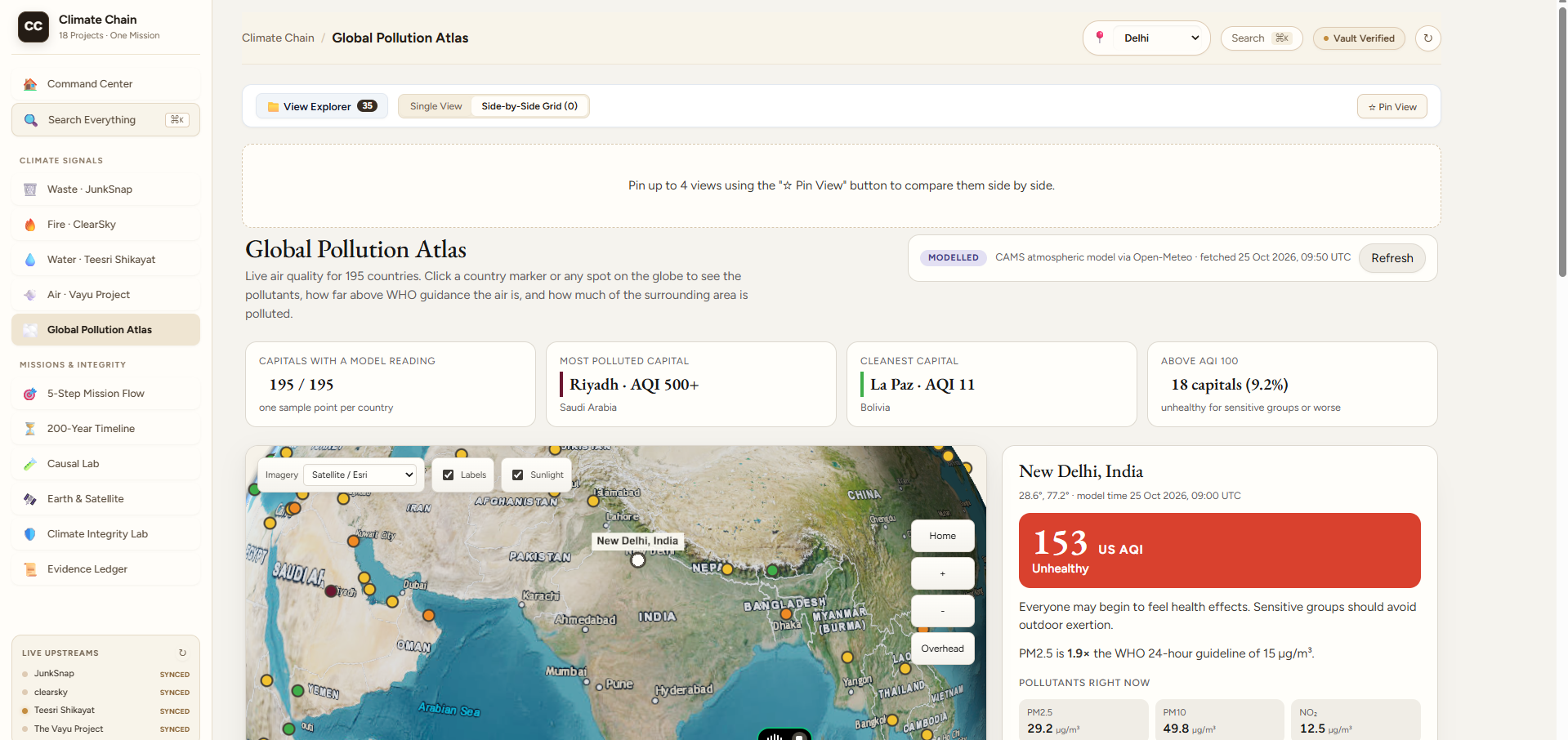
- Environmental Intelligence: Presents air-quality information, fire-related signals, water monitoring, and geographic environmental context through an interactive interface.
- Statistical Plausibility Engine: Uses historical climate patterns to identify unusual submitted values and recommend human review rather than automatically declaring them fraudulent.
- Data Refinery: Cleans and normalizes environmental CSV/JSON datasets, including timestamps, units, duplicates, and outliers.
- Specialist Climate Workspaces: Brings carbon markets, renewable energy, sustainable supply chains, and environmental monitoring into one interface through attributed, adapted modules and clearly labelled demonstration or research data.
The most important feature is that Climate Chain distinguishes between ACCEPTED, REJECTED, HUMAN_REVIEW_REQUIRED, and UNKNOWN.
When evidence is insufficient, the system does not need to invent certainty.
How we built it
We developed Climate Chain using a full-stack architecture combining deterministic verification, climate-data processing, and blockchain evidence recording.
Frontend: React 19, TypeScript, Vite, CesiumJS, and a unified responsive design system.
Backend: A Node.js API gateway providing environmental-data adapters, evidence processing, claim verification, and integration services.
Blockchain: Solidity smart contracts running on a local Hardhat EVM, using cryptographic commitments for evidence anchoring, claim registration, challenges, and corrections.
Climate data: A reproducible dataset containing 91,872 city-hour records across six cities, derived from Copernicus CAMS atmospheric models and ECMWF ERA5 reanalysis through Open-Meteo. We also included selected NOAA and NASA source datasets for historical reference.
Statistical evaluation: We developed a quantile-based plausibility model organized by city, environmental variable, season, and time of day.
Evidence verification: Our Trust Firewall uses canonical SHA-256 hashing and claim-specific policy checks. The second version introduced measurement-to-claim consistency, overlapping-period detection, evidence reuse checks, and bounded verification policies.
We also integrated specialist interfaces inspired by and adapted from existing open-source climate projects, preserving attribution and clearly distinguishing third-party functionality from our original Climate Chain infrastructure.
Our design principle was straightforward: AI and statistical methods can assist interpretation, but consequential verification decisions must remain explainable, constrained, and auditable.
Challenges we ran into
Our biggest challenge was understanding the difference between data integrity and environmental truth.
Initially, we could demonstrate that evidence had not been modified. But cryptographically valid evidence could still support a completely misleading claim.
That forced us to rethink our verification architecture.
We encountered several technical challenges:
- Preventing modelled environmental forecasts from being presented as observed measurements.
- Detecting duplicate claims even when identifiers, activity descriptions, or time periods changed.
- Verifying that reported emissions reductions were supported by appropriate baseline and post-intervention evidence.
- Combining environmental datasets with different units, geographic resolutions, timestamps, and scientific assumptions.
- Maintaining consistent provenance and uncertainty labels across multiple modules.
- Handling malformed inputs, inconsistent records, and unavailable external services without silently accepting unsafe claims.
We also discovered limitations in our own approach.
A completely fabricated but internally consistent evidence bundle can still pass our current authenticity checks. Duplicate detection is also limited to claims visible within our registry and supported spatial rules.
Instead of hiding these weaknesses, we documented them in our threat model and included explicit counterexamples.
That experience changed how we approached engineering: a trustworthy system must explain not only what it can verify, but also what it cannot.
Accomplishments that we're proud of
Our proudest accomplishment is building an original claim-verification workflow that goes beyond simply storing hashes on a blockchain.
Some of our measurable results include:
- 91,872 climate-data records across six geographic locations, with documented source classifications and provenance.
- 22,032 held-out records used to evaluate the statistical plausibility engine.
- 0.24% reported false-alarm rate on the held-out modelled/reanalysis values at the selected evaluation threshold.
- 55 synthetic regression scenarios covering evidence integrity, claim validity, missing provenance, stale information, and duplicate claims.
- 39/39 passing targeted v2 adversarial regression cases, with two additional known failure cases explicitly documented.
- Three unit-tested Solidity smart contracts supporting the local environmental evidence workflow.
- An end-to-end demonstration in which a modelled pollution reading is correctly rejected as a physical observation, an inflated claim is rejected, and a properly labelled model-based risk advisory is accepted.
The synthetic regression results are not presented as real-world fraud-detection accuracy, and the local blockchain is not represented as a permanent public registry.
What makes us proud is not a perfect-looking benchmark.
It is that we built a system capable of questioning a claim, showing its reasoning, and acknowledging uncertainty.
What we learned
Building Climate Chain taught us that environmental transparency requires much more than making information publicly available.
Transparency without verification can still spread misinformation.
We learned that blockchain provides useful evidence-integrity guarantees, but it cannot independently establish that an environmental measurement is genuine.
We also learned that climate AI must be evaluated carefully. A low false-alarm rate on historical model data does not automatically establish fraud-detection accuracy in the physical world.
Equally importantly, we discovered the value of separating observed measurements, modelled forecasts, derived estimates, and simulated scenarios.
These distinctions might seem small in software, but they can completely change the meaning of an environmental claim.
Above all, we learned that good engineering is not about making a system appear infallible.
It is about making its decisions reproducible, explainable, challengeable, and honest.
What's next for Climate Chain
We see Climate Chain as the foundation for a more trustworthy climate-verification infrastructure.
Our next priorities are:
- Authenticated evidence: Integrate cryptographically signed sensor and registry attestations and independently retrieve source records during verification.
- Cross-registry verification: Extend duplicate-claim detection beyond a single local registry, including geographically overlapping projects and shared credit histories.
- Independent scientific evaluation: Validate claim policies with external experts, independently labelled datasets, and real operational evidence.
- Production-grade blockchain integration: Move beyond the local demonstration chain with persistent infrastructure, formal contract review, and suitable deployment security.
- Expanded environmental intelligence: Incorporate additional verified government datasets, stronger historical provenance, and more geographic coverage.
- Human-centered climate accountability: Build practical review workflows for researchers, auditors, environmental organizations, and public agencies.
Our long-term vision is to make environmental evidence as easy to verify as it is to share.
Because climate action should not depend on how convincing a claim sounds.
It should depend on what the evidence can actually prove.
Climate Chain — Don't just record the claim. Verify the truth behind it.
Built With
- cesiumjs
- copernicus-cams
- css3
- ecmwf-era5
- ethereum-virtual-machine
- ethers.js
- github
- hardhat
- html5
- javascript
- json
- nasa-giss
- noaa
- node.js
- open-meteo-api
- react
- rest-api
- sha-256
- solidity
- three.js
- typescript
- vercel
- vite
- vitest

Log in or sign up for Devpost to join the conversation.