-
-
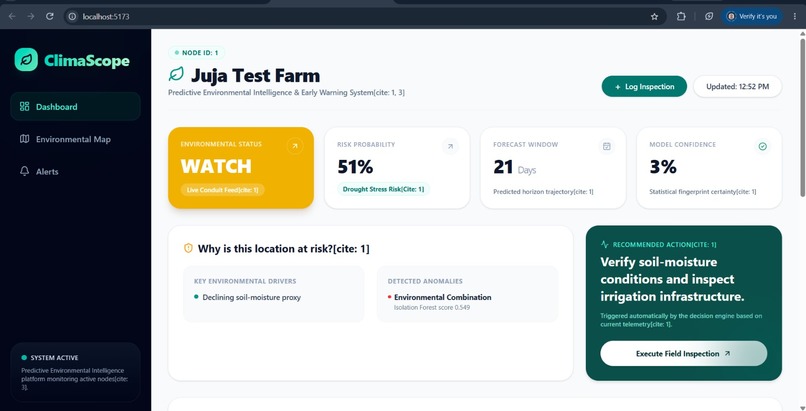
Dashboard
-
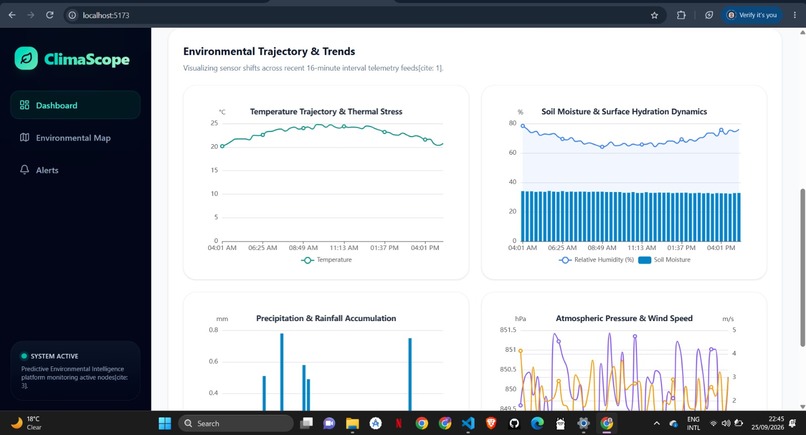
graphs
-
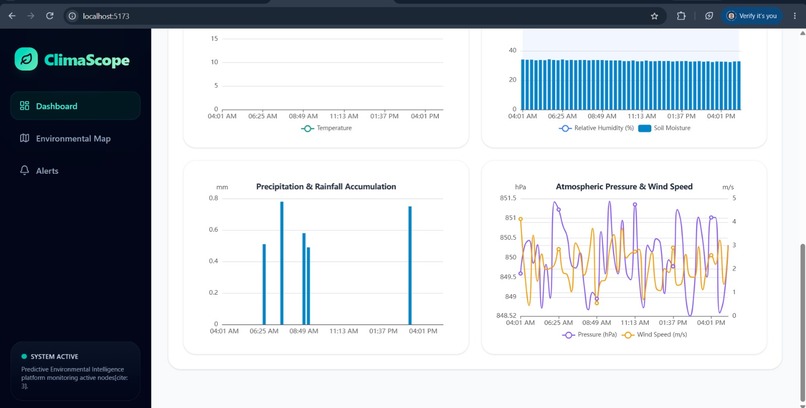
graphs
-
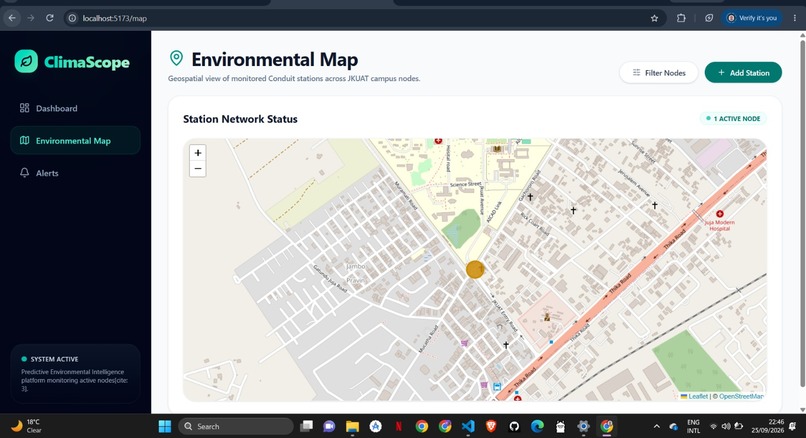
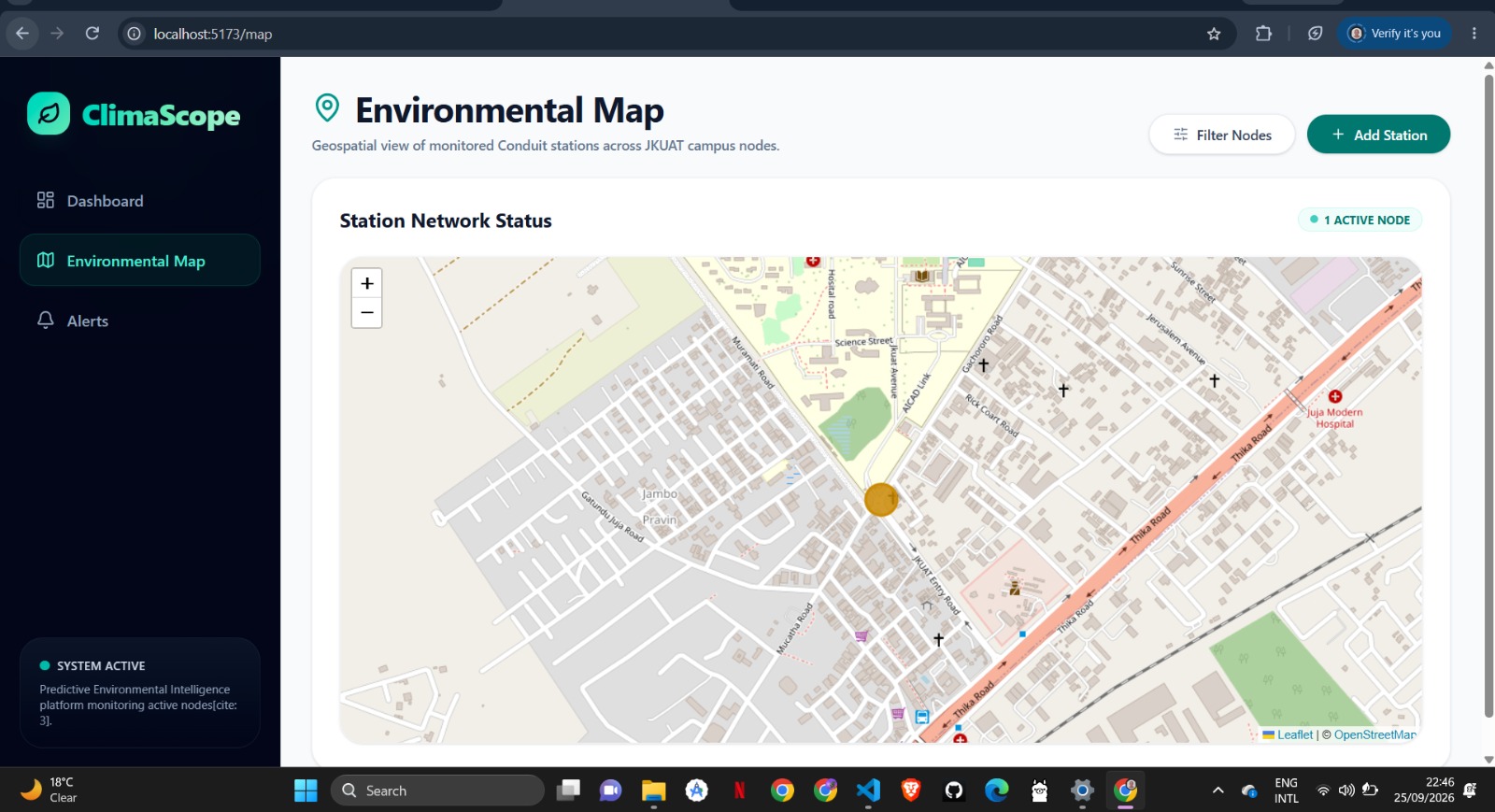
map
-
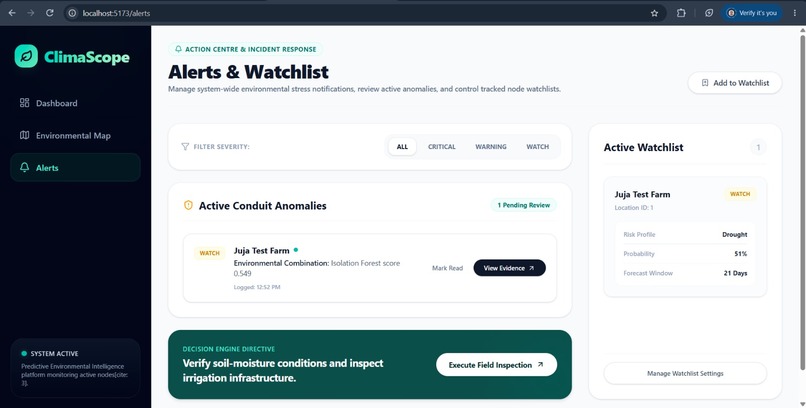
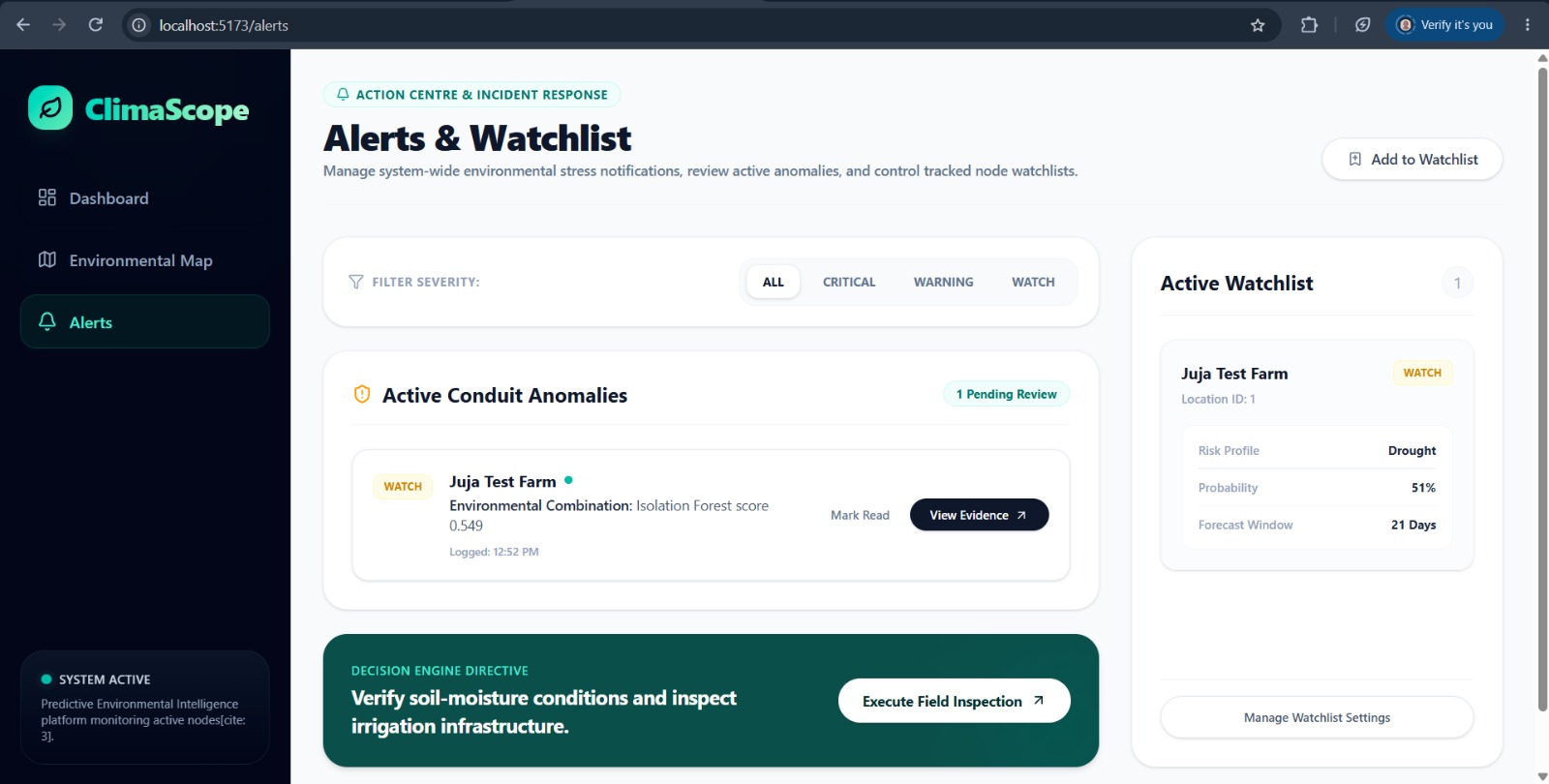
alerts
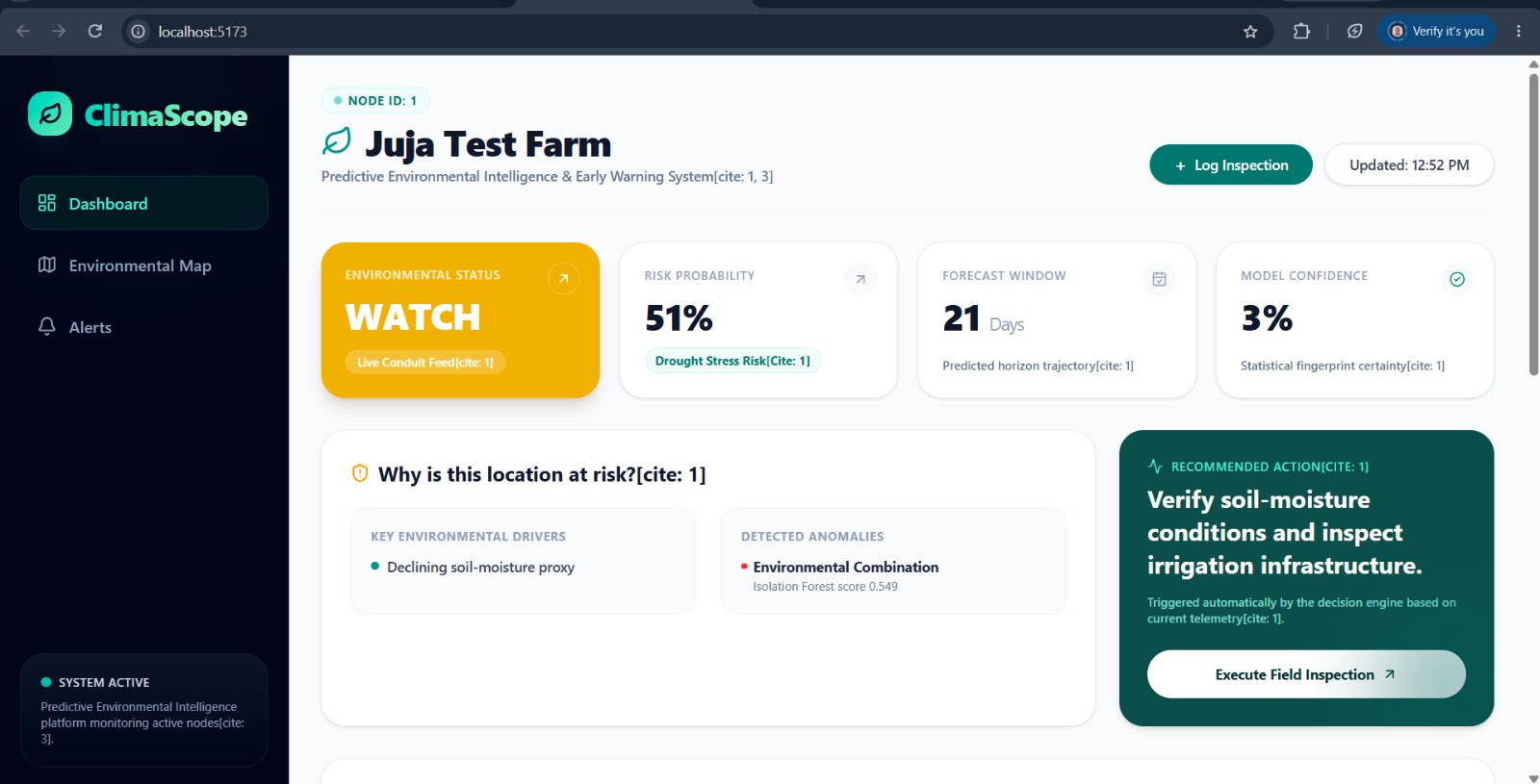
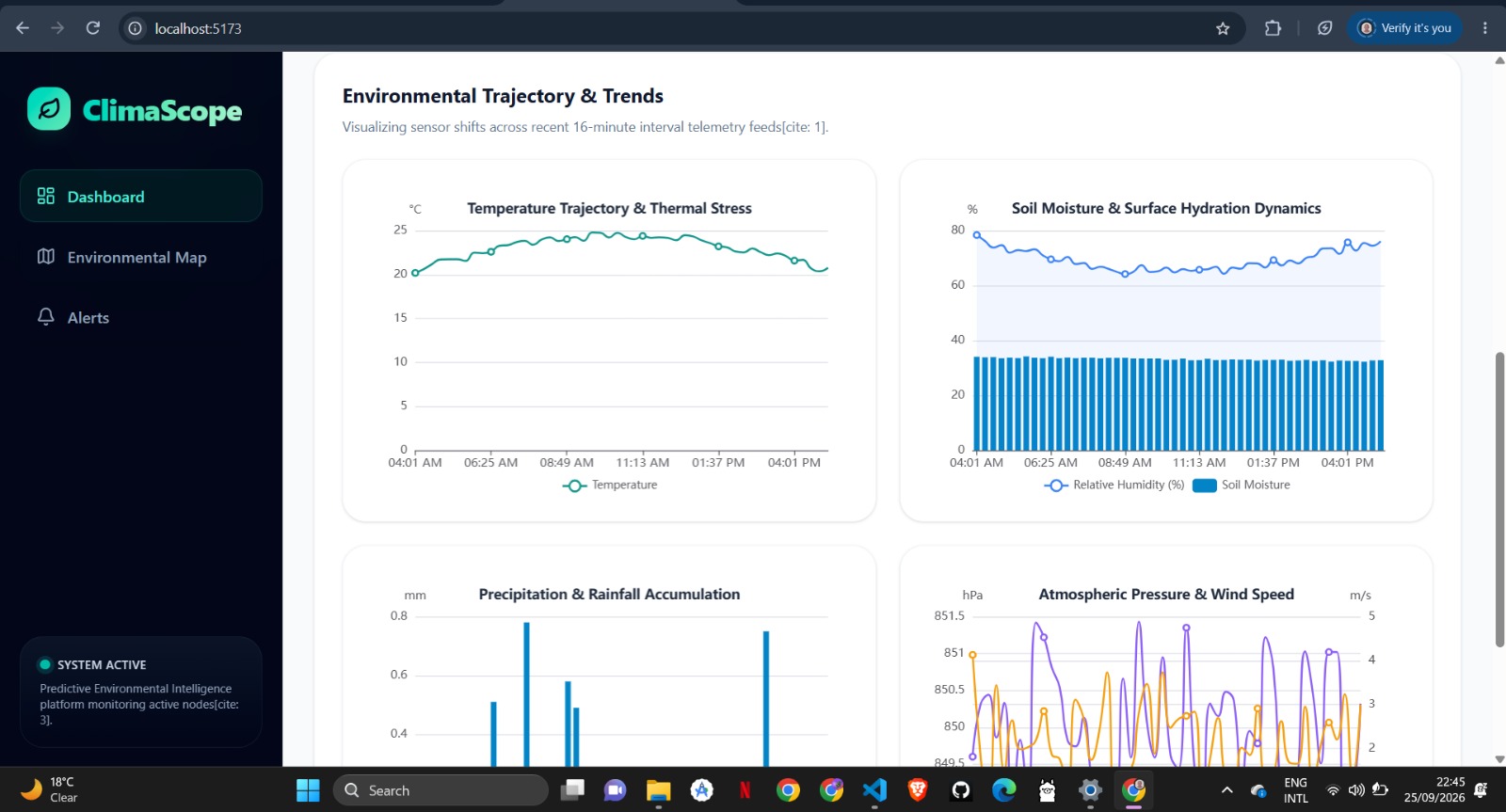
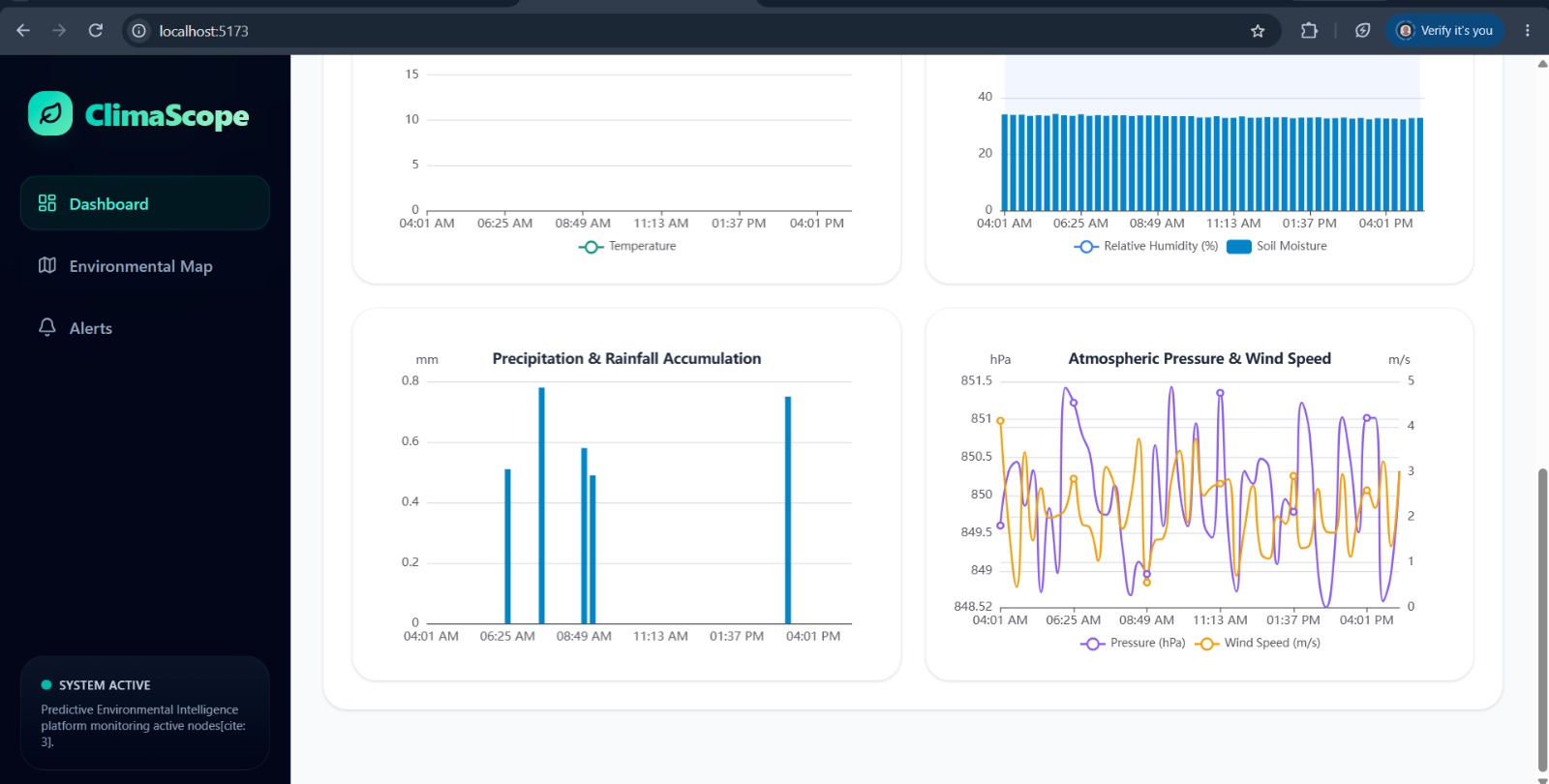
Inspiration
Environmental hazards rarely happen all at once. Drought, for example, can develop gradually through declining rainfall, increasing temperatures, drying soil, and changes in vegetation. By the time the effects are obvious, communities may already be dealing with serious consequences.
We wanted to explore a different approach: what if environmental data could tell us not only what is happening, but what is likely to happen next and why?
This inspired ClimaScope, a Predictive Environmental Intelligence platform that learns the normal environmental fingerprint of a location, detects deviations from that baseline, forecasts potential risk, explains the factors behind the warning, and recommends an action.
We chose drought as our initial use case so we could focus on building one complete, working hazard pipeline rather than creating several incomplete features.
What it does
ClimaScope transforms environmental measurements into actionable early warnings.
For our MVP, the system focuses on drought and environmental stress. It follows five stages:
Fingerprint → Detect → Forecast → Explain → Act
First, ClimaScope establishes what normal environmental conditions look like for a location. It then analyzes incoming environmental data and identifies unusual changes, such as declining moisture or rainfall conditions outside the expected range.
The system then estimates the potential for continued environmental stress and presents the result through an intuitive dashboard. Instead of simply displaying a risk score, ClimaScope also highlights the environmental factors contributing to the warning and connects the prediction to a potential action.
The goal is to help users move from:
"Something is changing." → "This could become a problem." → "Here is why." → "Here is what we can do."
Although our MVP focuses on drought, the architecture is deliberately hazard-agnostic. The same system can be adapted to floods, crop stress, water stress, heat risk, and other environmental hazards by changing the relevant environmental inputs, features, and prediction target.
How we built it
We used Conduit@Empathy environmental data as a key input to our machine-learning pipeline.
Our pipeline processes the environmental data, identifies patterns and deviations from expected conditions, and generates structured risk information that can be presented to users.
The system is built around several layers:
- Data layer: Environmental observations from Conduit and potential supporting datasets.
- Processing layer: Cleaning, organizing, and transforming environmental measurements into useful features.
- Fingerprinting: Establishing a baseline for normal environmental behaviour.
- Anomaly detection: Identifying environmental conditions that differ significantly from expected patterns.
- Risk prediction: Estimating potential drought/environmental stress.
- Explainability: Identifying the environmental factors contributing to a warning.
- Application layer: Presenting the results through an interactive dashboard and connecting warnings to potential actions.
Our technology stack includes React, TypeScript, Vite, Python, django, pandas, NumPy, and scikit-learn, with machine-learning models used for anomaly detection and risk prediction.
We designed the system around a structured prediction output containing information such as the hazard type, risk level, anomalies, environmental drivers, confidence, and recommended action. This creates a clear interface between the ML pipeline and the application.
Most importantly, we designed the architecture so that the drought model is only one possible implementation. A flood model, for example, could use rainfall intensity, soil saturation, and water levels, while a crop-stress model could use soil moisture, temperature, and vegetation indicators without requiring us to rebuild the entire platform.
Challenges we ran into
One of our biggest challenges was deciding how to turn environmental measurements into a meaningful prediction.
Environmental conditions naturally vary by location and season, so using a single fixed threshold would not accurately represent what is unusual everywhere. This pushed us toward the idea of an environmental fingerprint, where conditions are compared against the normal behaviour of a particular location.
Another challenge was working with the limitations of the available data. Environmental prediction requires reliable historical observations and, ideally, independently validated labels. Since our MVP does not yet have comprehensive ground-truth drought labels, we had to treat our current drought prediction as an early-warning prototype rather than claiming production-level forecasting accuracy.
We also had to balance ambition with the limited time available. We initially considered supporting several hazards at once, but doing so would have resulted in shallow implementations. We instead focused on drought while designing the architecture to support multiple hazards in the future.
Finally, we faced the challenge of making machine-learning predictions understandable. A number alone is not enough for someone making an environmental decision. This is why explainability became a core part of the product rather than an afterthought.
Accomplishments that we're proud of
We are proud that we were able to turn environmental data into a complete data-to-decision concept rather than building only a visualization dashboard or an isolated machine-learning model.
Our system connects:
Data → Detection → Prediction → Explanation → Action
We are also proud of the modular architecture. Drought is our demonstrated use case, but the underlying system is not tied to drought. The same pipeline can support other hazards by providing it with different environmental signals and defining a different prediction target.
Another accomplishment was integrating Conduit data into the environmental intelligence pipeline and designing a user experience around the questions a real decision-maker would ask:
- What is happening?
- Is it unusual?
- Is it getting worse?
- Why is it happening?
- What should I do?
This helped us shift our thinking from simply building a machine-learning model to building a decision-support system.
What we learned
We learned that building an environmental AI system is not just about choosing a sophisticated machine-learning algorithm.
The quality and context of the data matter just as much as the model. We learned the importance of understanding environmental baselines, seasonal variation, feature engineering, anomaly detection, and the limitations of available labels.
We also learned that explainability is essential when predictions are intended to support real-world decisions. Users need to understand why a system is raising a warning before they can confidently act on it.
Perhaps our biggest lesson was the value of building around a strong architecture rather than a single use case. By separating data processing, environmental fingerprinting, detection, forecasting, explanation, and action, we created a foundation that can evolve beyond drought.
What's next for ClimaScope
Our next step is to move from a hackathon MVP toward a more robust environmental intelligence platform.
We plan to:
- Integrate real-time environmental data streams.
- Add more historical and satellite-derived datasets.
- Improve model validation using established drought indices and independently validated observations.
- Add geographic mapping and location-based monitoring.
- Develop automated alerts and notifications.
- Connect the ML pipeline to a persistent backend and database.
- Add field-inspection and reporting workflows.
Most importantly, we want to expand beyond drought.
The same ClimaScope architecture can be adapted for flood risk, crop stress, water stress, heat risk, and other environmental hazards. Each hazard would use its own relevant environmental fingerprint and prediction target, while retaining the same core intelligence pipeline:
Fingerprint → Detect → Forecast → Explain → Act
Our vision is to build a platform that doesn't simply tell people what the environment looks like today, but helps them understand what is changing, what may happen next, and how they can act before a hazard becomes a crisis.
Built With
- and-scikit-learn
- conduit@empathy
- django
- numpy
- pandas
- python
- react
- scikit-learn
- typescript
- vite

Log in or sign up for Devpost to join the conversation.