-
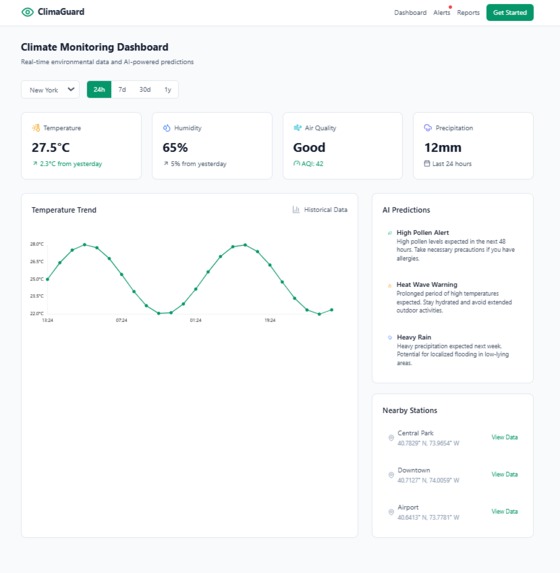
Prototype Image
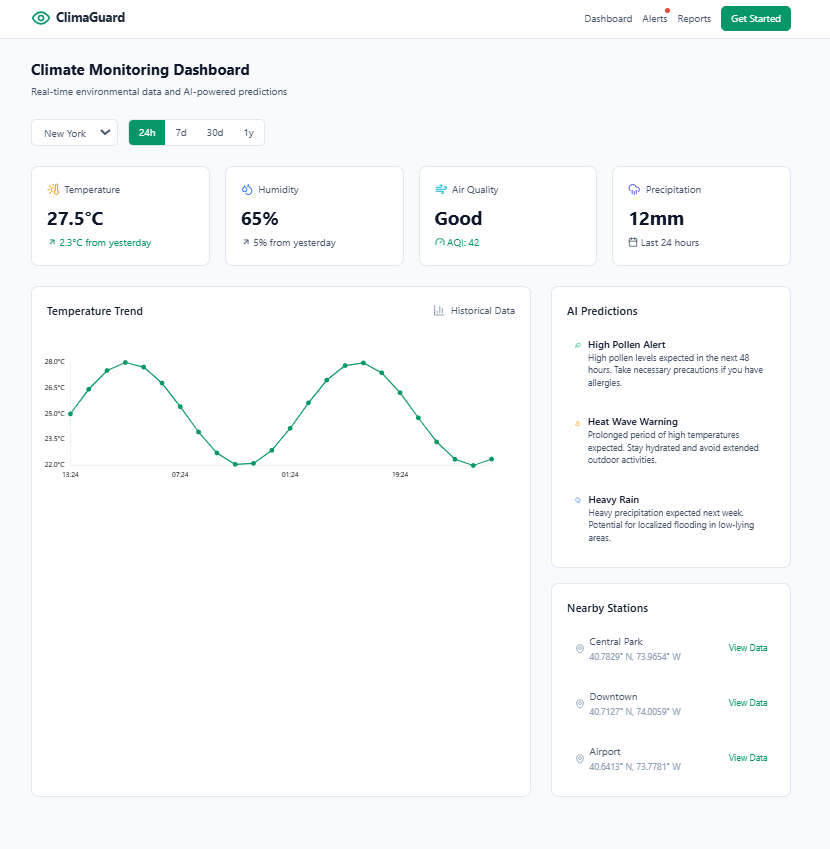
ClimaGuard: AI-Powered Climate Resilience
Executive Summary
ClimaGuard is an AI-driven platform designed to predict, monitor, and mitigate climate-related risks. By leveraging real-time environmental data and machine learning models, it provides actionable insights to communities and policymakers to combat climate change effectively. This document outlines the inspiration, research, development process, challenges faced, and the potential impact of ClimaGuard.
Inspiration
The idea for ClimaGuard was born out of a deep concern for the increasing frequency of climate disasters worldwide. From devastating floods to deadly heatwaves, communities are struggling to adapt to the rapidly changing environment. Our team wanted to develop a data-driven solution that could empower governments, organizations, and individuals to take proactive measures in the face of climate change. Seeing the limitations of existing forecasting models, we set out to create a smart, AI-powered system that not only predicts risks but also provides actionable recommendations.
What We Learned
Throughout this project, we gained valuable insights into:
- The complexity of climate modeling and the need for high-quality data.
- How AI and IoT can be integrated to provide real-time environmental insights.
- The importance of scalable cloud infrastructure for handling large datasets efficiently.
- How user-friendly interfaces enhance accessibility and usability of climate data.
- Beyond technical aspects, we also learned about policy challenges in climate governance and how data-driven approaches can inform better decision-making.
Introduction
Climate change is one of the most pressing global challenges, leading to extreme weather events, rising sea levels, and ecosystem disruptions. The need for proactive solutions has never been more urgent. ClimaGuard is designed to bridge the gap between climate data and informed decision-making by using AI-powered predictive analytics and IoT-enabled monitoring.
Research & Findings
Key Areas Explored:
- Climate Change Impact: Analyzing the increasing frequency and severity of environmental disasters.
- AI & Machine Learning in Climate Science: Utilizing predictive models to assess climate risks.
- IoT & Cloud Integration: Implementing real-time data collection and scalable infrastructure.
- Challenges in Data Accuracy & Interpretation: Addressing inconsistencies in climate datasets.
System Design & Development
Core Components:
- Backend: Developed using Python (Flask/Django) for efficient server-side processing.
- AI/ML Models: Built with TensorFlow and Scikit-learn to analyze climate patterns and generate forecasts.
- Frontend: A React.js-based user interface ensuring accessibility and usability.
- Database: Firebase/SQL-based architecture for secure and efficient data storage.
- IoT Integration: Sensors (Arduino/Raspberry Pi) deployed to monitor air quality, temperature, and humidity.
- Cloud Deployment: AWS/GCP utilized for scalable computing and storage.
The system processes real-time environmental data and generates early warning alerts and adaptation strategies for climate resilience.
Challenges Faced
Key Challenges:
- Data Quality & Accuracy: Addressed through advanced preprocessing and data validation techniques.
- Model Performance Optimization: Balanced accuracy and efficiency in AI-driven predictions.
- Real-Time Processing: Implemented low-latency data streaming for prompt alerts.
- Scalability: Designed a modular architecture to accommodate large-scale data inputs.
- Hardware Limitations: Ensuring that IoT sensors could operate efficiently in extreme conditions.
Despite these hurdles, our team continuously iterated on our solutions to enhance performance and reliability.
Solutions for Environmental Challenges
1. Air Pollution Control
- AI-Based Air Quality Prediction: Use machine learning models to forecast air pollution levels.
- IoT-Based Air Monitoring Stations: Deploy IoT sensors to provide real-time air quality data.
- Green Infrastructure Implementation: Promote urban forests and green walls to absorb pollutants.
2. Water Pollution Reduction
- Smart Water Filtration Systems: AI-powered filtration units that detect and remove contaminants.
- Remote Water Quality Monitoring: IoT sensors placed in water bodies to detect pollution levels.
- Wastewater Recycling Technologies: Implement efficient purification and reuse systems.
3. Waste Management & Plastic Pollution
- Automated Waste Sorting: AI-powered robotics to categorize and recycle waste efficiently.
- Biodegradable Packaging Solutions: Development of sustainable packaging materials.
- Incentive-Based Recycling Programs: Reward systems for communities that recycle efficiently.
4. Deforestation Prevention & Biodiversity Conservation
- Satellite & AI-Based Deforestation Tracking: Real-time monitoring of forests to detect illegal activities.
- Drone-Assisted Reforestation: Using drones to plant trees in affected regions.
- Eco-Conscious Farming Practices: Promote agroforestry and regenerative agriculture techniques.
5. Climate Adaptation & Disaster Response
- AI-Based Disaster Prediction: Use climate models to forecast extreme weather events.
- Smart Evacuation Systems: Real-time alerts and routing systems for disaster-prone areas.
- Resilient Infrastructure Development: Climate-adaptive building designs and materials.
Potential Impact & Future Scope
Anticipated Benefits:
- Improved Disaster Preparedness: Helps communities take proactive measures.
- Policy Support: Assists governments in formulating climate action strategies.
- Environmental Awareness: Provides individuals with insights to reduce their carbon footprint.
Future Enhancements:
- Expansion to More Environmental Factors: Including water pollution and deforestation tracking.
- Blockchain Integration: For secure and transparent environmental data management.
- Global Scalability: Enhancing AI models for broader geographic adaptation.
Conclusion
ClimaGuard is a pioneering step toward leveraging AI and IoT to combat climate change. By providing real-time insights and predictive analytics, it empowers individuals, communities, and governments to take decisive actions. This project has not only strengthened our technical expertise but also deepened our commitment to environmental innovation.
Together, we can harness technology to create a sustainable future.

Log in or sign up for Devpost to join the conversation.