My Journey Building ClimaGrow AI for the Gemini 3 Hackathon
What Inspired Me
As extreme weather events intensified in recent years, droughts wiping out harvests, unexpected floods, and shifting growing seasons, I became deeply concerned about smallholder farmers who feed much of the world yet lack tools to adapt. Reports from organizations like the World Bank and USDA highlighted how climate-smart agriculture could boost resilience, cut emissions, and sustain yields, but many solutions remained inaccessible to those who need them most.
The launch of Gemini 3 with its state-of-the-art reasoning, multimodal understanding, and agentic capabilities felt like the perfect moment to act.
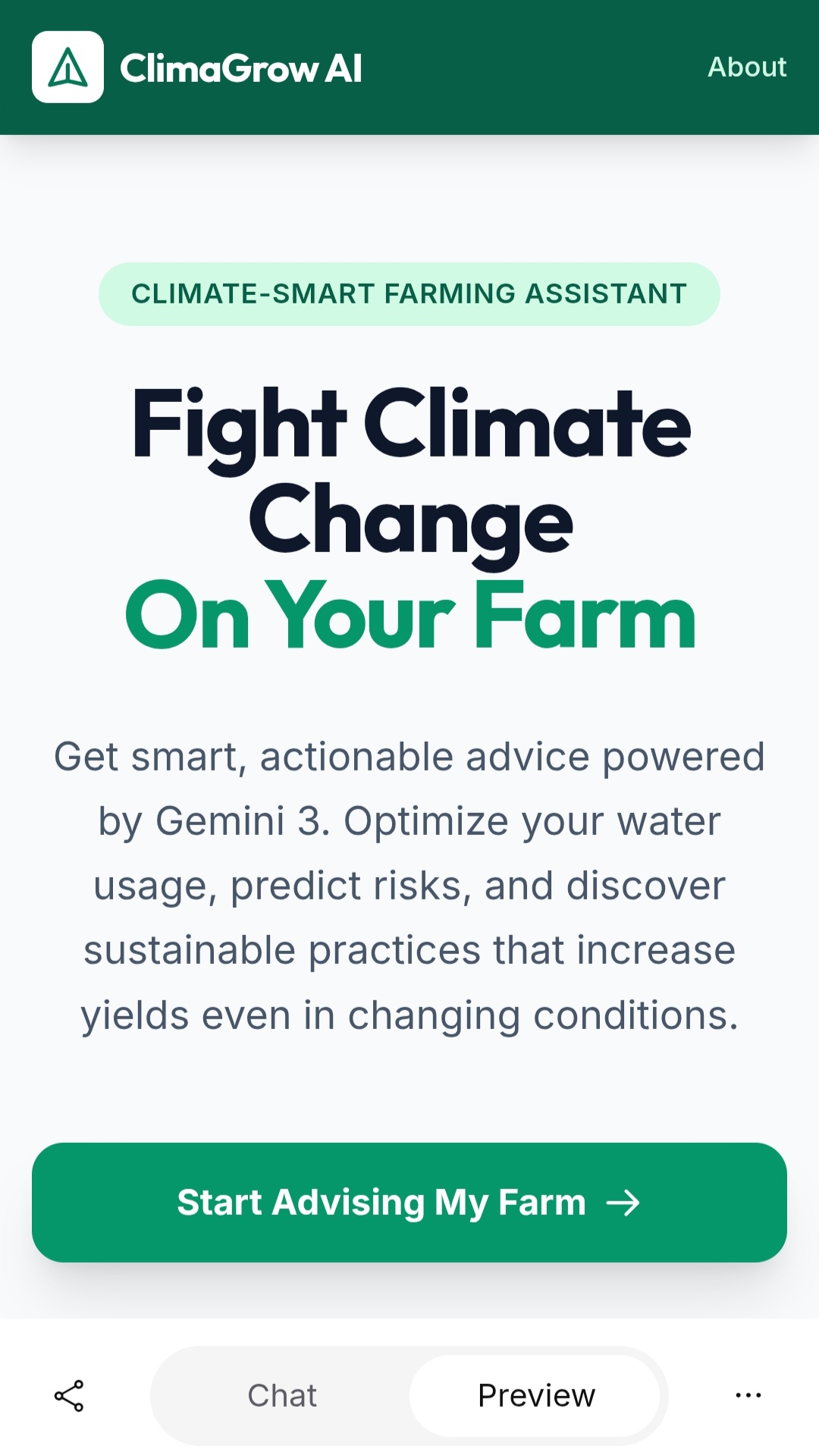
Climate change is already destroying crop yields, yet most farmers are still forced to make critical decisions using static, outdated information. With Gemini 3’s advanced reasoning, multimodal understanding, and agentic capabilities, ClimaGrow AI transforms real-time climate uncertainty into clear, actionable farming decisions. This project was inspired by a simple goal: to put powerful climate intelligence directly into the hands of farmers who need it most.
What I Learned
Participating in the Gemini 3 Hackathon taught me the true power (and limits) of frontier AI in real-world domains:
- Multimodal reasoning shines in agriculture: Gemini 3 excels at integrating text prompts, weather APIs, soil data images, and satellite-derived insights to provide nuanced recommendations, far beyond what earlier models could handle reliably.
- Precision farming demands context-aware adaptation: Generic advice fails; location-specific factors (soil type, microclimate, crop variety) matter enormously.
- Sustainability metrics like carbon sequestration estimates require careful prompting and validation against real agronomic formulas.
- Ethical AI matters: Bias in training data could disadvantage certain regions, so I prioritized diverse datasets and transparent explanations.
I also deepened my understanding of prompt engineering for agentic workflows using Gemini 3 to chain weather prediction → risk assessment → crop/water optimization → emission-reducing practice suggestions.
How I Built the Project
ClimaGrow AI is a mobile/web app powered entirely by Gemini 3 (via Google AI Studio and Vertex AI integration):
- Frontend: Built with React Native for cross-platform access (farmers often use affordable Android devices).
Core AI Engine:
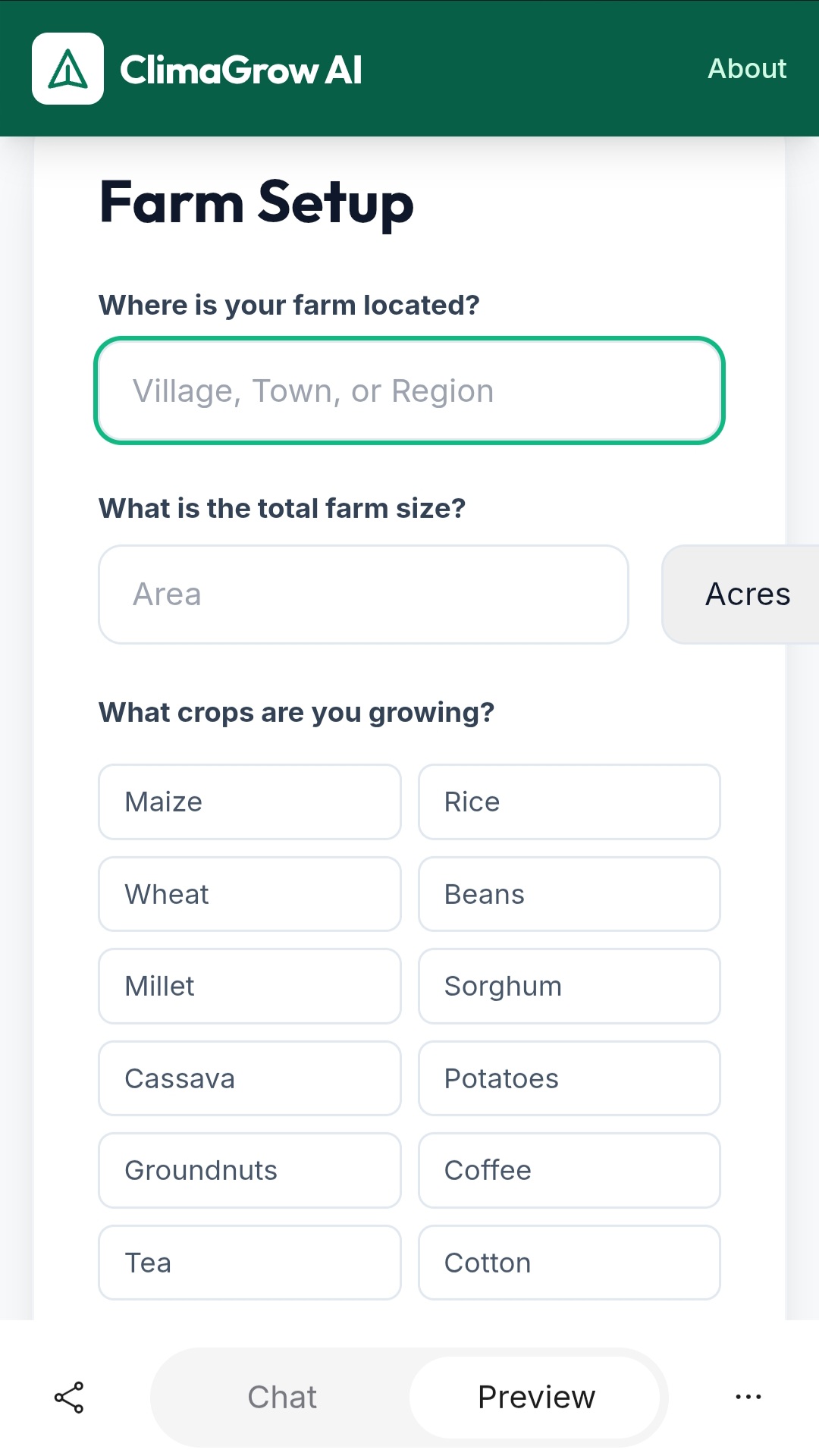
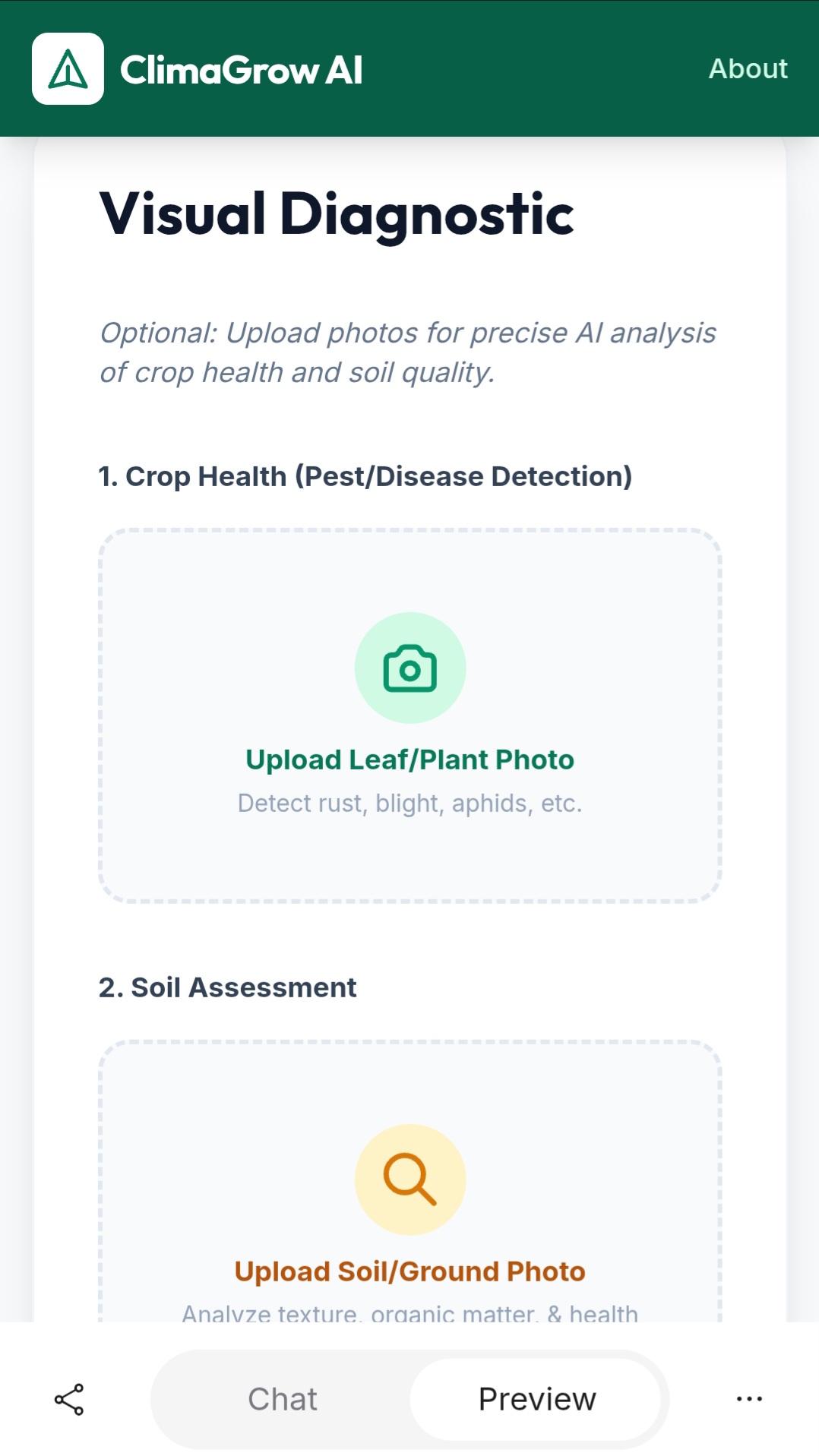
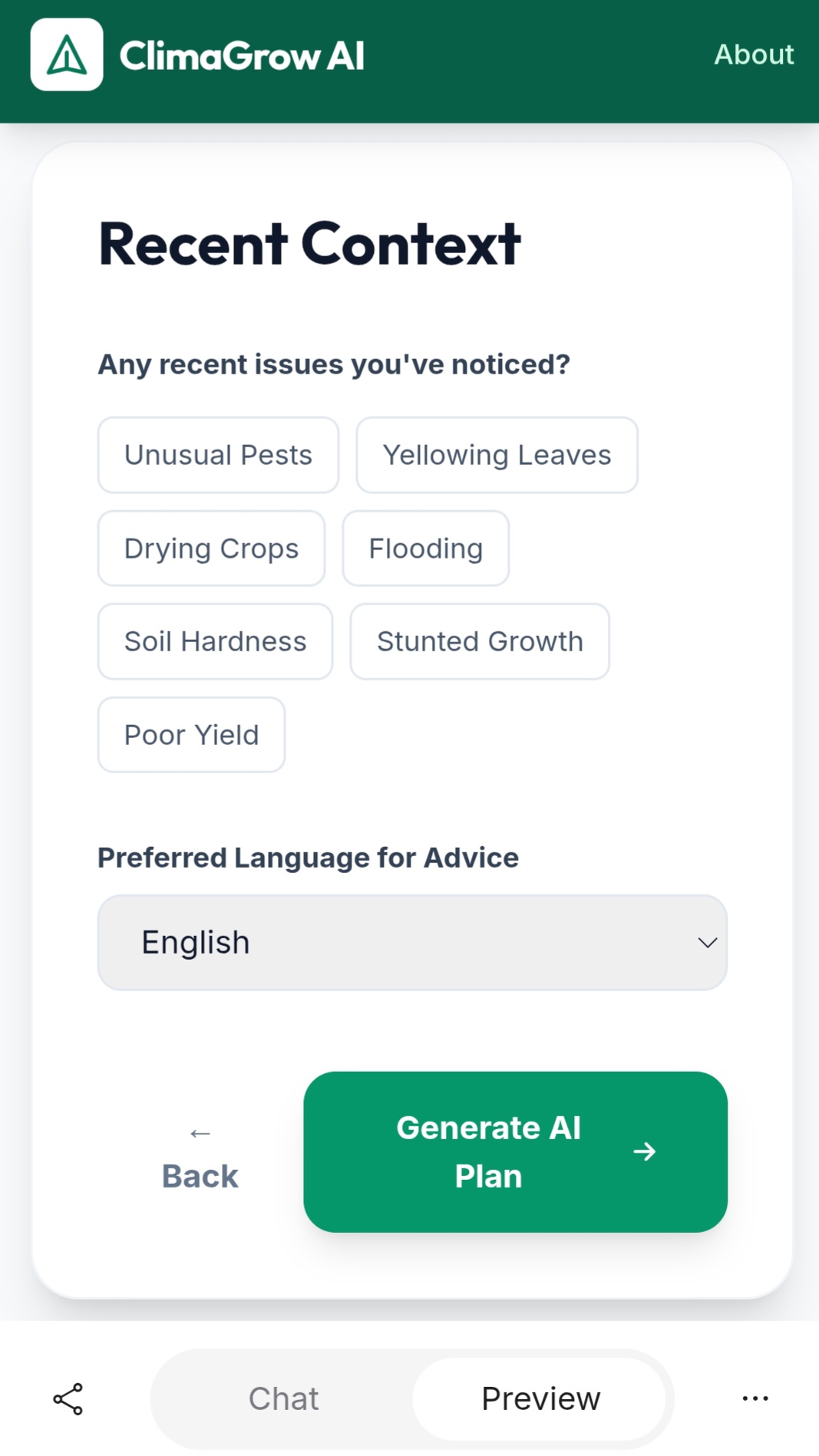
- Users input farm details (location, crop, soil photo, recent context).
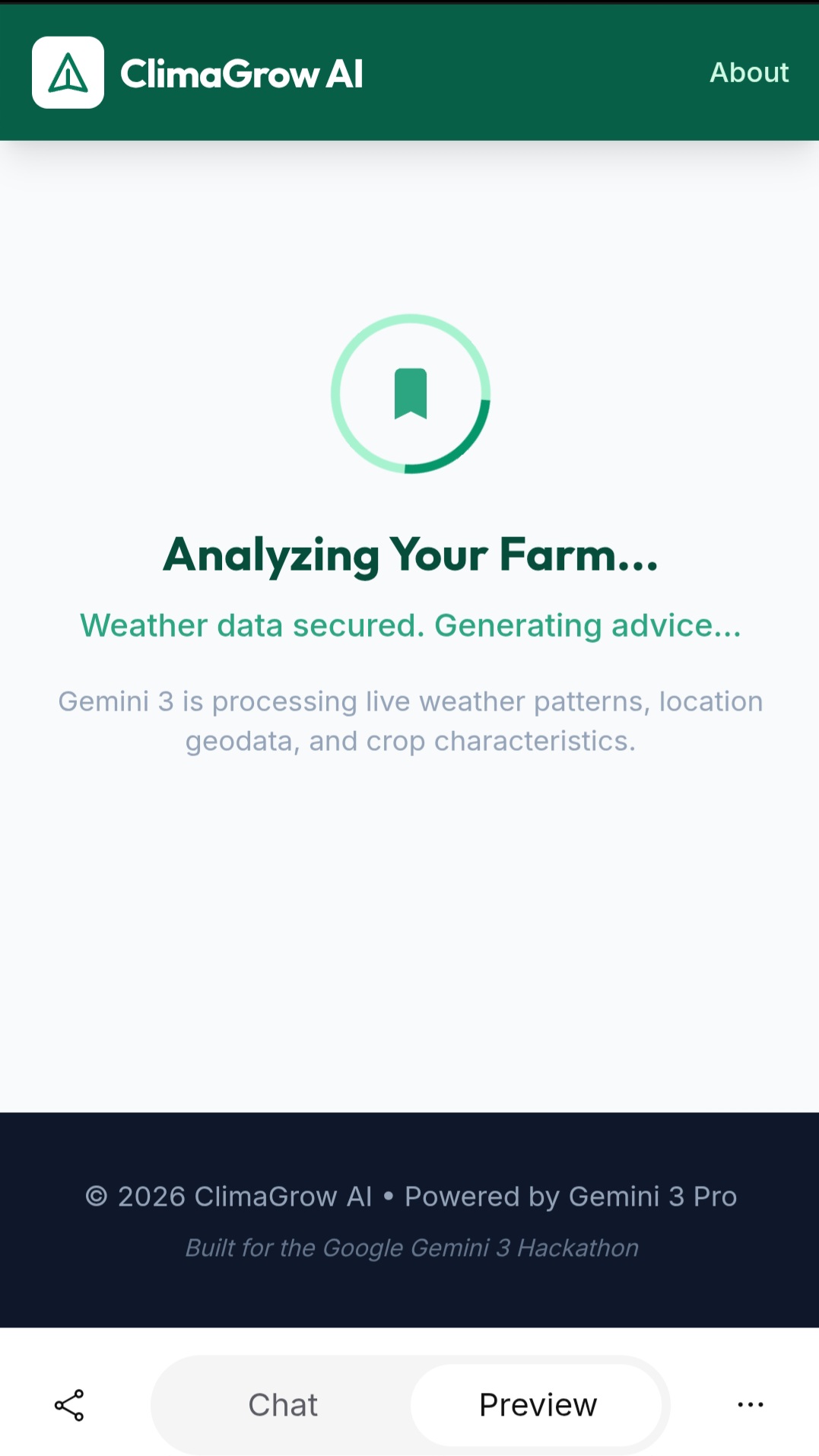
- Gemini 3 processes multimodal inputs: analyzes uploaded soil/crop images, combines with real-time weather APIs, and reasons over historical climate trends.
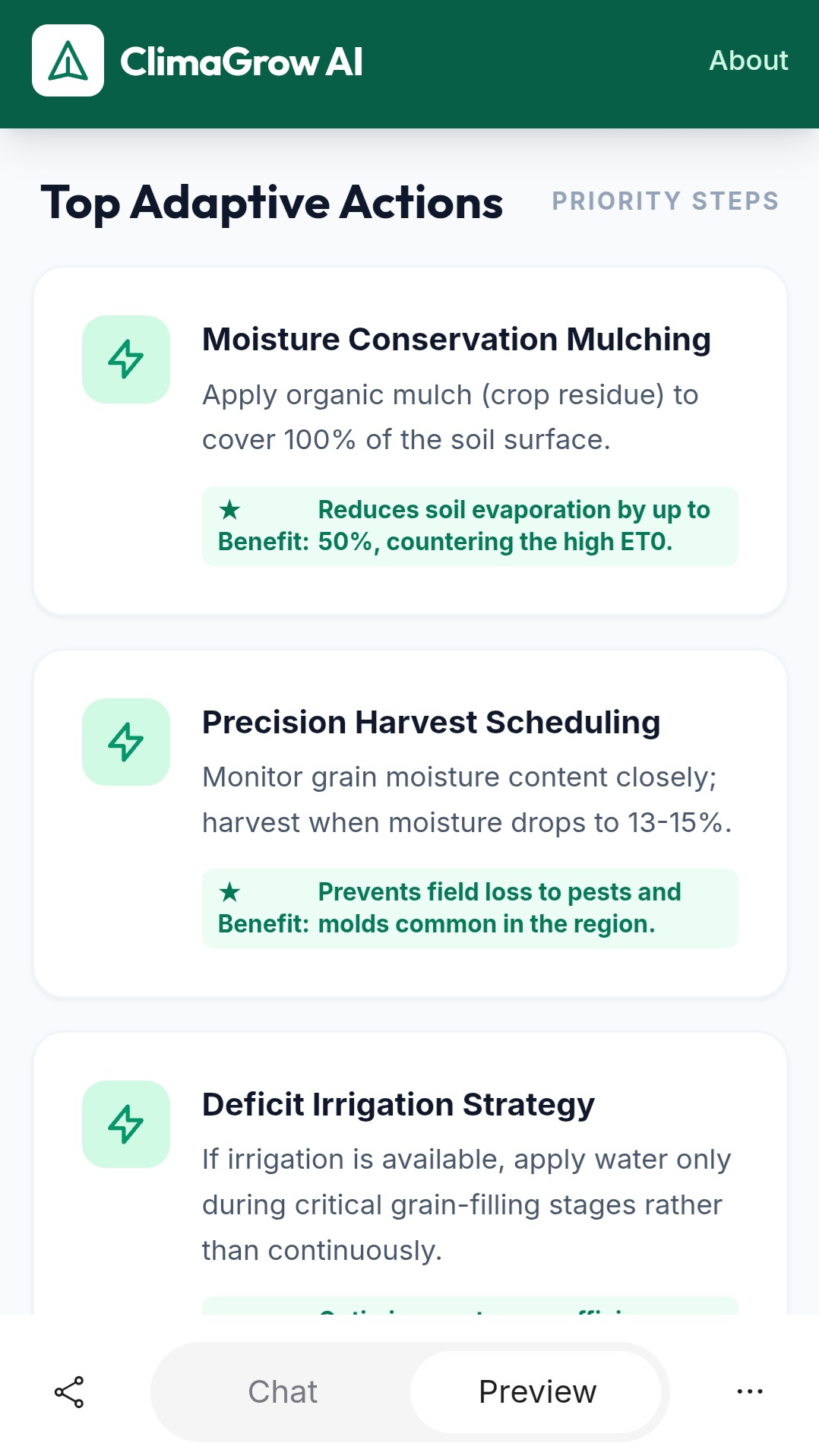
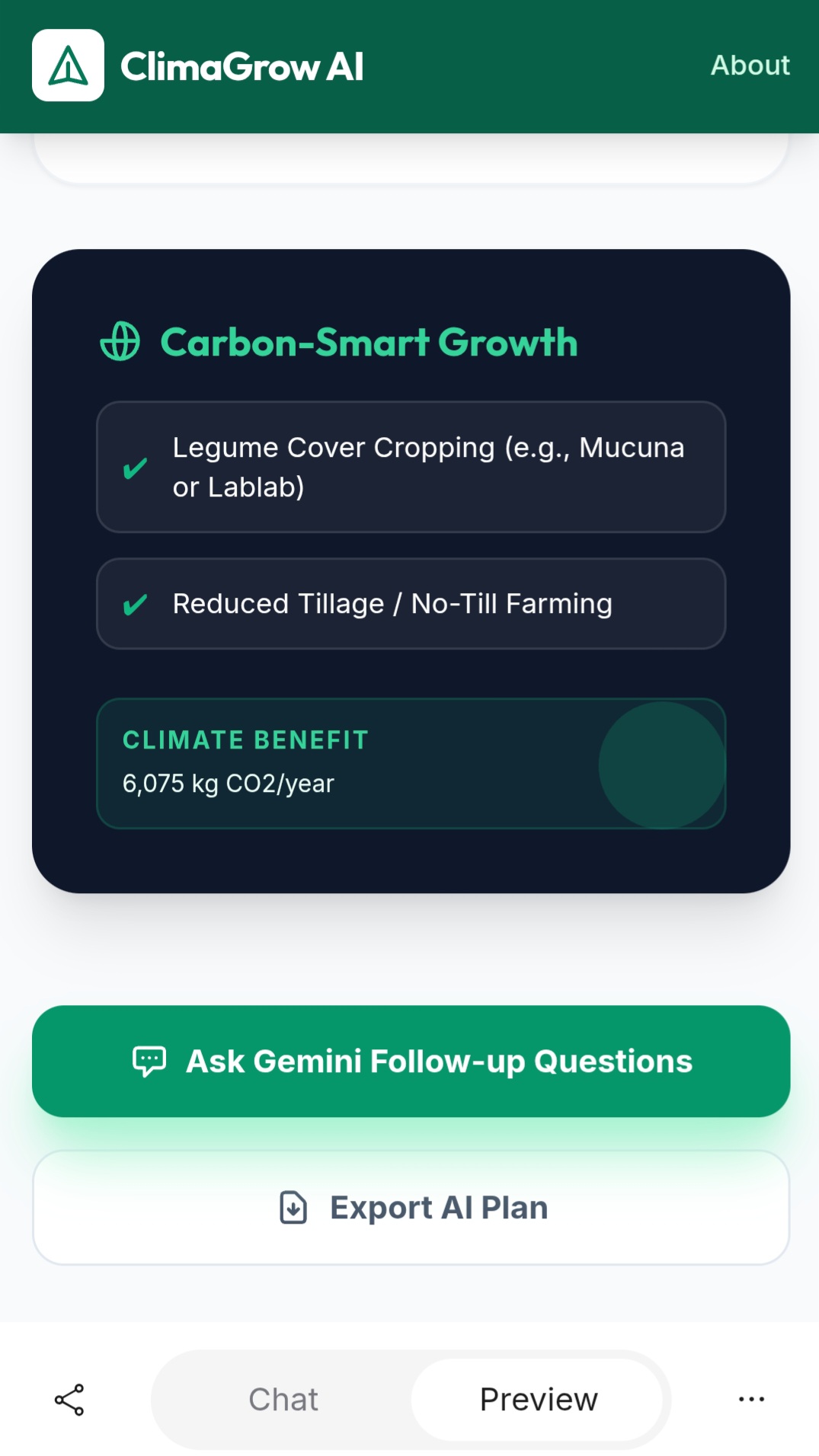
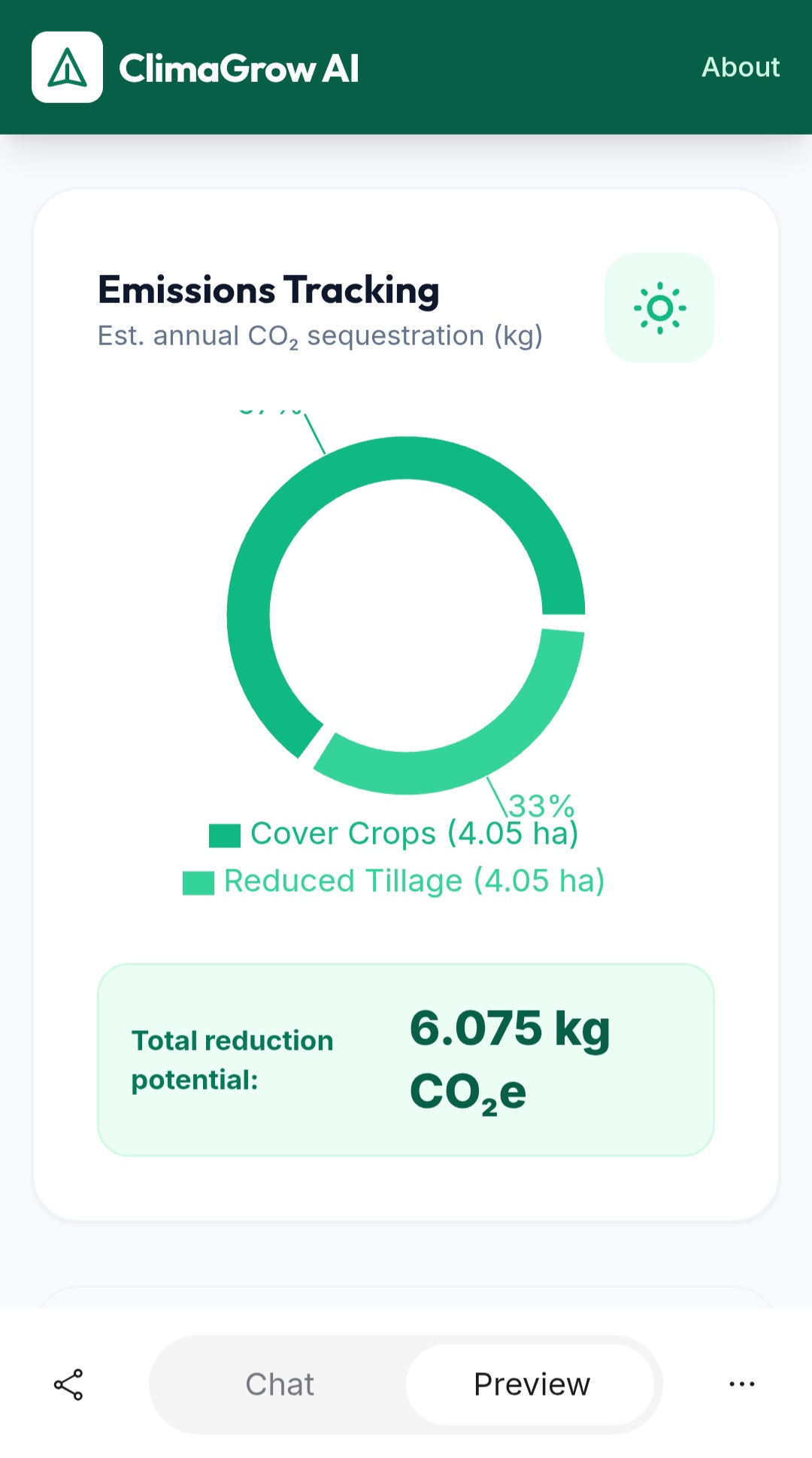
- Outputs personalized advice: drought/flood risk forecasts, adaptive crop rotation suggestions, precision irrigation plans, and carbon-smart practices (e.g., cover cropping to sequester CO₂).
Features:
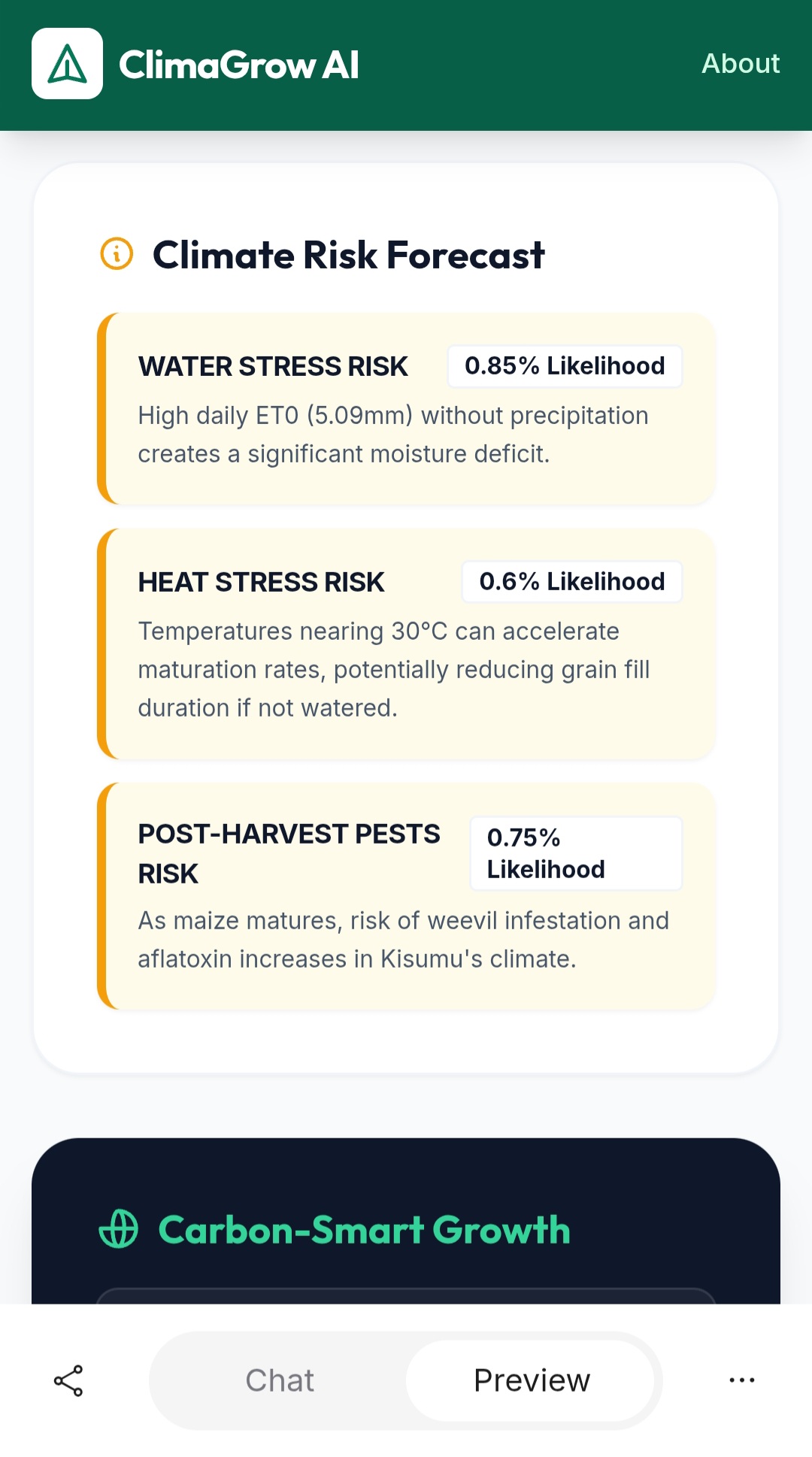
- Real-Time Climate Risk Assessment
Gemini 3 Pro analyzes live weather API data, historical climate trends, and user-provided farm inputs to generate context-aware drought, flood, and crop stress risk insights.
- Conversational Decision Support (Gemini 3 Flash)
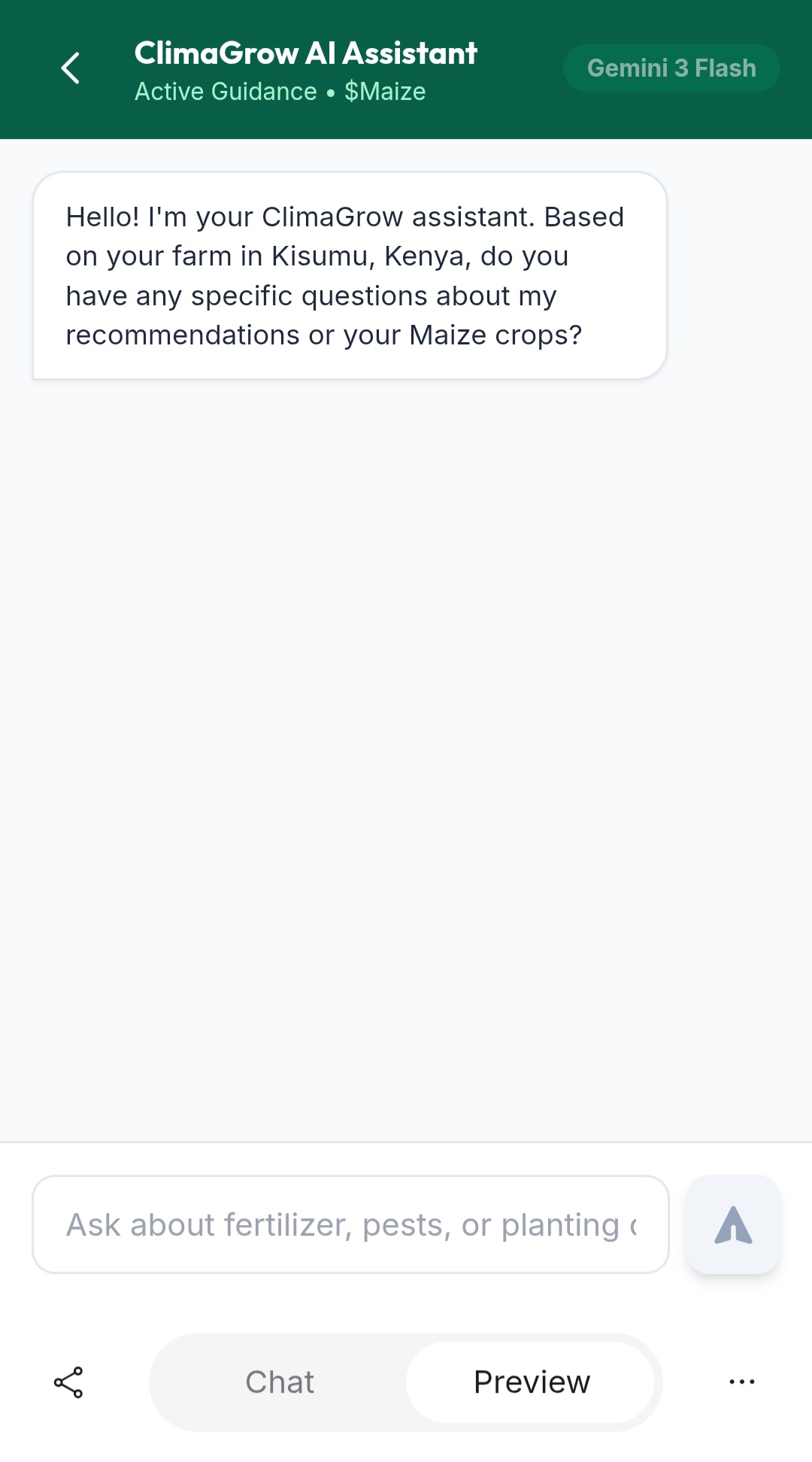
Farmers can ask scenario-based follow-up questions (e.g., crop substitution or planting time changes). The system adapts recommendations dynamically based on the current farm state.
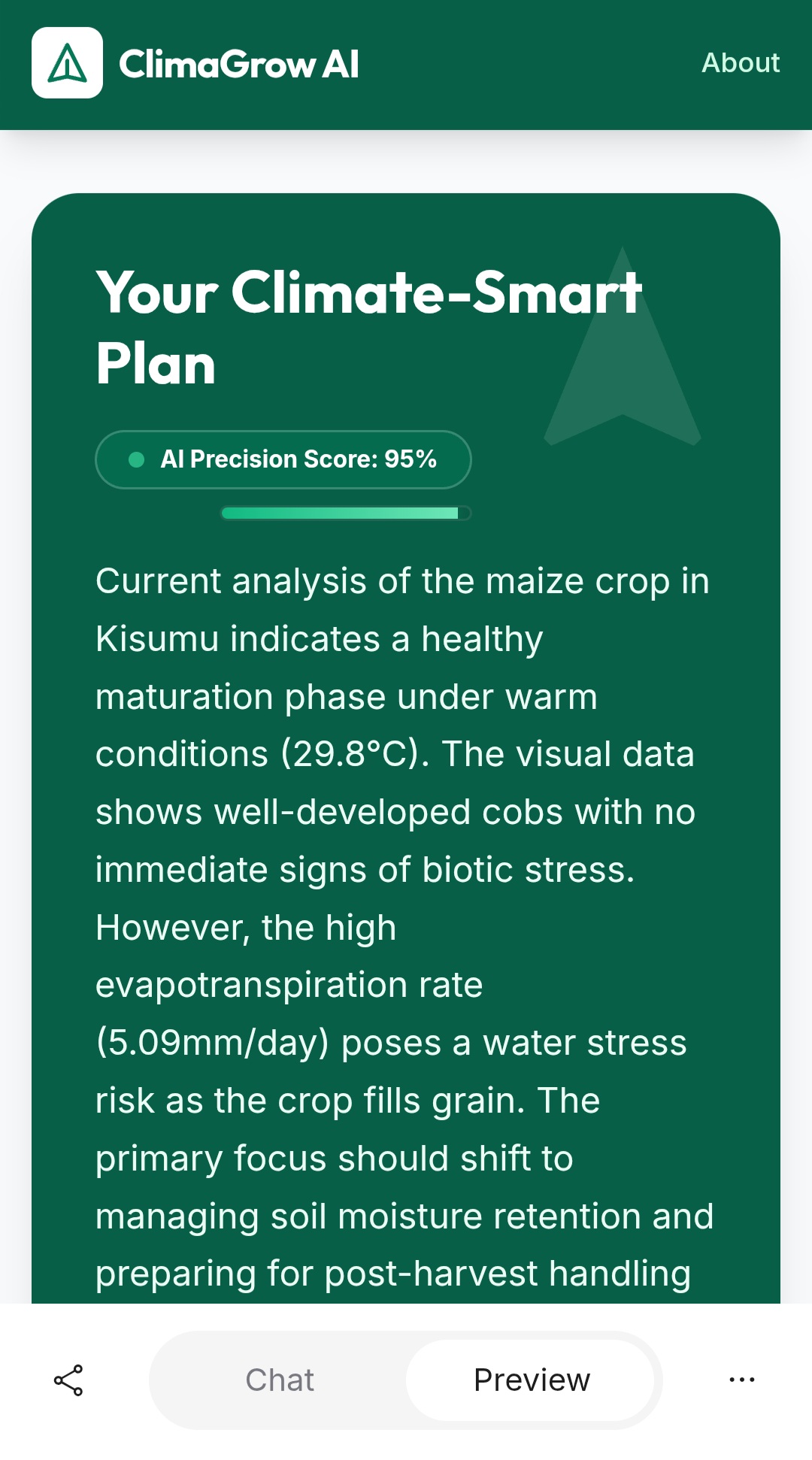
- Smart Results Dashboard with Confidence Scoring
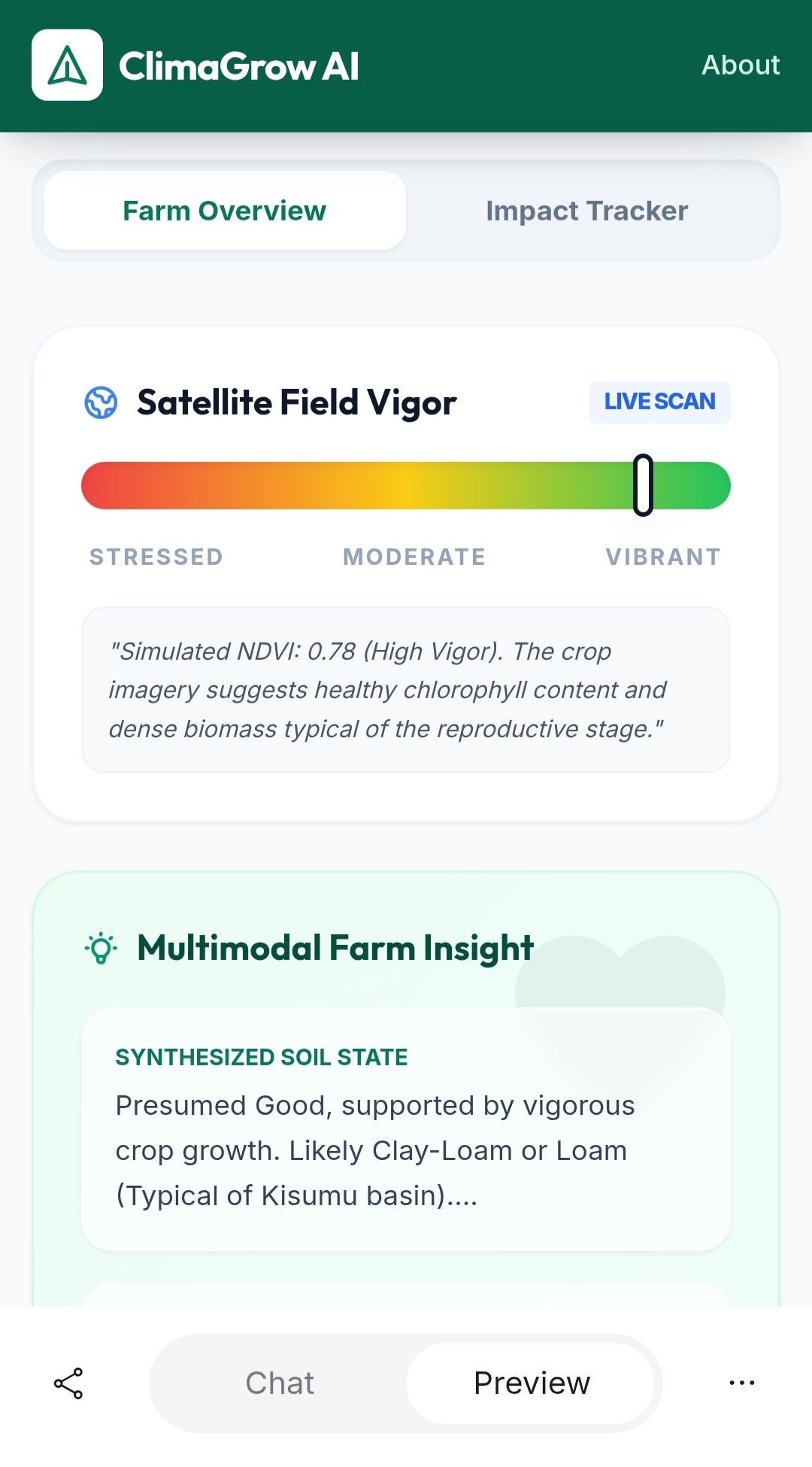
A unified action plan combining weather forecasts, simulated satellite NDVI insights, and crop/soil condition modeling. Each recommendation includes a confidence score based on data consistency and completeness.
- Impact Tracker (Session-Based)
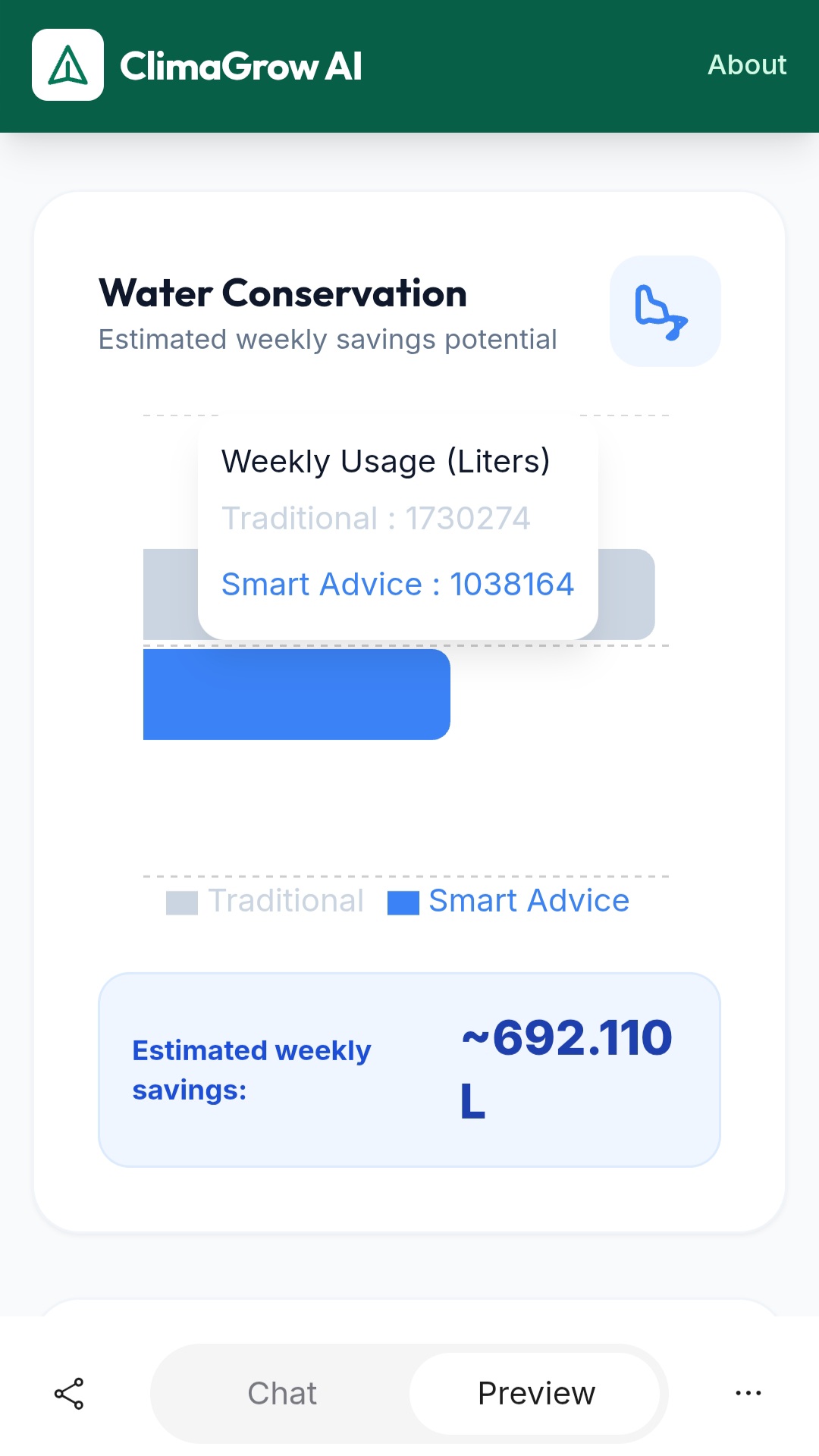
After each analysis, the app provides a sustainability summary highlighting estimated water optimization and climate-smart practice benefits.
- Smart Satellite Insights (NDVI Integration)
Gemini 3 analyzes simulated or live satellite-derived NDVI (Normalized Difference Vegetation Index) data to assess crop vigor. This enables ClimaGrow AI to detect plant stress long before it’s visible to the human eye, integrating biomass density directly into the adaptive action plan.
- Crop & Soil Health Analysis (Multimodal)
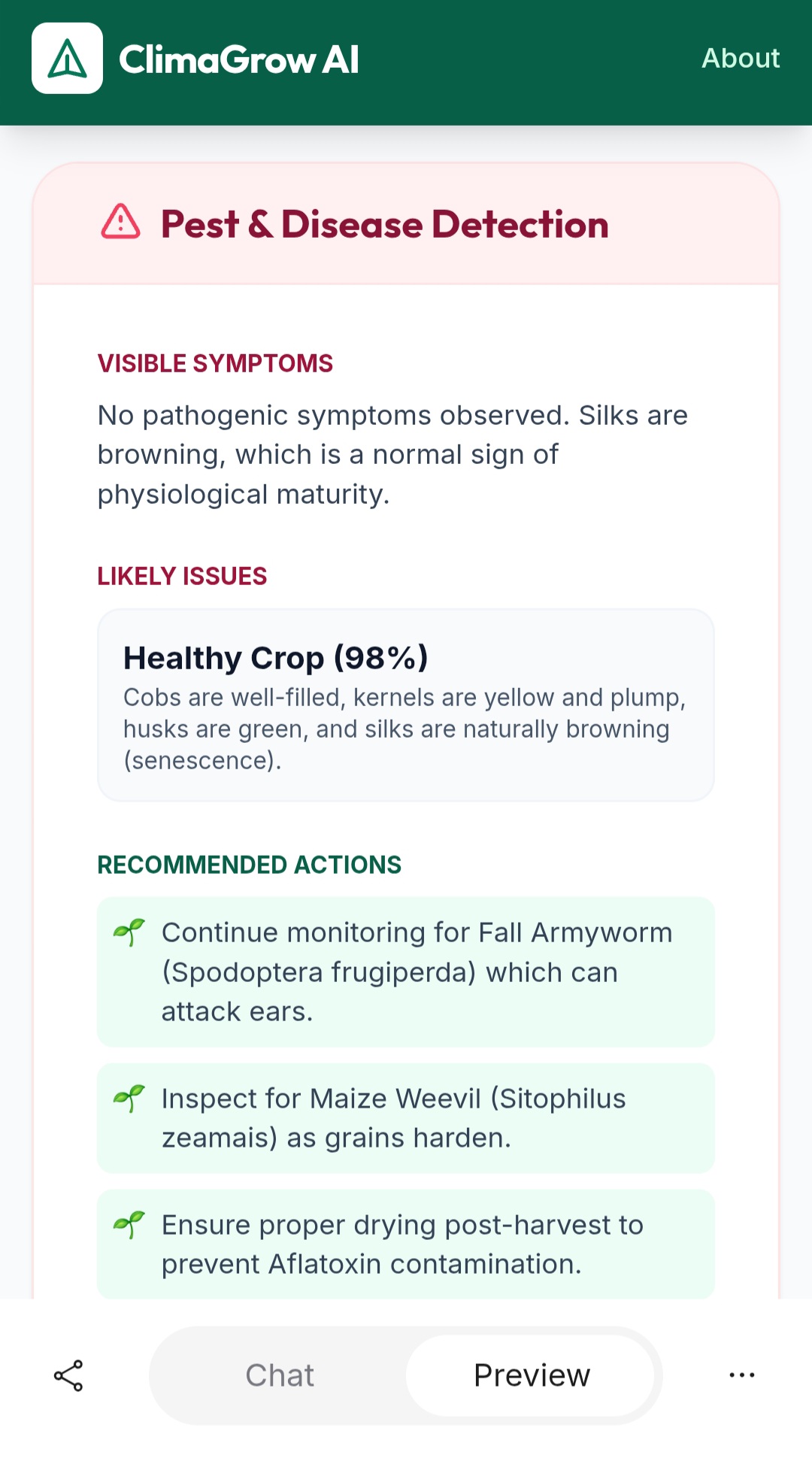
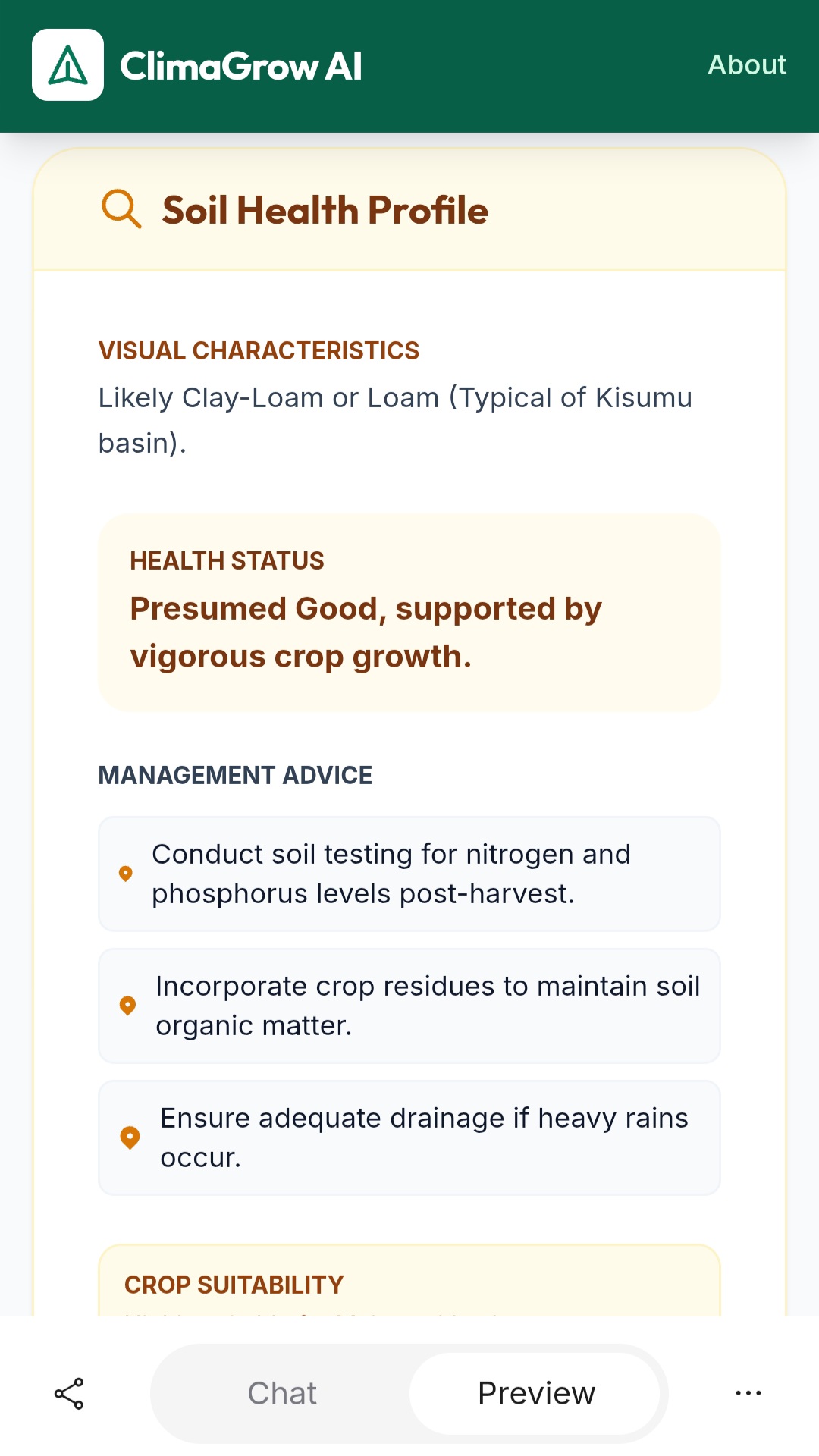
Users upload leaf or soil images, and Gemini 3 Pro performs visual analysis to identify potential pest pressure, disease indicators, nutrient deficiencies, and soil health concerns, followed by actionable treatment guidance.
3.1 Future Roadmap:
- Real-time push notifications
Firebase Cloud Messaging (FCM) to send urgent alerts (e.g., incoming drought/flood risk, extreme weather warnings) directly to farmers' phones when they grant permission. This would enable proactive protection during critical growing periods.
- Persistent impact monitoring dashboard
Impact dashboard that helps tracking cumulative water savings and estimated greenhouse gas emission reductions across multiple farm sessions, enabling longitudinal assessment of climate-smart practice adoption.
- Automated Edge & IoT Integration
Establish a seamless loop between on-field IoT soil sensors and Gemini 3’s agentic reasoning. This integration will enable the AI to autonomously trigger smart irrigation valves and hardware systems in real-time based on live moisture data, moving from "decision support" to autonomous climate-smart farm management.
- Community features
Farmer-to-farmer knowledge sharing or local expert connections.
- Tech Stack:
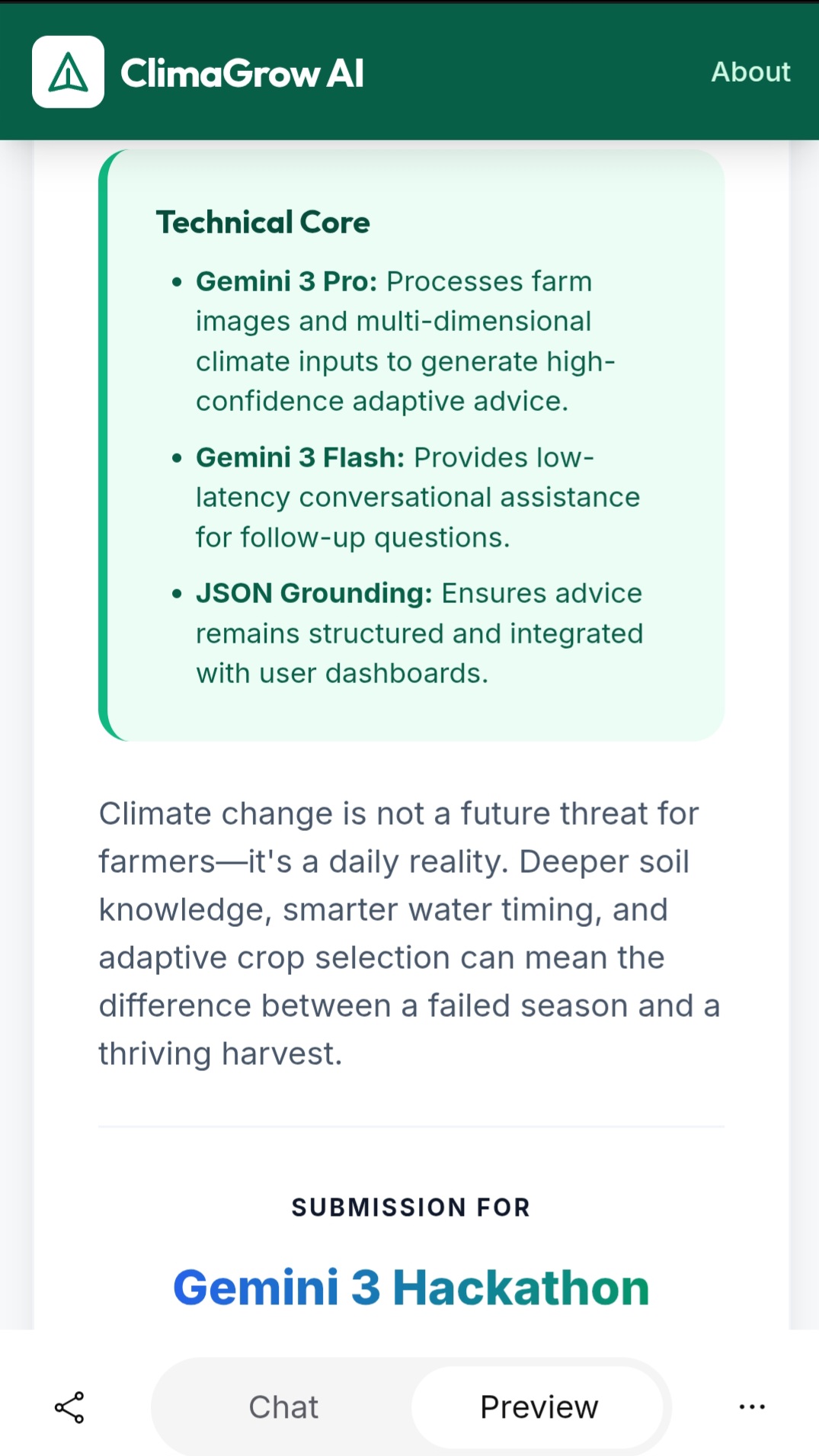
- Gemini 3 Pro for deep reasoning and multimodal processing.
- Gemini 3 Flash for faster, cost-efficient daily predictions.
- Integrated open weather/soil APIs; no heavy custom ML training needed thanks to Gemini's zero-shot and few-shot strengths.
Development took ~4 intense weeks, mostly iterating prompts to make outputs agronomically sound and farmer-friendly (simple language, visual explanations).
Impact
- Early Drought Detection (7–14 Days Ahead)
ClimaGrow AI helps small-scale farmers anticipate drought stress up to 7–14 days earlier, enabling timely irrigation and crop protection decisions before damage occurs.
- Reduced Yield Loss
By translating climate uncertainty into actionable recommendations, the system supports proactive interventions that can significantly reduce crop yield losses caused by extreme weather variability.
- Water Efficiency & Conservation
Smarter, earlier decision-making helps farmers optimize irrigation schedules, reducing unnecessary water use and minimizing waste during critical growth periods.
- Climate-Resilient Farming for Smallholders
Designed with accessibility in mind, ClimaGrow AI delivers advanced climate intelligence directly to smallholder farmers via mobile-friendly interfaces.
- Lower Environmental Footprint
More precise resource use—water, fertilizers, and energy—contributes to reduced emissions and supports sustainable, climate-smart agriculture practices.
- Scalable Global Impact
The platform is adaptable across regions and crops, making it applicable to diverse climate conditions and agricultural systems worldwide.
Challenges I Faced
- Data fragmentation: Reliable, hyper-local climate/soil data is scarce in many regions; I mitigated this by leaning on Gemini 3's strong generalization and synthetic augmentation via reasoning.
- Latency vs. depth: Balancing Gemini 3 Pro's powerful (but slower) reasoning with Flash's speed for mobile use required hybrid prompting strategies.
- Hallucination risks in high-stakes advice: I added guardrails—explicit source citations, confidence scores, and "consult local expert" disclaimers.
- Accessibility: Designing for low-bandwidth, low-literacy users meant stripping complexity, adding voice input/output, and supporting regional languages.
- Time crunch: The hackathon deadline (Feb 10, 2026) forced ruthless prioritization—core risk prediction and crop advice made it; advanced carbon modeling became a stretch goal.
Final Thoughts
Building ClimaGrow AI was exhilarating. It showed me how Gemini 3 can bridge cutting-edge AI with tangible impact helping farmers adapt to climate chaos while promoting sustainable practices. The project is a meaningful step toward climate-resilient agriculture.
I'm grateful for the hackathon opportunity and excited about refining it further. If this resonates, I'd love feedback on scaling it to real farmers! 🌱🤖

Log in or sign up for Devpost to join the conversation.