-
-
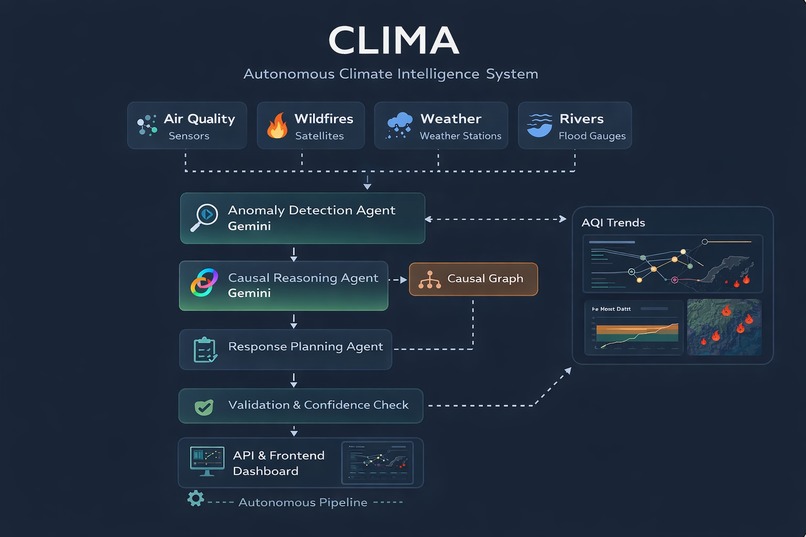
ARCHITECTURE DIAGRAM
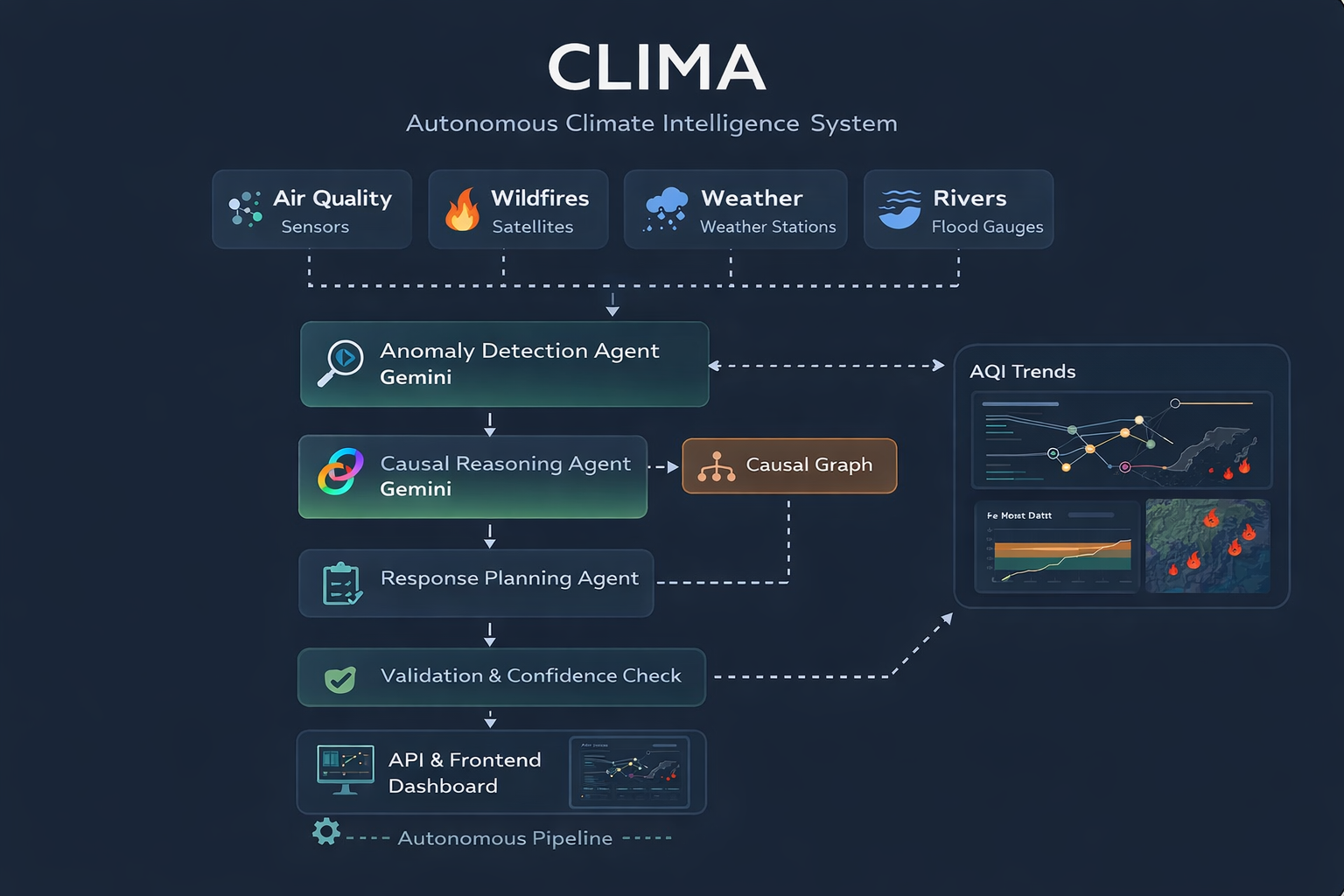
Project Story — CLIMA: Autonomous Climate Incident Intelligence
Inspiration
CLIMA was inspired by a simple observation: most climate platforms today are passive dashboards. They visualize air quality, weather, or floods, but they rarely explain why incidents happen or what actions should follow.
At the same time, climate events are becoming increasingly compound—wildfires worsen air quality, heatwaves amplify pollution, and flooding coexists with urban smog. These interconnected signals are hard to reason about manually.
I wanted to explore a different paradigm:
What if environmental systems could reason autonomously—detect anomalies, infer causes, and generate response plans without human prompting?
That question became CLIMA.
What I Built
CLIMA is an autonomous climate intelligence agent that continuously ingests environmental signals and transforms them into actionable insights.
Instead of acting like a chatbot or static dashboard, CLIMA operates as a closed-loop system:
$$ \text{Sensors} \rightarrow \text{Anomaly Detection} \rightarrow \text{Causal Reasoning (Gemini)} \rightarrow \text{Response Planning} \rightarrow \text{Validation} $$
The system processes four core data streams:
- Air Quality (PM2.5 / PM10)
- Wildfire hotspots
- Weather conditions
- River levels
When anomalies are detected, Gemini is used as a causal reasoning engine to:
- Infer root causes
- Construct causal chains
- Generate incident summaries
- Produce citizen advisories and mitigation steps
These are converted into structured outputs and visualized through a real-time dashboard featuring:
- Causal graphs
- AQI trend charts
- Geographic hotspots
- Response timelines
- Incident history
The goal was to move from monitoring to decision intelligence.
How I Built It
The project is organized as a modular multi-agent system:
anomaly_agent— detects multi-signal anomaliescausal_agent— performs Gemini-powered causal inferenceresponse_agent— generates response plansvalidation_agent— compares predictions with observed dataclimate_monitor— orchestrates the full pipelinescheduler— runs CLIMA autonomously
Gemini is used for reasoning, not just text generation. Its outputs are parsed into structured JSON and converted into causal graphs, enabling explainable decision paths rather than black-box answers.
The frontend is a lightweight operations dashboard that visualizes:
- Incident summaries
- Hierarchical causal graphs
- AQI trends
- Hotspot maps
- Response timelines
Everything runs locally with dummy datasets, simulating real-world environmental signals.
Challenges I Faced
1. Multi-signal reasoning vs single-metric triggers
Early versions were AQI-centric. I redesigned anomaly detection to support compound events, allowing CLIMA to reason over partial or missing signals instead of assuming all data sources exist.
2. Schema drift and real-world robustness
Environmental data rarely arrives in perfect formats. I had to make every agent tolerant to:
- Missing fields
- Empty arrays
- Mixed schemas
This pushed the design toward defensive, production-style agents rather than brittle prototypes.
3. Autonomous execution and rate limits
Because CLIMA runs continuously, I encountered LLM quota limits quickly. This led to implementing:
- Result caching
- Retry backoff
- Reduced polling frequency
It was a practical lesson in building budget-aware AI systems.
4. Turning LLM output into system behavior
Parsing Gemini’s responses into graphs and response plans was harder than expected. I learned how important it is to treat LLMs as probabilistic components inside deterministic pipelines—not as the system itself.
What I Learned
This project taught me that building agentic systems is less about prompts and more about architecture:
- Designing feedback loops
- Handling partial observations
- Normalizing data
- Validating model outputs
- Building explainable pipelines
Looking Forward
CLIMA is an early prototype, but the architecture can naturally extend to:
- Forecasting agents
- Risk scoring models
- Multi-city incident correlation
- Satellite imagery integration
The broader vision is to evolve CLIMA into a climate operations copilot—helping governments and communities respond faster and more intelligently to environmental crises.
Built With
- built-with-python
- chart.js
- fastapi
- google-gemini-api
- html/css/javascript
- leaflet.js
- vis.js


Log in or sign up for Devpost to join the conversation.