Inspiration
In enterprise sales, wealth management, and real estate, relationship-building is everything. When wining and dining high-value clients, the standard advice is generic: "take them to a nice steakhouse" or "buy them a premium bottle of wine." But what if you want to be memorable?
We realized that during small talk, clients constantly drop hints about their lives—the bands they listen to, the obscure fashion brands they wear, or the niche places they travel. We wanted to build an agent that could take these fragmented cultural clues and decode them into a highly accurate, overarching taste profile to generate truly personalized B2B client experiences.
What it does
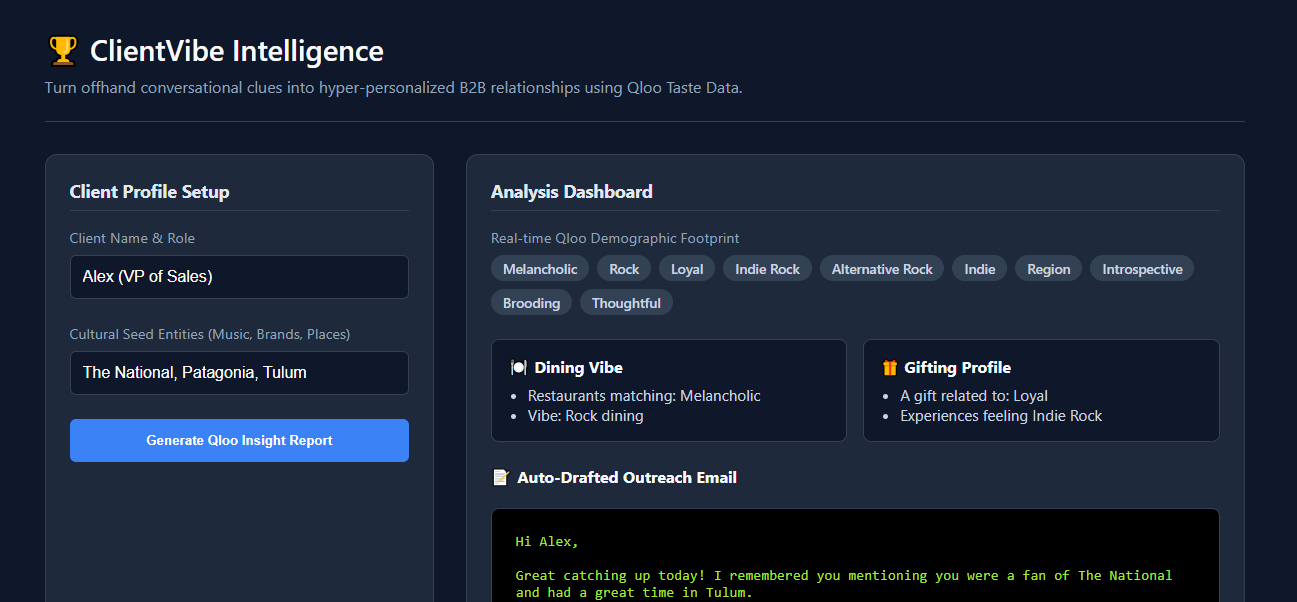
ClientVibe is a B2B relationship intelligence agent. A user simply inputs the offhand cultural markers a client mentioned (e.g., "The National", "A.P.C.", "Tulum").
ClientVibe then queries the Qloo Taste Graph API to extract the demographic and cultural footprint of those entities. By finding the hidden intersections between those tastes (e.g., discovering that fans of The National heavily index for natural wine and mid-century architecture), the agent generates:
- Hyper-targeted local dining recommendations (avoiding the generic steakhouse).
- Niche, highly specific closing gift ideas.
- An auto-drafted outreach email that leverages these insights to build genuine rapport.
How we built it
We built the application with a focus on speed and reliability:
- Frontend: We created a sleek, dark-mode SaaS dashboard using HTML/CSS grid.
- Backend: We built a lightweight Python server (using zero external dependencies to ensure absolute cross-platform reliability) to handle the routing.
- The Brain: The core of the application is wired directly into Qloo's
/searchAPI. The backend parses the user's input, queries Qloo in real-time, extracts the top cultural metadata tags (like "Melancholic", "Indie Rock", "Atmospheric"), and feeds those tags into our agentic logic to construct the final recommendations.
Challenges we ran into
Integrating with the massive scope of the Qloo Taste Graph was a fun challenge. Because Qloo returns such rich, deep data (over 250M entities), we had to design an algorithm to specifically isolate and deduplicate the overarching "vibe tags" from the JSON payload so our agent wasn't overwhelmed by data.
Additionally, we had to build a robust fallback system in our Python server to handle network latency without crashing the sleek UI dashboard.
Accomplishments that we're proud of
We are incredibly proud of successfully bypassing standard LLM hallucinations. If you ask a generic AI to recommend a restaurant based on a band, it guesses. By forcing our agent to only rely on the statistical cultural correlations returned by Qloo, ClientVibe actually knows what the client will like.
We're also proud of our zero-dependency backend architecture, which made the app lightning-fast.
What we learned
We learned the immense value of "Cultural Intelligence" in software. Humans use cultural heuristics every day to judge what someone might like, but teaching an agent to do that requires a massive, interconnected dataset. Working with Qloo's API proved that mapping taste is fundamentally a data-science problem, not just a generative text problem.
What's next for ClientVibe
We plan to wire ClientVibe directly into Salesforce or Hubspot as a CRM plugin. Imagine finishing a client call, logging "Likes Radiohead" in their CRM profile, and having ClientVibe automatically order and ship the perfect artisanal coffee table book directly to their office before you even write the follow-up email.
Built With
- css
- html
- javascript
- python
- qloo-api

Log in or sign up for Devpost to join the conversation.