
Inspiration
Hiring managers can get hundreds of applications for one role, and most of them get a few seconds of attention in a crowded applicant tracking system. We wanted something more intuitive. Many AI tools now give a percentage match between a resume and a job description, but we didn’t want the AI to make the decision. Clicked keeps the human in charge. Built around the hackathon’s 2016 theme, it turns applications into a deck of cards the hiring manager swipes through: the AI suggests, and the person decides to pass or accept each applicant.
What it does
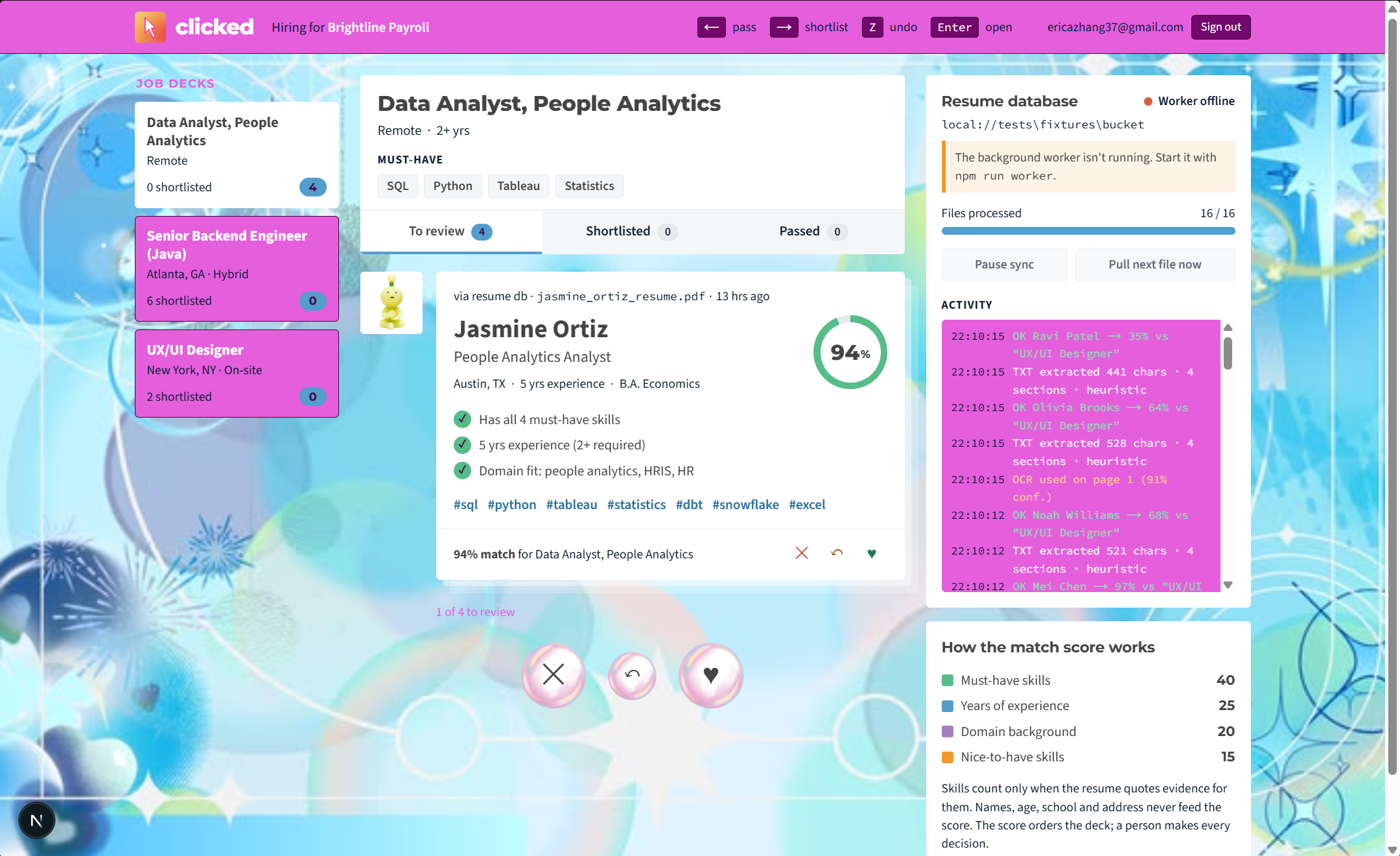
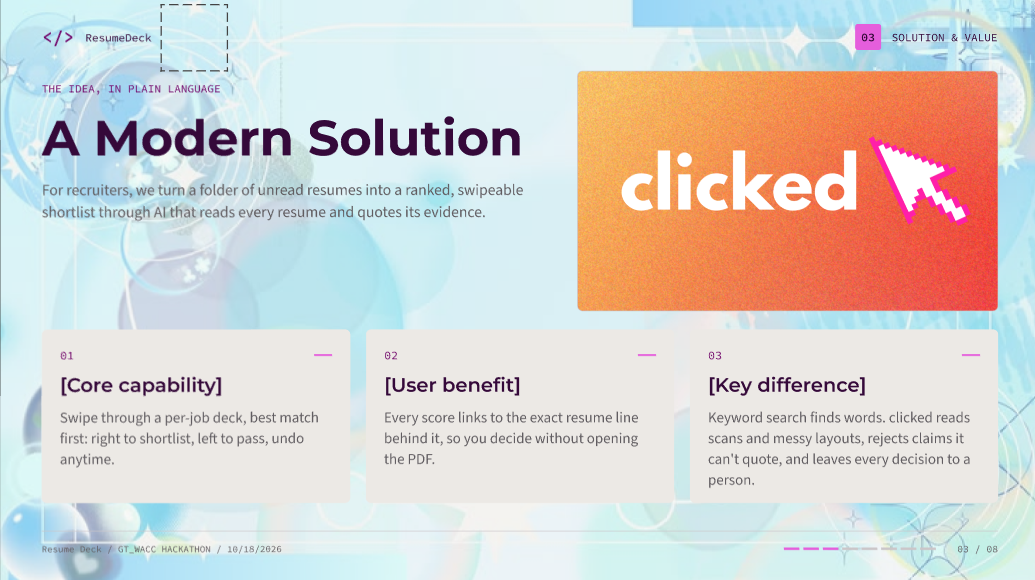
Clicked turns a company’s pile of resumes into a deck of cards for each open job.
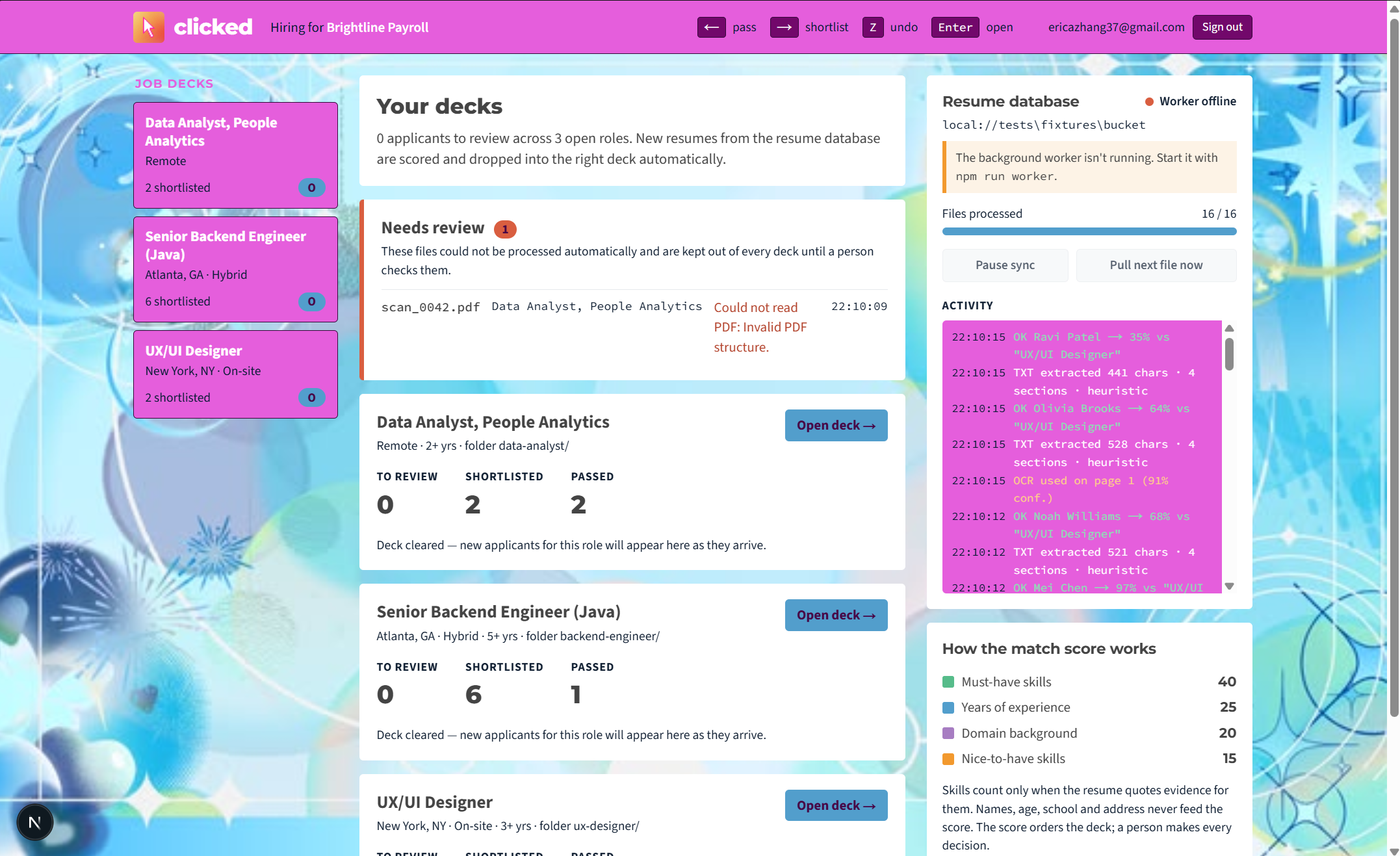
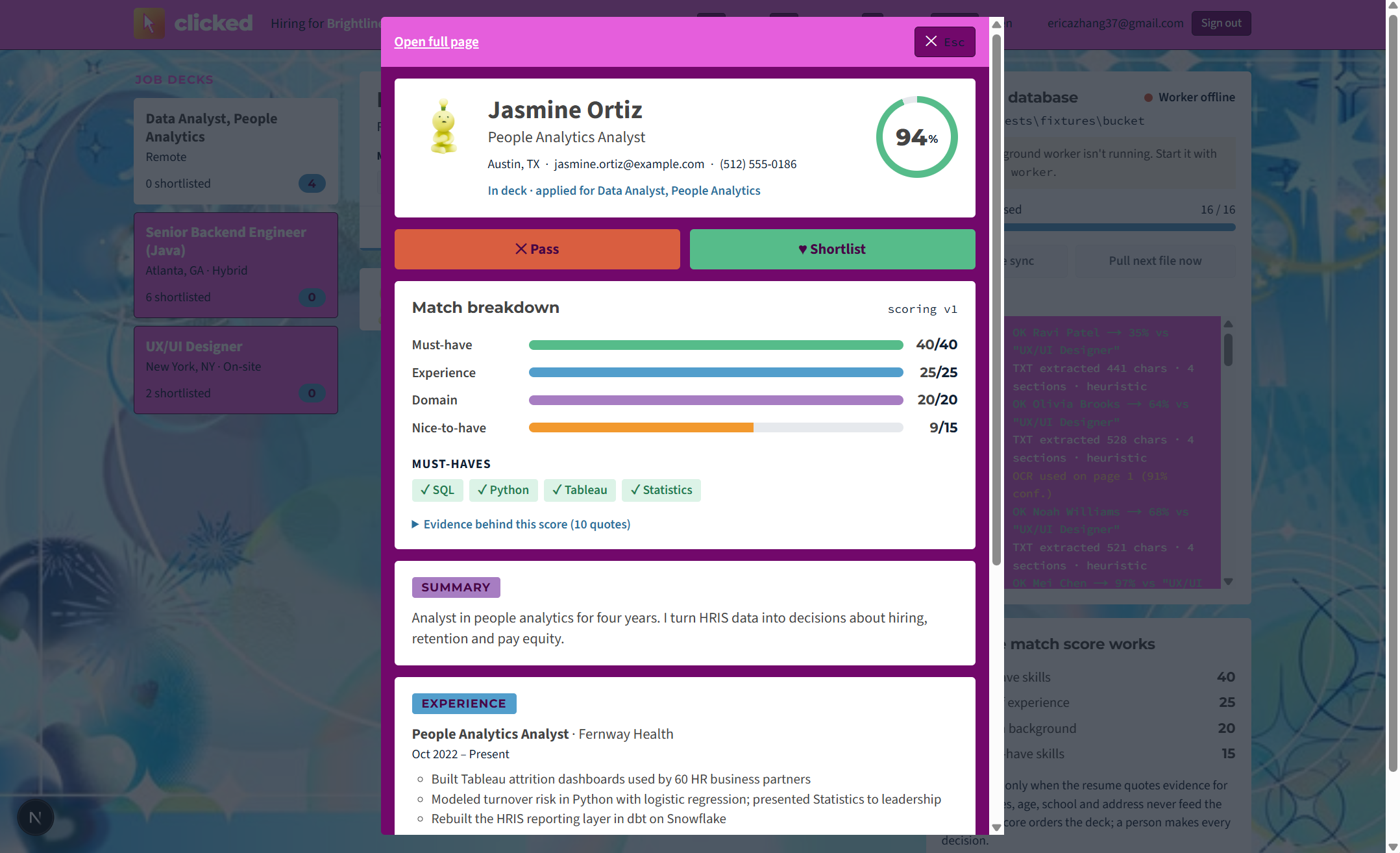
Automatic intake: Candidates apply through the company’s usual process, and their resumes go into the company’s resume database. Clicked checks that database every few minutes and pulls in new resumes on its own, so nobody has to upload anything. Resume to card: Each PDF is turned into text and reorganized into clear sections (summary, experience, skills, education). The recruiter sees a clean, 2016-style card with the applicant’s name, current role, location, years of experience, and match percentage. Match score from 0 to 100: Each resume is scored against the job description it was submitted for, with three short reasons showing what matched and what’s missing. One deck per job: Every open role has its own deck, with the strongest matches first. Swipe to decide: Swipe right to accept, left to pass, or use the buttons or arrow keys. Click a card to see the full resume and a breakdown of the score. Undo: A back button brings back the last card if the recruiter makes a mistake. Human final say: Nobody is rejected automatically. A low score only moves a card further down the deck, and a person makes every decision.
How we built it
We used Supabase to store each client company’s resumes, with a folder for every job and the resumes saved as PDF files inside. Our application checks this database every few minutes for new files. Each PDF is turned into text, and a model running locally through Ollama reformats that text into the structured sections that make up each card in the recruiter’s deck.
Every resume is then scored with a simple formula. A resume can earn up to 100 points across four buckets:
Must-have skills (40): the share of the job’s must-have skills that are backed by an evidence line in the resume Experience (25): total years of experience (with overlapping jobs counted once) divided by the required years, capped at full credit Industry (20): two matching industry words anywhere in the resume earn full credit Nice-to-haves (15): the share of nice-to-have skills backed by an evidence line
We calculate the score in code instead of asking the AI for a number. That way the same resume always gets the same score, and every point can be traced back to a line in the resume.
Challenges we ran into
Handling keys in Supabase and protecting applicant privacy were the biggest challenges. Resumes contain personal information, so we had to think carefully about which keys stay on the server, who can access each company’s files, and how to keep one company’s applicants separate from another’s.
Accomplishments that we're proud of
Finding alternatives when something didn’t work, like switching from Anthropic’s API to Ollama. Running the model locally meant no API costs, and resumes never had to be sent to an outside AI service. Building a scoring formula that’s transparent. Recruiters can see exactly why a candidate got their score instead of trusting a black box. Making the hiring manager’s work faster without taking the decision away from them. Creating a full workflow, from a resume landing in the database to a decision on a card, that runs without anyone uploading files by hand.
What we learned
We learned that many factors go into building a website. There are separate layers for what users see and what developers work with, and they all have to connect: the swipe interface, the API, the database, file storage, and the AI model. A small change in one layer, like how a resume is structured, affects everything after it. We also learned that a hiring tool has to be designed for privacy and fairness from the start, not added at the end.
What's next for Clicked
Connect to real applicant tracking systems such as ADP Workforce Now so resumes come in the moment a candidate applies. Offer guidance: after a recruiter accepts a candidate, show a suggested salary range for different locations based on public wage data. Blind review mode: hide names and contact details until a decision is made, to reduce bias. Better parsing for scanned resumes and unusual layouts, and flagging any file that can’t be read cleanly so a person can check it. Team features: let several people on a hiring team review the same deck and share notes.
