-
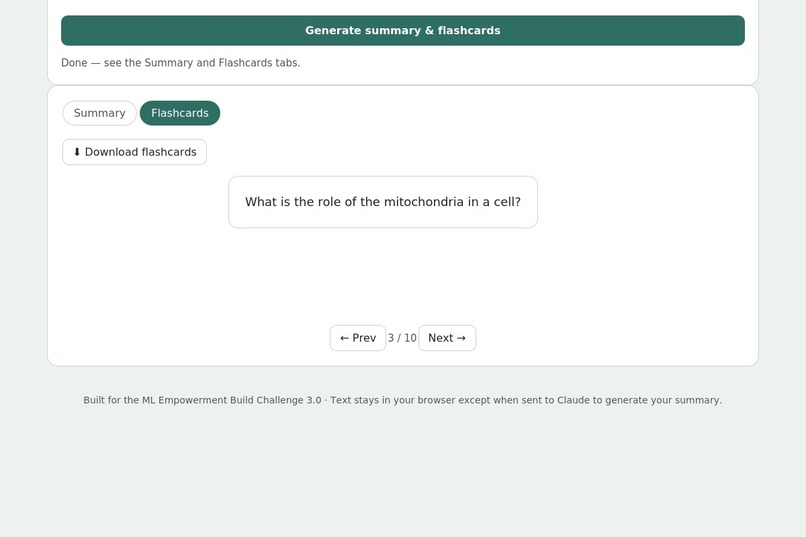
Clearway 3 flashcards
-
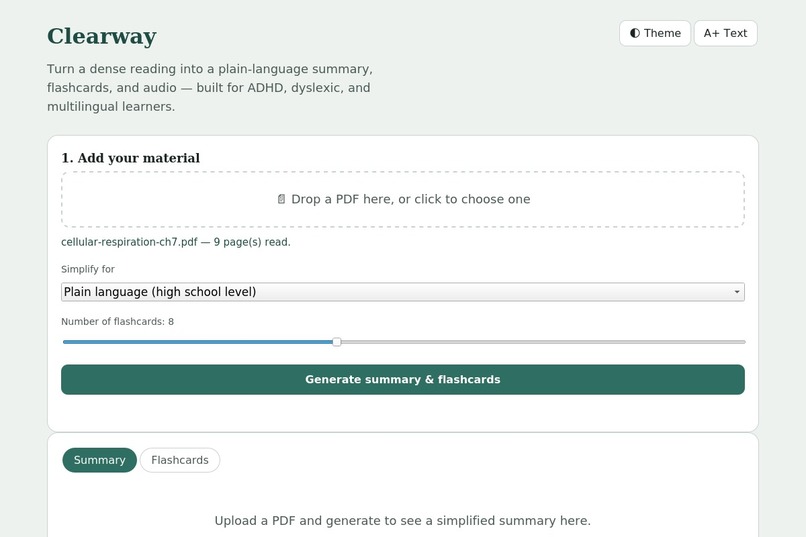
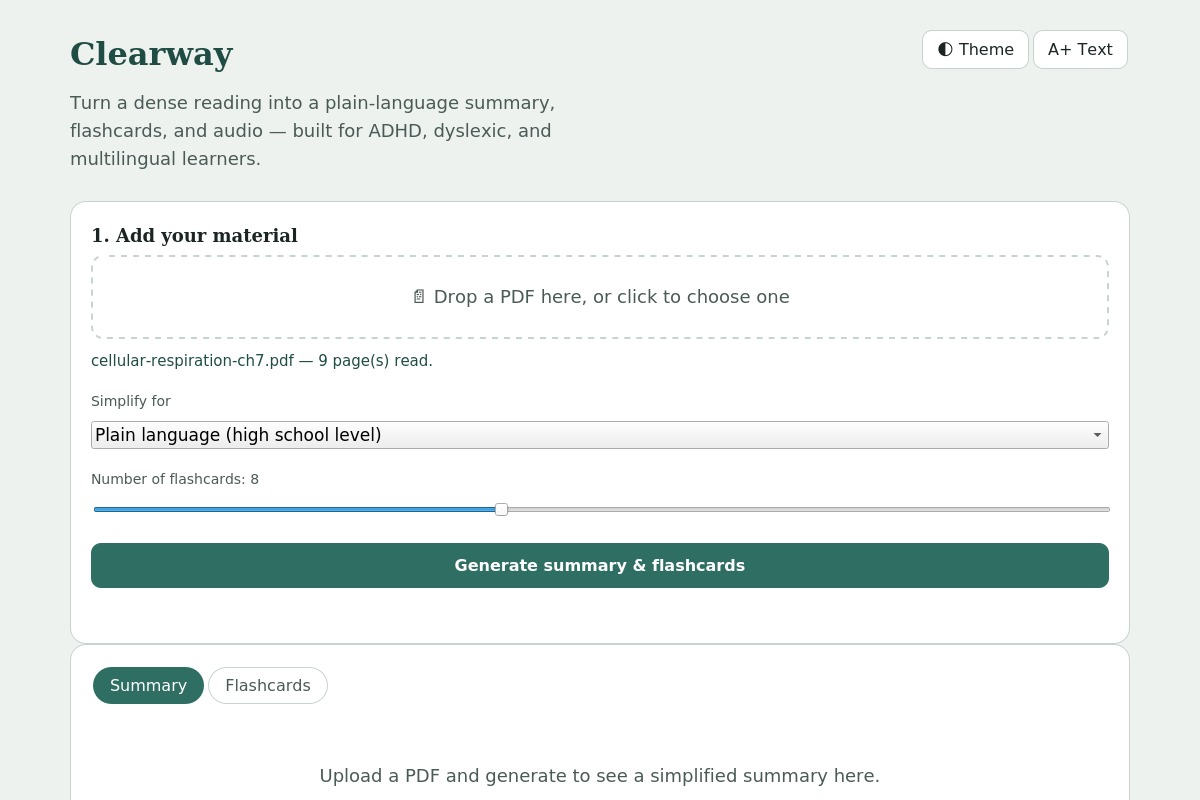
Clearway 1 upload
-
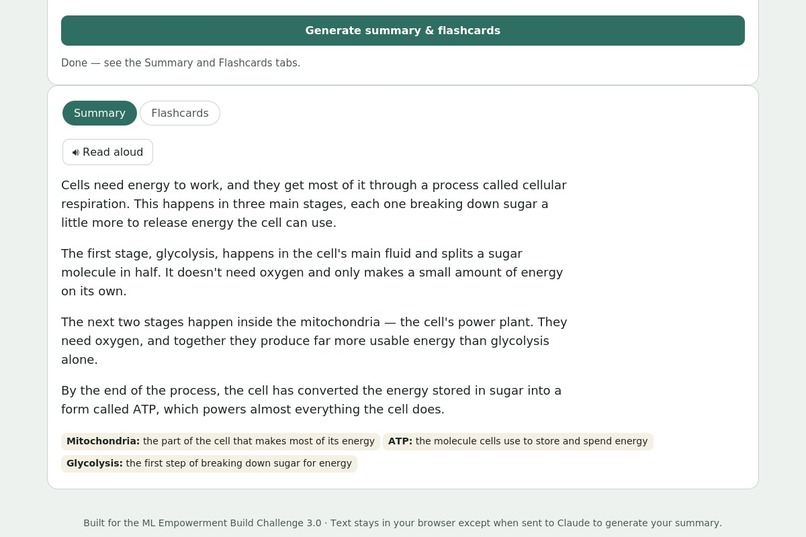
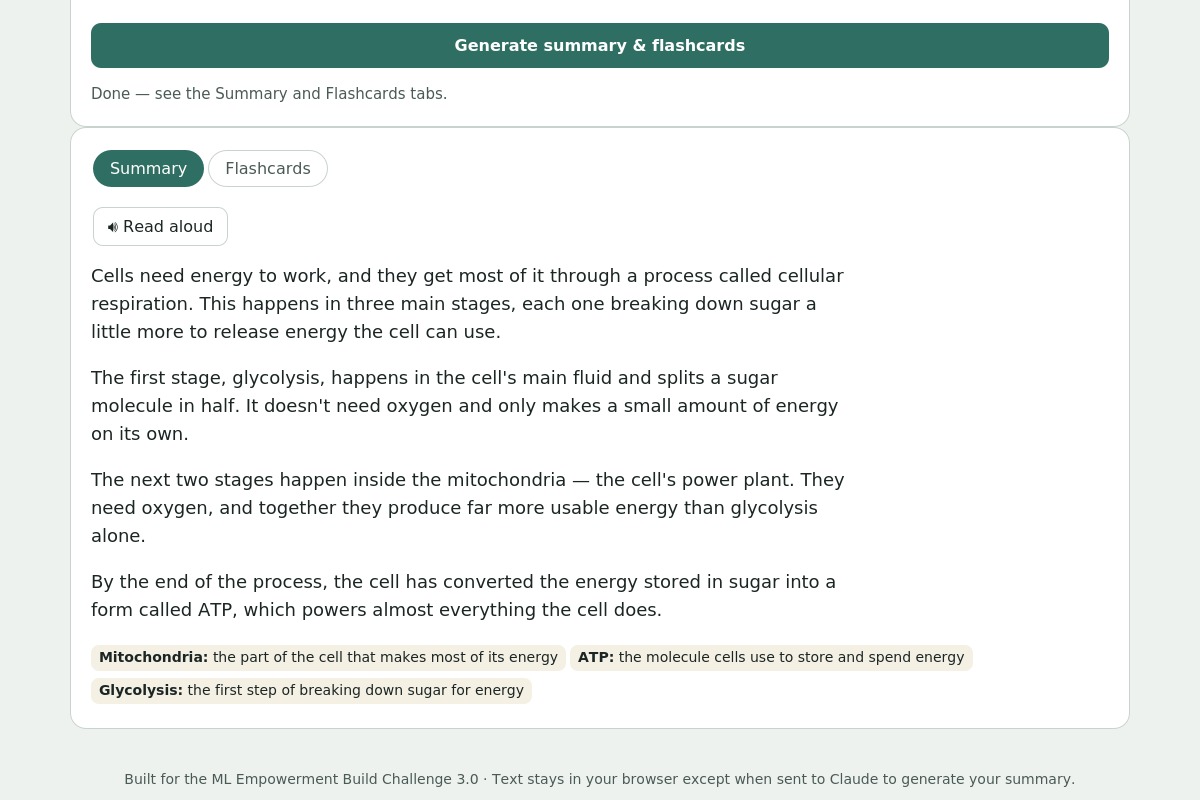
Clearway 2 summary
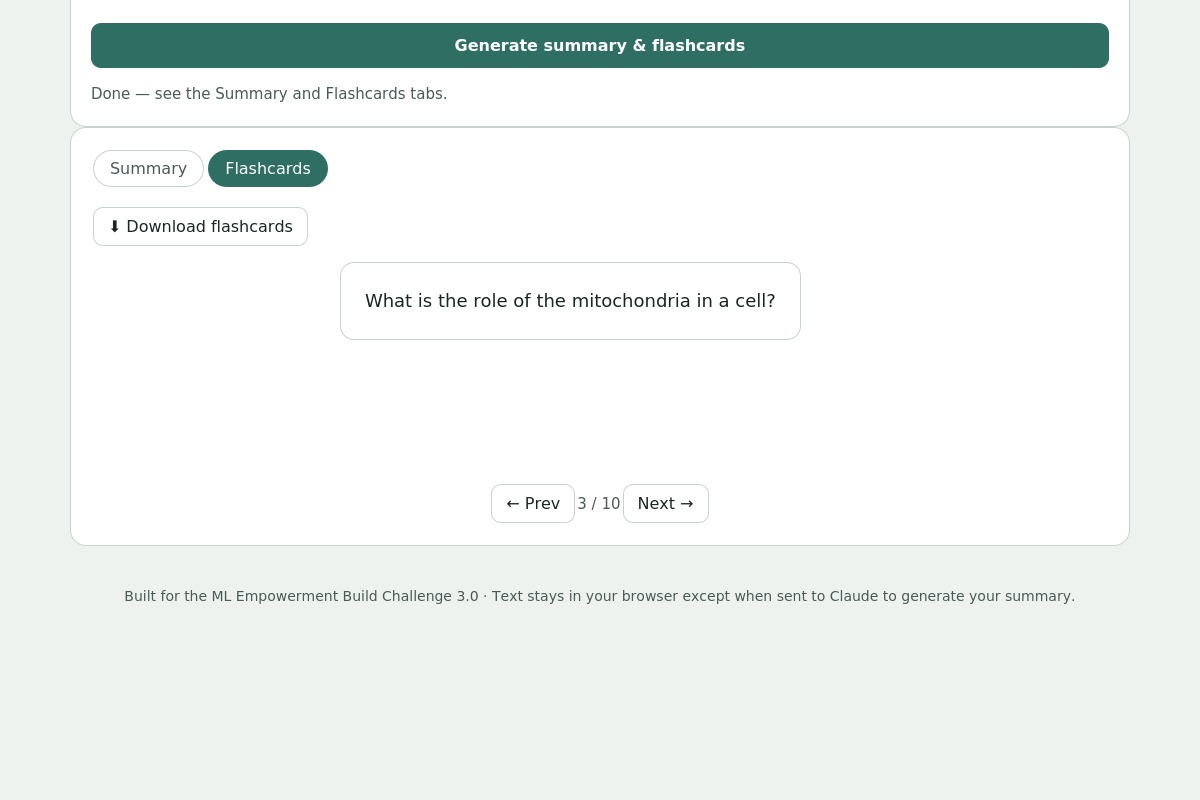
Inspiration
(Add your own story here — e.g. a class, a friend, or your own experience with dense reading material. A one- or two-sentence personal note goes a long way with judges.)
More broadly: dense textbook chapters and lecture PDFs are hard to study from if you have ADHD, are dyslexic, or are learning in a second language. Most study tools just format the same wall of text differently — they don't actually make the language easier to process. We wanted something that does the simplifying for you.
What it does
Clearway takes a PDF (a textbook chapter, lecture notes, slides) and turns it into:
- A plain-language summary, rewritten at a reading level you choose (very simple, high-school plain language, or ESL-friendly)
- A set of flashcards covering the key ideas, generated automatically from the text
- A glossary of key terms with one-line definitions
- Read-aloud audio of the summary, for auditory learners or anyone who focuses better listening than reading
- Accessibility features throughout: a dyslexia-friendly typeface (Atkinson Hyperlegible), adjustable text size, and a dark mode
Everything runs from a single page — upload a PDF, pick a reading level, and generate.
How we built it
- PDF parsing: PDF.js extracts text from the uploaded file entirely in the browser — the file itself never leaves the device.
- Simplification & flashcard generation: the extracted text is sent to Claude (Anthropic's AI model) with a prompt that asks for a plain-language summary, flashcards, and a glossary, returned as structured JSON.
- Audio: the browser's built-in Web Speech API reads the summary aloud, with no extra service or cost.
- Accessibility-first design: Atkinson Hyperlegible (a typeface designed for low vision and dyslexic readers), generous spacing, adjustable font size, dark mode, and full keyboard navigation.
- Hosting: built and deployed as a Claude Artifact, so it's live and shareable with no separate backend to stand up.
Challenges we ran into
- Getting the AI to simplify rather than just shorten the source material — the prompt needed to explicitly ask for plain vocabulary and short sentences at a specific reading level, not just a shorter summary.
- Making sure the tool stays accurate: the prompt instructs the model not to invent facts that aren't in the source material.
- Balancing a feature-rich tool (PDF parsing, AI generation, flashcards, audio) against keeping the interface simple enough for someone already struggling to focus on dense material.
What we learned
(Add a line or two here — e.g. what you learned about prompting AI models for accessibility use cases, or about designing for neurodivergent users.)
What's next for Clearway
- Testing against scanned/image-based PDFs (which need OCR rather than direct text extraction)
- Highlighting key terms directly in the summary text
- Letting users export flashcards in formats compatible with tools like Anki
Built With
- accessibility
- anthropic
- claude-api
- claude-artifacts
- css
- html5
- javascript
- pdf-js
- web-speech-api

Log in or sign up for Devpost to join the conversation.