-
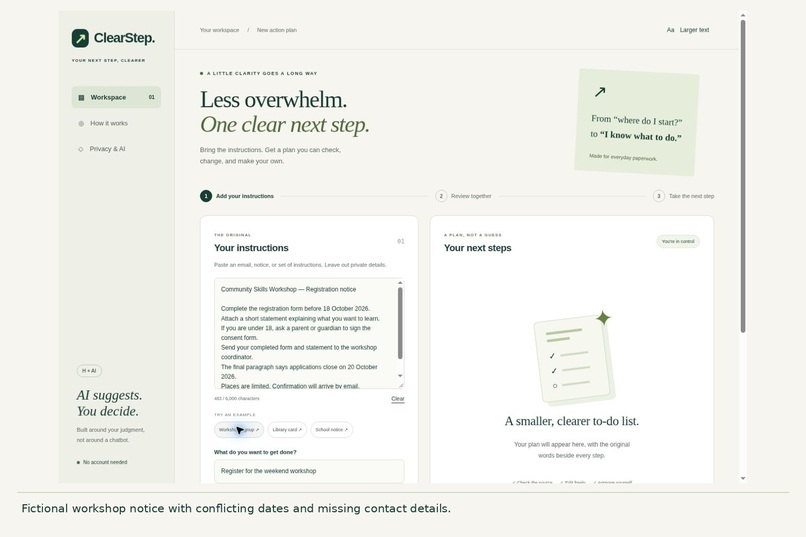
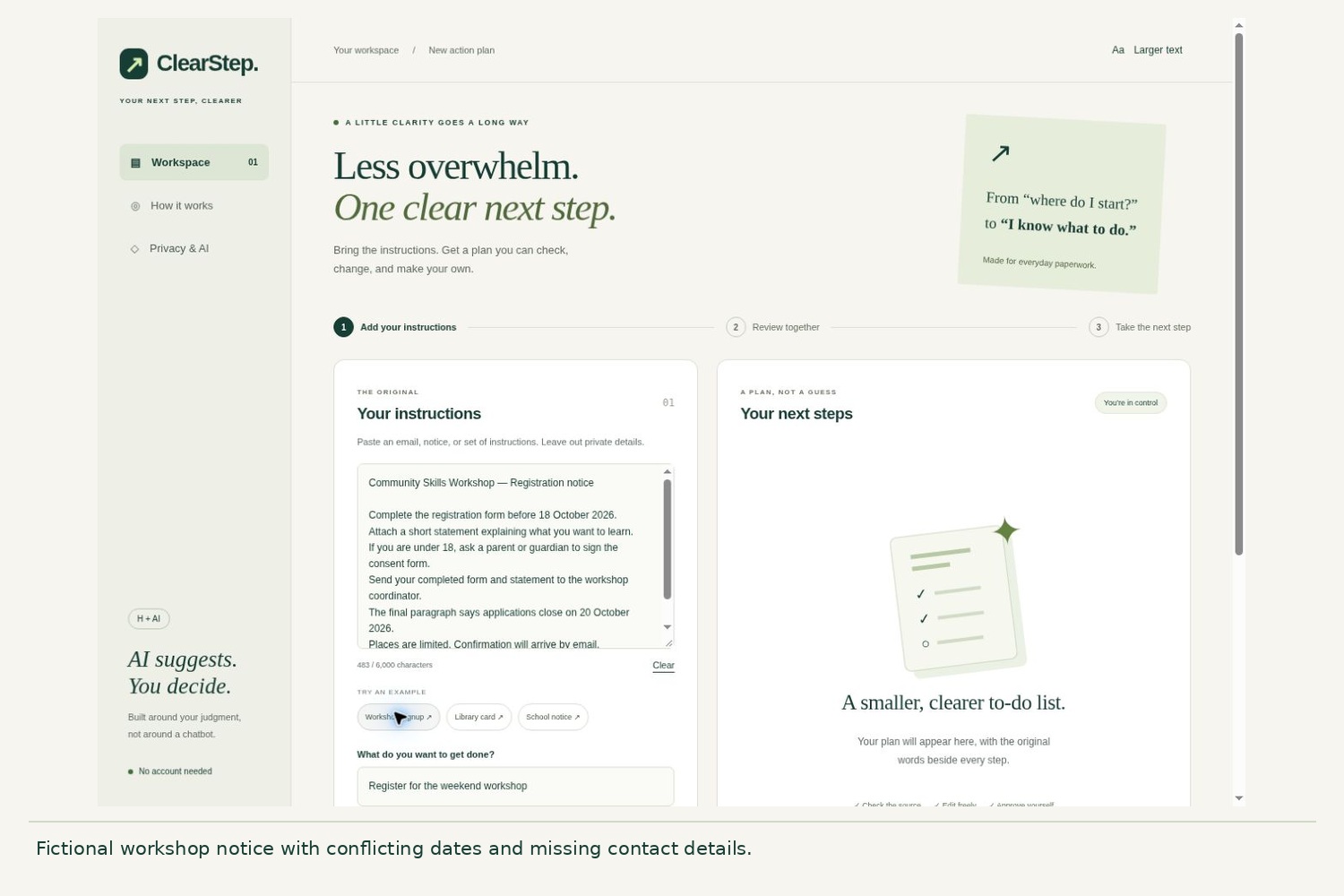
Fictional workshop notice with conflicting dates and missing contact details.
-
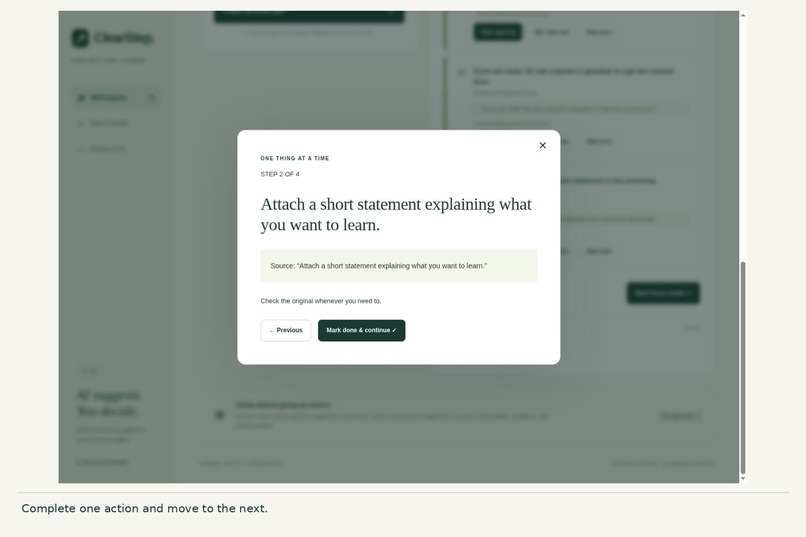
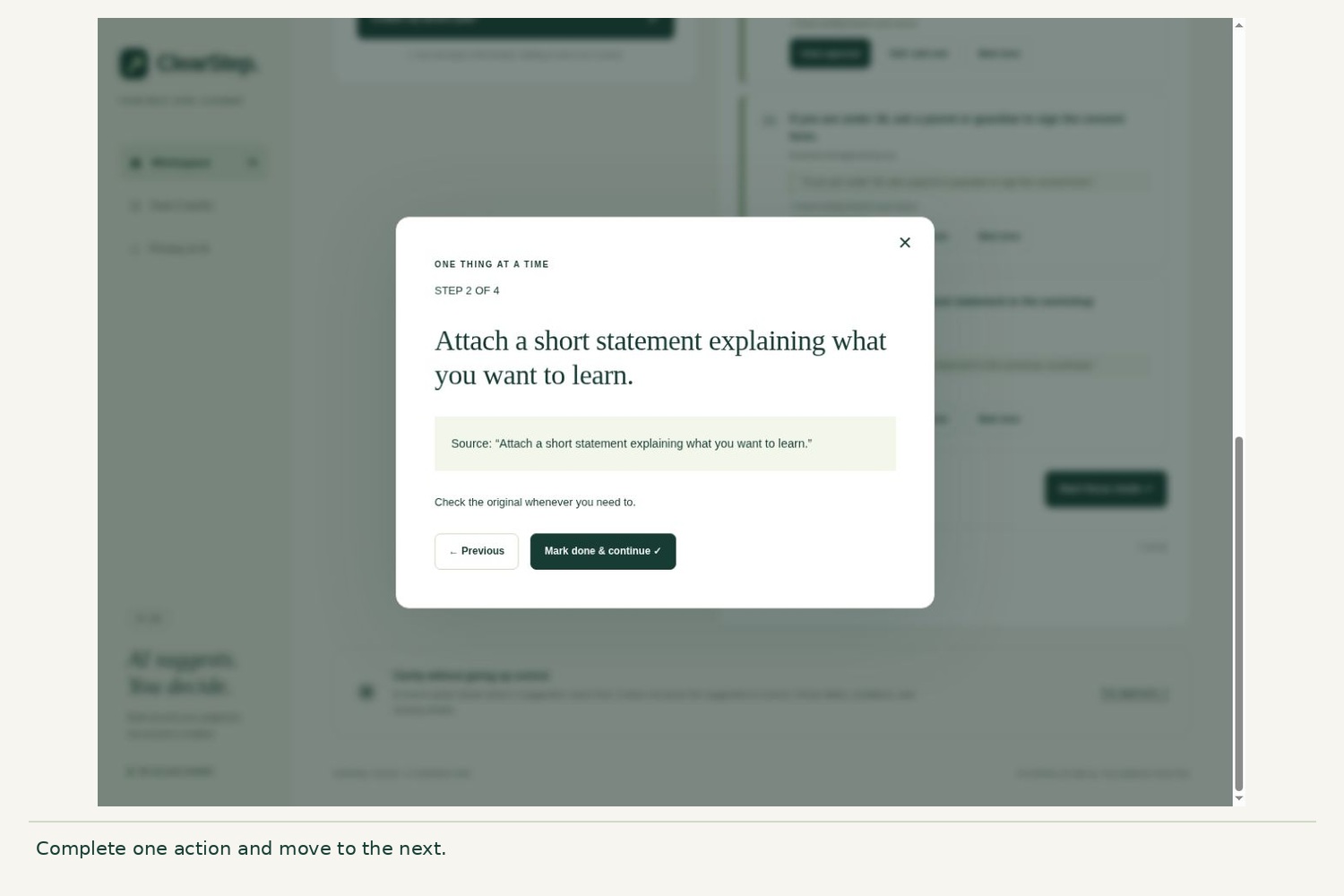
Complete one action and move to the next.
-
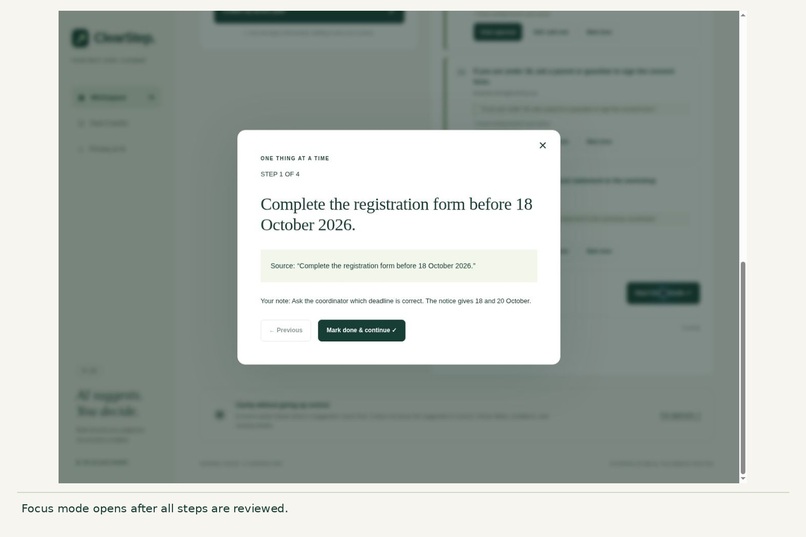
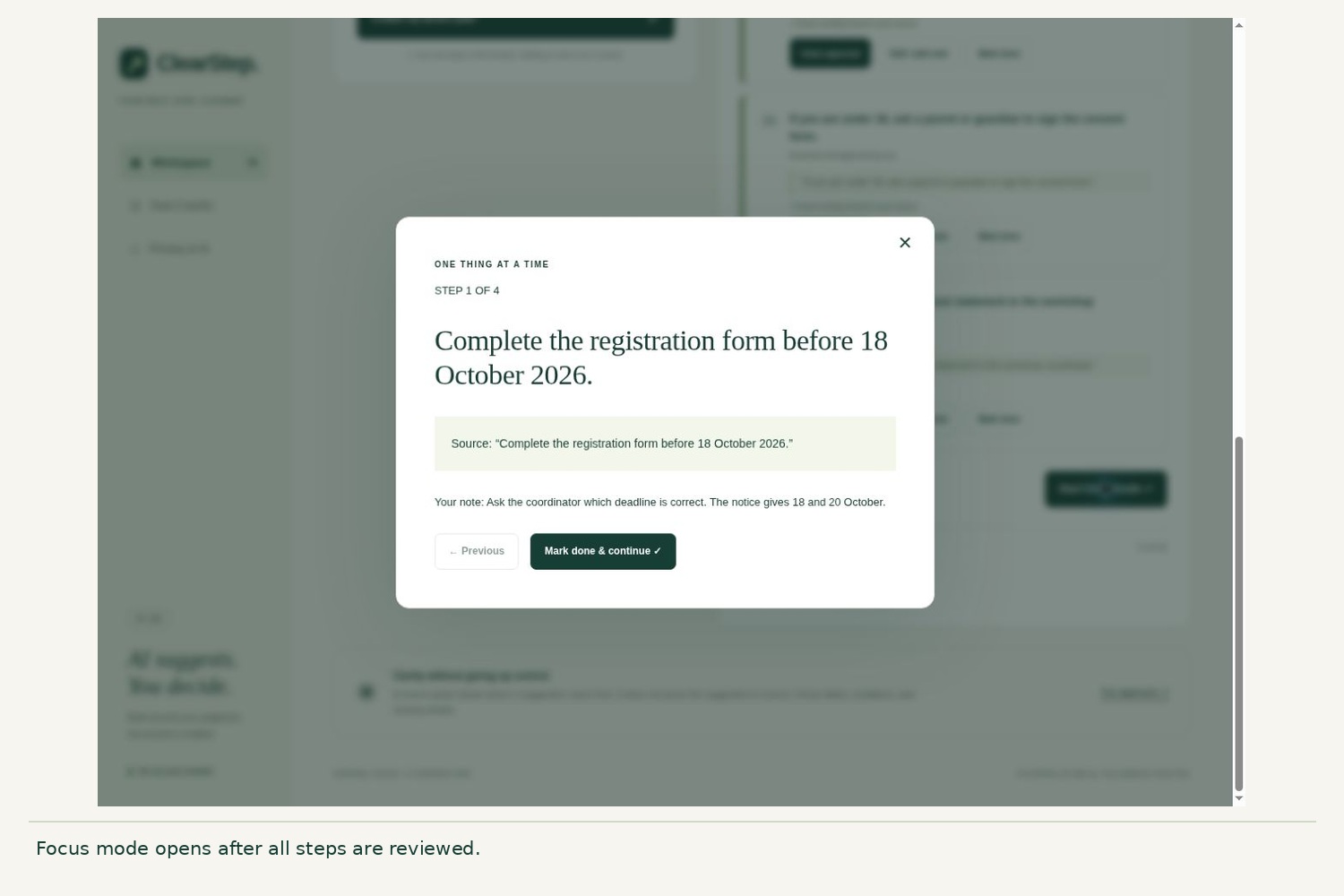
Focus mode opens after all steps are reviewed.
-
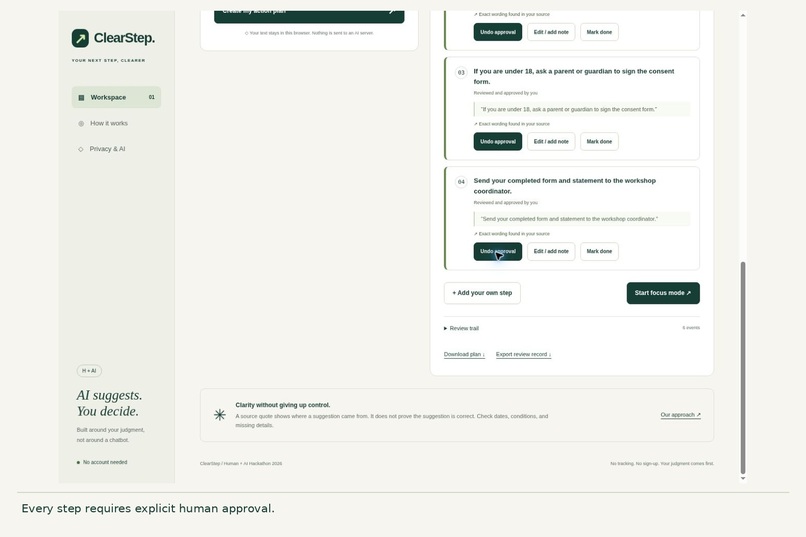
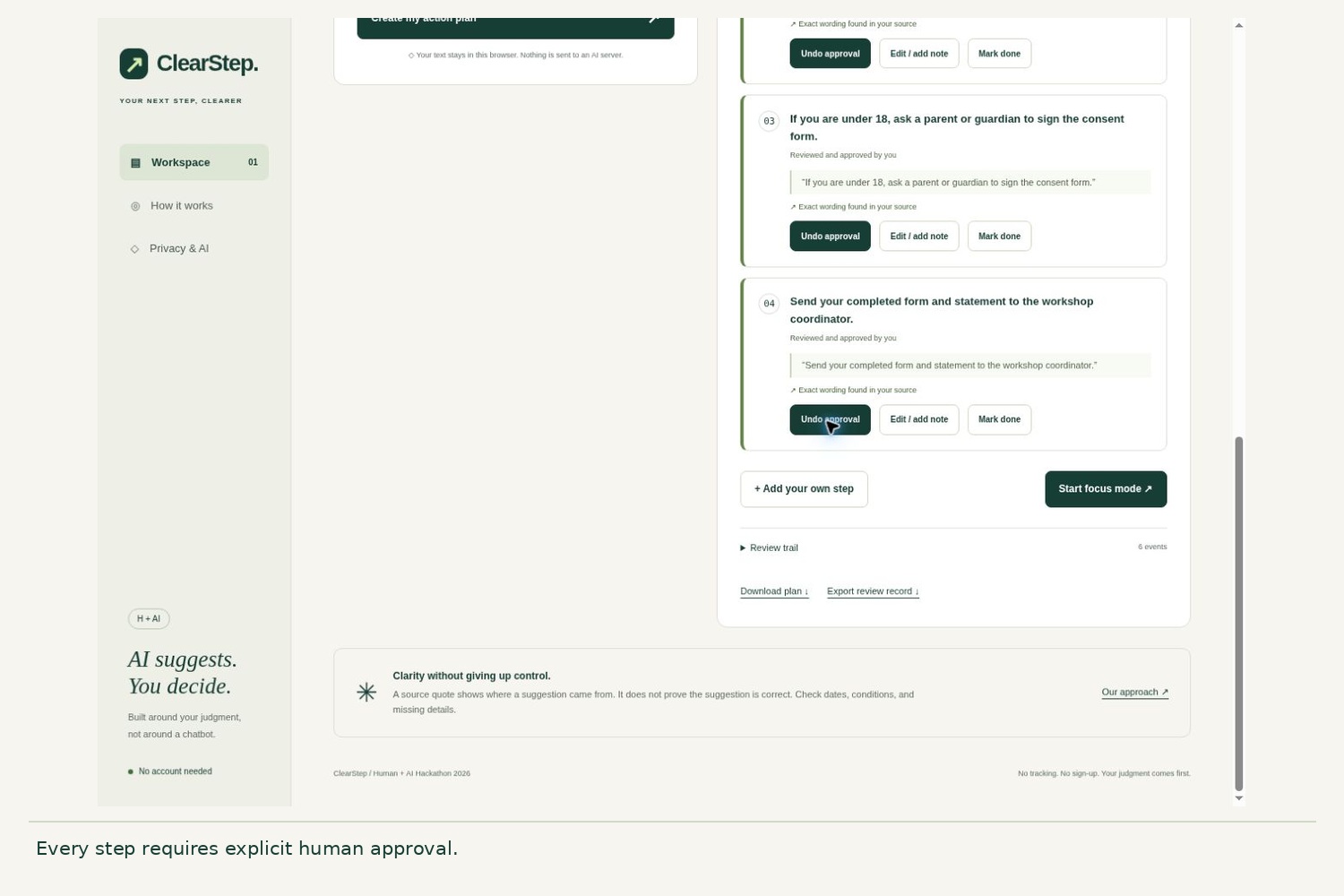
Every step requires explicit human approval.
-
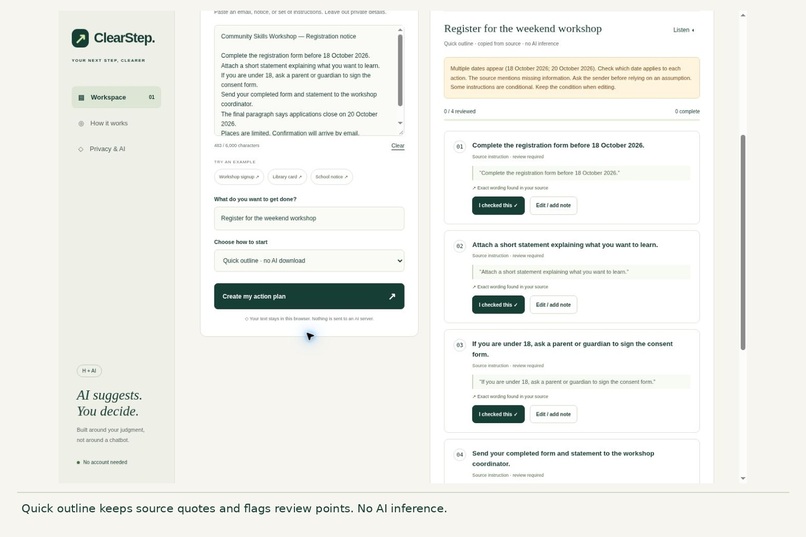
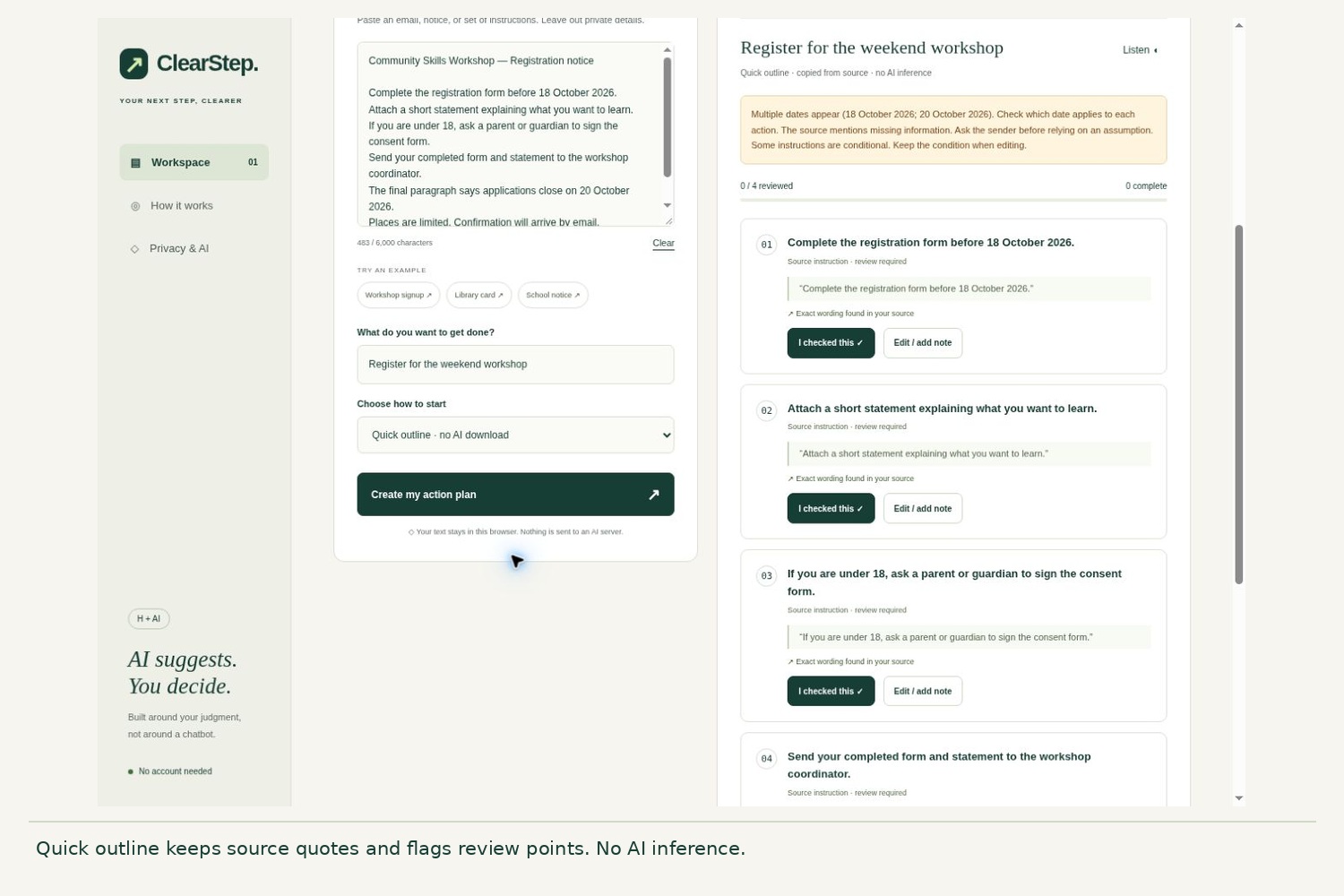
Quick outline keeps source quotes and flags review points. No AI inference.
-
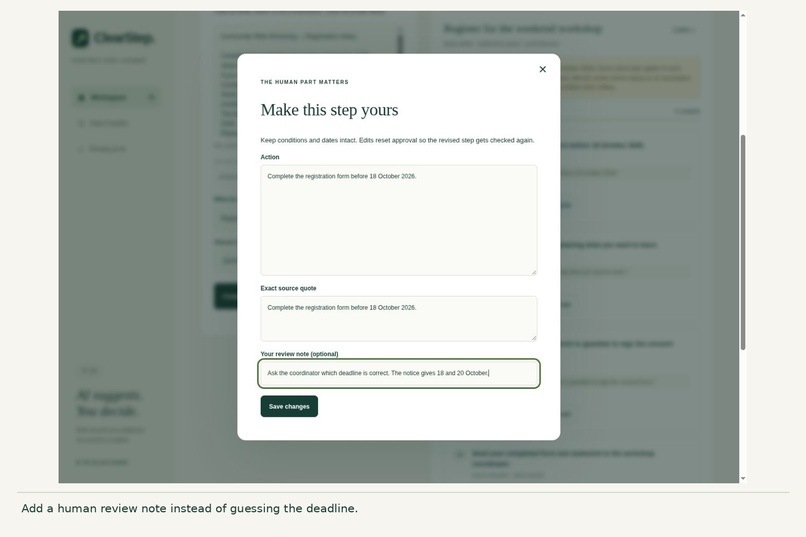
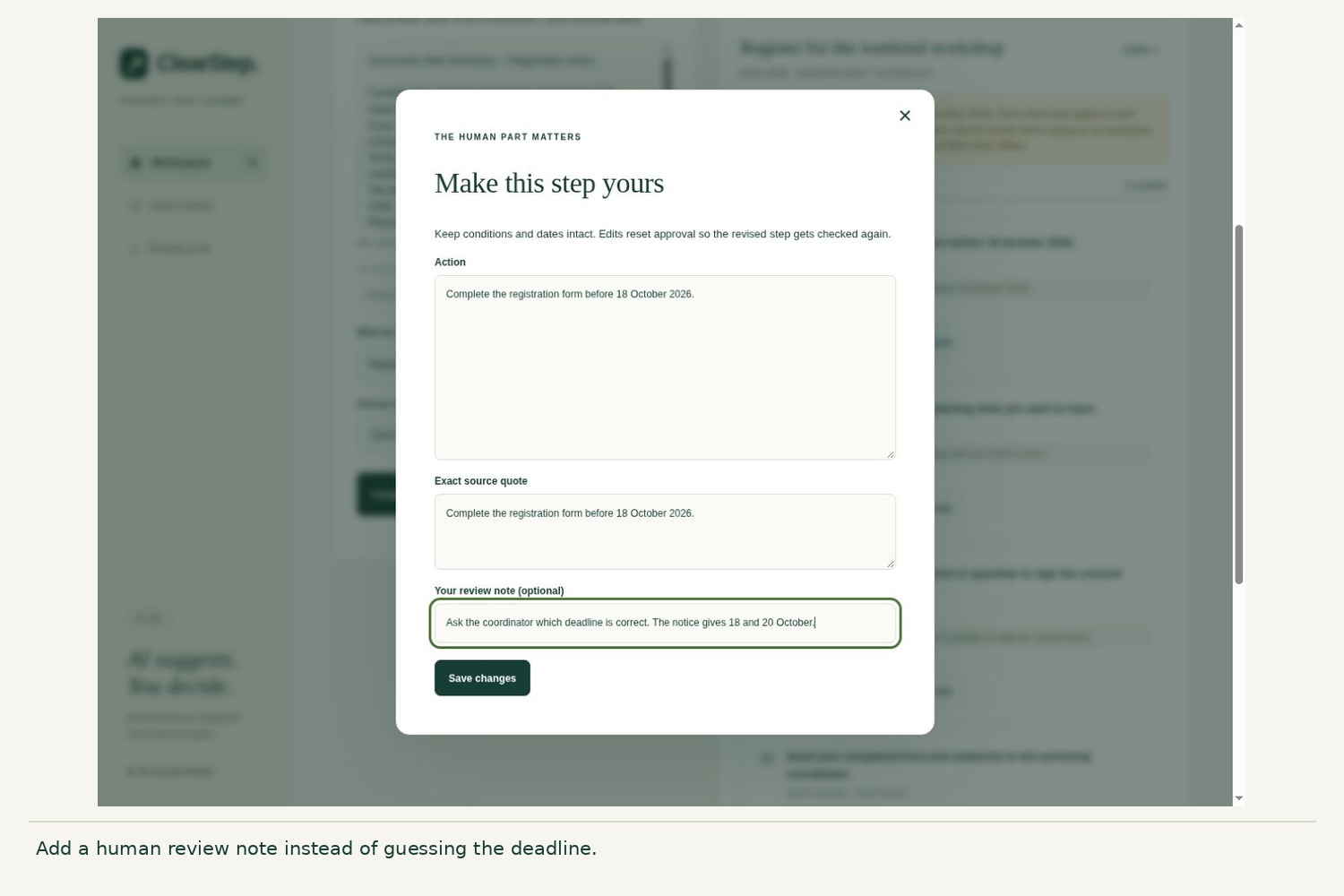
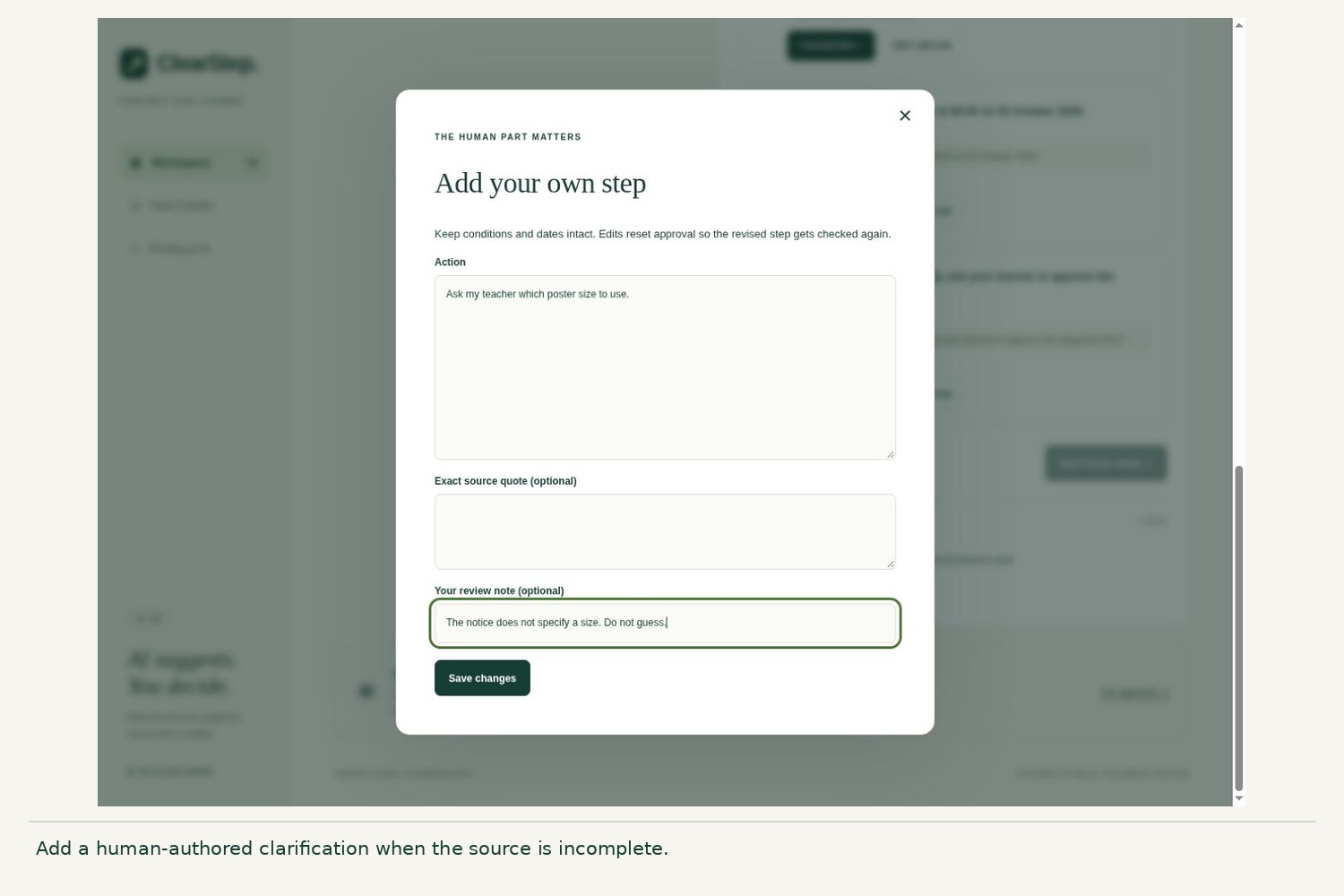
Add a human review note instead of guessing the deadline.
-
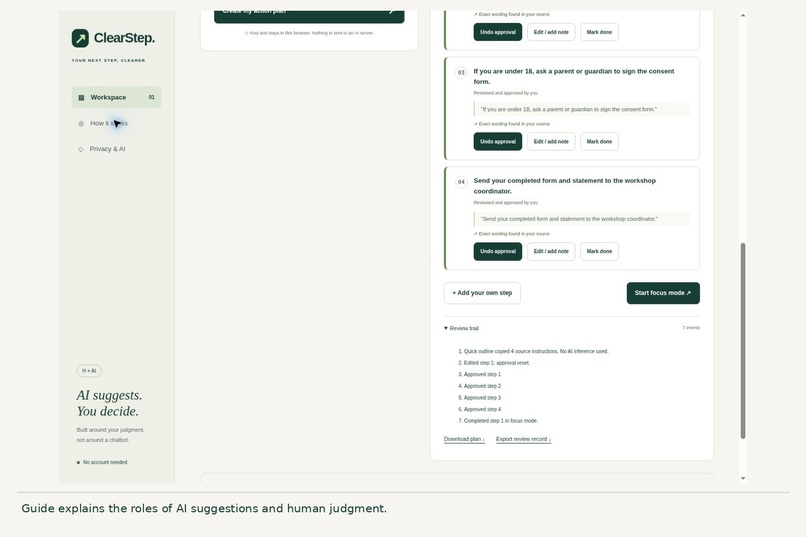
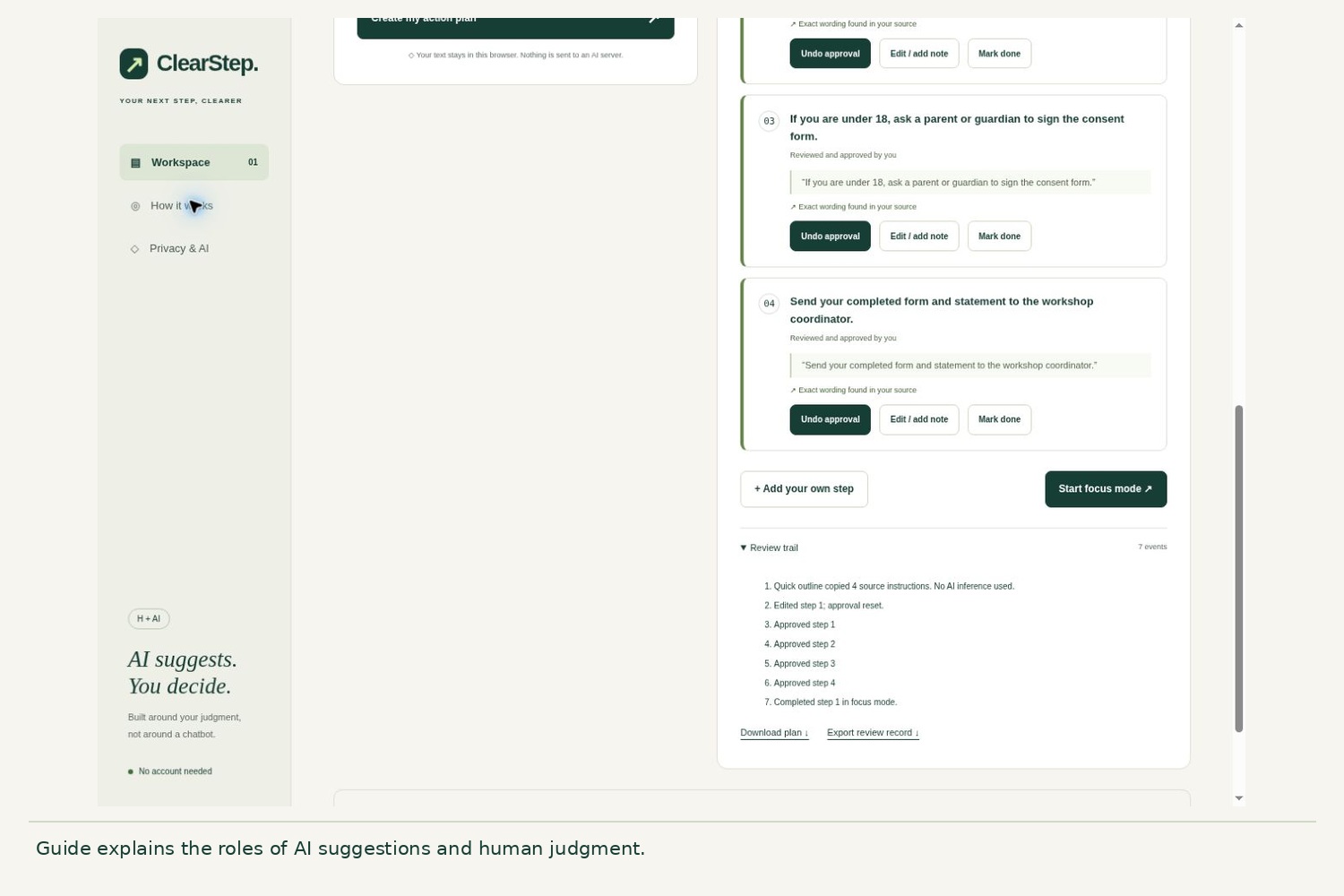
Guide explains the roles of AI suggestions and human judgment.
-
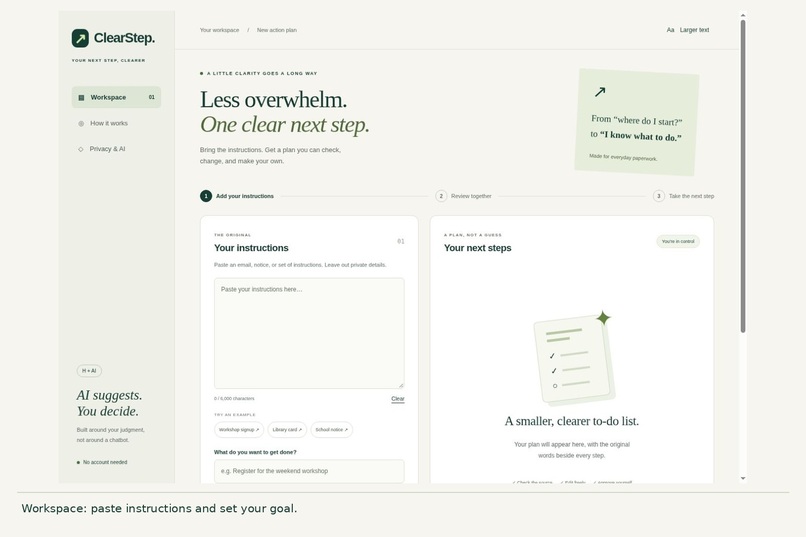
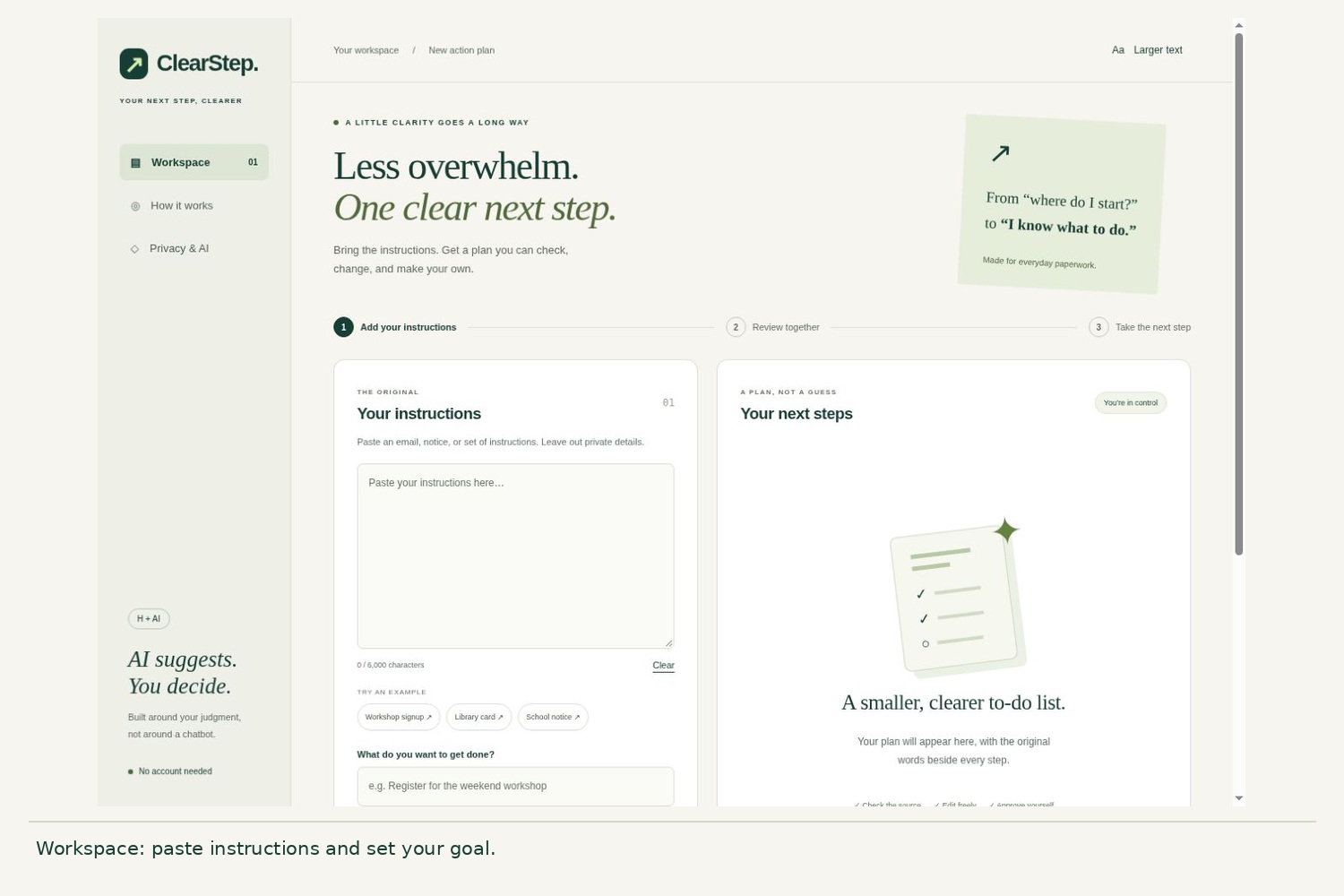
Workspace: paste instructions and set your goal.
-
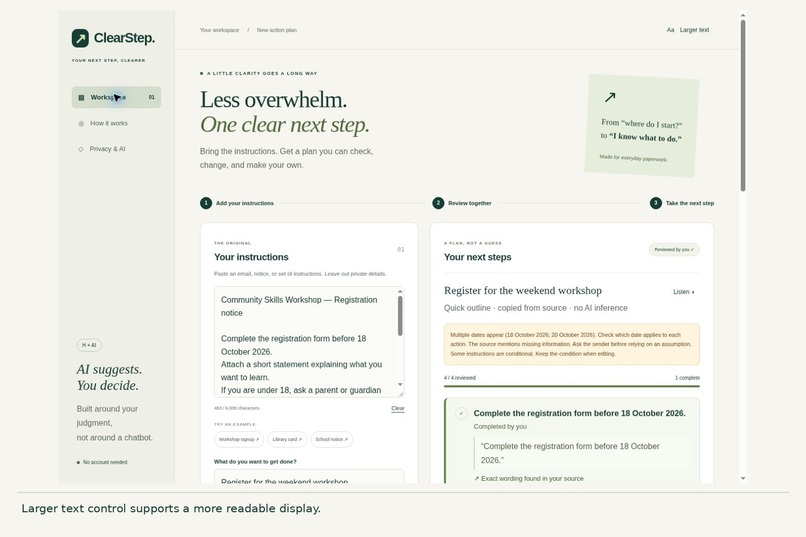
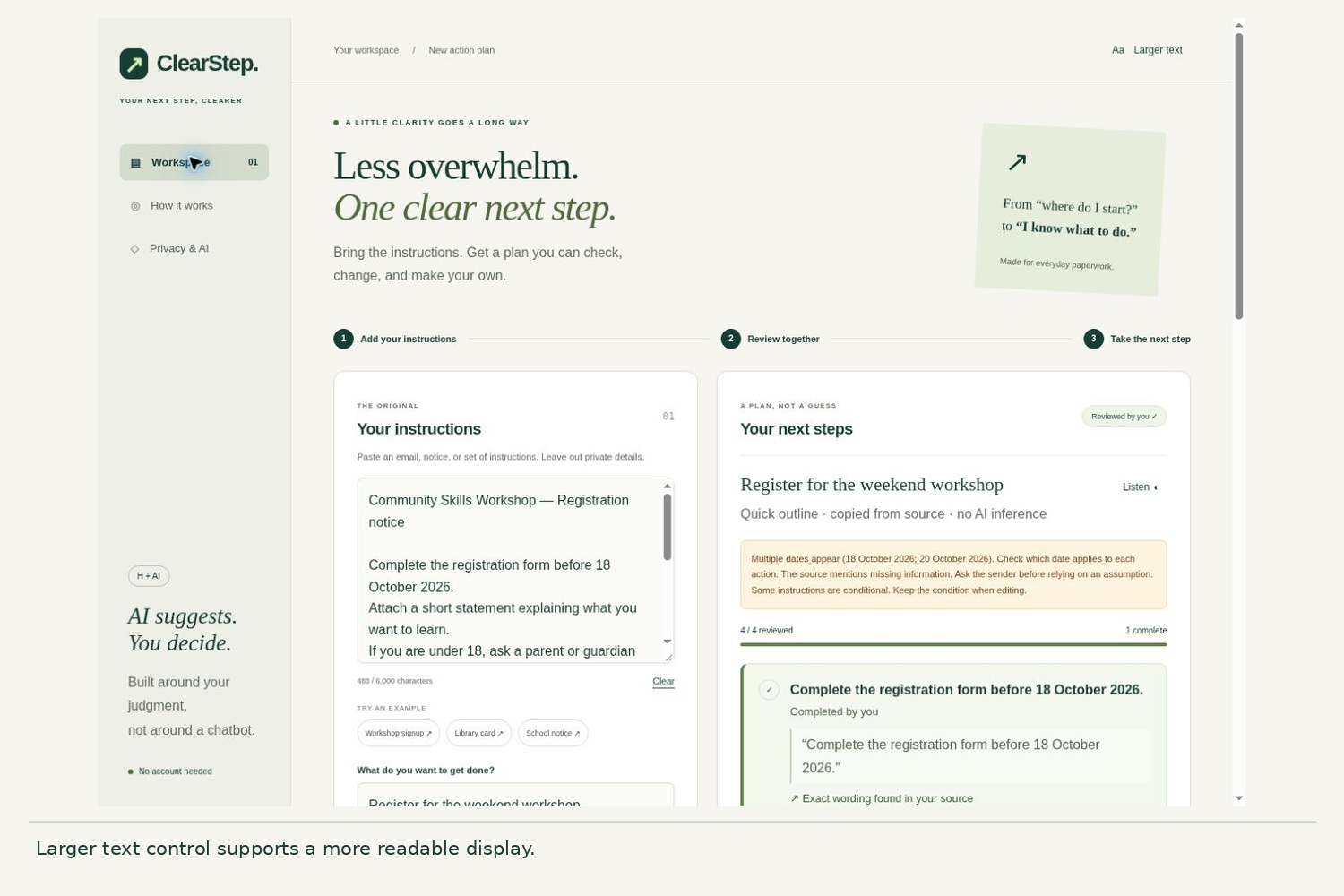
Larger text control supports a more readable display.
-
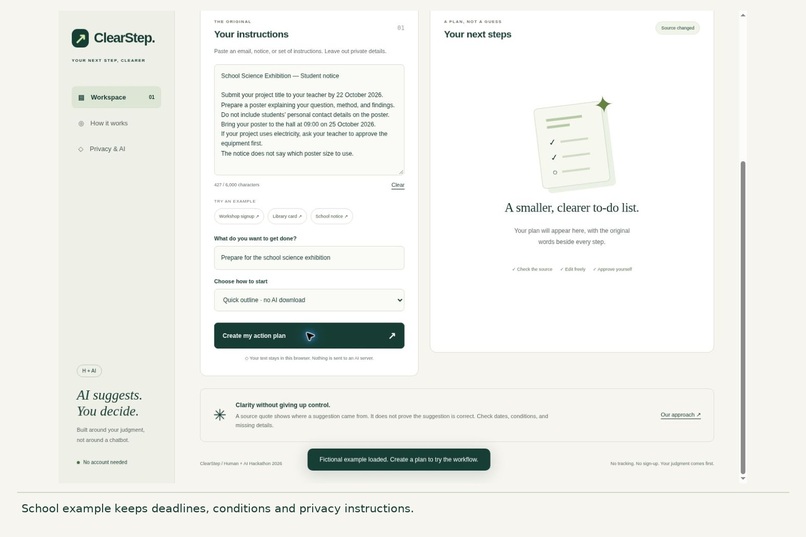
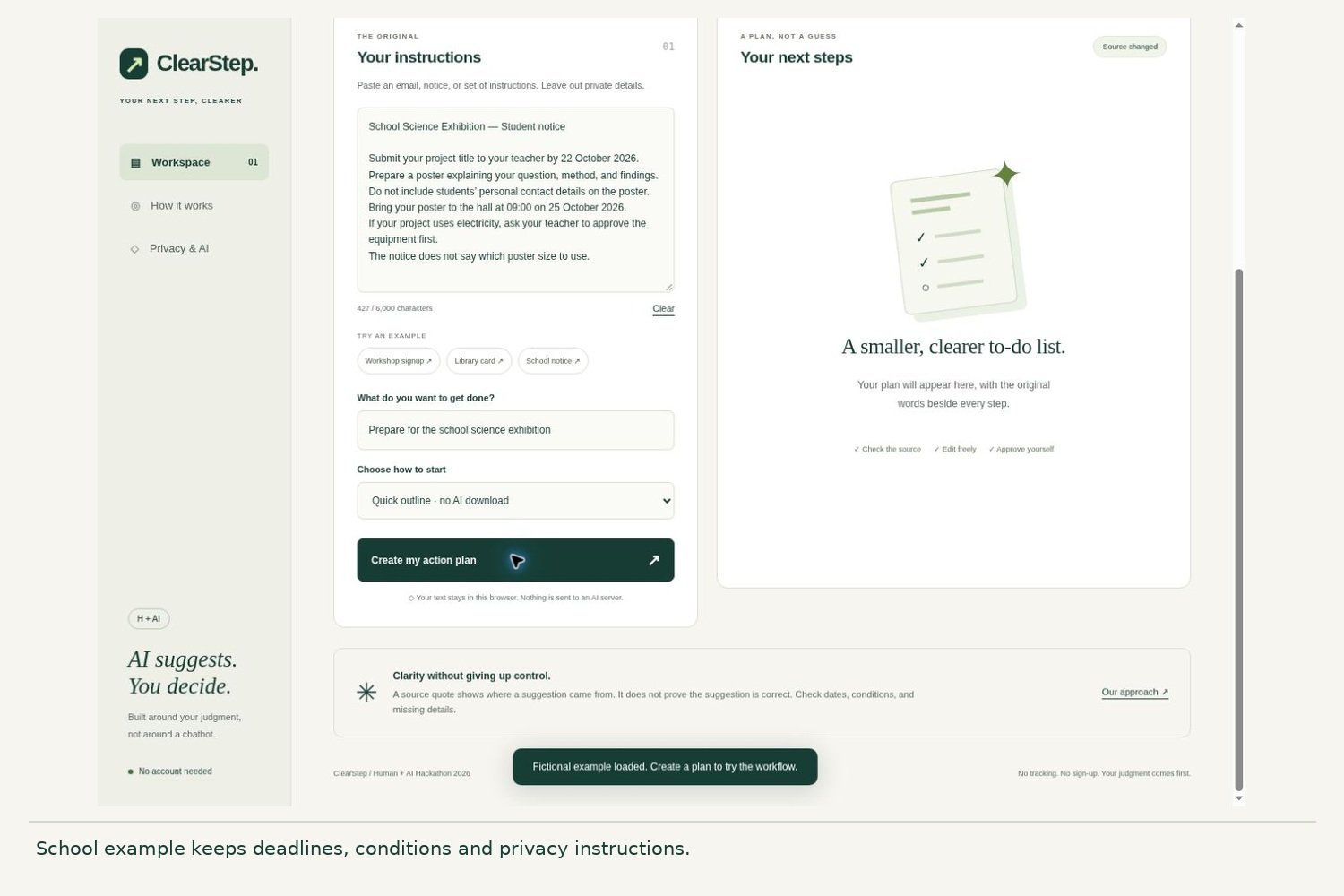
School example keeps deadlines, conditions and privacy instructions.
-
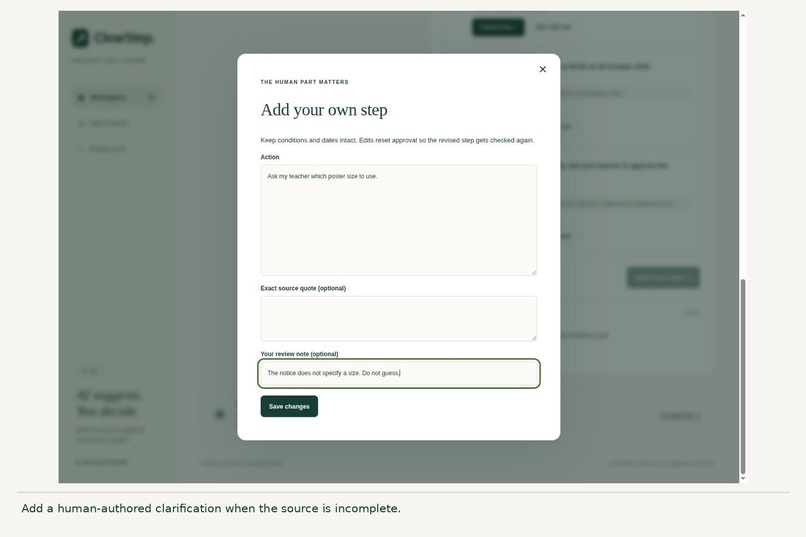
Add a human-authored clarification when the source is incomplete.
-
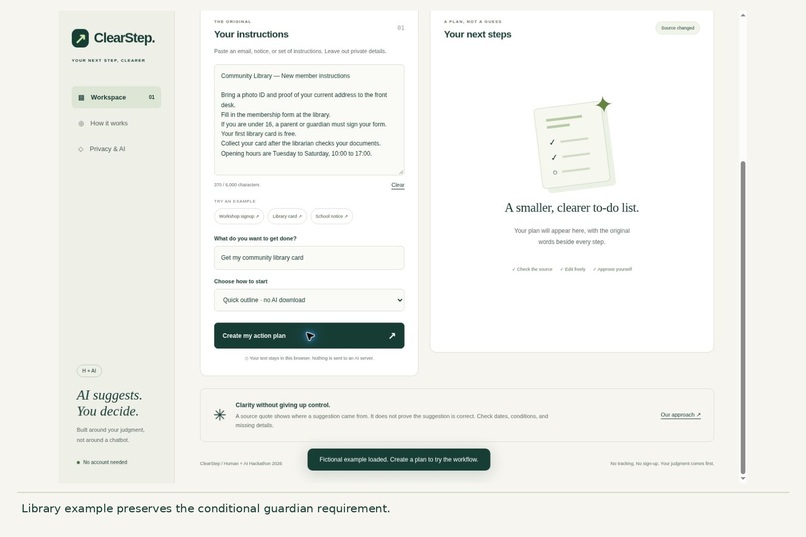
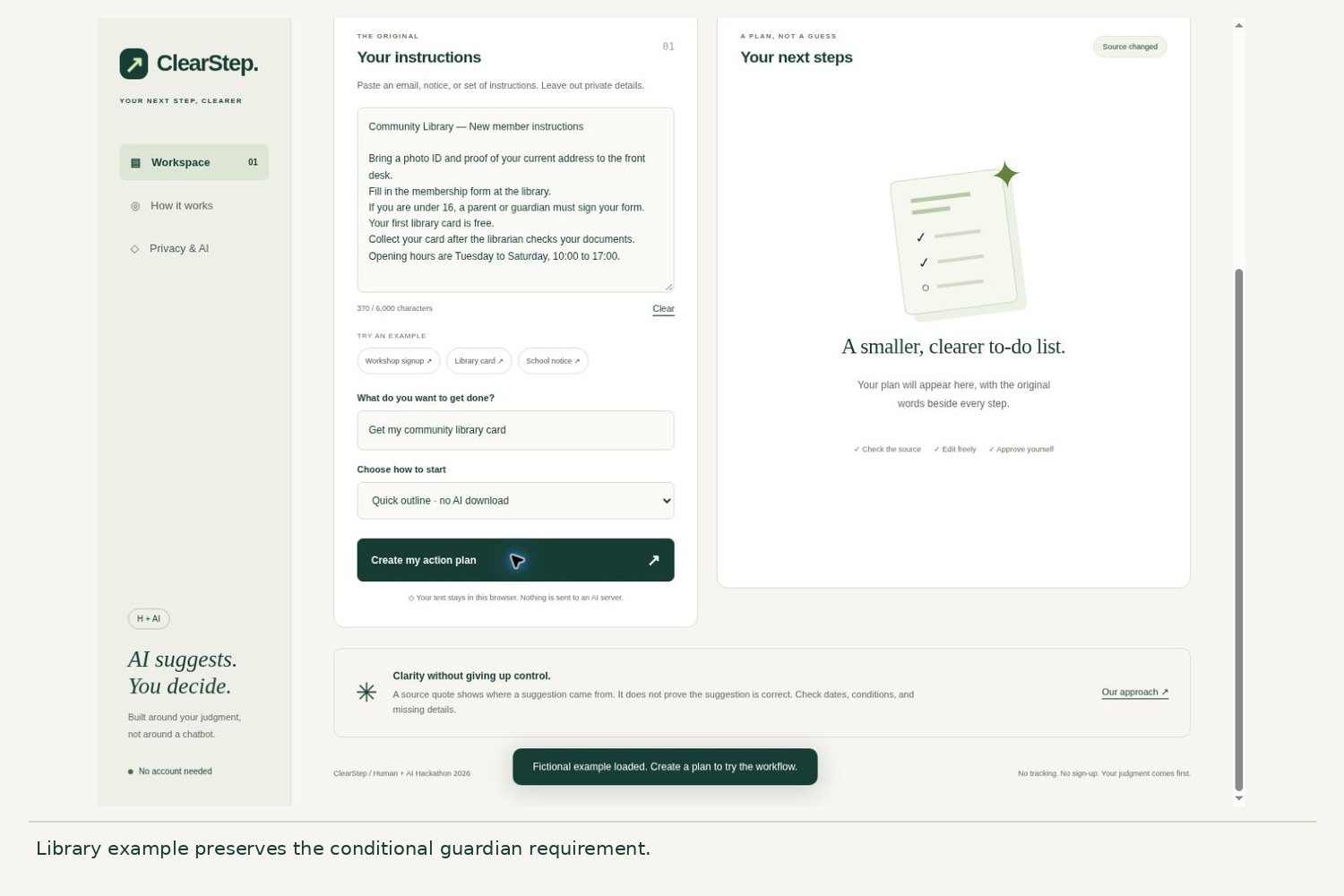
Library example preserves the conditional guardian requirement.
-
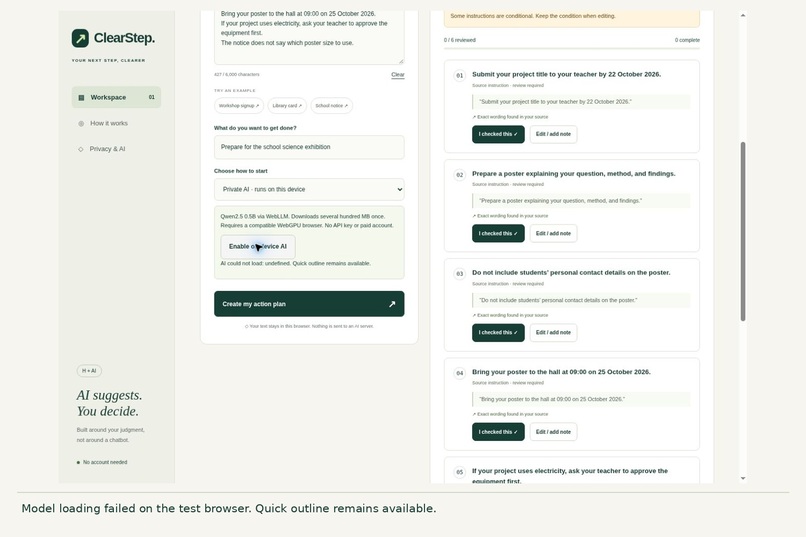
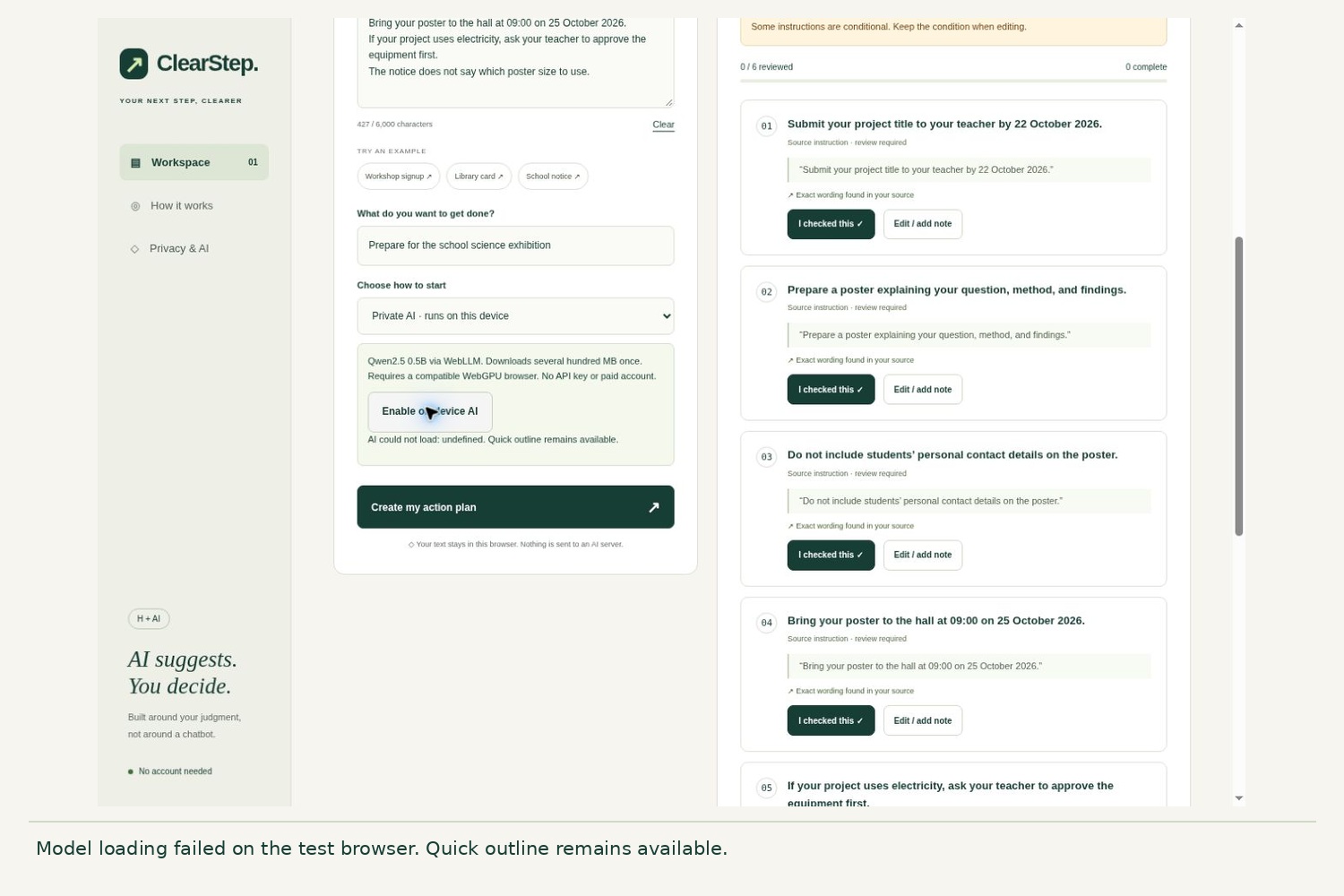
Model loading failed on the test browser. Quick outline remains available.
-
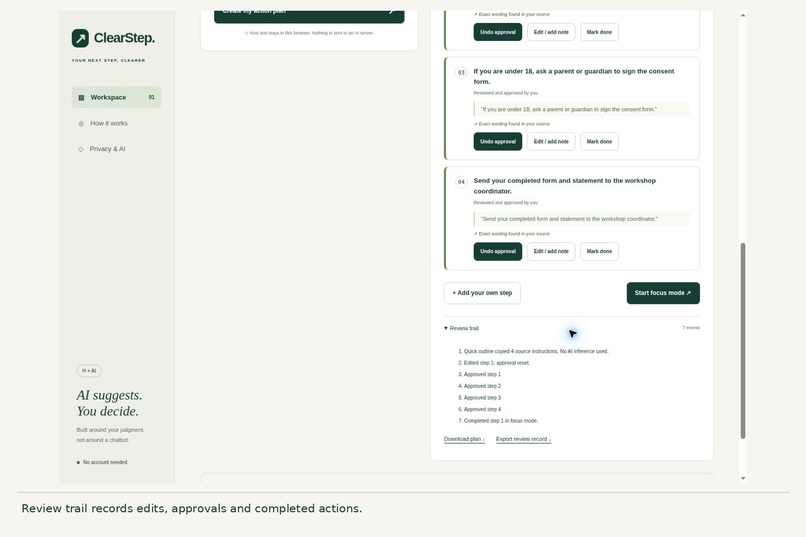
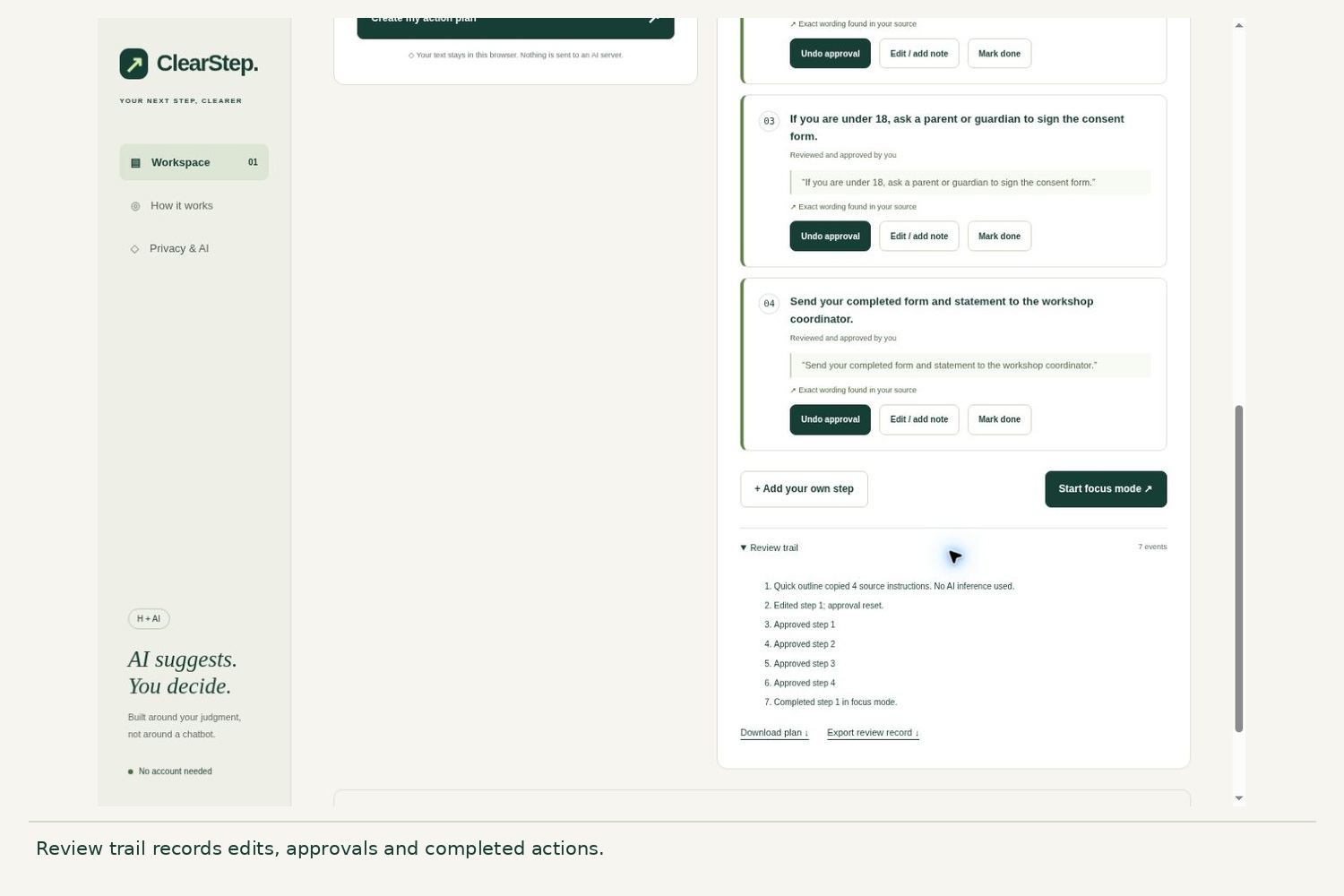
Review trail records edits, approvals and completed actions.
-
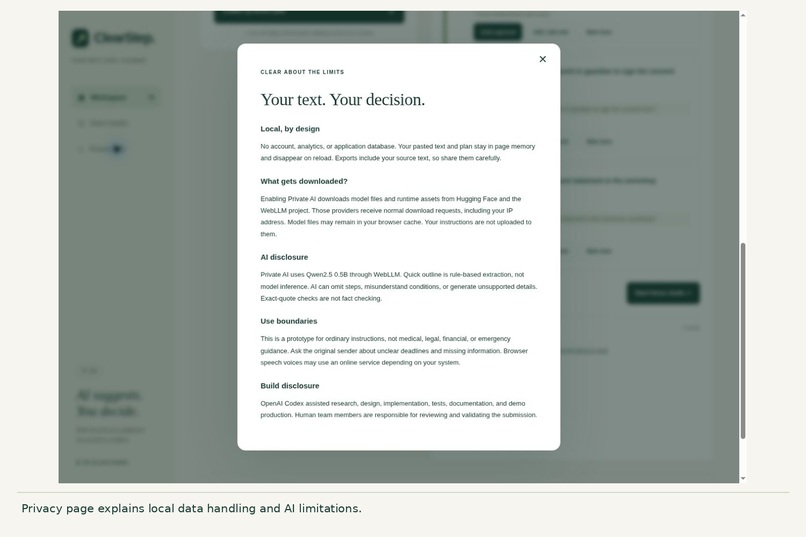
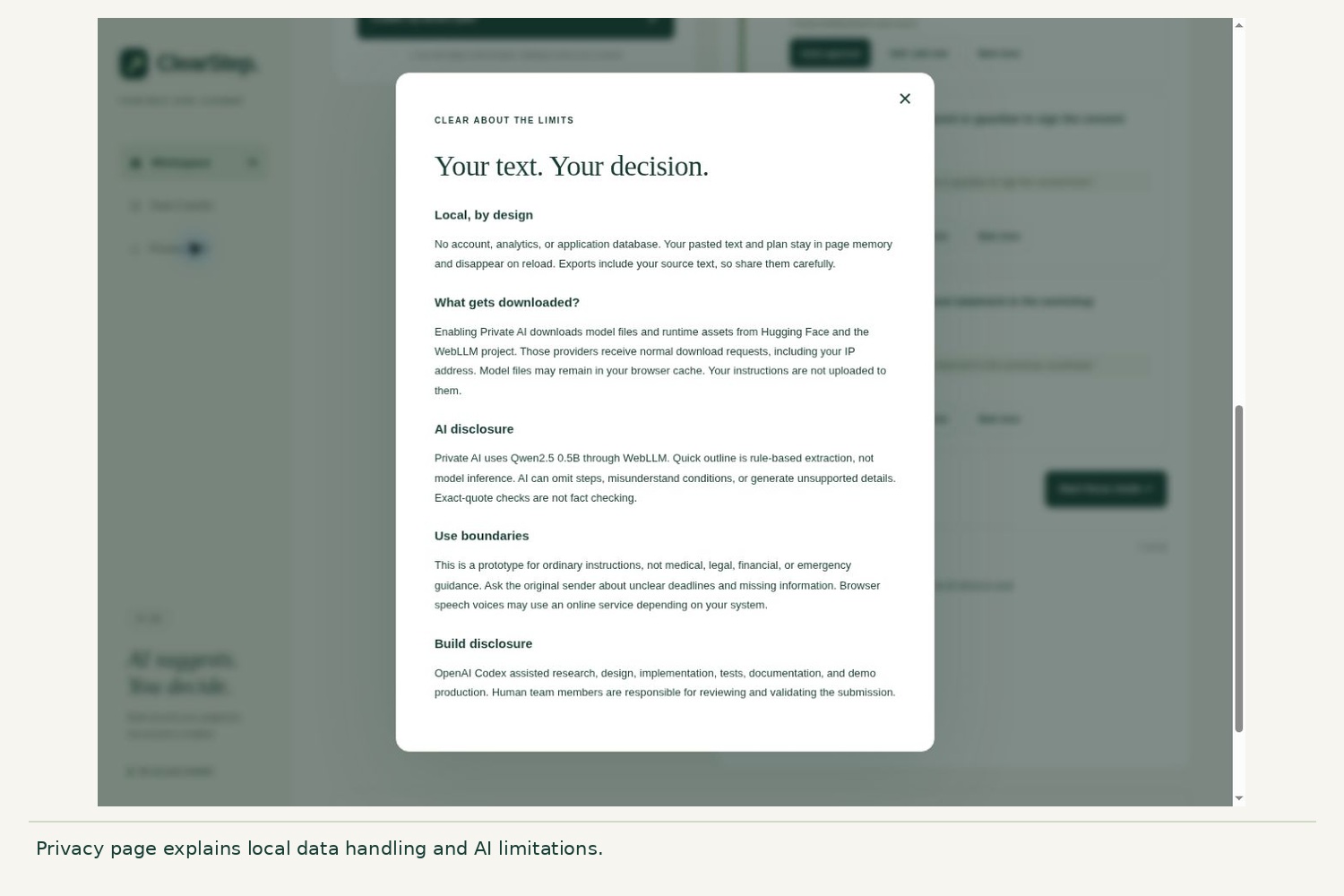
Privacy page explains local data handling and AI limitations.
Demo video
Watch the 96-second 1080p captured walkthrough: https://clearstep-human-ai.adeelfalaksher900.chatgpt.site/demo
The captioned video is hosted publicly with no login. It demonstrates the review workflow using actual app captures. It has no audio narration and shows the lightweight classifier result. It does not show Qwen language-model inference.
Inspiration
A simple notice can hide a surprising amount of work: deadlines, conditions, missing contact details, and decisions the reader still has to make. We explored a practical question: what if AI helped someone understand instructions without taking their judgment away?
ClearStep is a prototype for students and anyone who wants everyday instructions broken into a manageable plan. W3C guidance on clear, step-by-step instructions and Microsoft Research's human-AI interaction guidelines informed the design. We have not yet validated it with people with cognitive disabilities.
What it does
Paste a notice, email, or set of ordinary instructions and add your goal. Every suggested step keeps a supporting source quote visible. You review it, edit it, add a note, or add your own missing step. Focus mode opens only after every step has been approved. You then work through one action at a time and download a text plan or a JSON review record.
There are three clearly labelled modes:
- Lightweight AI uses a multinomial Naive Bayes sentence classifier trained on 80 synthetic English examples with Codex-authored draft labels. It runs on the device CPU, selects original source sentences, and does not rewrite them. The training data, model parameters and training script are included. It can miss actions or select context incorrectly, so the full source still needs review.
- Quick outline uses rules to copy action-like sentences. It is not AI and is labelled accordingly.
- Private AI integrates Qwen2.5 0.5B through WebLLM in a Web Worker. The model is downloaded and runs on the user's device, with no API key. This experimental path needs WebGPU and sufficient device memory. End-to-end model inference has not yet been verified in our test environment.
The human + AI collaboration
The lightweight model selects action-like source sentences. The experimental language model is intended to propose shorter actions. The person's role is to interpret the original, preserve conditions, resolve ambiguity, correct suggestions, and approve the final plan. Approval is never automatic. Editing resets approval. A quote that is not found in the source blocks approval for that AI step. Human-authored additions are labelled separately.
Our fictional workshop example deliberately contains two dates and a missing coordinator email. ClearStep surfaces these as review prompts instead of inventing an answer. Literal quote matching is a traceability check, not proof that an interpretation is correct.
How it is built
A lightweight HTML, CSS and JavaScript frontend, a worker-based WebLLM integration, and pure functions for extraction, validation and export. No application account, database, or API key is required. The interface includes keyboard focus styles, a skip link, larger text, reduced-motion support, browser read-aloud and one-step focus mode. These are implemented features, not a claim of certified WCAG conformance.
The public source ZIP includes the complete code, dependency lockfile, setup instructions, MIT license, third-party runtime license, and tests. It is provided as an accessible project-files alternative to a GitHub repository.
Verification and challenges
Eleven automated logic tests pass. The classifier also matches the labels on 12 separately authored synthetic held-out examples. This tiny internal check is not an independently validated benchmark or evidence of real-world accuracy. They cover exact source matching, conditions and dates, negation, missing information, malformed model output, approval gates, and exported provenance. JavaScript syntax checks also pass.
Public-app browser checks passed for workshop, library and school outline generation, human review notes, approval gating, focus progression, review trail, JSON export, larger text and human-added steps. The experimental Qwen language model failed to load in the test browser. Its end-to-end inference remains unverified. The lightweight classifier also ran successfully in the public browser app, selecting four action sentences from the workshop notice with exact source quotes and the human approval gate. Small models can miss instructions or alter meaning, and a matching quote does not remove that risk.
Privacy and responsible use
Pasted text and plans remain in page memory and are lost on reload. Exports include source text and notes, so users should share them carefully. Enabling AI downloads model assets from third-party hosts, which see ordinary network metadata. Browser speech voices may use an online service depending on the device. This prototype is for ordinary instructions, not medical, legal, financial or emergency guidance.
Team and AI disclosure
Assigned responsibilities: Adeel, product ownership and submission coordination, Raouf khalid: usability review and test coordination. These assignments are not claims that either person independently authored all implementation or completed user testing.
OpenAI Codex assisted research, concept development, design, coding, tests, documentation and submission preparation. OpenAI image generation produced the project thumbnail. Runtime AI uses the included Naive Bayes classifier, with an experimental Qwen2.5 0.5B option via WebLLM. The 1080p demo uses actual screenshots captured while testing the public app, composed with Hyperframes. It is a captured walkthrough, not continuous screen recording or a Qwen language-model inference demonstration. All notices are fictional.
What comes next
Validate with intended users. Build a labelled evaluation set for omitted conditions and unsupported suggestions. Test across WebGPU devices. Measure whether the review workflow helps people catch errors before considering persistence or document upload.

Log in or sign up for Devpost to join the conversation.