-
-
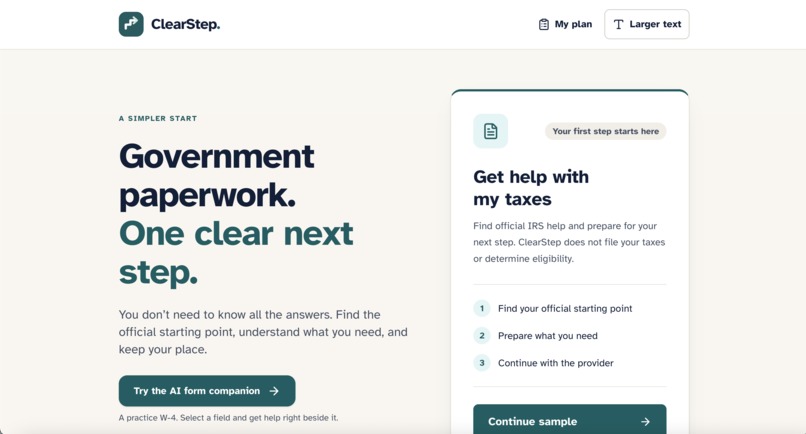
Home Page
-
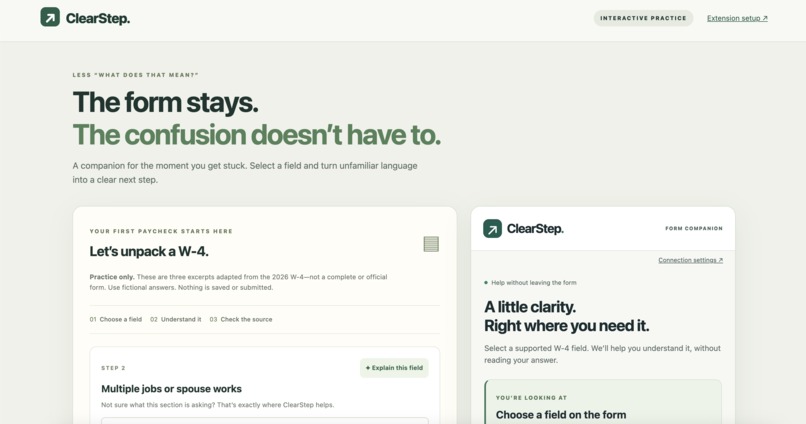
AI Companion
-
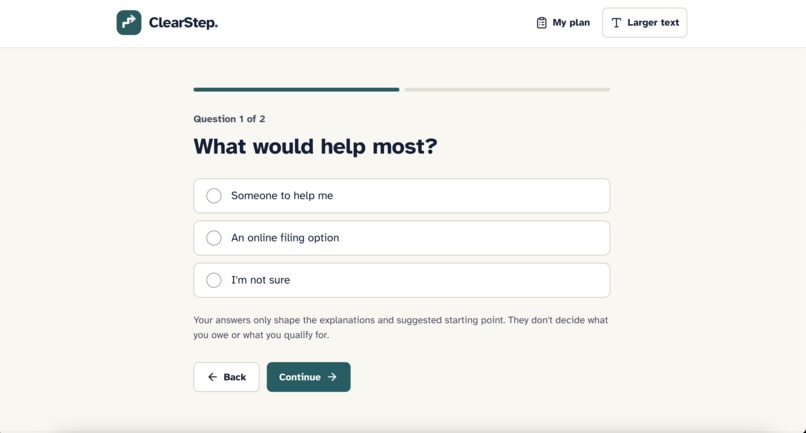
Questionnaire
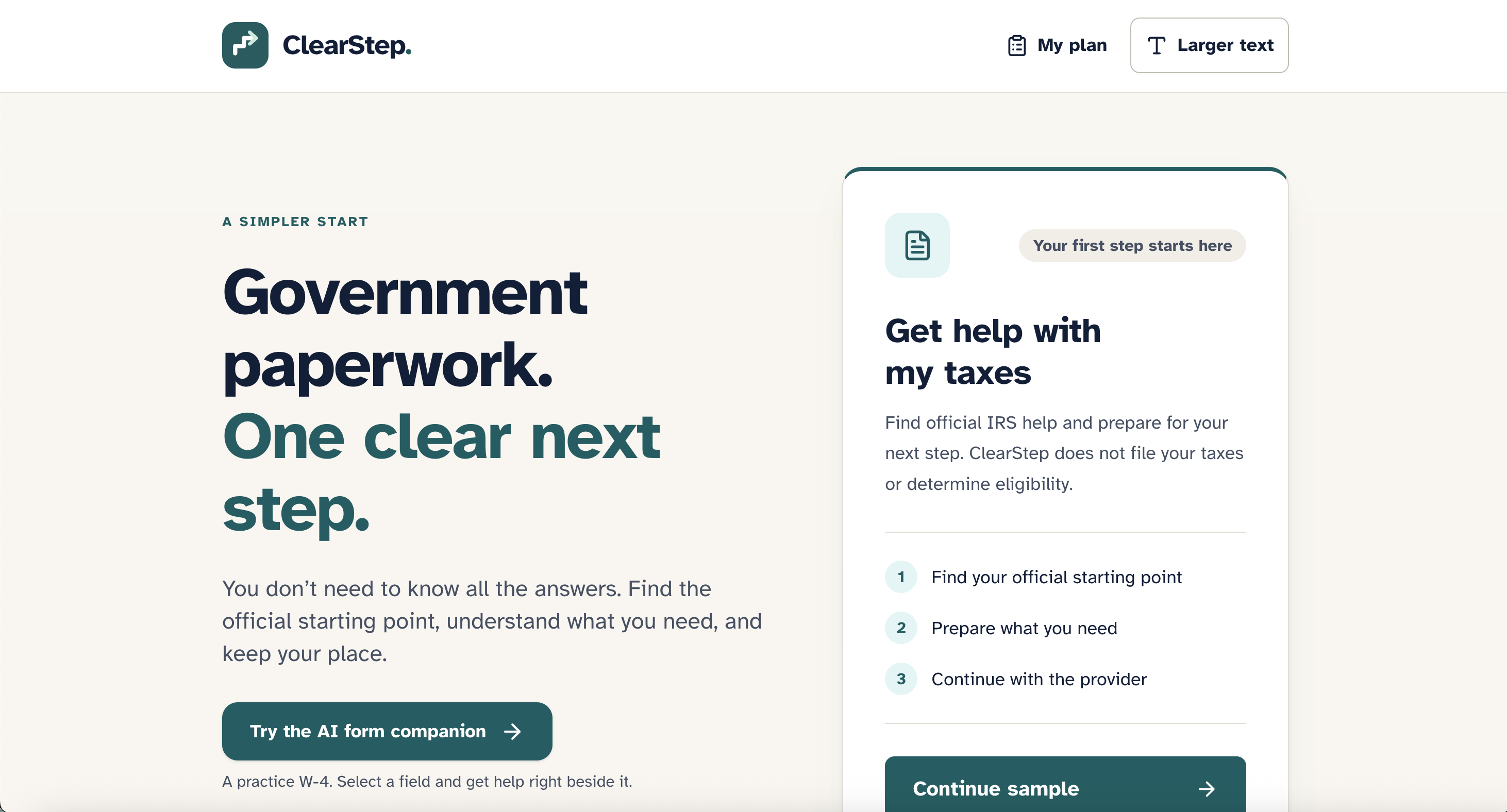
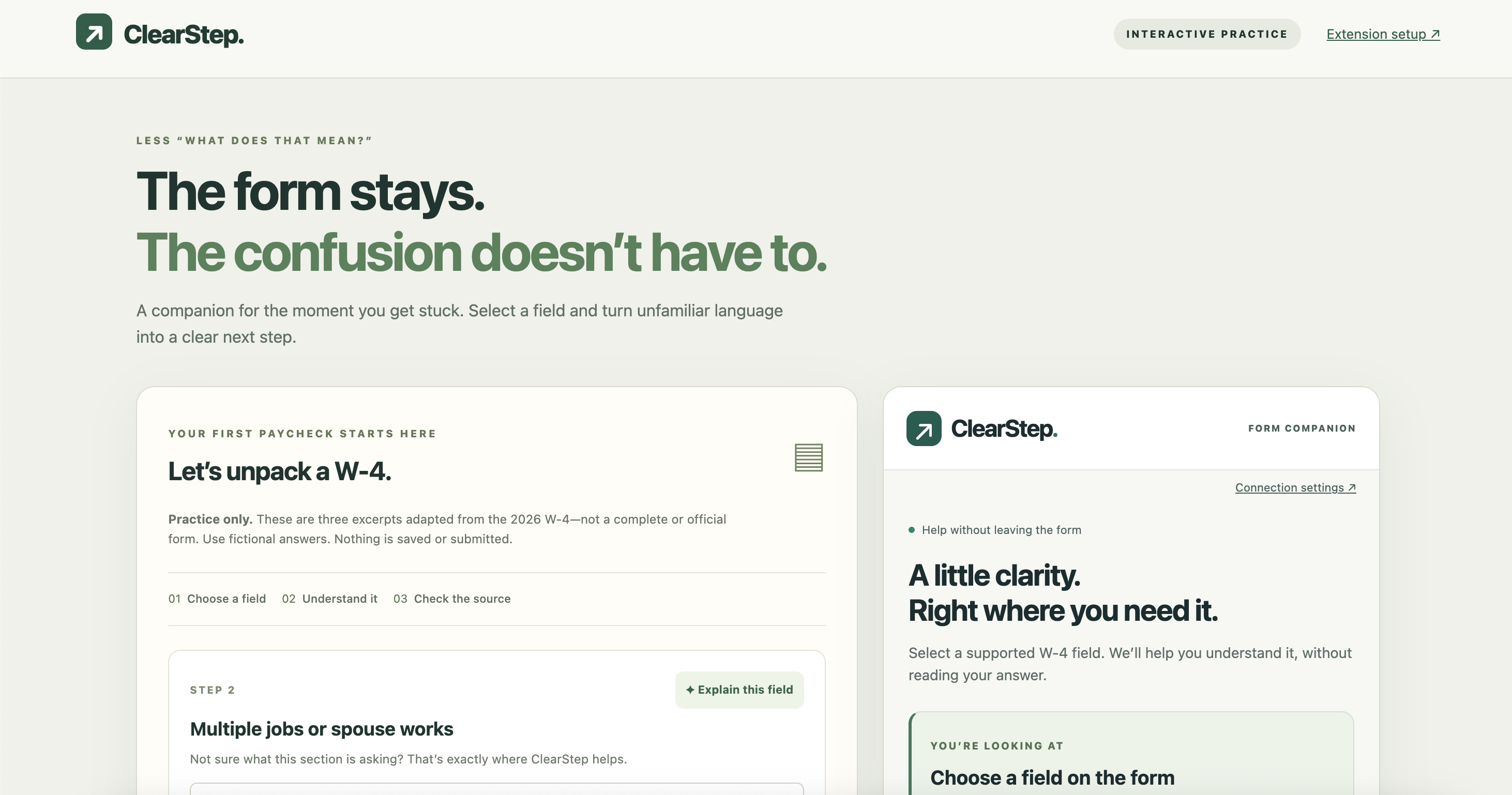
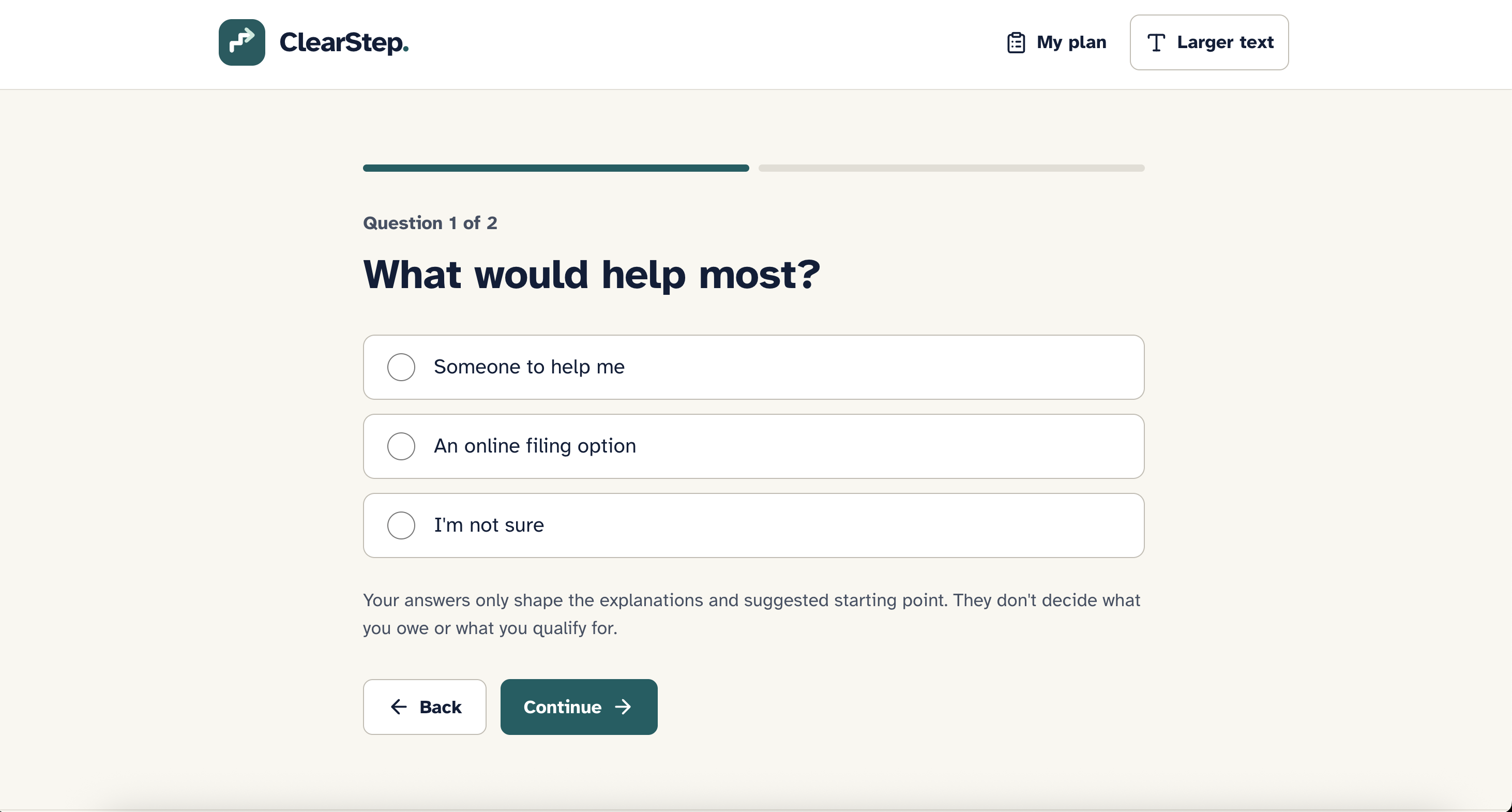
Try it: https://clear-step-accessible.vercel.app/
What did we build and how does it address the prompt?
ClearStep is an intelligent form companion designed to make confusing government and financial forms easier to understand and complete.
Forms like the IRS W-4 are technically available to everyone, but access is not the same as usability. Dense terminology, unfamiliar tax concepts, and instructions spread across multiple documents can make even one field feel intimidating—especially for first-time filers or people with limited tax knowledge.
ClearStep addresses the Hack to the Future prompt by redesigning the experience around the exact moment a user gets stuck.
Our prototype focuses on the W-4. Instead of forcing users to leave the form, search the web, or interpret pages of official instructions, ClearStep provides contextual assistance directly alongside the form. A user can ask:
- What does this mean?
- Where do I find this information?
- Explain it more simply
ClearStep then provides concise, plain-language guidance grounded in reviewed IRS information.
We also built a preparation flow that helps users understand what information they may need before starting the form.
Importantly, ClearStep is designed to explain the form rather than make tax decisions for the user. Personal values entered into the form are not required to generate field explanations.
By moving help directly into the workflow, ClearStep aims to turn forms from something users merely have access to into something they can actually understand and complete.
How did we build it?
ClearStep is a full-stack TypeScript application built with React, TanStack Start, Vite, Tailwind CSS, Nitro, and Vercel.
We separated the product into two layers:
- A reviewed knowledge layer containing field definitions, official-source context, and safe fallback explanations.
- An AI-assisted explanation layer that can generate plain-language help for recognized fields.
One of our biggest challenges was reliability. During development, language models could sometimes produce wording that sounded helpful while subtly changing an important condition from the underlying tax instructions.
To address this, we added field-specific context, constrained response formats, validation rules, and reviewed fallback explanations. If the AI service is unavailable or returns something that fails our checks, ClearStep still provides useful guidance instead of failing completely.
We also designed the AI layer so that providers can be swapped without rebuilding the user experience. During development we experimented with local models through Ollama as well as hosted AI APIs.
Privacy was another major design constraint. ClearStep can generate assistance using the field label and reviewed instructions rather than sending personal financial values entered by the user.
We also created automated tests around the form-help flow, field detection, response validation, and privacy behavior.
Challenges we ran into
The hardest challenge was balancing AI flexibility with correctness.
A general-purpose model may generate an answer that is fluent but not precise enough for sensitive form instructions. That led us to rethink the product from “just ask an AI” into a safer layered system with source-grounded context, output validation, and reviewed fallbacks.
We also ran into deployment and API integration issues while moving from a local prototype to a hosted version. We resolved the deployment architecture by using TanStack Start with Nitro on Vercel and kept the AI provider abstraction separate so the product remains usable even when a hosted model is unavailable.
How can we implement this further?
ClearStep currently demonstrates the concept through a focused W-4 workflow, but the same architecture can extend far beyond one tax form.
Next, we would build ClearStep as a browser extension or embeddable accessibility layer that recognizes supported fields directly on official websites and provides contextual help without forcing users to leave the form.
Future directions include:
- Supporting additional government, healthcare, education, immigration, benefits, and financial forms
- Building a verified source-ingestion pipeline so explanations stay aligned with updated official instructions
- Adding multilingual explanations
- Adapting explanations to different reading levels
- Improving screen-reader and keyboard accessibility
- Allowing institutions to integrate ClearStep directly into their own digital forms
- Conducting usability testing with the communities who actually struggle with these systems
Long term, ClearStep could become a reusable translation layer between institutional language and the people expected to act on it.
Littlebird Award
Littlebird helped us refine ClearStep as a product rather than treating it as a one-off chatbot.
We used Littlebird during development to reason over the evolving context of the project and iterate on the user experience as ClearStep changed from a basic preparation checklist into a contextual form companion.
Compared with using a general-purpose chatbot for isolated brainstorming prompts, the value was continuity. We could keep product decisions, user pain points, and prior iterations in context while refining the workflow.
That helped us focus ClearStep around one clear interaction:
A user encounters an unfamiliar field, asks for help, understands it, and continues.
This was more useful than simply adding generic AI features because it kept the product centered on the actual accessibility problem we were trying to solve.
Built With
- gemini
- littlebird
- nitro
- ollama
- qwen
- react
- tailwind-css
- tanstack-start
- typescript
- vercel
- vite
- vites
- zod


Log in or sign up for Devpost to join the conversation.