-
-
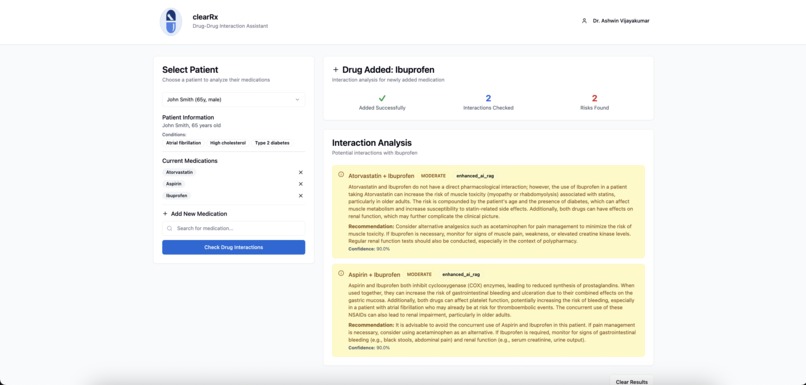
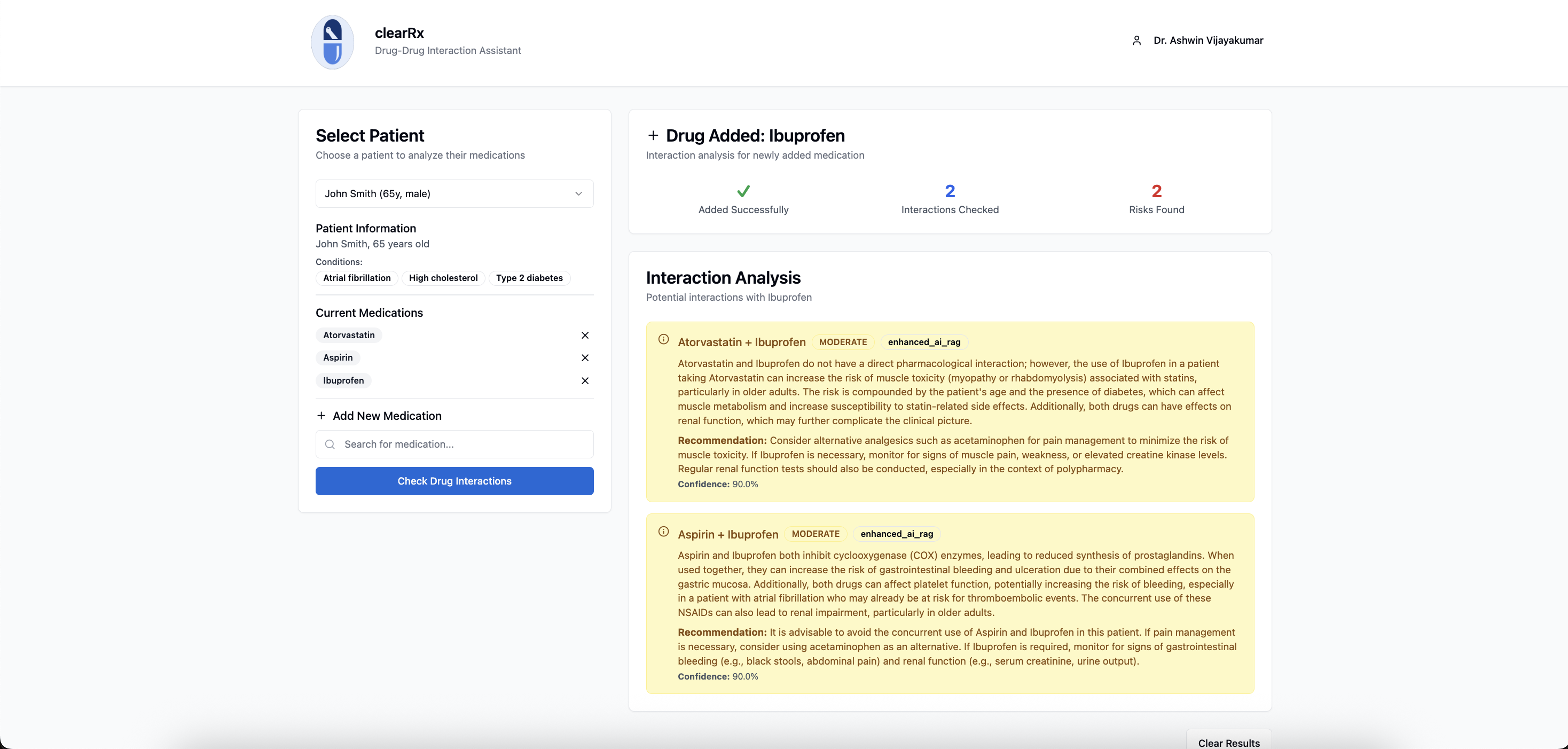
When a clinician adds ibuprofen, the system instantly flags interactions with current medications and provides clear safety recommendations.
Inspiration
Medication safety is one of the most pressing challenges in healthcare. When patients are prescribed multiple drugs, drug–drug interactions (DDIs) can cause harmful side effects, hospitalizations, and even fatalities. Clinicians often rely on outdated or clunky tools that require manual lookups. We wanted to build something faster, smarter, and AI-powered that gives providers actionable insights instantly, without adding to their workload.
What it does
clearRx is a Drug–Drug Interaction Assistant designed to help providers make safer prescribing decisions. It allows a healthcare provider to:
- Load a patient record and view their active medications.
- Instantly check for possible DDIs using FDA and curated datasets.
- See color-coded severity levels (mild, moderate, severe) for quick risk assessment.
- Read AI-generated plain-English explanations of why a drug combination may be harmful.
- Automatically store interaction checks into logs for review.
How we built it
- Frontend: React, TypeScript, TailwindCSS for a clean, EHR-inspired UI for providers.
- Backend (API): Node.js + Express connecting the frontend with Supabase and the AI service.
- Database: Supabase storing patients, medications, drug info, and logs.
- AI/ML Service: Python + FastAPI using Hugging Face sentence transformers for embeddings, FAISS for retrieval, and OpenAI GPT-4 mini for generating clear, contextual explanations.
- Data Sources: OpenFDA APIs and a curated JSON dataset of common drugs and interactions for demo purposes.
Challenges we ran into
- Data complexity: Drug interaction data is vast, fragmented, and often unstructured. Integrating openFDA API for drug information and retrieval was a challenge
- System integration: Linking Supabase, Express, and FastAPI into a single smooth workflow was technically challenging.
- Time limitations: We had to balance between building real features and simulating others with placeholders to meet hackathon deadlines.
Accomplishments that we're proud of
- Built an end-to-end working prototype that feels like a real clinical dashboard.
- Integrated RAG-based AI explanations that transform dense drug label text into useful provider insights.
- Designed a minimal but professional UI that healthcare providers could realistically adopt.
- Demonstrated how AI can directly reduce clinical risk and increase efficiency.
What we learned
- How to design AI-powered healthcare apps that combine structured databases, external APIs, and generative AI.
- How to implement retrieval-augmented generation (RAG) to make LLMs more reliable and fact-based.
- How critical usability and design are in healthcare and how insights must be clear, fast, and easy to act on.
What's next for clearRx
- Expanding to a comprehensive drug interaction knowledge base using FDA and PubMed datasets.
- Adding patient-specific factors (age, comorbidities, genetics) to refine risk assessments.
- Integrating with EHR/EMR systems so checks happen automatically at the point of prescribing.
- Utilizing advanced ML modeling to develop more accurate confidence scores for risk assesments
- Exploring commercial partnerships with providers, payers, and pharmacies to bring ClearRx into real clinical workflows.
Built With
- express.js
- fastapi
- huggingface
- javascript
- node.js
- openai
- openfda
- python
- rag
- react
- sentencetransformers
- sql
- supabase
- tailwind
- typescript


Log in or sign up for Devpost to join the conversation.