-
-
1
-
2
-
3
-
4
-
5
-
6
Inspiration
Finding a job is one of the most important and time-consuming processes in a person’s life.
A serious application can require researching the employer, rewriting a résumé, preparing a cover letter, answering screening questions, and sharing personal information. Yet job seekers are often expected to make that investment before they know whether the listing is current, credible, connected to real hiring, or even published by the company it claims to represent.
The problem is becoming more serious as AI makes it inexpensive to generate professional-looking job advertisements at scale.
A listing can appear detailed and convincing while still being:
- fake or impersonating a real employer;
- designed to collect résumé data or other personal information;
- no longer connected to an active hiring process;
- repeatedly reposted for months;
- missing from the employer’s own career website;
- published inconsistently across different job platforms;
- copied from another company or older listing;
- automatically generated from a generic template;
- vague about the actual role, compensation, location, or hiring process;
- unrealistically promising;
- badly written but made to look credible through confident language;
- used primarily for talent-market research, résumé collection, employer branding, or pipeline building rather than an immediate vacancy.
Traditional job boards usually show the listing, but they do not explain whether the opportunity deserves the applicant’s time.
Generic AI tools may summarize the text, but they rarely separate:
- listing quality;
- source credibility;
- employer identity;
- freshness;
- duplicate history;
- possible fraud indicators;
- real hiring-intent signals;
- and what remains unknown.
ClearRole was created to address this trust gap.
Our long-term goal is to build a decision-support and provenance layer for the job market: a system that helps people, companies, career professionals, and job platforms understand whether a listing appears credible, current, transparent, and worth acting on.
The ClearRole vision
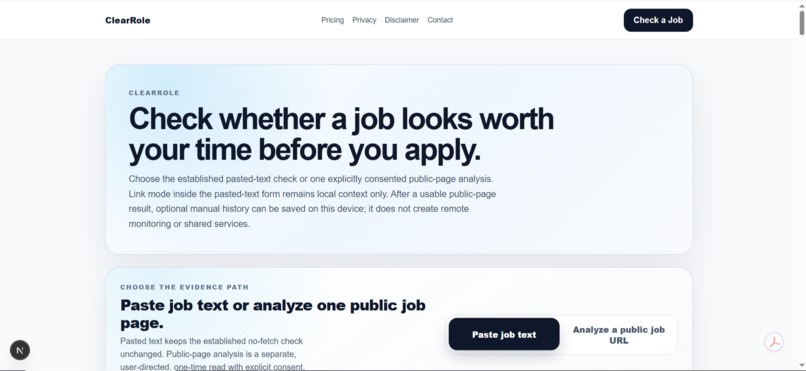
ClearRole is being designed as more than a one-time job-description analyzer.
The full product vision combines three connected layers:
1. Ghost Job Detector
The user-facing application helps job seekers review an opportunity before investing significant time or sharing personal information.
Users will be able to:
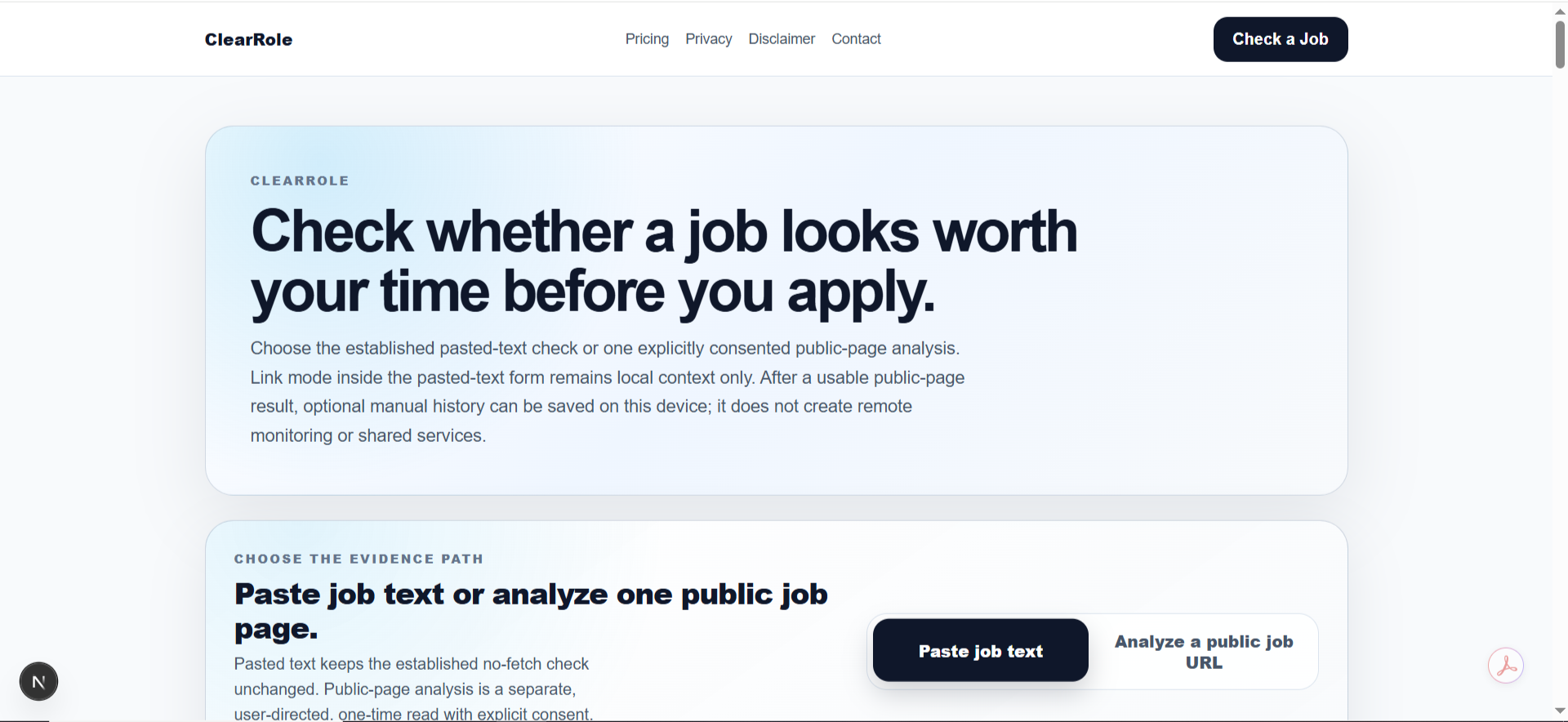
- paste the text of a job description;
- submit a direct public job-listing link;
- receive a score, risk level, confidence level, and verdict;
- see the exact evidence behind the result;
- identify missing, contradictory, vague, or potentially manipulative information;
- understand whether the listing appears worth applying to;
- receive a practical verification checklist;
- compare the listing with information found elsewhere;
- observe whether the listing changes, disappears, or remains active for an unusually long time.
The product does not simply ask whether a listing “looks good.”
It is designed to evaluate questions such as:
- Does the employer clearly identify itself?
- Is the role also present on the company’s official career page?
- Does the same position exist on other trusted platforms?
- Are the title, salary, location, responsibilities, and requirements consistent?
- Has the listing remained online or been reposted for months?
- Does the application destination match the employer?
- Does the listing request payment, financial information, equipment purchases, or unnecessary personal data?
- Does the wording contain signals commonly associated with résumé harvesting, impersonation, scams, templated listings, or low-intent hiring?
- Does the description contain enough concrete information to justify the applicant’s time?
- Does the listing appear AI-generated, heavily templated, internally contradictory, or unrealistically persuasive?
ClearRole will not claim that any individual signal proves fraud or proves that an employer has no intention to hire.
Instead, it will combine evidence, provenance, source quality, uncertainty, and time-based observations into a transparent decision-support result.
2. ClearRole Trust Engine
The second layer is designed for B2B use.
Job boards, recruitment platforms, marketplaces, staffing companies, and employers face their own trust and quality problems.
Platforms need better tools to identify:
- duplicate and repeatedly reposted listings;
- suspicious application destinations;
- employer impersonation;
- incomplete or misleading job advertisements;
- inconsistent compensation, location, or employment-type information;
- potential résumé-harvesting patterns;
- low-quality AI-generated listings;
- listings that violate platform standards;
- outdated jobs that remain publicly visible;
- content that may damage user trust in the platform.
The ClearRole Trust Engine is intended to provide structured listing-quality and trust signals through dashboards, moderation tools, and APIs.
Potential B2B use cases include:
- pre-publication quality checks for employers;
- automated trust and transparency reviews for job boards;
- fraud and impersonation risk flagging;
- duplicate and repost detection;
- listing-health monitoring;
- employer-facing recommendations to improve job advertisements;
- marketplace trust scoring;
- moderation prioritization;
- provenance and change-history APIs.
This creates value for both sides of the market.
Job seekers receive better protection and clearer information.
Employers receive guidance for producing more credible and effective listings.
Job platforms can reduce low-quality or harmful content and strengthen user trust.
3. ClearRole Source Intelligence Layer
The third layer is the long-term technical foundation.
A trustworthy job-analysis system cannot rely only on the words inside one advertisement. It must also understand where the information came from, whether it can be verified, and how it changes over time.
The planned Source Intelligence Layer will support controlled analysis of public job-listing sources and build an evidence graph around listings, employers, domains, and historical observations.
This layer is intended to evaluate:
- official company career pages;
- job-board copies of the same opportunity;
- publication and modification history;
- redirects and application destinations;
- employer and domain relationships;
- listing duplication;
- title, salary, location, and requirement consistency;
- page freshness and disappearance;
- cross-platform existence;
- corrections and changes over time;
- source confidence and provenance.
The goal is not to become a general web-scraping platform.
ClearRole is being designed specifically for public job-listing intelligence with controlled access, source-quality metadata, privacy boundaries, network protections, and explicit uncertainty.
What ClearRole does today
The OpenAI Build Week release proves the core pasted-text experience.
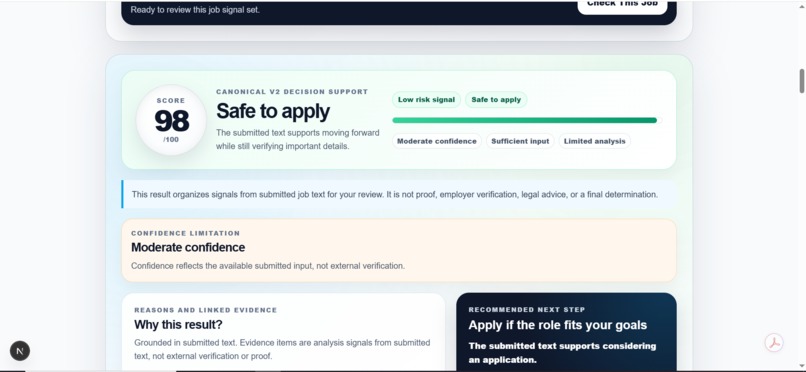
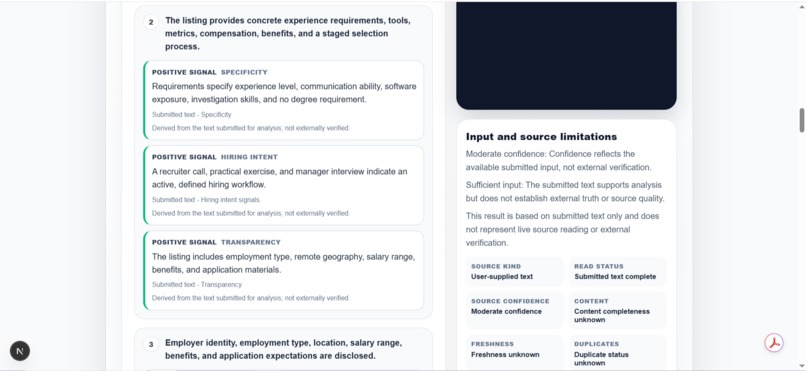
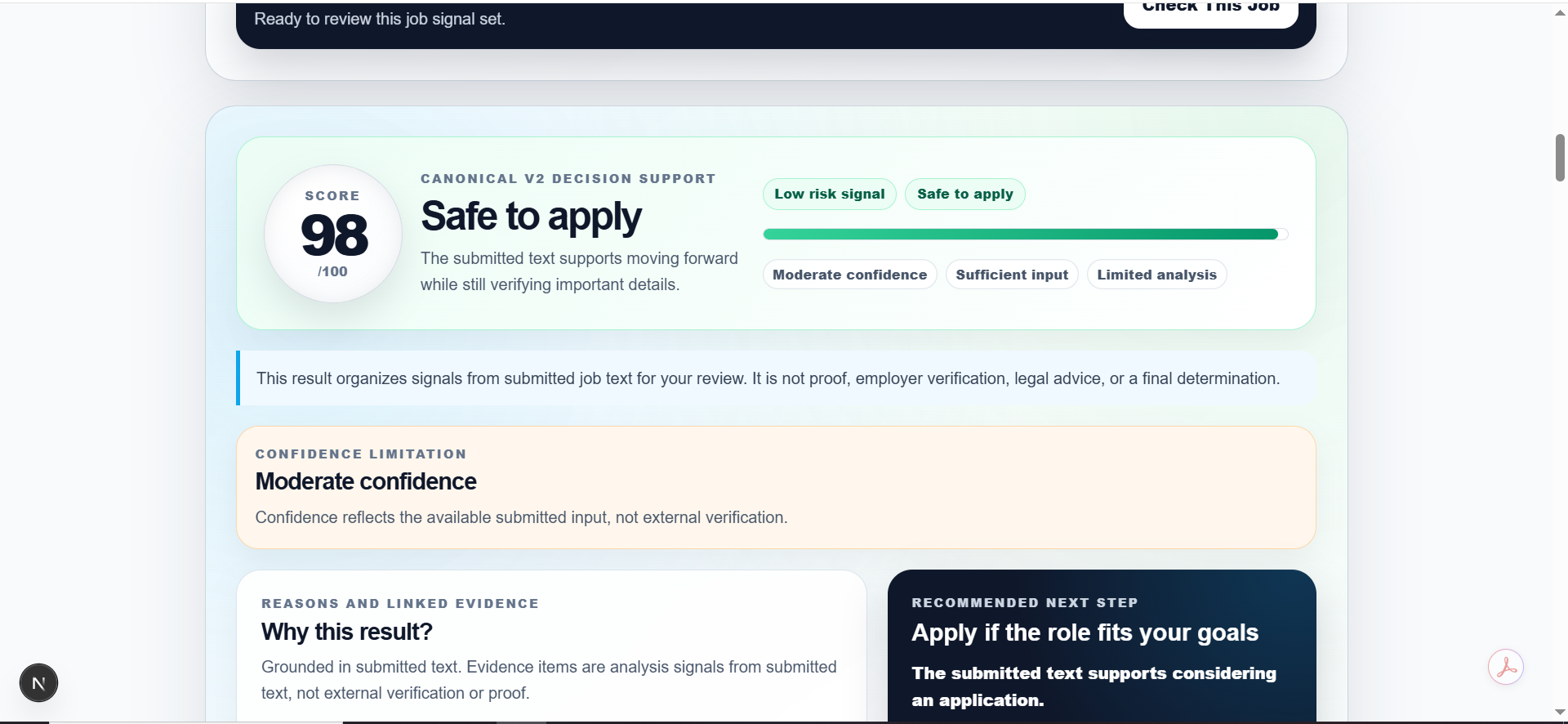
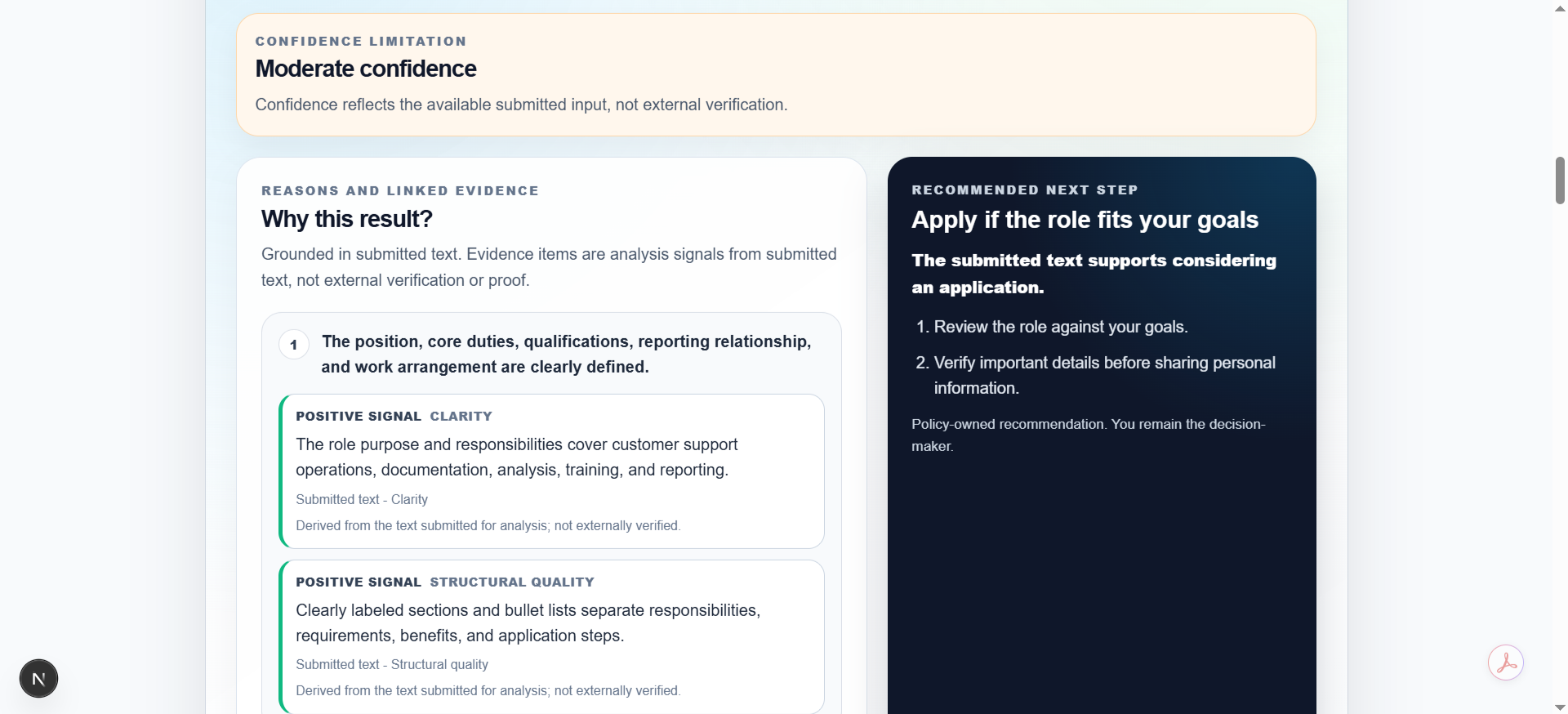
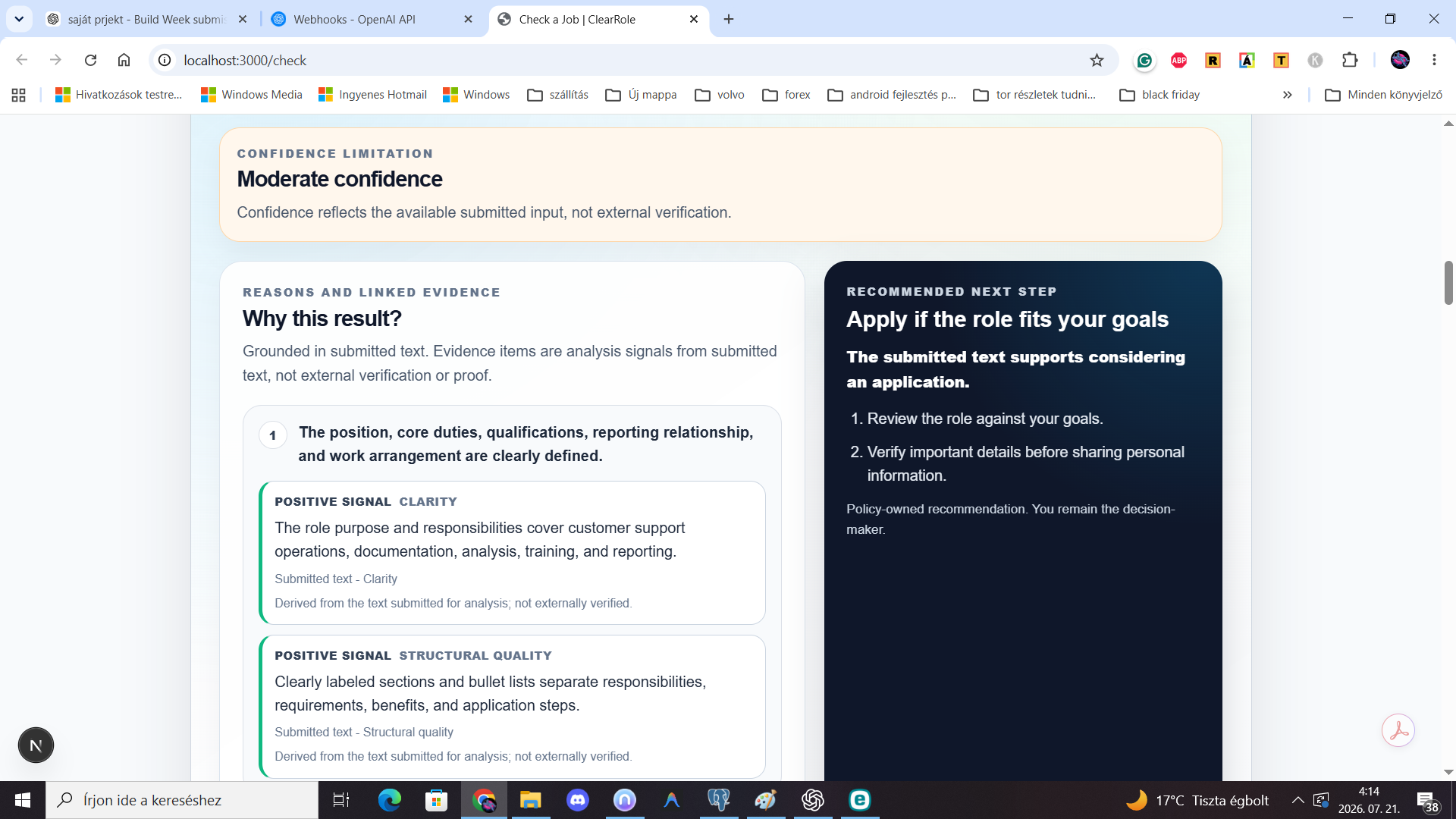
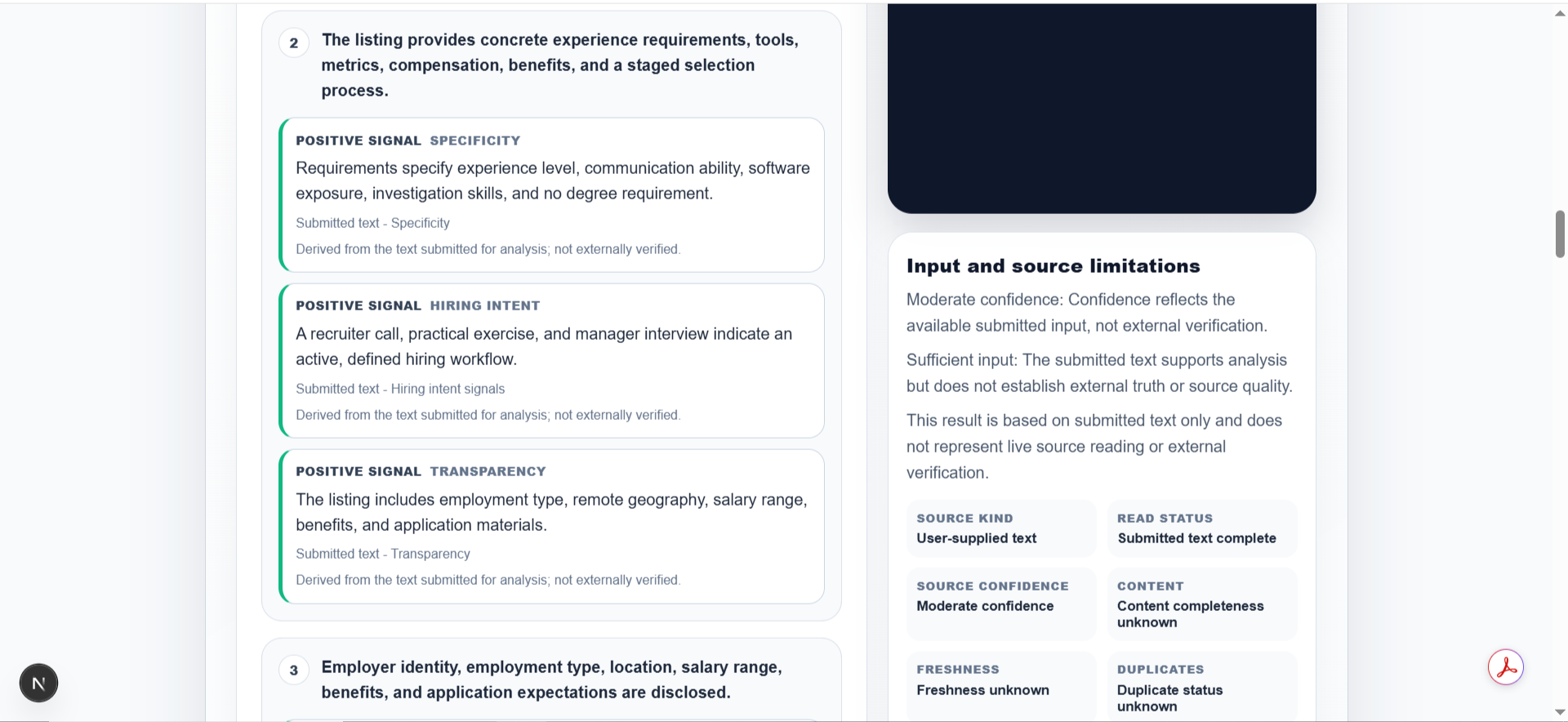
A user pastes a complete job description, and ClearRole produces a structured analysis containing:
- a 0–100 listing score;
- a low, medium, or high risk signal;
- a clear verdict;
- an evidence-aware confidence level;
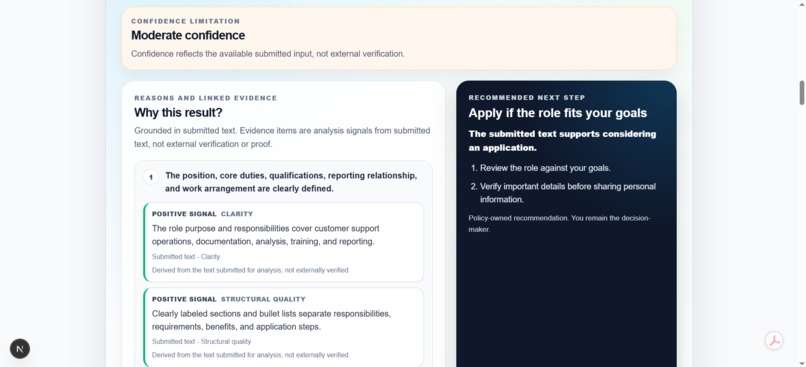
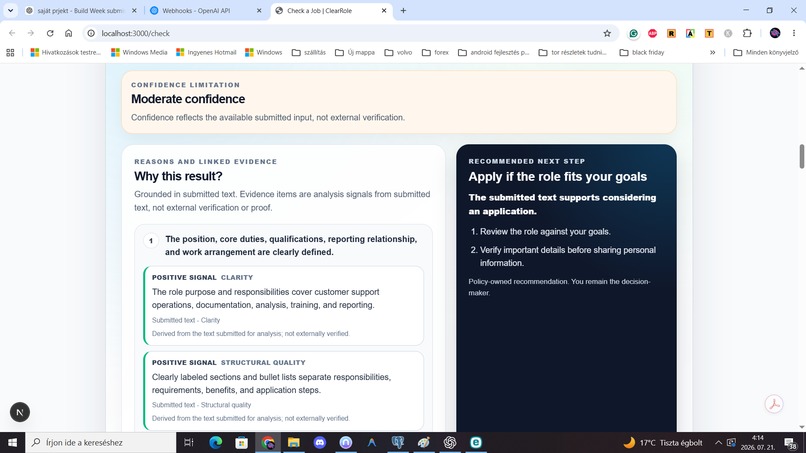
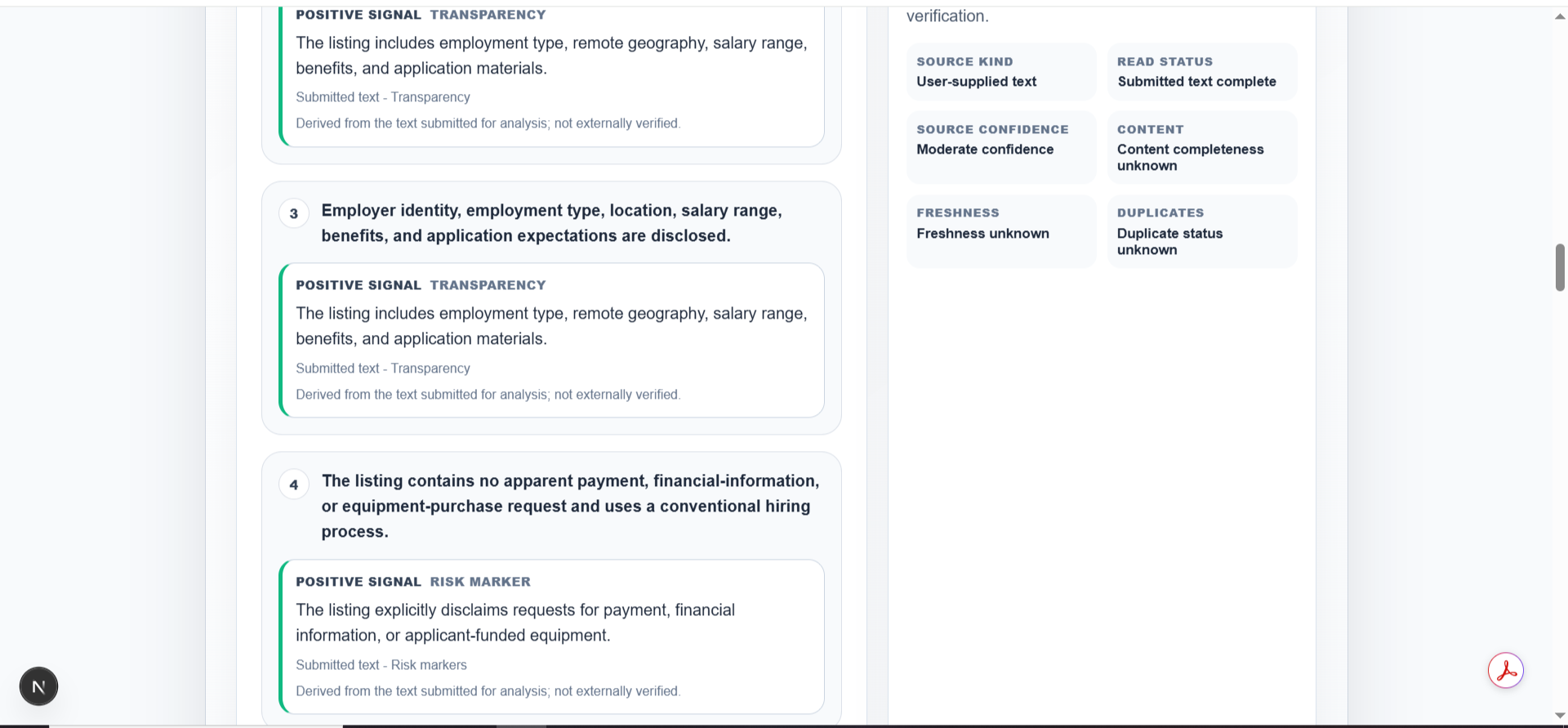
- reasons linked to specific categories;
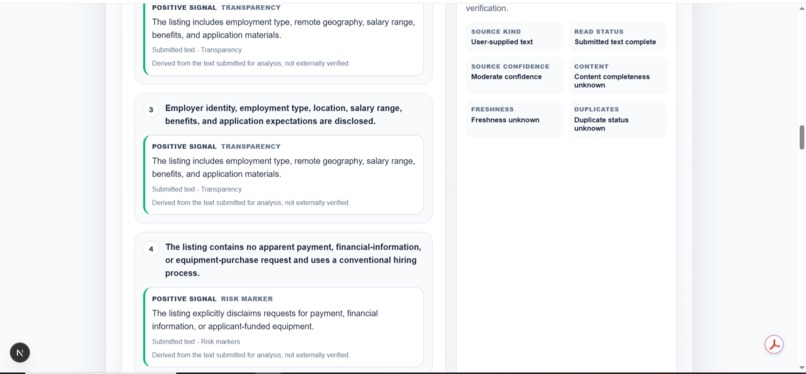
- positive, weak, and risk signals;
- input and source limitations;
- a recommended next action;
- a verification checklist.
The analysis considers signals related to:
- clarity;
- specificity;
- structural quality;
- hiring intent;
- employer transparency;
- salary and benefit disclosure;
- location and employment terms;
- application-process transparency;
- suspicious payment or equipment requests;
- contradictory or unrealistic requirements;
- possible template or generic-language patterns;
- missing company identity;
- weak or incomplete input.
The result is intentionally not presented as proof that an employer is legitimate or that a job is real or fake.
ClearRole clearly separates:
- what is observable from the submitted text;
- what is inferred as a signal;
- what has not been externally verified;
- and what the applicant should check independently.
For example, a strong listing may receive a high score while still receiving only moderate confidence because pasted text cannot verify the employer, freshness, duplicate history, or real hiring intent.
That separation is one of the core principles of ClearRole.
Planned Chrome extension
A planned Chrome extension will make ClearRole available directly inside the user’s normal job-search workflow.
The concept is similar to enabling an ad blocker or browser security extension.
When the user visits a supported job listing, the extension could:
- recognize the listing page;
- display a ClearRole score and risk flags;
- summarize important positive and weak signals;
- warn about suspicious destinations or requests;
- show whether the role appears elsewhere;
- highlight missing salary, location, company identity, or application details;
- indicate whether the listing has been observed before;
- provide a one-click verification checklist;
- allow the user to save an observation locally and manually recheck it later.
The extension is intended to reduce friction.
Users should not need to copy every listing manually once the production source-intelligence system is reliable and fully tested.
How we built it
ClearRole is built with Next.js, React, TypeScript, Codex, the OpenAI Responses API, and GPT-5.4-5.6 Sol mixed with xhigh, Max , Ultra
The demonstrated Build Week flow is:
- The user pastes a complete job description.
- The browser sends the content to a Next.js
/api/check-textroute. - The server performs one bounded GPT-5.6 Luna request.
- The provider output is parsed and validated locally.
- The result is normalized into the canonical ClearRole V2 result contract.
- The interface displays the score, verdict, confidence, linked evidence, limitations, and recommended action.
The demonstrated path:
- performs at most one OpenAI request;
- performs no public URL fetch;
- performs no server-side history write;
- stores no pasted job description server-side;
- does not log the pasted text or raw model output;
- is explicitly limited to localhost and non-production execution.
The server independently validates the local demo environment so the emergency Build Week path cannot be activated in production.
The wider ClearRole codebase also contains foundational work for:
- canonical result contracts;
- evidence categories;
- scoring policy;
- confidence controls;
- source-quality separation;
- controlled public-source reading;
- network and private-address protection;
- PostgreSQL-backed authorization and accounting foundations;
- listing history and observation concepts;
- change detection;
- source discovery;
- safe fallbacks and uncertainty handling.
Not all of these wider systems are enabled in the submitted demonstration. The judged Build Week experience focuses on the stable pasted-text vertical slice.
How Codex helped
Codex was used as a repository-level engineering partner throughout the project.
During the Build Week submission period, Codex helped us:
- trace the real browser-to-server request path;
- identify a missing Next.js API route;
- create the
/api/check-textadapter; - preserve the existing client response contract;
- create a strictly local and non-production demo path;
- implement production and same-origin safeguards;
- build secret-safe provider failure diagnostics;
- identify OpenAI request-schema incompatibilities;
- simplify the provider integration to the minimum supported Responses API request;
- validate TypeScript and production builds;
- review the final changes for scope and production-safety regressions.
The final working vertical slice was not mocked.
It performs a real GPT-5.6 Luna analysis and returns a real ClearRole result.
Challenges we ran into
The largest challenge was the difference between building infrastructure and proving a complete product experience.
ClearRole contains several ambitious systems: source intelligence, controlled network access, authorization, accounting, observation history, result contracts, scoring policy, and public-page analysis.
Many individual components and safety checks passed their isolated tests, but the first complete browser-based tests exposed integration and lifecycle gaps.
During Build Week we encountered and investigated issues involving:
- local route resolution;
- browser session lifecycle;
- entitlement selection;
- recovery and teardown assumptions;
- provider request compatibility;
- error evidence being collapsed into generic failures;
- the difference between a successful build and a successful end-to-end user journey.
The most important lesson was that complexity must earn its place.
Safety is essential, but safety systems must also be observable, diagnosable, and operationally simple enough to support the actual product.
For the submission, we made a deliberate decision to freeze the incomplete production lifecycle and prove one narrow, real, reliable user journey.
Accomplishments that we are proud of
We are proud that the submitted ClearRole release demonstrates a real browser-to-GPT-5.6-to-user-result flow.
The working Build Week version:
- accepts a complete pasted job description;
- performs a real GPT-5.6 Luna analysis;
- produces a canonical V2 result;
- displays a score, verdict, risk level, and confidence;
- links reasons to concrete evidence categories;
- distinguishes listing signals from external verification;
- communicates uncertainty and source limitations;
- recommends practical next steps;
- stores no submitted job text server-side in the demonstrated path;
- uses no mock or hard-coded analysis;
- cannot activate its local demo path in production.
We are also proud that the product is designed not only to be impressive, but to be responsible.
ClearRole does not tell users that AI can prove an employer’s intent.
It helps them understand evidence, risk, uncertainty, and what they should verify next.
What we learned
We learned that a responsible AI result requires more than a score.
It requires:
- evidence;
- confidence;
- provenance;
- limitations;
- user control;
- and a clear separation between signal and proof.
We also learned that end-to-end product testing must come before adding more infrastructure.
A system can contain sophisticated architecture and thousands of passing checks while still failing the person using the product.
The Build Week process changed our development priorities.
The future ClearRole roadmap will begin with complete, observable user journeys and then add infrastructure only when each layer can be proven in real use.
Who ClearRole is for
Job seekers
ClearRole helps individuals decide:
- whether an opportunity deserves their time;
- which details they should verify;
- whether they should share personal information;
- whether the listing contains unusual or suspicious signals;
- and how much confidence to place in the available evidence.
Career coaches and educational organizations
ClearRole can help professionals teach job seekers how to evaluate listings and avoid scams or low-quality opportunities.
Employers and recruiters
ClearRole can provide pre-publication feedback on clarity, transparency, compensation disclosure, application process, and listing quality.
Job boards and marketplaces
ClearRole can support moderation, duplicate detection, impersonation detection, listing-health analysis, trust scoring, and platform-quality improvement.
Enterprise and API customers
The future Trust Engine and Source Intelligence APIs can provide structured listing evidence and risk metadata for third-party products.
Business opportunity
ClearRole can begin as a freemium consumer product.
Possible consumer offerings include:
- limited free listing checks;
- premium analysis;
- saved job observations;
- manual change detection;
- browser-extension access;
- application-risk checklists;
- job-search intelligence dashboards.
B2B opportunities include:
- job-board trust APIs;
- marketplace moderation tools;
- employer listing-quality checks;
- recruiter transparency tooling;
- provenance and change-history services;
- fraud and impersonation risk signals;
- white-label career-platform integrations.
The long-term defensibility is not one model prompt or one score.
The potential moat is a growing evidence layer built from:
- listing provenance;
- historical changes;
- duplicate relationships;
- source confidence;
- employer and domain relationships;
- corrections;
- user feedback;
- and measured outcomes.
What is next for ClearRole
Our next priorities are:
- Simplify and harden the production authorization and accounting lifecycle.
- Test every core user journey end to end before adding more infrastructure.
- Restore controlled public-page analysis.
- Compare listings across employer websites and job platforms.
- Detect stale, reposted, duplicated, and inconsistent opportunities.
- Add user-owned observation history and manual change detection.
- Develop fraud, impersonation, résumé-harvesting, and suspicious-destination signals.
- Build the Chrome extension.
- Validate the system with job seekers, career coaches, recruiters, employers, and job platforms.
- Develop ClearRole Trust Engine APIs and B2B moderation workflows.
The long-term mission is to make job information more transparent, accountable, and trustworthy.
Build Week scope disclosure
ClearRole existed before the OpenAI Build Week submission period.
During the submission period, we implemented and validated the working browser-to-GPT-5.6 pasted-text vertical slice, including:
- the Next.js
/api/check-textroute; - the local-only execution gate;
- provider failure diagnostics;
- OpenAI request compatibility;
- response parsing and normalization;
- production and non-local execution guards;
- and the final end-to-end demonstration.
The judged demo focuses on the stable pasted-text experience.
Public URL acquisition, cross-platform listing comparison, remote monitoring, the Chrome extension, user history, and the production Guardian lifecycle are part of the larger ClearRole architecture and roadmap, but are not represented as completed features in the submitted demonstration.
Built With
- api
- codex
- gpt-5.4
- gpt-5.5
- gpt-5.6
- next.js
- node.js
- openai
- react
- responses
- typescript

Log in or sign up for Devpost to join the conversation.