Inspiration
Industrial buyers send RFQs as messy emails and PDFs: shorthand dimensions, duplicate-looking items, missing quantities and certificate requirements. Turning these requests into a quote requires careful interpretation—and a confident guess can become an expensive mistake.
We built ClearQuote around one principle: ask the buyer instead of inventing an answer.
What it does
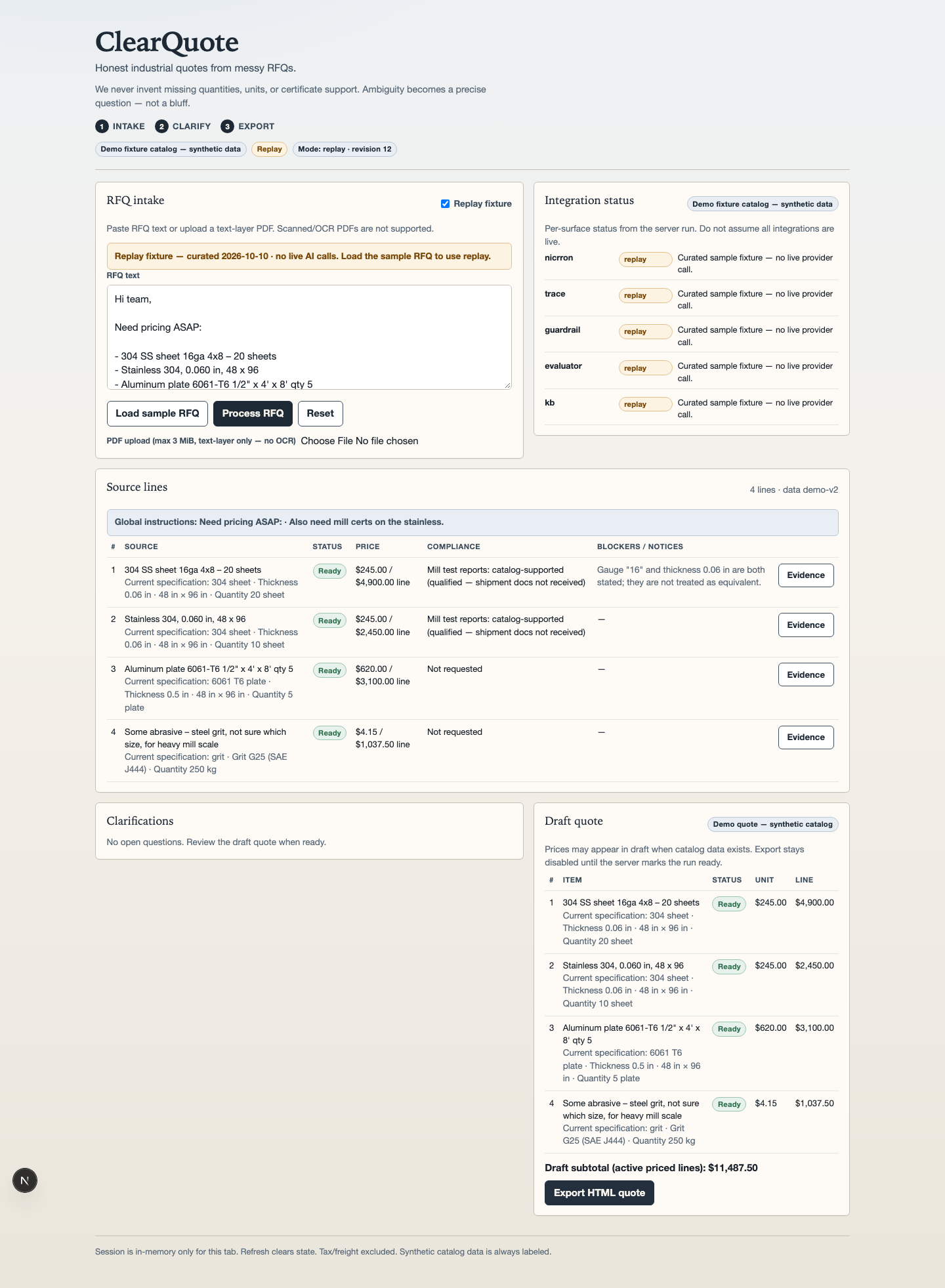
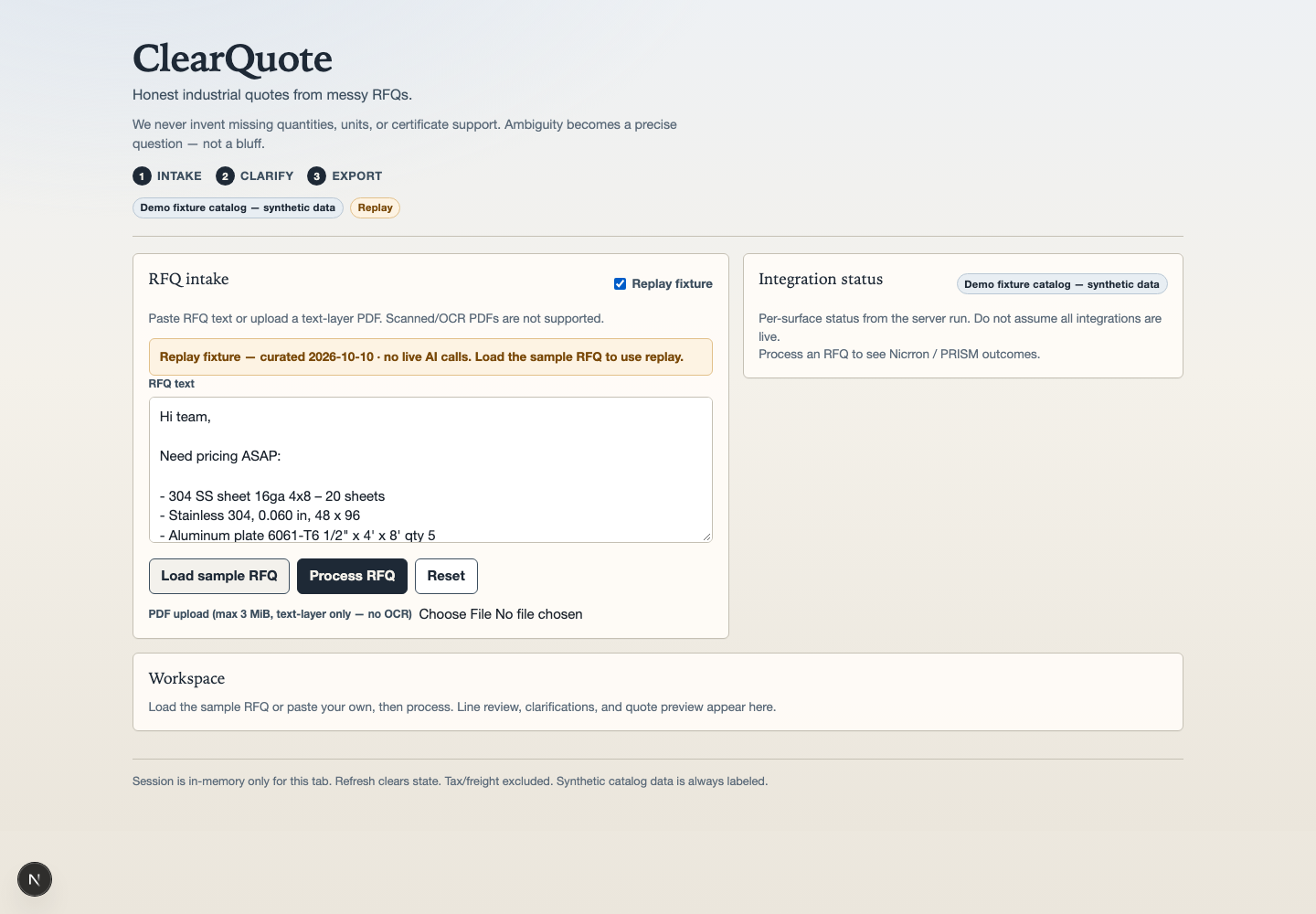
ClearQuote accepts pasted RFQ text or a PDF containing selectable text. It preserves each source item, proposes structured specifications, checks catalog compatibility, calculates prices and surfaces compliance requirements.
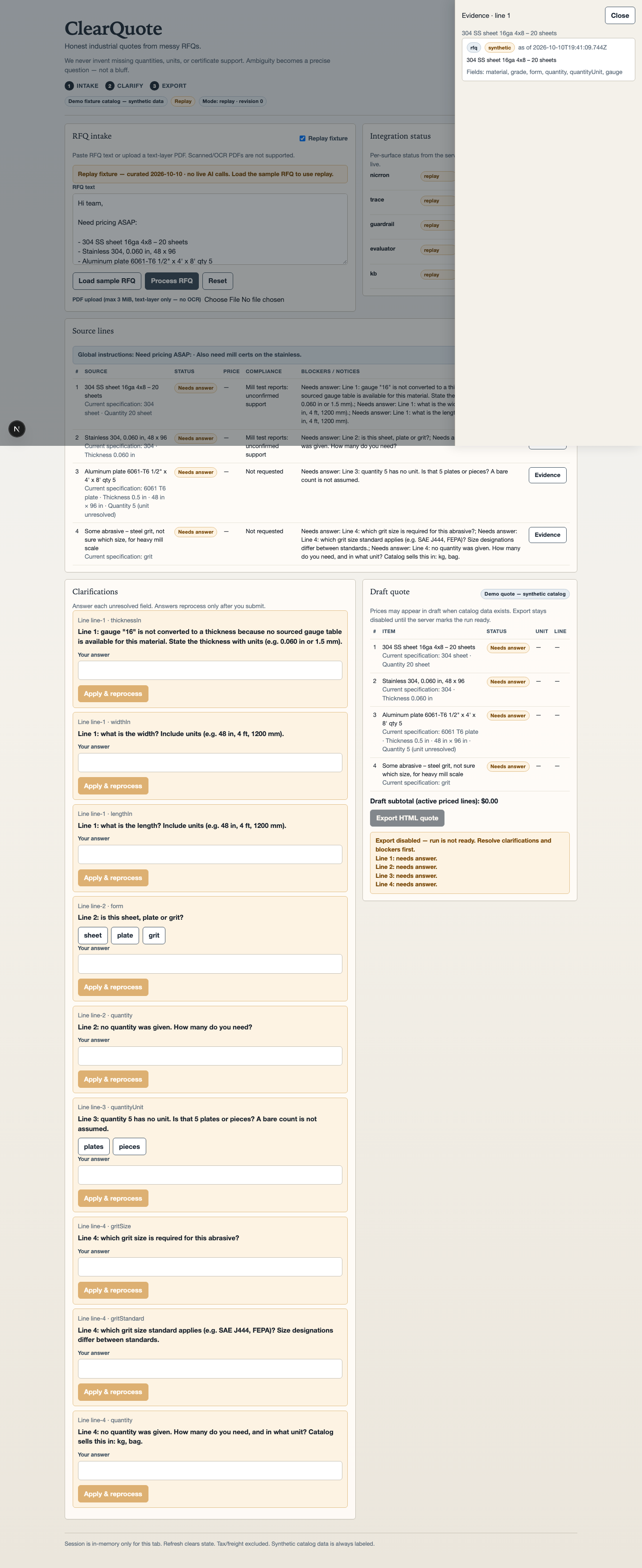
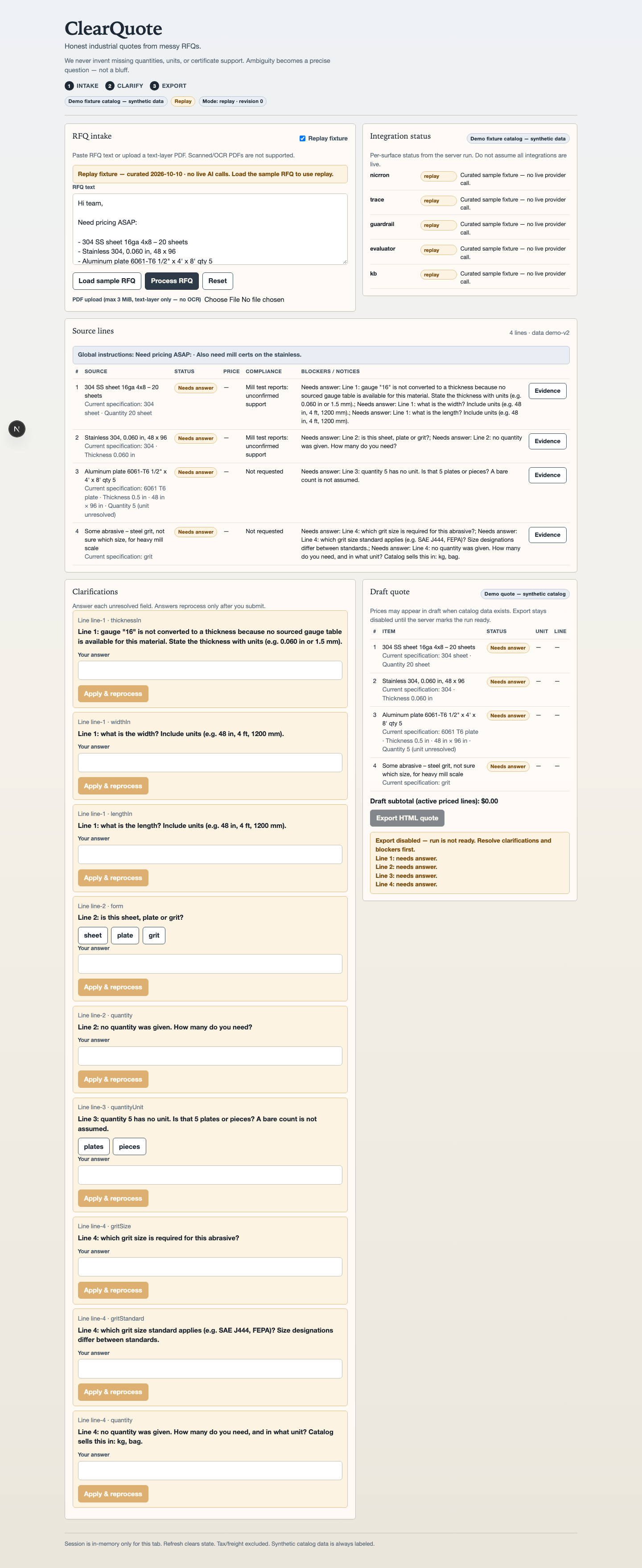
Missing quantities, unclear units and abrasive specifications become focused buyer questions. Similar-looking lines remain separate until the buyer confirms their intent. Each answer becomes evidence, and the server recalculates readiness before allowing an HTML quote export.
The catalog and benchmarks are clearly labeled synthetic demo data. Prices demonstrate the workflow; they do not represent current supplier inventory or market prices. Catalog-supported certificate capability does not mean shipment documents have been received.
How we built it
ClearQuote uses Next.js, React and TypeScript, deployed on Vercel. Nicrron provides structured language interpretation. PRISM by Block Convey supplies input guardrails, tracing, readiness evaluation and Knowledge Base grounding.
Server-side code validates model output against the original source, performs deterministic matching and pricing, and controls finalization. Signed snapshots protect server-derived state from browser edits.
We used parallel coding and review agents, including Ninoo Code, while keeping integration and verification under one coordinated workflow.
Challenges we ran into
The hardest challenge was preventing plausible model output from becoming unsupported facts. We added checks for omitted or merged source lines, unsupported quantities and ambiguous units. Gauge is never silently converted into thickness.
We also made evaluator disagreement a real export blocker. A failed verdict remains visible; a fresh passing review is required to proceed. Deployment testing caught a PDF dependency missing from the serverless bundle, which we fixed and verified on Vercel.
Accomplishments that we're proud of
The hosted original four-line sample completed with real Nicrron and PRISM integrations, a passing 92/100 evaluator result and successful quote export. A separate live PDF workflow also passed.
The application passes 94 unit tests, type checking and five hosted browser checks. Injection, tampered-state and unresolved-export checks reject unsafe requests.
What we learned
Trustworthy automation needs more than a good extraction prompt. It needs source preservation, explicit uncertainty, traceable buyer answers and server-enforced decision gates.
What's next for ClearQuote
Connect real supplier catalogs and benchmarks, add durable multi-user history, and expand document support. The current prototype provides in-app clarification and downloadable quotes; real email delivery, ordering and scanned-PDF OCR remain future work.
Built With
- next.js
- nicrron
- ninoo
- prism
- react
- tailwind-css
- typescript
- vercel
- zod