Inspiration
It started with my grandmother at her kitchen table, holding a letter she had read four times and still didn't understand. It was from her health insurer — a dense page of codes that ended with a number in bold: she owed $4,000. She was ready to quietly start paying it, because that felt safer than admitting she didn't understand. Buried three paragraphs down was the part that actually mattered: she had the right to appeal, and a deadline to do it.
She isn't alone. Every day, people get eviction notices, surprise medical bills, benefits-termination letters, and government notices written in a language they don't speak — legalese — usually at the exact moment they're most stressed and least able to deal with it. The challenge brief is called "Help Is Hard to Find," but we realized the truth is sharper: the help often exists. The letter standing between a person and that help is what's impossible to read.
So we built Plainsight. We gave my grandma an early version with one of her benefits letters. Fifteen seconds later she had it in plain words, her deadline counted down to the day, and the phone number for free help — and for the first time that week, she wasn't scared of the envelope. That was the whole project, right there.
What it does
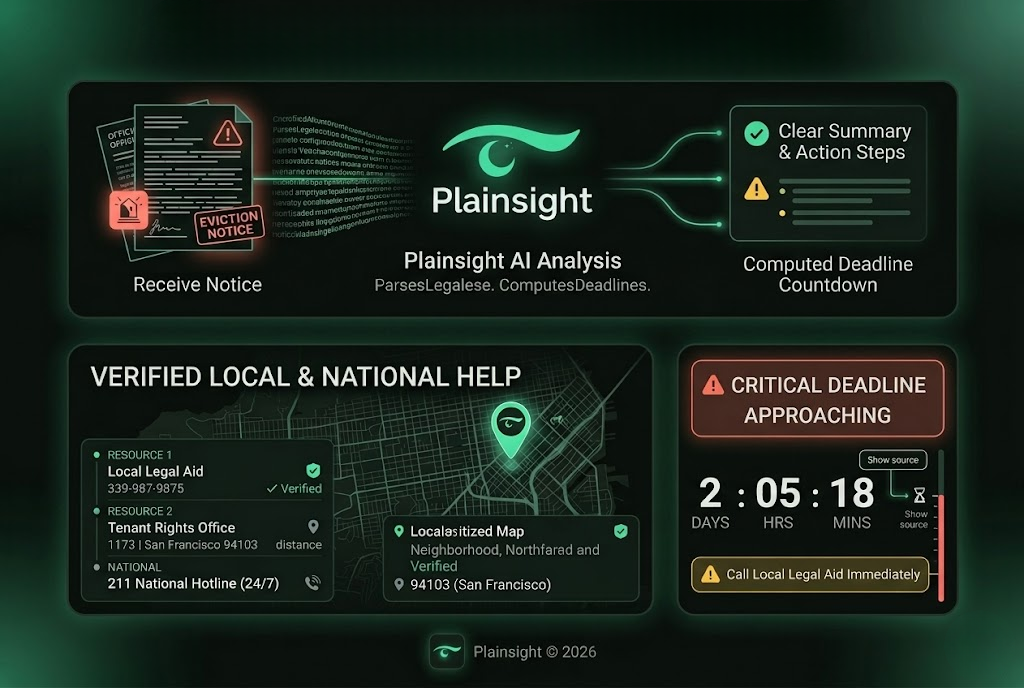
You paste, upload, or photograph a confusing official notice. Plainsight reads it and gives you back the same thing every time:
- A plain-language summary at a 6th-grade reading level (with a "more detail" toggle).
- The one deadline that matters, extracted and shown as a live countdown — it even computes the real calendar date when the letter only says "within 3 days of service."
- A prioritized checklist of what to actually do, ordered by urgency.
- Real, verified human help — legal aid, 211, patient advocates, benefits offices — matched to your document type, plus offices near you from your ZIP code.
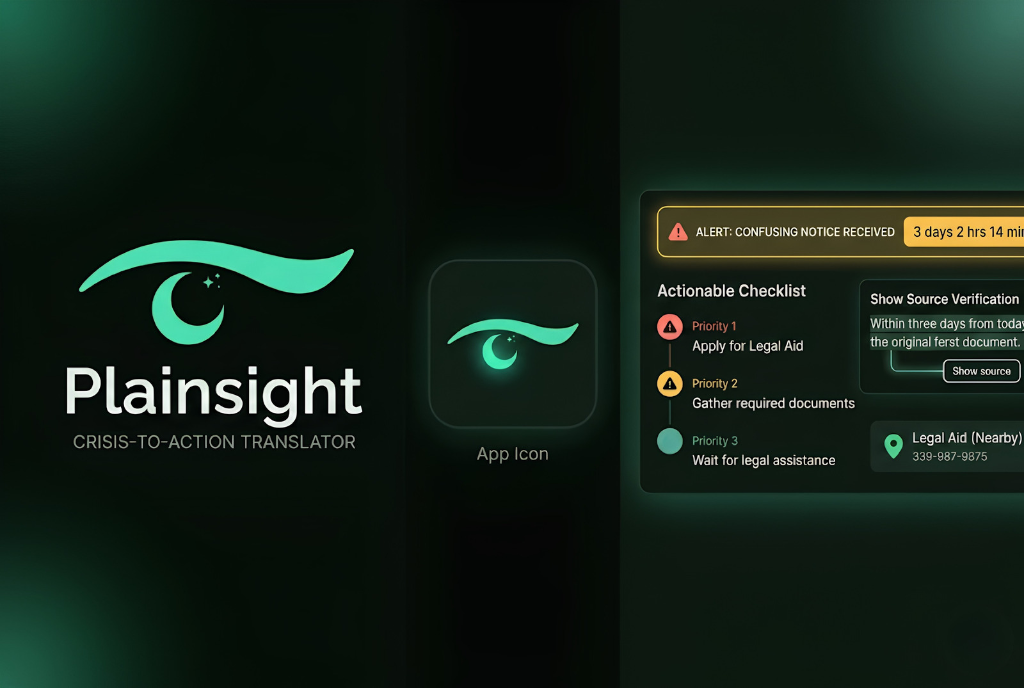
- A source for every fact. Tap "Show source" and Plainsight shows the exact line from your letter, verified word-for-word, so you never have to take the AI's word for it.
It works on eviction notices, insurance/medical bills, hospital discharge papers, school notices, government letters, and benefits notices — and it speaks English, Spanish, Chinese, Vietnamese, and Tagalog. You can save the plan however you need: add the deadline to your calendar, download a PDF, share it to Messages or Reminders, email it, or print it.
And it's honest about its limits: it names the decision it won't make ("it doesn't decide whether to fight an eviction or move — a lawyer should advise that") and hands you to a human.
How we built it
Plainsight is a structured intake → fixed pipeline → structured output system, not a chatbot.
- Intake (in the browser): files are parsed on-device — PDFs with
pdf.js, Word docs with Mammoth, and photos with Tesseract OCR — so nothing but the extracted text ever leaves your device. - Extraction (one AI call): the text goes to Llama 3.3 70B via Groq, called once, in strict JSON mode, against a fixed schema at low temperature. The same prompt runs on every document, so the output is consistent instead of "whatever a conversation happens to produce." The model also returns a verbatim source quote for each deadline and step.
- Deterministic enrichment (no AI): our server computes "days remaining" from the extracted date and attaches resources from a hand-verified database by category — so links and phone numbers can never be hallucinated.
- Output: a React + Tailwind interface designed for a stressed person — calm, high-contrast, legible the instant it loads. Translation is a second on-demand model call that translates only the values, leaving numbers, dates, and org names untouched.
No database, no login. Checklist progress lives in your browser. It deploys as a Vercel serverless function.
Challenges we ran into
- Making an LLM reliable. Free-form output is useless in a crisis. We treated the prompt as a contract: strict JSON schema, low temperature, and a single call — then wrapped it in deterministic code for anything that has to be exact.
- The deadline can't be wrong. A misread date is the most dangerous failure for this user, so we made the model compute calendar dates from phrases like "within 3 days," show a capped confidence score, and pin a "verify this against your actual notice" reminder next to every date.
- Stopping hallucinated help. Early on, the model invented plausible-sounding hotlines. We moved all resources to a hand-verified database and made local results live Google Maps searches — never AI-generated.
- Proving trust. It isn't enough to be right; a scared person has to believe it. That's why we built word-for-word source traceability.
- Privacy + phones. We pushed document parsing (including OCR) entirely client-side and resolve location in the browser, so we never have to store anything sensitive.
Accomplishments that we're proud of
- One pipeline that handles six very different document types — and could handle more — instead of six brittle one-offs.
- Source traceability: every claim links back to the exact words in your own document, with a "found word-for-word" check. This is our answer to "why should I trust an AI with this?"
- Genuinely private: no login, no database, on-device parsing.
- Built for everyone in the crisis: five languages, 6th-grade reading level, works on a phone, and a real human handoff every time.
- Responsible AI as a feature, not a disclaimer — the confidence score, the "verify this date" prompt, and "the decision Plainsight won't make" are all visible in the product.
What we learned
- The hard part of "help" is trust, not information. Showing our work mattered more than any single feature.
- An LLM is most powerful when it's boxed in. Strict schemas and deterministic code around the model turned an unpredictable chatbot into a dependable tool.
- Designing for a stressed user is its own discipline — fewer words, bigger type, the deadline first, no jargon, and calm by default.
- Accessibility and language access aren't extras for this audience; they're the difference between help and no help.
What's next for Plainsight
- Deadline reminders via the calendar export and optional SMS, so people get nudged before the window closes.
- Deeper local routing — integrating directories like 211 and legal-aid finders so "near me" goes straight to the right office.
- More document types and categories (education, immigration, utilities) on the same pipeline.
- Partnerships with legal-aid and patient-advocacy nonprofits to keep the verified resource database current.
- More languages and screen-reader/voice-first modes.
- A privacy-preserving way to measure the only metric that matters: did the person act before their deadline?
Built With
- bigdatacloud
- express.js
- framer-motion
- google-calendar
- groq
- icalendar
- javascript
- jspdf
- llama-3.3-70b
- lucide
- mammoth.js
- node.js
- pdf.js
- react
- resend
- tailwindcss
- tesseract.js
- vercel
- vite
- web-share-api


Log in or sign up for Devpost to join the conversation.