
Inspiration
Every day, millions of people across the EU receive medical letters, insurance documents, and legal notices filled with jargon they cannot understand. For older adults, non-native speakers, and anyone without a medical or legal background, a single paragraph can mean the difference between following treatment correctly and missing a critical deadline.
We were inspired by public-service kiosks the kind you see in hospitals and government offices where clarity and accessibility matter more than flashy design. We asked: what if understanding your own paperwork was as simple as using an ATM?
What it does
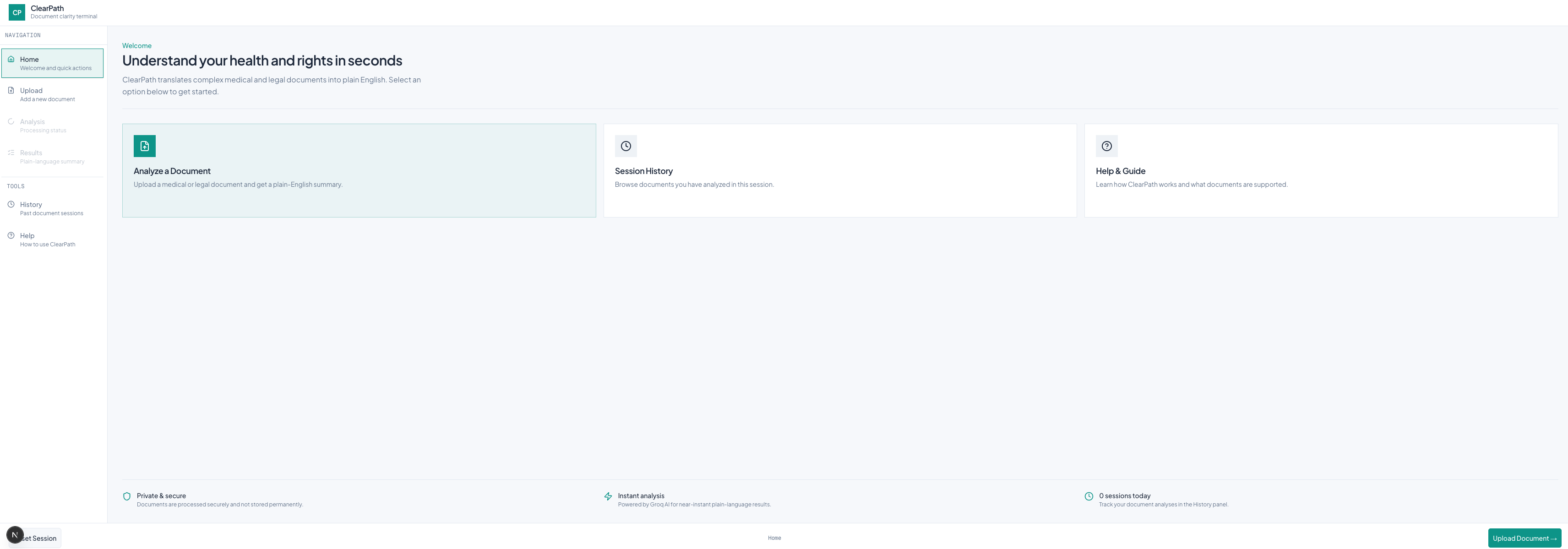
ClearPath is a kiosk-style web application that:
- Accepts - a medical or legal document (PDF or plain text)
- Extracts the text and sends it to Groq AI
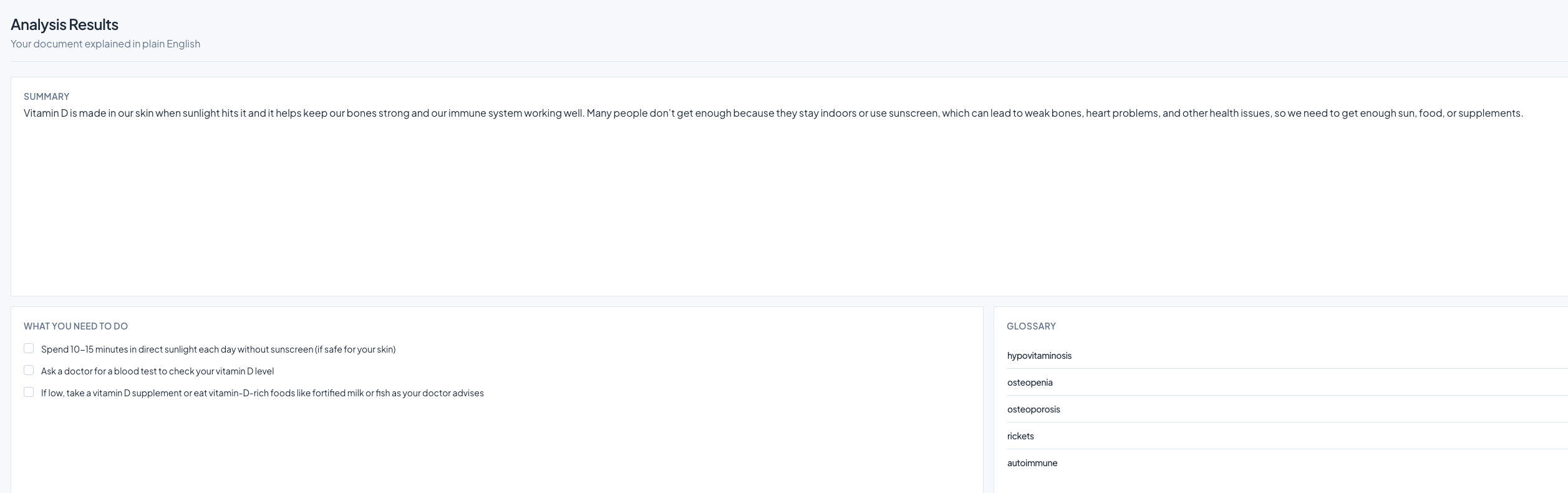
- Returns a structured, plain-English analysis with:
- Summary -- 2 sentences explained like you're 10 years old (ELI5)
- Action Items -- 3 concrete steps to take (with checkboxes)
- Glossary -- difficult terms with simple definitions The app is fully in English, designed for the EU market, and built as a navigable multi-panel application (Home, Upload, Analysis, Results, History, Help) not a marketing landing page.
How we built it
- Frontend: Next.js 16 (App Router), React 19, TypeScript, Tailwind CSS v4, shadcn/ui, Plus Jakarta Sans
- AI: Groq API (
openai/gpt-oss-120b) via Vercel AI SDK withstreamObjectfor real-time structured JSON output - PDF parsing:
unpdffor server-side text extraction - Schema validation: Zod schema enforcing
summary,action_items[3],difficult_words[] - Deployment: Vercel with
GROQ_API_KEYas environment variable - Development: Cursor + Claude for rapid iteration
Architecture flow:
Upload PDF → /api/extract (unpdf) → plain text → /api/analyze (Groq streamObject) → UI panels
The kiosk UI was designed with sharp panels, high-contrast teal accents, and large touch targets optimized for clarity over aesthetics.
Challenges we ran into
- PDF extraction vs. demo shortcuts: Our initial hackathon MVP sent hardcoded sample text instead of reading the uploaded file. We caught this during testing and implemented real PDF text extraction with
unpdf. - Scanned PDFs: Image-based (scanned) PDFs cannot be parsed without OCR, we added clear error messages and documented supported formats.
- Model deprecation: Groq deprecated older Llama 3 models during development; we migrated to
openai/gpt-oss-120bfor structured output support. - From landing page to application: Our first version looked like generic AI slop. We redesigned into a kiosk-style multi-panel app with proper navigation and institutional UX.
Accomplishments that we're proud of
- Built a working end-to-end pipeline real PDF upload → text extraction → AI analysis → structured UI in under 24 hours
- Achieved near-instant results thanks to Groq's LPU inference speed
- Designed a genuinely usable kiosk interface with Home, History, Help, and step-based workflow
- Zero cost to run on Groq free tier + Vercel free tier
- Structured AI output that is actionable, not just a wall of text
What we learned
- Structured output (
streamObject+ Zod) is far more useful than free-form chat for document analysis users need predictable sections, not paragraphs - Speed matters: when analysis takes under a second, the product feels trustworthy; when it takes 5+ seconds, users assume it broke
- Kiosk UX patterns (step indicator, sidebar nav, action bar) work better than scrollable landing pages for utility apps
- Always test with a real uploaded file demo shortcuts hide broken pipelines
What's next for ClearPath
- OCR support for scanned PDFs and image uploads (JPG, PNG)
- Multi-language output: English, Polish, German, French for broader EU coverage
- Document type detection: auto-tune prompts for medical vs. legal vs. insurance documents
- Printable action plan: export summary + checklist as PDF
- Accessibility audit: WCAG 2.1 AA compliance for public kiosk deployment
- Persistent history with optional anonymous session storage
Authors
- Kamil Piejko - full stack
- Joanna Pich - flow and logic
- Dominika Zięba - UI
Built With
- ai
- cursor
- groq
- healthcare
- nextjs
- node.js
- react
- shadcn-ui
- tailwindcss
- typescript
- unpdf
- vercel
- vercel-ai-sdk
- zod

Log in or sign up for Devpost to join the conversation.