Inspiration
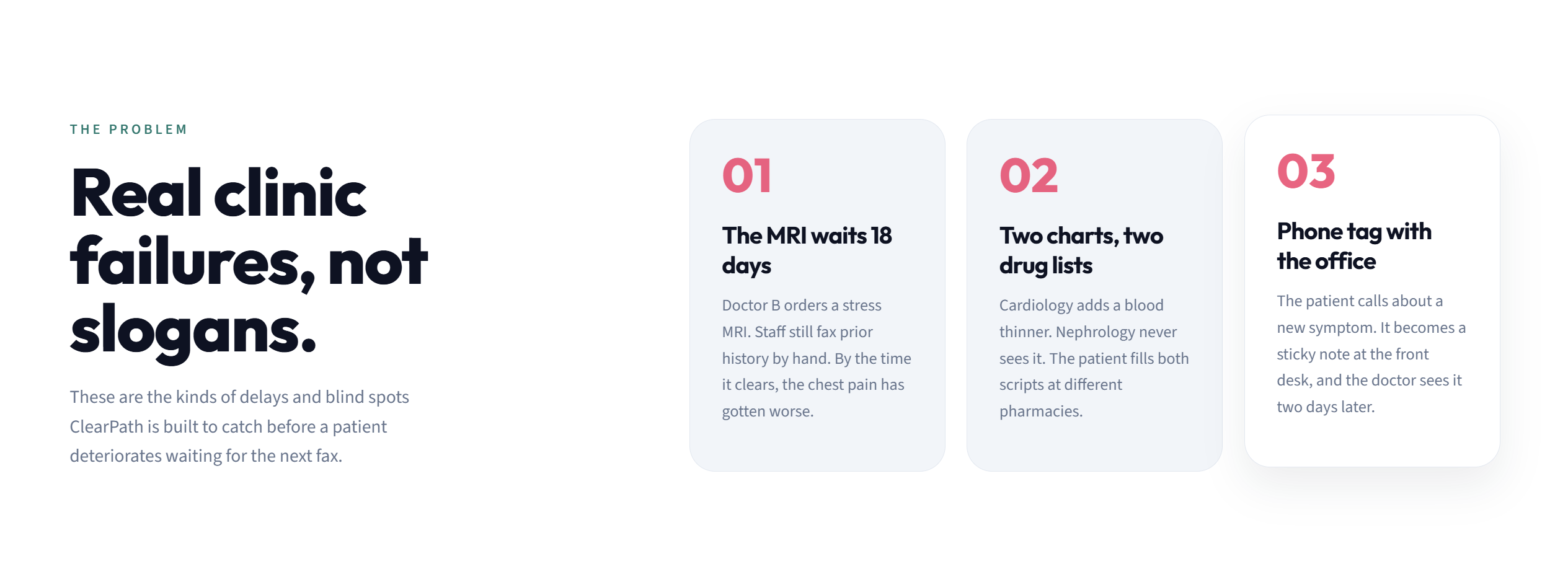
The doctor has a treatment plan. The patient has hope to get better soon. but, The next step is waiting for a approval.
Behind that wait are questions someone must answer: Does this health service require prior authorization? What documentation does the insurance plan need? Which doctor has the missing information? Who is following up?
For the patient, those questions become one: “What happens next?”
We built ClearPath Health to make that answer clearer.
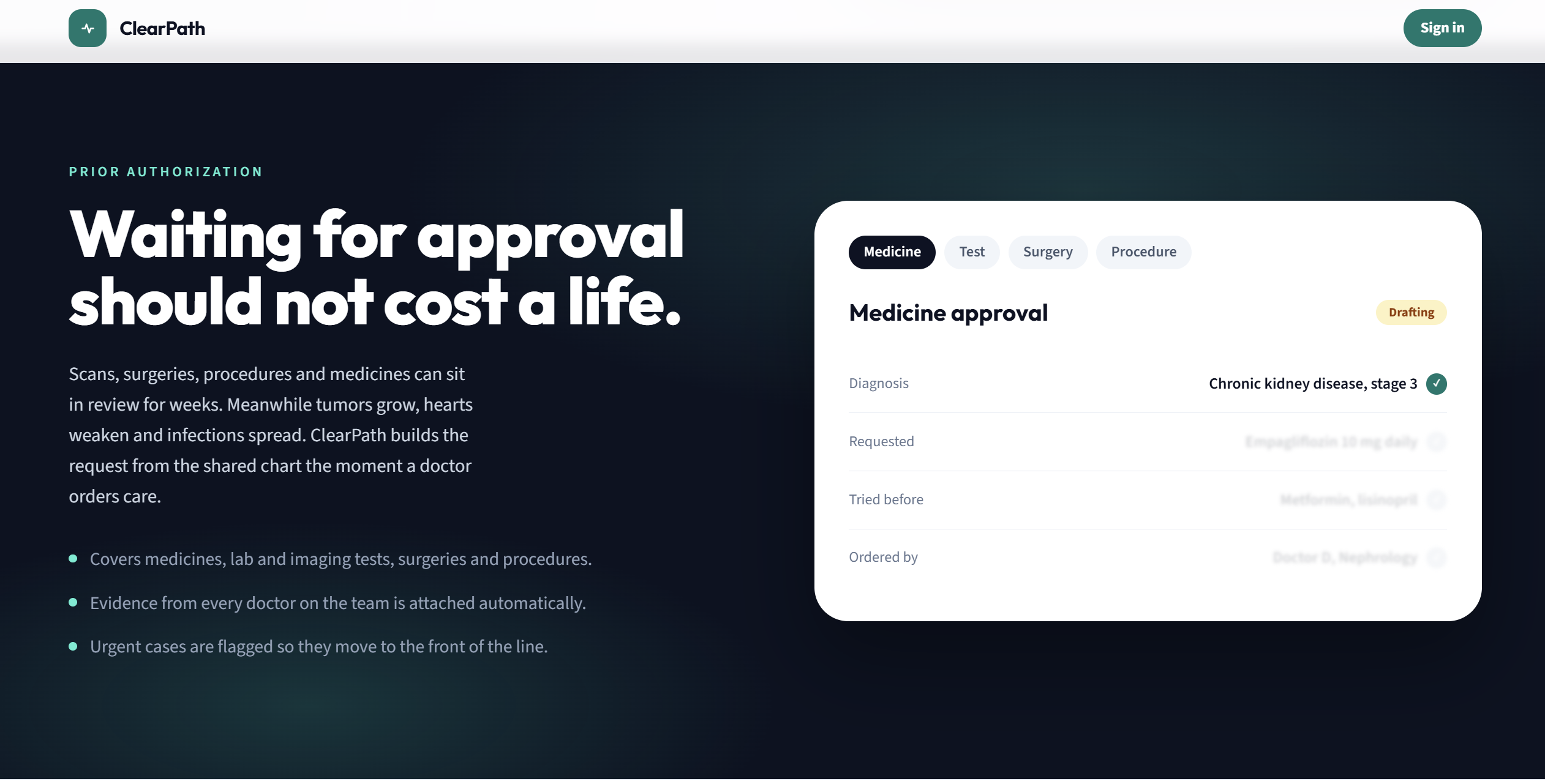
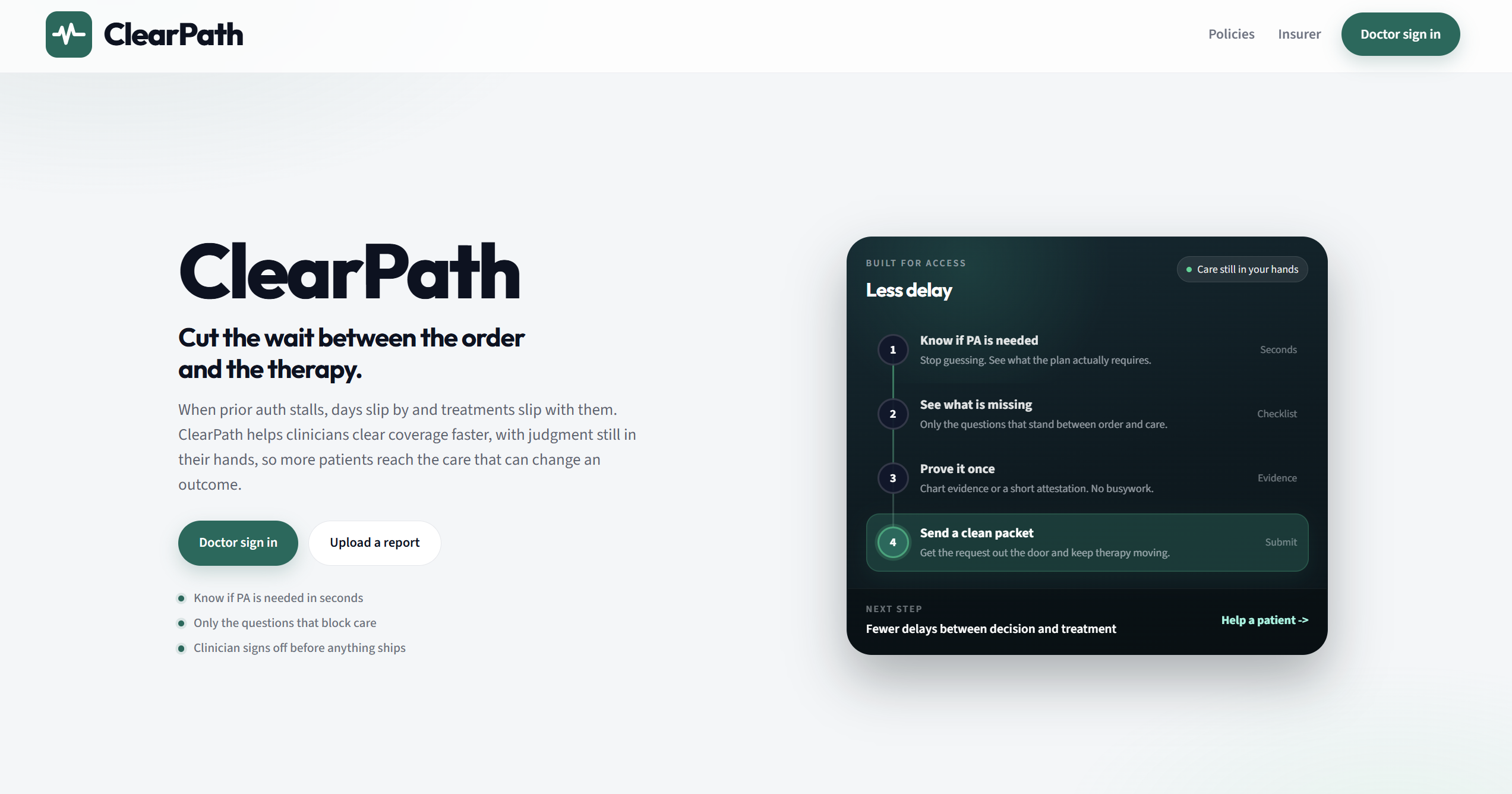
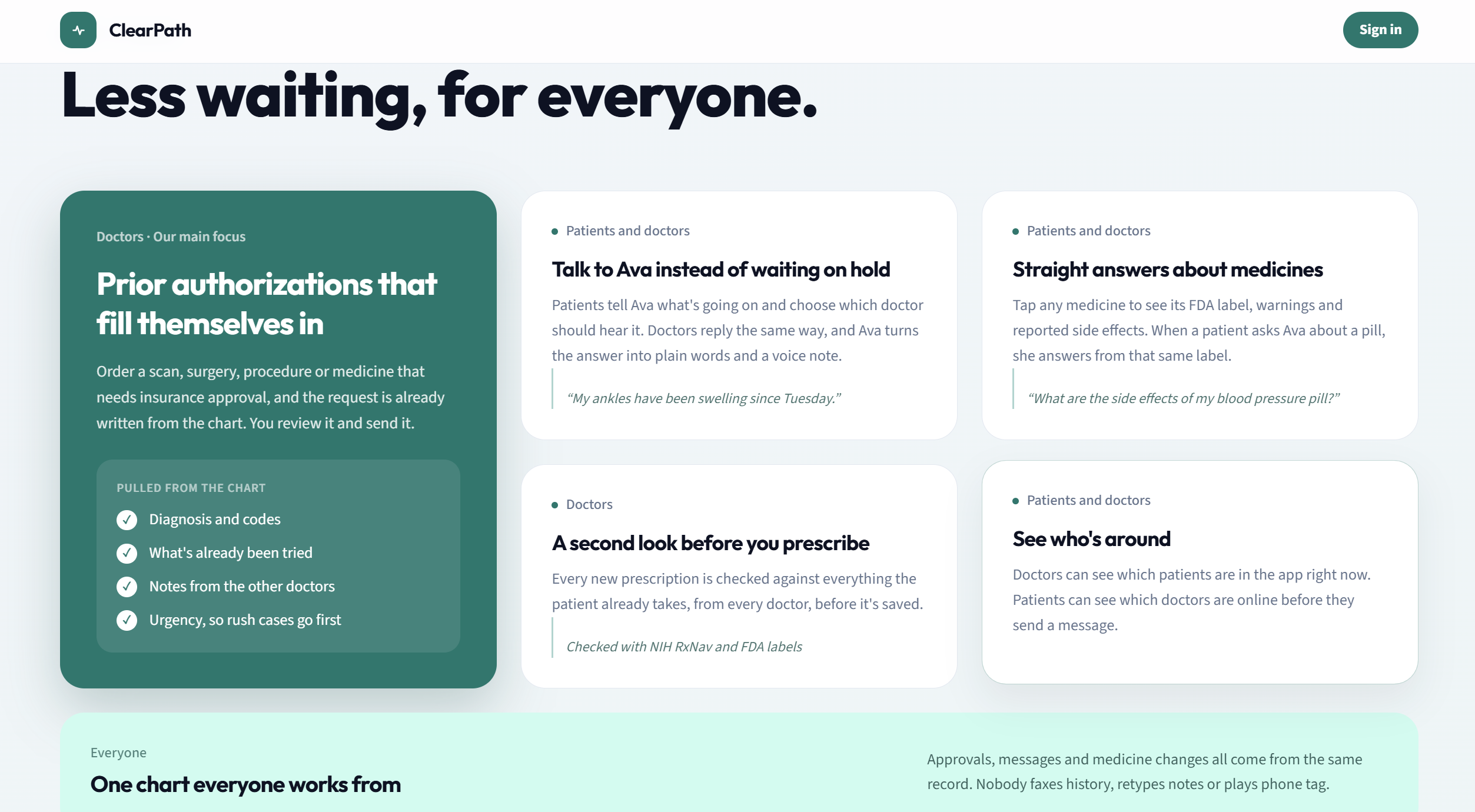
Prior authorization is our primary focus. We turn insurance policy requirements into structured checks, guided documentation, and a review workflow that patients can follow.
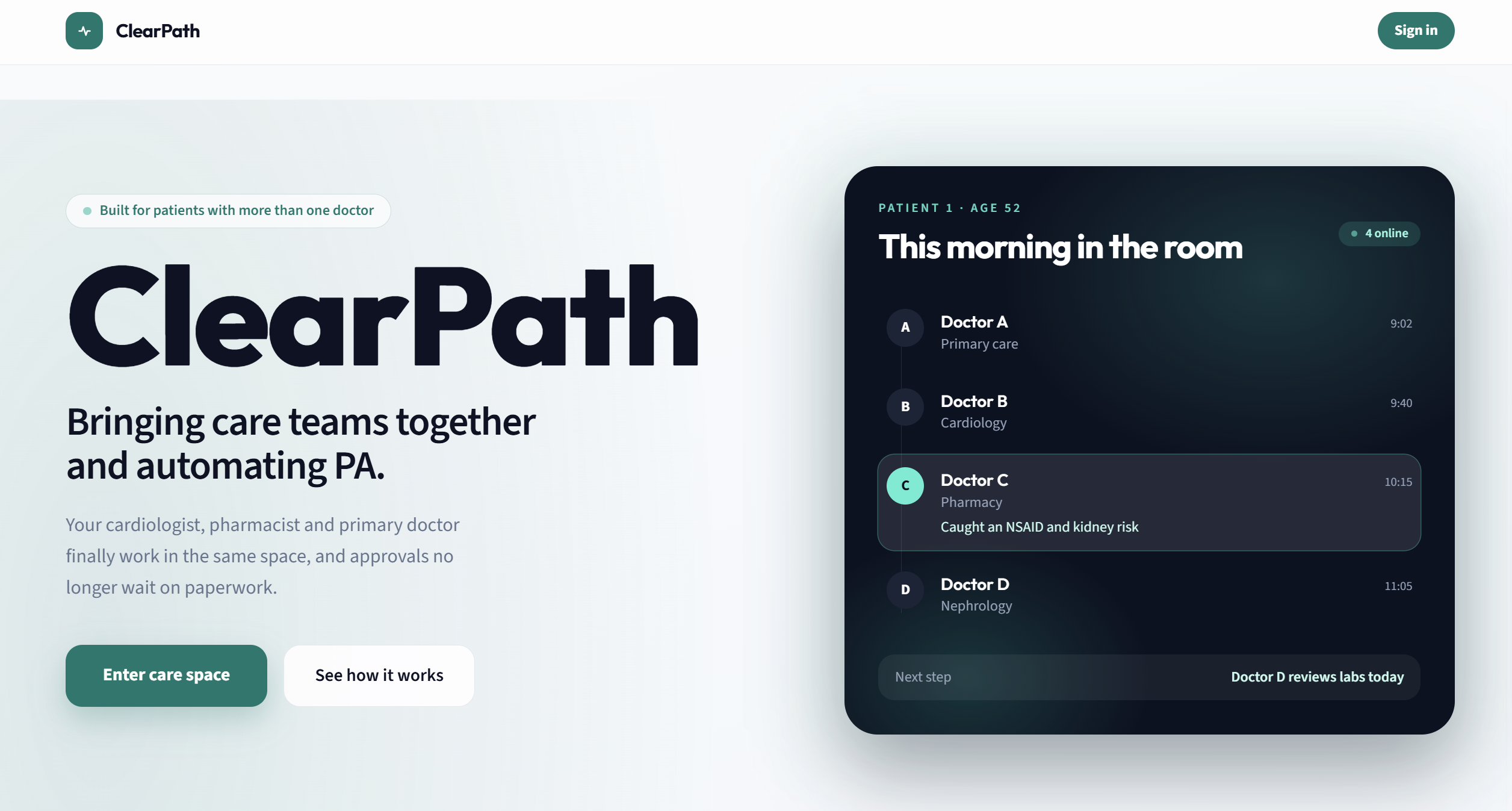
Supporting that process is a shared care experience where doctors communicate around one chart and patients can participate in their care. A primary care doctor, cardiologist, and endocrinologist may each hold information relevant to the same treatment request. ClearPath creates a place for that context to come together.
Our goal is to help healthcare professionals move care forward while keeping patients connected to the people working on their behalf.
What it does
Makes prior authorization requirements understandable
Our PA engine is grounded in a real 253-page 2026 UnitedHealthcare Dual Complete OH-S3 Evidence of Coverage document.
We structured its medical benefits and authorization information into 90 benefit categories:
| Authorization requirement | Categories |
|---|---|
| Required | 41 |
| Not required | 41 |
| Conditional | 8 |
Each category includes source page references and relevant coverage notes. Conditional requirements preserve distinctions such as diagnosis, service location, and network status.
A doctor enters the patient, insurance plan, and requested treatment. The engine checks the policy library and identifies the applicable authorization requirement.
An “authorization not required” result answers that specific question; other coverage and payment requirements still apply.
Guides a request from documentation to decision
When authorization is required, the doctor completes a structured questionnaire and submits the request to a reviewer queue.
The reviewer can approve, deny, or request additional information. If more information is needed, the doctor can complete the missing documentation and resubmit.
Each action becomes part of a timestamped history. The patient-facing status page reads from the same request record, keeping progress connected to what actually happens in the workflow.
Prior Authorization Workflow
- Enter the request: The doctor selects the patient, insurance plan, and treatment.
- Check the policy: ClearPath identifies whether authorization is required, not required, or conditional, with source references.
- Prepare documentation: When needed, the doctor completes the supporting questionnaire.
- Review and verify: The doctor checks the evidence and answers before submission.
- Submit: The request is sent through the prototype’s simulated insurer workflow.
- Track progress: The patient can view the request’s status and recorded history.
Brings the care team together around the patient
The shared care application brings together conditions, medicines, visit notes, treatment information, and conversations.
Each patient has a team room. AI-generated briefings organize shared context around three questions:
- Who owns the next step?
- What question is still open?
- What needs to happen next?
The Insights page brings handoffs and team activity into one view. Presence indicators show who is active, and a care-team graph makes the relationships around the patient visible.
This shared context supports our broader authorization goal: assembling relevant evidence and helping the right people resolve outstanding questions.
The shared-care application and PA engine were developed as separate workstreams. Completing their connection is our next integration milestone.
Gives patients a voice through Ava
Patients can speak or type to Ava, describe a concern, and answer follow-up questions. They then choose whether to send the conversation summary to one doctor or the whole care team.
Doctors receive organized context linked to the patient. They can also use Ava to draft an explanation in everyday language, review and edit it, and send it as text with an optional voice note.
A patient can explain what they are experiencing in their own words, and a doctor can respond with the relevant context already available.
Supports medication review and explanation
Doctors can open a medication panel containing label information, warnings, product details, reported adverse events, and source links.
The “Explain to the patient with Ava” action prepares a patient-friendly draft from the retrieved label. Patients can also ask questions about their medicines using that same information.
The prescription-checking workflow considers active medicines across prescribers and surfaces potential concerns for clinician assessment.
Questions about starting, stopping, or changing a dose remain with the doctor. Adverse-event reports are presented with context explaining that reports alone do not establish causation or an individual patient’s risk.
How we built it
We built the shared-care application with a Next.js and React frontend and a FastAPI backend, deployed through Vercel.
Policy ingestion and authorization engine
We extracted benefit and authorization information from the insurance document into a structured policy library. Rules preserve their classification, conditions, coverage notes, and source references.
Policy libraries can move between draft, live, and archived states, with an audit trail recording changes.
The PA engine connects those rules to documentation questionnaires and a request workflow. Request history is append-only, preserving earlier actions and decisions. Questionnaire safeguards protect already-submitted answers.
How the Policy Engine Works
- Read the policy: Extract text from the uploaded insurance PDF.
- Structure the requirements: Organize the policy into authorization rules, conditions, and source references.
- Validate with Grok: A second-model review flags potential issues for human inspection.
- Review and activate: A person accepts, edits, or rejects extracted items before activating the policy library.
- Check the treatment: The engine uses the patient, plan, and requested service to identify applicable requirements.
- Prepare the request: The doctor completes the documentation, checks supporting evidence, and verifies answers before submission.
- Preserve progress: The request history records actions and supports the doctor and patient status views.
We represented authorization requirements using FHIR-shaped CoverageEligibilityResponse data and documentation through Questionnaire and QuestionnaireResponse.
These structures provide a foundation for future interoperability work. The demonstration uses a reviewer queue rather than a live payer connection.
AI and data services
Each service has a specific responsibility within the experience:
| Technology | Role |
|---|---|
| Policy rules engine | Checks structured authorization requirements and conditions |
| FHIR-shaped resources | Organize authorization and documentation data |
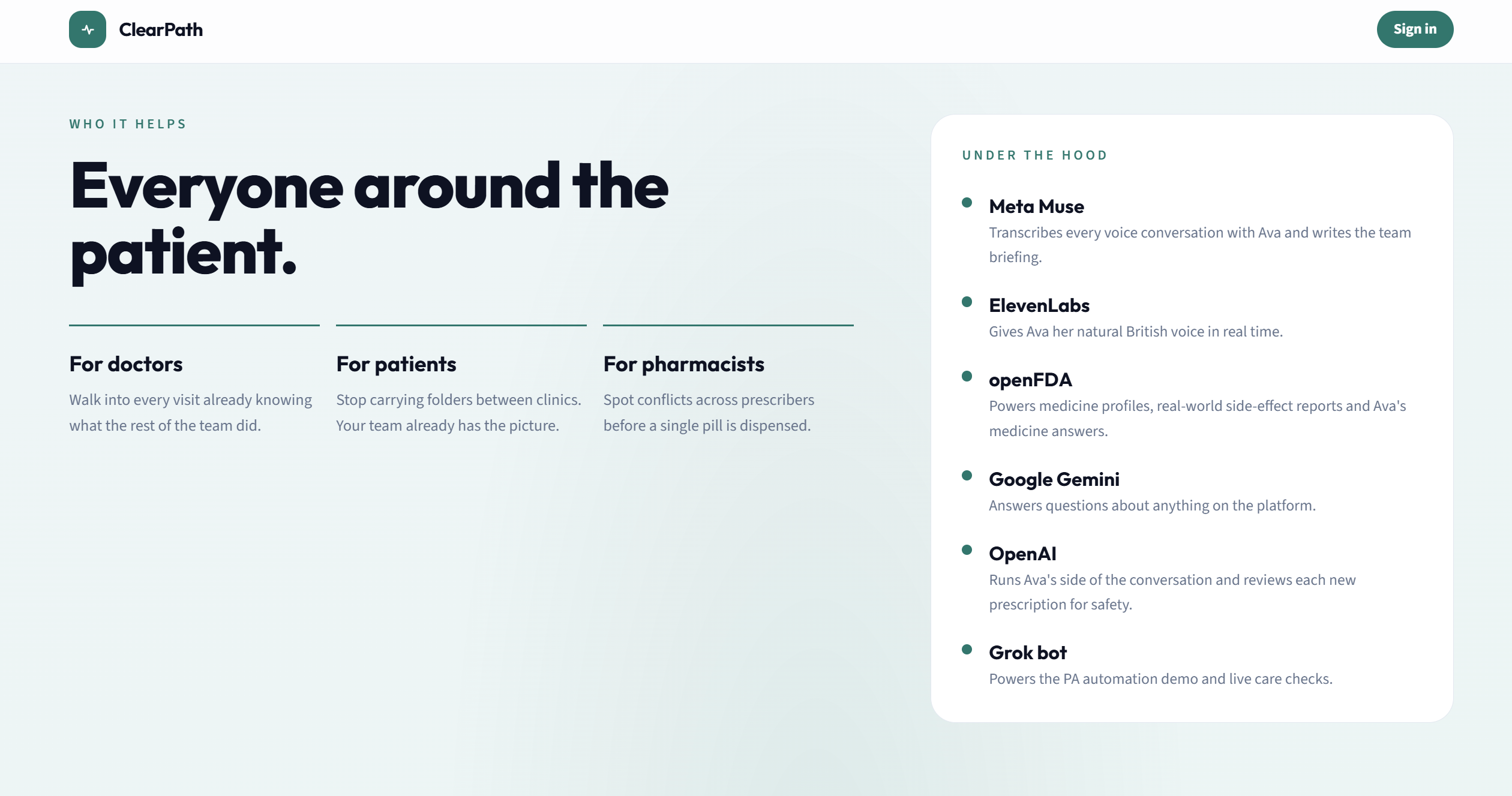
| Google Gemini | Powers Ask ClearPath using available application data and screen context |
| Muse Spark integration | Generates care-team briefings with ownership and next steps |
| Muse Voice integration | Transcribes audio in the voice workflow |
| OpenAI | Supports Ava’s conversations, summaries, and message drafts |
| ElevenLabs | Produces Ava’s spoken replies when configured |
| openFDA | Supplies medication labels, product information, and adverse-event data |
| NIH RxNav | Supports medication lookup and normalization |
The communication workflow connects AI assistance to a human recipient:
Patient speaks/types → Ava gathers context → Patient reviews → Doctor receives → Doctor reviews → Patient gets response
We added medication-data caching, preloading, and duplicate-request handling to improve responsiveness. We also refined label matching to reduce confusion between individual medicines and combination products.
Explicit rules manage authorization requirements and workflow transitions. AI helps organize and explain information, while people review communication and authorization decisions.
Challenges we ran into
Preserving the meaning of insurance policies. Requirements and exceptions can appear across different sections. We retained conditional classifications and source references so the structured rules remain connected to their original context.
Separating different decisions. Whether authorization is required, whether documentation is complete, and whether a reviewer approves a request are different questions. Our workflow represents each explicitly.
Making collaboration actionable. Shared information becomes more useful when someone owns the next step. This shaped our briefings, handoffs, and activity views.
Matching everyday medication language. Patients may describe a medicine by its purpose, while source data uses ingredient names, brands, and product identifiers. We refined matching around the patient’s chart and the appropriate label.
Keeping the application responsive. We addressed blocking AI calls, duplicate Ava responses, and a medication-preloading issue that froze the backend.
Integrating parallel workstreams. When a planned extraction branch could not be merged, we built an isolated upload module feeding the PA order desk. That kept the authorization demonstration progressing and clarified the remaining integration work.
Accomplishments that we're proud of
We turned a real insurance document into 90 structured benefit categories and built a guided authorization workflow around them: requirement checks, documentation, reviewer decisions, and patient-visible history.
Alongside that, we built a shared care experience where patients can explain concerns, doctors can coordinate, and AI can organize information into understandable next steps.
Impiricus: Invent the Next Way We Engage HCPs
ClearPath’s proposed HCP engagement model begins with work that already matters to a clinician: moving a treatment request forward.
The authorization engine helps identify requirements and organize documentation. The shared-care experience supports clarification, medication review, and patient explanations in the context of that work.
A clinician can inspect medication information, prepare a patient-friendly explanation, and coordinate with another provider around the same chart.
The potential commercial value is a workspace healthcare professionals can return to whenever care requires authorization or collaboration. We would validate that value through documentation effort, request completeness, repeat use, and clinician feedback.
Meta: Bringing People Closer Together with AI
ClearPath focuses on the relationships between a patient and their care team, and among the professionals caring for that patient.
A patient can have several doctors and still feel alone coordinating their care. Our shared experience is designed to help those people work together with a clearer understanding of one another.
Ava helps patients express concerns in their own words and share them with a chosen doctor or team. AI-generated briefings help doctors understand shared updates and identify responsibility. Reviewed explanations help patients understand the response.
AI plays a meaningful role by organizing conversational and chart information into something another person can use: a concern summary, an understandable explanation, or a handoff with a clear owner.
Prior authorization gives that collaboration a concrete purpose. Missing documentation requires coordination. A request for clarification needs an owner. A changing status needs an understandable update for the patient.
The connection we aim to strengthen is a patient and their doctors working together through the next step of care.
AI/ML: Oracle of the Deep
ClearPath combines conversational AI, retrieved medication information, chart context, structured summaries, and task-oriented briefings with an explicit policy rules engine.
The engineering challenge is selecting relevant information, preserving its meaning, and producing useful outputs within a workflow.
Gemini contributes contextual assistance through Ask ClearPath. Ava combines conversation, transcription, and speech to support communication. The rules engine provides a traceable foundation for authorization checks.
Our evaluation priorities include policy-extraction accuracy, summary fidelity, medication-match quality, response time, and whether users can identify and complete the next step.
Gemini and ElevenLabs
Gemini powers Ask ClearPath, allowing users to ask questions with available platform data and screen context.
ElevenLabs gives Ava a spoken interface and supports the voice experience alongside text. Its purpose is practical: letting people hear an explanation and participate through conversation.
What we learned
We learned that a useful authorization experience begins before a request is submitted.
It begins with identifying the applicable policy, understanding its conditions, and gathering information from the people caring for the patient.
We also learned that an AI output needs a clear destination. A summary should help a doctor respond. A briefing should help someone take ownership. An explanation should help a patient understand.
Traceability matters throughout: a rule needs a source, a status needs an event behind it, and a next step needs an owner.
Building ClearPath showed us how administrative clarity and human connection support each other.
What's next for ClearPath
Our immediate priority is connecting the shared chart and PA engine into one continuous experience: treatment request, supporting evidence, policy check, documentation, review, and patient-visible status.
Next, we plan to:
- Validate extracted rules and documentation workflows with domain experts.
- Expand the policy library beyond the initial insurance plan.
- Replace in-memory demonstration data with persistent storage.
- Strengthen permission-based sharing and auditability.
- Integrate real payer submission and response systems.
- Evaluate task completion, handoff clarity, and patient understanding with users.
The current prototype uses demonstration patient data and a simulated reviewer workflow. ElevenLabs voice has been tested locally; the deployed experience uses it when configured and otherwise falls back to browser speech.
Our goal is to help healthcare professionals move requests forward and help patients understand the people and actions supporting their care.
ClearPath Health: clearer authorization, connected care, and a patient who stays part of the conversation.
Built With
- elevenlabs
- fastapi
- fhir
- fhir.resources
- google-gemini
- httpx
- next.js
- openai
- openfda
- pdfplumber
- postcss
- pydantic
- pytest
- python
- python-dotenv
- rank-bm25
- react
- reportlab
- rxnav
- sql
- tailwindcss
- typescript
- uvicorn
- vercel


Log in or sign up for Devpost to join the conversation.