-
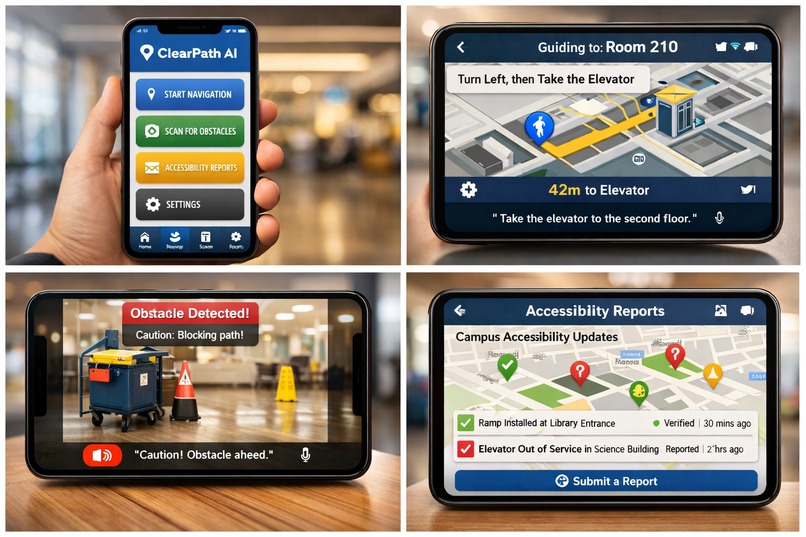
project media image set
-
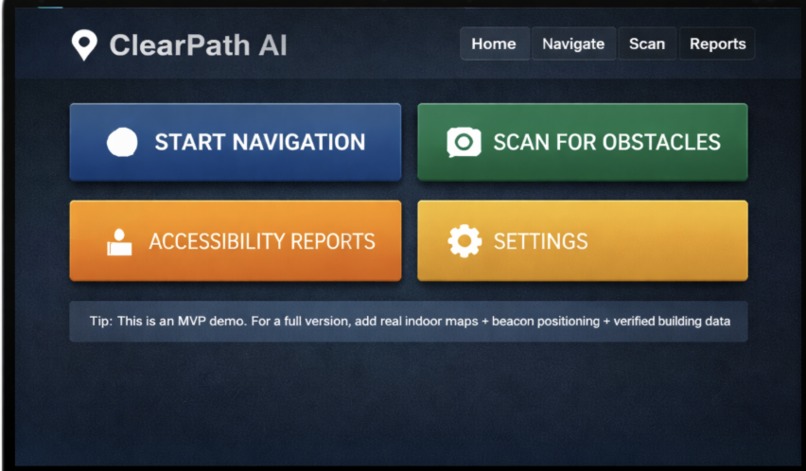
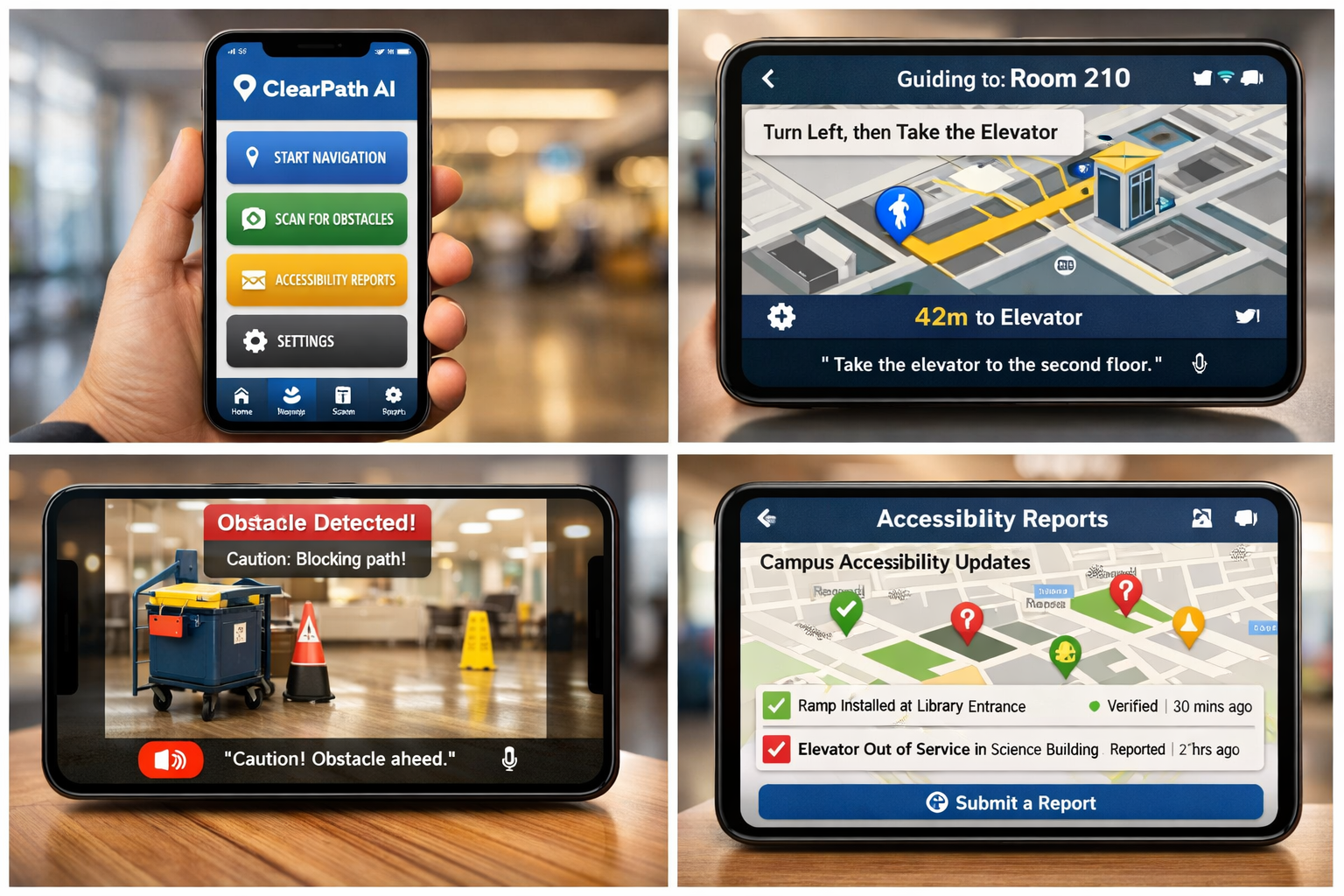
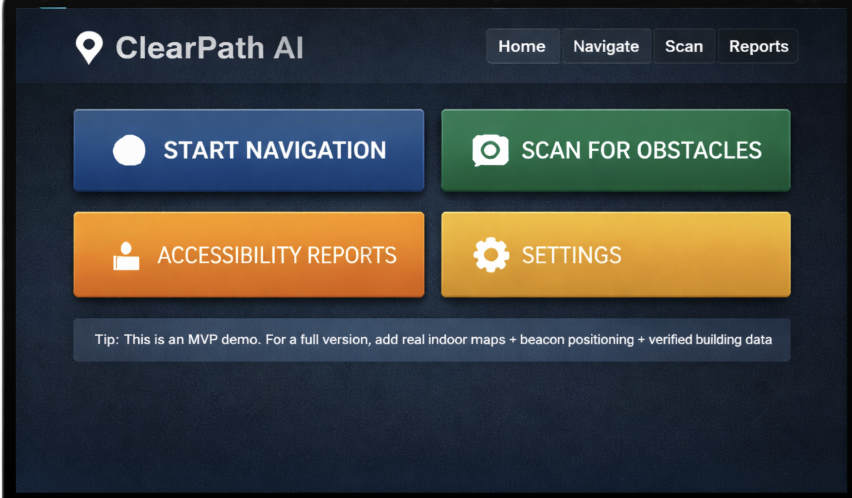
ClearPath AI
Inspiration
ClearPath AI was inspired by a simple but powerful observation:
Outdoor navigation is advanced. Indoor accessibility is not.
Hospitals, universities, malls, and public buildings often lack clear accessible routes. Elevators are hard to find, ramps are hidden, and signage is not always readable for people with visual impairments.
We believe independence is a fundamental right, and accessibility should not stop at the entrance of a building.
What it does
ClearPath AI is an AI-powered indoor navigation assistant designed specifically for people with mobility and visual impairments.
Key Features
- ♿ Step-free route optimization (automatically avoids stairs)
- 🔊 Voice-guided indoor navigation
- 👁 AI-powered obstacle detection
- 🗺 High-contrast simplified maps
- 🌍 Community accessibility reporting
Unlike traditional navigation systems that minimize only distance, ClearPath AI minimizes physical barriers.
Inline math example:
The system reduces \(AccessibilityCost\) instead of only \(Distance\).
Display equation:
$$ AccessibilityCost = \alpha \cdot Stairs + \beta \cdot NarrowPaths + \gamma \cdot Obstacles $$
Where higher weights increase penalties for inaccessible paths.
How we built it
Technology Stack
- React Native – Mobile development
- Firebase – Authentication & database
- Vision API – Object detection integration
- Text-to-Speech & Speech-to-Text APIs
- Figma – UI/UX design
- GitHub – Version control
Routing Model
We modeled indoor spaces as a weighted graph:
Inline math:
\(G = (V, E)\)
Where:
- \(V\) = locations
- \(E\) = pathways
Edge weight logic:
$$ w(e) = \begin{cases} 1 & \text{Accessible path} \\ 5 & \text{Narrow pathway} \\ 10 & \text{Stairs} \end{cases} $$
The system minimizes:
$$ \min \sum_{e \in Path} w(e) $$
This ensures safer routes are prioritized.
Challenges we ran into
- Indoor mapping limitations – No universal GPS for indoor spaces.
- Balancing simplicity and functionality – Accessibility tools must remain clean and intuitive.
- AI reliability – Lighting and environment variations affect detection accuracy.
We solved this by designing a simplified prototype model and prioritizing voice-first interaction.
Accomplishments that we're proud of
- Accessibility-first routing algorithm
- Clean high-contrast UI
- AI obstacle awareness integration
- Realistic MVP built within hackathon timeframe
- Strong social impact focus
What we learned
- Accessibility must be designed intentionally.
- Universal design benefits everyone.
- Simple solutions can create powerful impact.
- Empathy is as important as technical skill.
What's next for ClearPath AI
- Partner with schools and hospitals for real-world mapping
- Integrate Bluetooth beacons for better positioning
- Improve AI obstacle detection accuracy
- Add multilingual support
- Develop a facility accessibility dashboard
Long-term vision:
$$ InclusiveNavigation \rightarrow UniversalIndependence $$
Technology should guide everyone.

Log in or sign up for Devpost to join the conversation.