Inspiration
ClearPath AI was inspired by my own experiences receiving important messages about payroll, housing, benefits, education, and services that contained unclear instructions or conflicting deadlines. I realized that many workers, students, caregivers, tenants, families, and small-business owners face the same problem: the information may be important, but it is not always written in a way that makes the next step obvious.
As a Computer Science student, entrepreneur, and founder of Whitney Codes, I wanted to create a practical tool that helps people move from confusion to clarity and confidence.
What it does
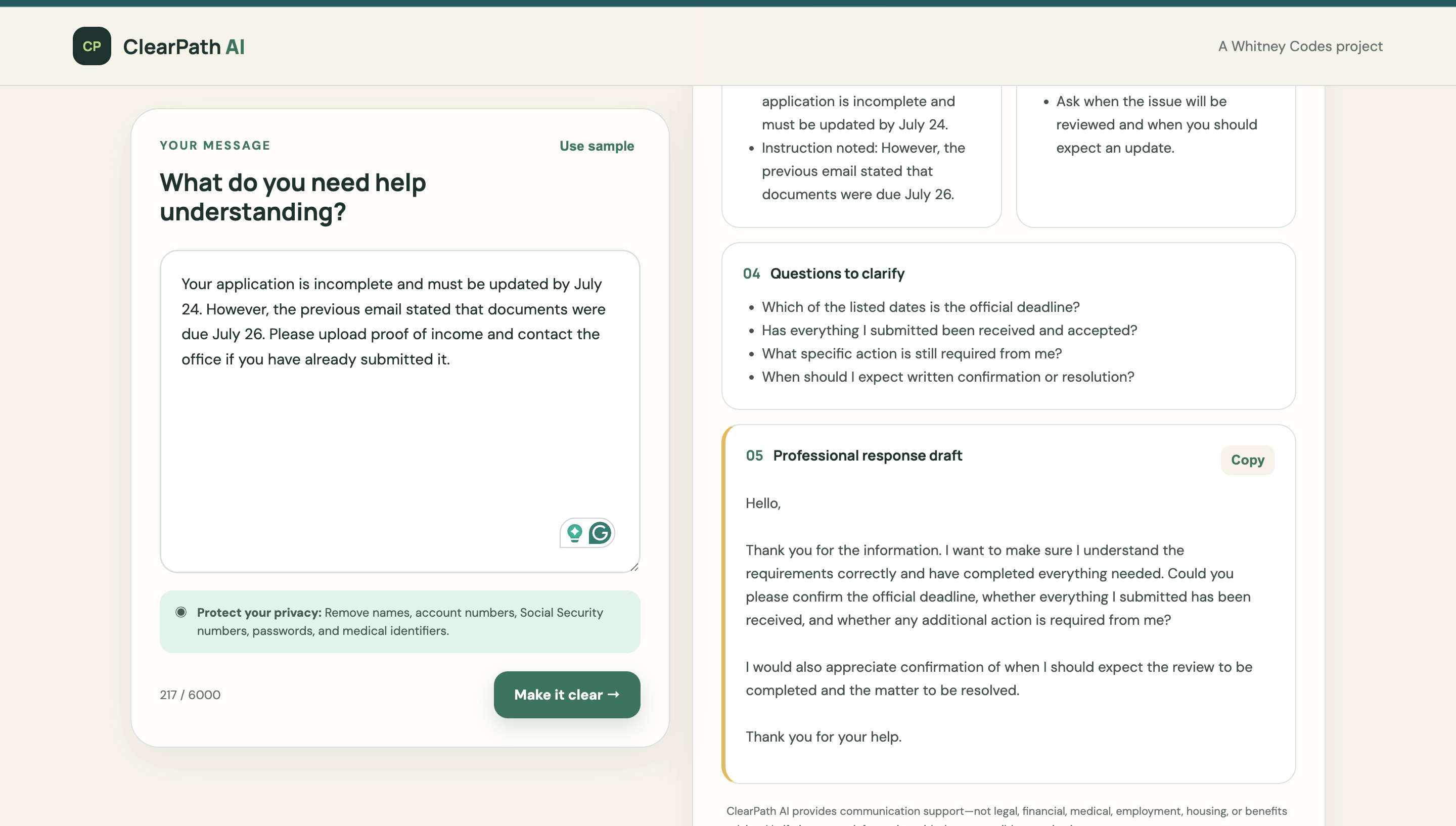
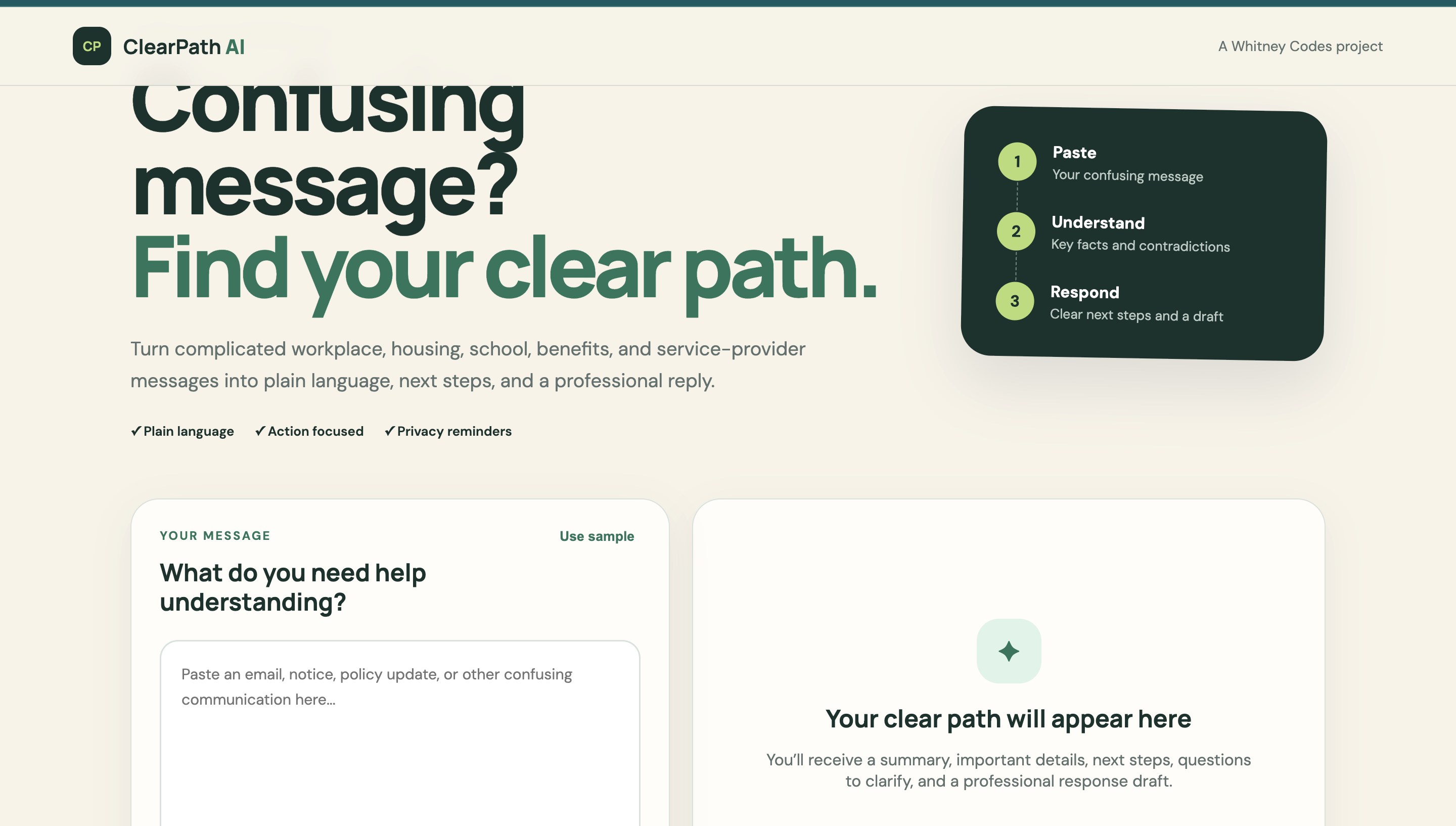
ClearPath AI transforms a complicated administrative message into five useful sections:
- A plain-language summary
- Important dates and details
- Actionable next steps
- Questions or contradictions to clarify
- A professional response draft
The prototype also reminds users to remove sensitive personal information and clearly explains that it provides communication support rather than legal, financial, medical, employment, housing, or benefits advice.
How we built it
I used Codex throughout the development process to turn the initial concept into a working product. Codex helped me:
- Define the minimum viable product
- Organize the user experience
- Generate and refine the HTML, CSS, and JavaScript
- Create responsive and accessible interface elements
- Develop the message-analysis workflow
- Add privacy and responsible-use safeguards
- Write project documentation
- Troubleshoot, test, and deploy the prototype
GPT-5.6 supported the ideation, product reasoning, content structure, and development decisions made during the build.
The prototype uses HTML, CSS, and JavaScript and is hosted through GitHub Pages. The current version performs structured message analysis locally in the browser, which allows the demonstration to work without collecting or storing users’ messages.
Challenges we ran into
My biggest challenge was reducing a much larger LifeReady-inspired vision into a focused product that could be designed, built, tested, documented, and deployed within the Build Week deadline.
I also had to make careful decisions about privacy, scope, and responsible use because ClearPath addresses communications that may involve sensitive areas. Instead of presenting the tool as a source of professional advice, I designed it to help users organize information, identify questions, and communicate more effectively.
Accomplishments that I’m proud of
This is my first public Whitney Codes software project and my first GitHub Pages deployment. I am proud that I transformed a real problem from my own life into a polished, functional prototype with a clear audience and purpose.
The prototype successfully identifies important dates, recognizes potentially conflicting information, recommends next steps, prepares clarification questions, and generates a professional response users can copy.
What we learned
I learned how to move from an idea to a minimum viable product, organize a public GitHub repository, document technical work, deploy a website through GitHub Pages, test interactive features, and make responsible product decisions.
Most importantly, I learned that I do not have to wait until I feel like an expert to begin building useful technology.
What’s next for ClearPath AI
The next phase is to integrate a live OpenAI model for more contextual analysis while maintaining strong privacy protections. Future versions could include:
The next phase is to integrate a live OpenAI model for more contextual analysis while maintaining strong privacy protections. Future versions could include:
- Secure document and screenshot uploads
- Multilingual explanations
- Adjustable reading levels
- Message categories for employment, housing, education, and benefits
- Saved action checklists and deadline reminders
- Accessibility features such as text-to-speech
- Connections to the larger LifeReady platform
My long-term vision is for ClearPath AI to become part of LifeReady: a collection of practical tools that help people understand and navigate the systems affecting everyday life.
Built With
- ai
- codex
- css3
- design
- generative
- github
- gpt-5.6
- html5
- javascript
- pages
- responsive

Log in or sign up for Devpost to join the conversation.