-
-
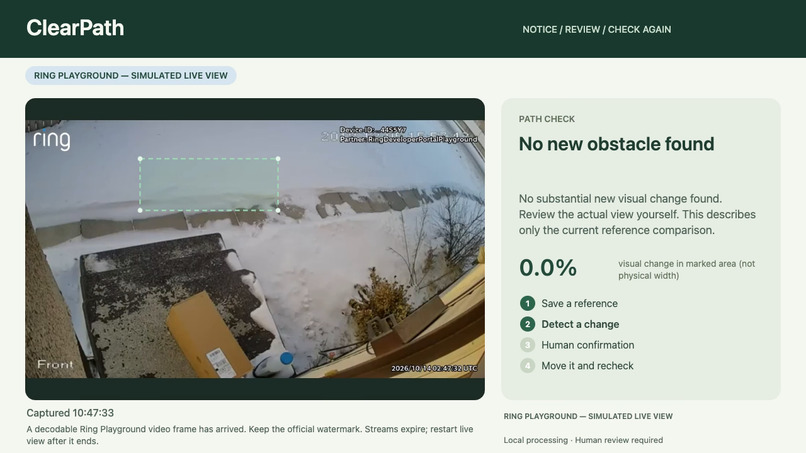
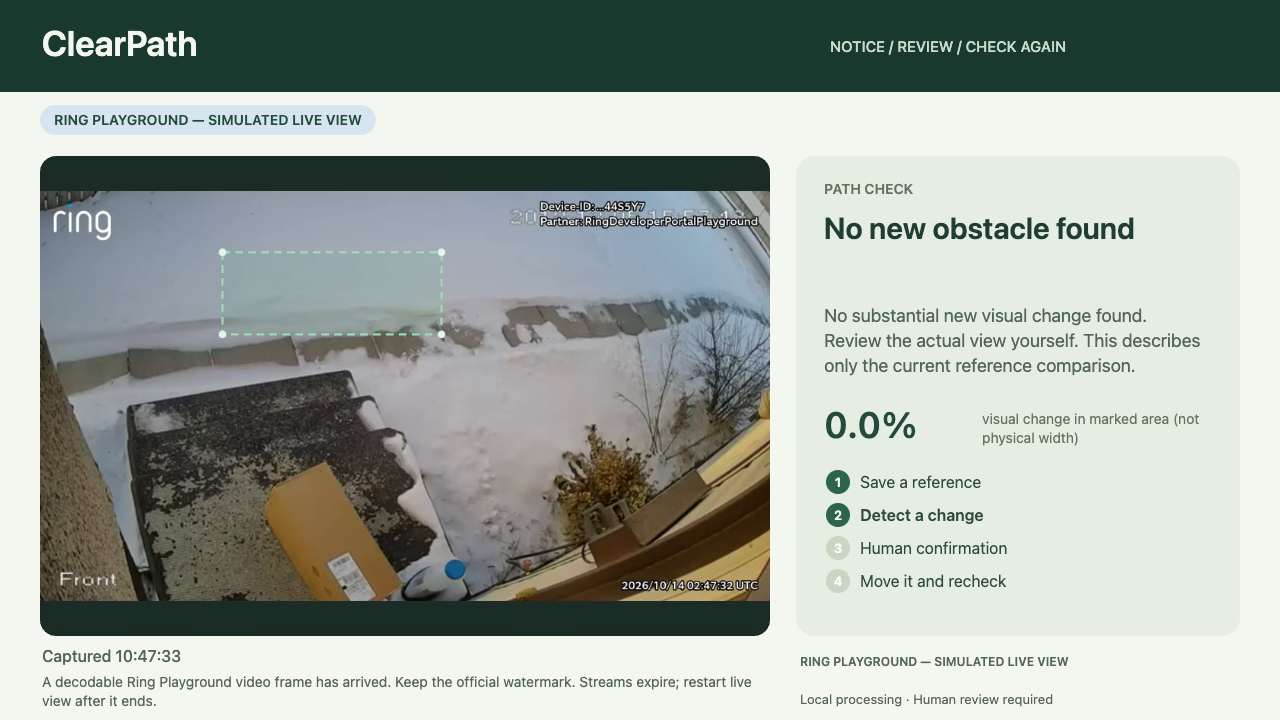
Official Ring Playground video in ClearPath: comparing an empty step area. Demonstrates integration, not detection accuracy.
Inspiration
A package left near a doorway can become an obstacle for someone using a wheelchair, walker, or stroller. A delivery notification tells a resident that something arrived, but leaves another question unanswered: does this change need attention, and has it been addressed?
ClearPath explores that follow-up. It turns camera views into a review process: notice a possible obstruction, inspect the evidence, make a decision, and check a later frame after the object is moved.
Accessibility and caretaking motivated the project. We have not yet validated its benefits through an intended-user study.
What it does
The resident marks an area they want to keep empty and saves a reference frame they have checked is clear. ClearPath compares a later frame with that reference and highlights possible new visual changes inside the selected area.
Each observation retains its captured evidence. The resident can confirm or dismiss it. A confirmed observation requires a later-frame recheck; an older or repeated video frame cannot close the follow-up.
When camera movement, poor image quality, or incomplete visibility prevents a supported comparison, ClearPath preserves uncertainty and asks for review or recalibration.
The application accepts official Ring Developer Playground video and separately labeled local footage. It does not identify people, unlock doors, or automatically contact anyone.
How we built it
ClearPath uses HTML, CSS, JavaScript modules, and Canvas for the interface and basic visual comparison. A small Python backend handles official Ring device discovery, WHEP signaling, and session cleanup. Browser WebRTC receives the video stream and supplies decoded frames to the comparison workflow.
We verified this actual Ring integration with authenticated device discovery, a successful WHEP response, moving 1280×720 simulator video, and a comparison using frames from that stream. The demonstrated Ring comparison uses an already-empty upper step area. It proves the integration and processing path, rather than package-removal accuracy.
An optional same-computer enhancement uses OpenCV SIFT and NumPy to handle some camera-movement cases. Registration must pass independent matching, geometry, spatial-support, and visibility checks. Unsupported comparisons remain uncertain.
Basic comparison runs in the browser. Optional registration sends reduced frames only to the loopback server on the same computer. Private footage is not sent to a cloud vision service. The prototype required no new hardware purchase or paid service.
Challenges we ran into
Camera movement can look like a new object. Our first phone development recording produced a broad false detection and unsuccessful rechecks. The second recording also failed its original configuration.
We retained those failures. The second recording's original selected region still fails the final visibility guard because part of its required support moves outside the later image.
A separately calibrated, smaller region left enough framing margin for the demonstrated development workflow to succeed. That improvement covers less ground; it does not turn the original failure into a success.
We also addressed stale asynchronous results, repeated frames, competing image patterns, and image processing that could conceal meaningful color changes. These cases shaped the rejection checks and evidence handling.
What we accomplished
ClearPath demonstrates two distinct results:
- Actual official Ring Playground video reaches the application and enters local comparison.
- One self-recorded development sequence completes the review workflow: an empty reference at 2 seconds, a possible obstruction at 12 seconds, a confirmation action, and a cleared recheck at 20 seconds.
The self-recorded result uses the smaller development region. Its occupied and cleared comparisons report 29.6% and 0.5% changed pixels respectively. These values describe visual change, not physical obstruction width.
The final source revision passed 158 engineering checks: 109 JavaScript tests and 49 Python tests, with none skipped. These checks cover processing guards, frame freshness, Ring lifecycle handling, HTTP boundaries, metrics, and recording behavior. They are not a real-world accuracy benchmark.
The project includes an English demonstration, reproducible setup instructions, product feedback, and publicly accessible MIT-licensed source code.
What we learned
A useful follow-up needs evidence, source labels, and a clear distinction between an observation and a human decision.
We learned to preserve the analyzed frame, require fresh evidence before closing an observation, and reject comparisons when the selected region cannot be supported. Keeping failures visible also helped us make narrower, more defensible claims about what the prototype can do.
What's next
Next, we plan to freeze the implementation, evaluate independent new scenes, and collect feedback from consenting intended users.
At least ten independent unseen scenes and 90% on each target rate are our own pending engineering goals. They are not contest requirements or results already achieved.
ClearPath currently demonstrates one successful reused development scene. It does not measure usable passage width, certify safety, or establish performance across homes, lighting conditions, and camera placements.
Demo and source
The demonstration clearly separates official Ring simulator footage from self-recorded development material. English narration was synthesized locally from the creator's explicitly authorized voice reference. Original private footage, voice references, transcripts, credentials, and model files are excluded from the source repository.
Source code and English run instructions: https://github.com/xufei1993-eng/clearpath-ring-2026

Log in or sign up for Devpost to join the conversation.