Inspiration
Personal finance is easy to postpone. A small purchase goes unrecorded, a recurring bill is forgotten, and a monthly budget stops reflecting reality. Recording everything manually takes effort, while charts alone cannot answer questions like, "Why did I spend more this month?"
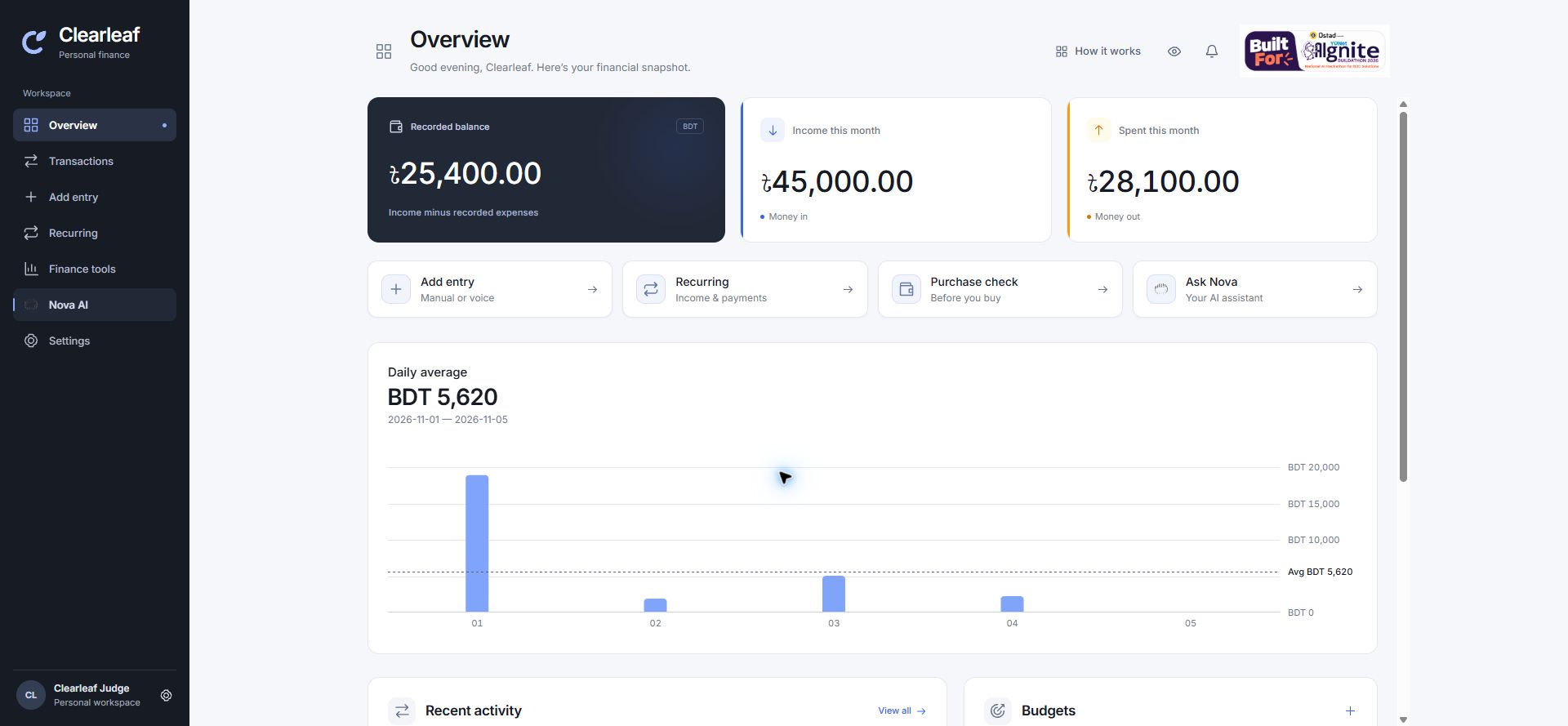
I built Clearleaf to make managing money easier and more interactive. Instead of simply recording transactions, I wanted to create an application that could understand financial questions, explain spending patterns, and help people evaluate decisions before spending their money.
The goal is simple: make personal finance less about maintaining records and more about understanding your money.
What it does
Clearleaf is an AI-powered personal finance web application featuring Nova AI, a conversational assistant that helps users track, understand, and plan their finances.
1. One conversation, multiple financial entries
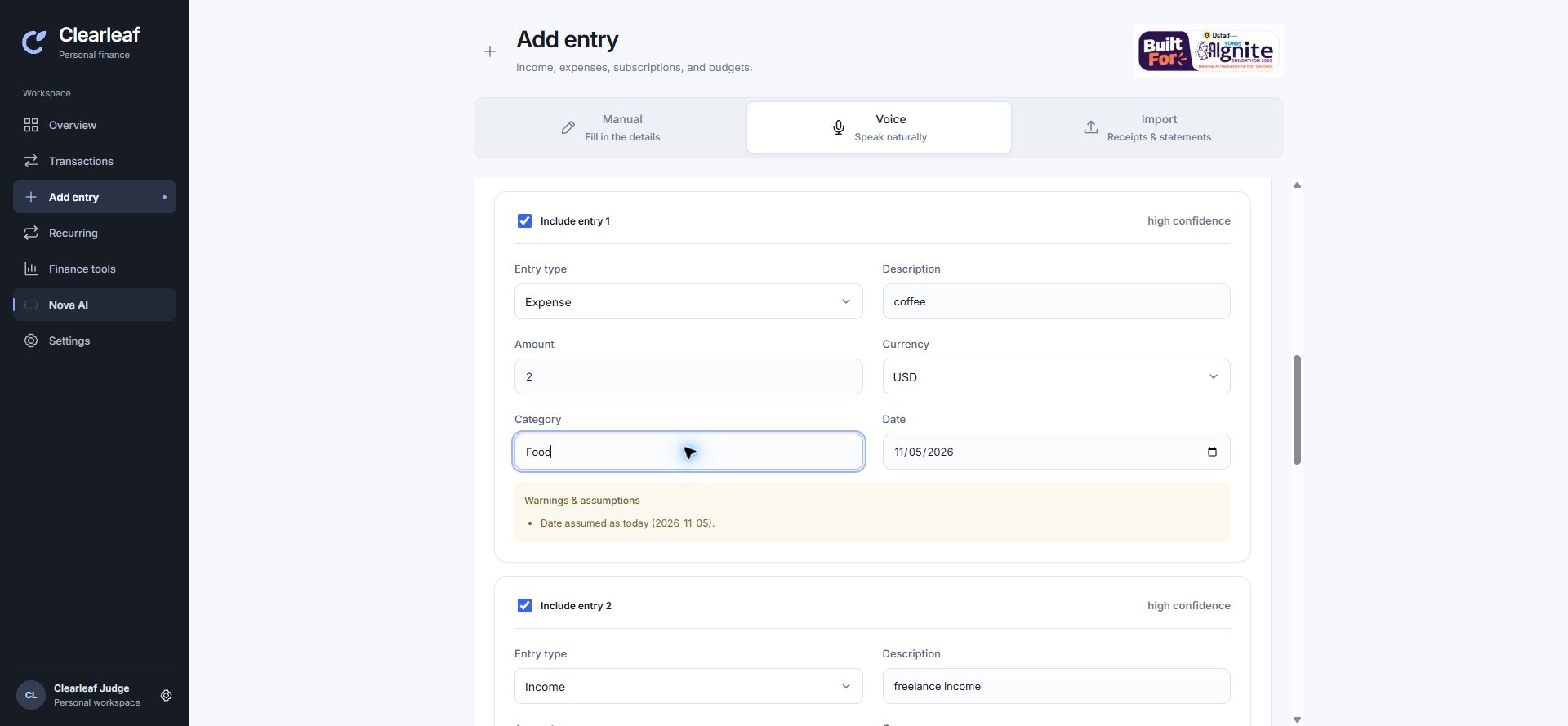
Users can record expenses, income, recurring payments, and budgets through natural language or voice commands.
For example:
"Add a 2 US dollar coffee expense and 2,500 taka freelance income today. Add a 3 US dollar monthly cloud storage subscription starting next month. Set my overall monthly budget to 80,000 taka."
Nova understands the request and prepares four separate, editable financial entries. Users review and approve them before anything is saved.
2. AI-powered spending explanations
Instead of manually analyzing transaction histories, users can ask Nova questions such as:
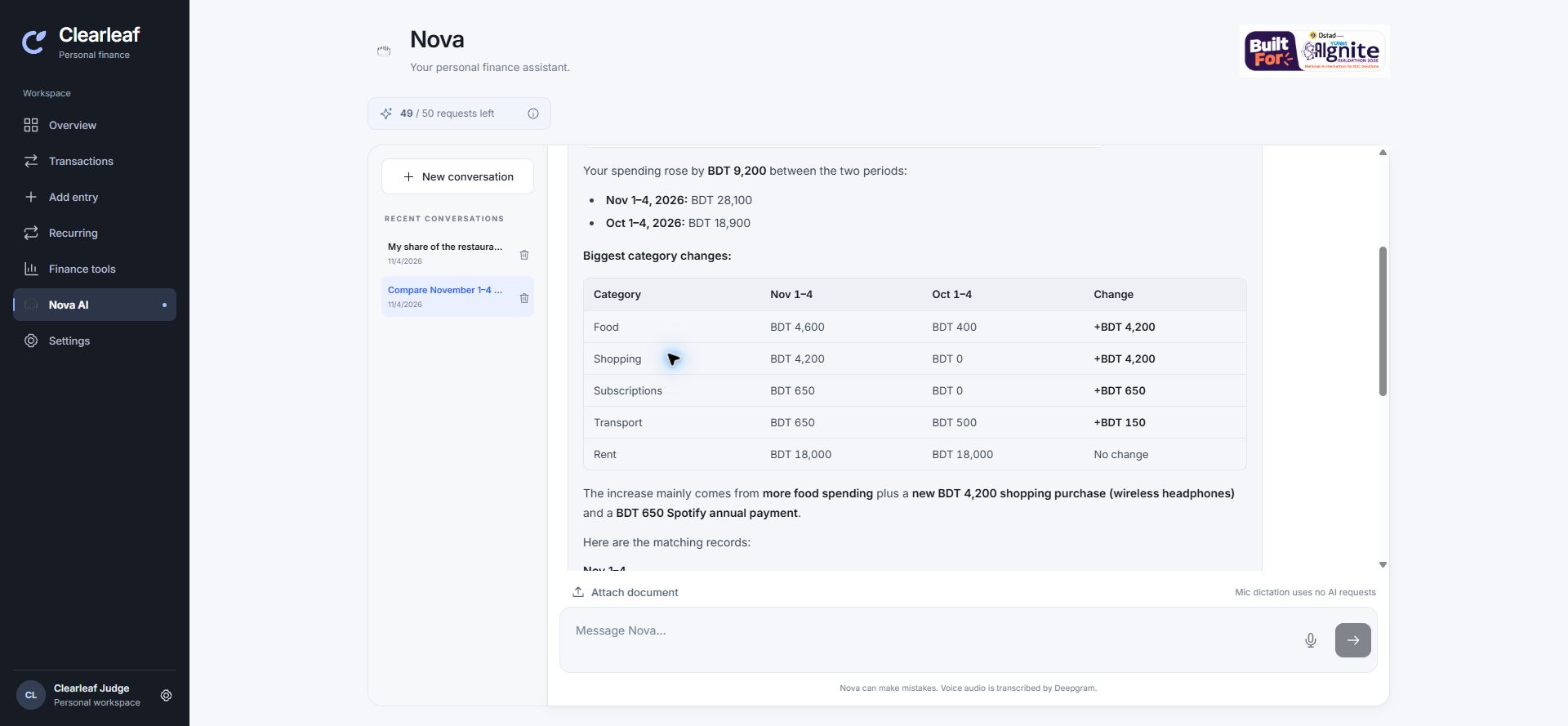
"Why did I spend more in the first four days of November?"
Nova retrieves relevant financial records, compares spending across periods and categories, and explains the differences.
The application also displays the checks performed and allows users to inspect supporting records, making its explanations more transparent.
3. Intelligent receipt understanding
Users can upload receipts and ask questions about specific items.
For example:
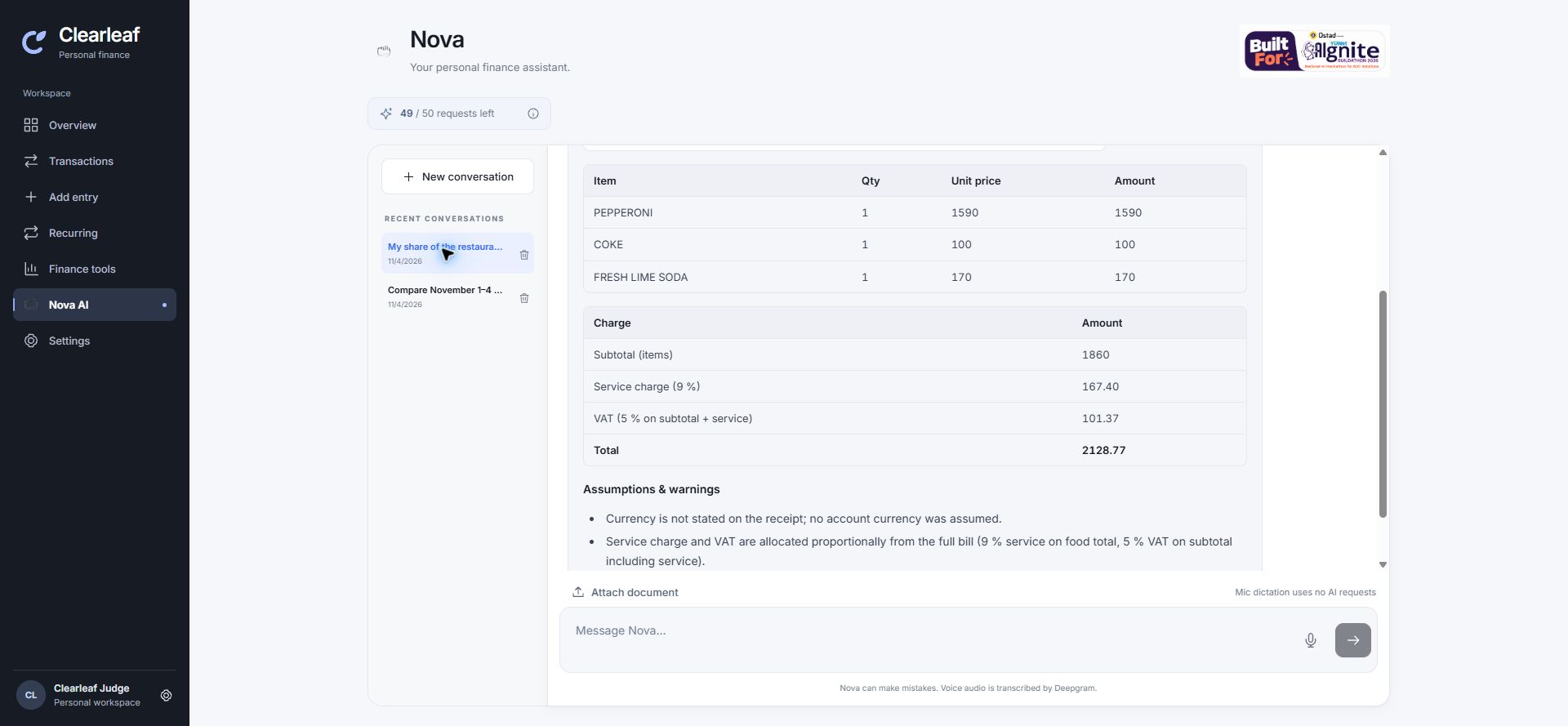
"I had a pepperoni, one Coke, and fresh lime soda. How much is my bill?"
Clearleaf uses OCR to extract receipt information and calculation tools to determine the user's share, accounting for item quantities, service charges, and VAT.
In the demonstrated example, the calculated share is 2,128.77, including proportionally allocated charges.
Users can ask questions about receipts without automatically recording expenses. Transactions are only prepared for saving when explicitly requested.
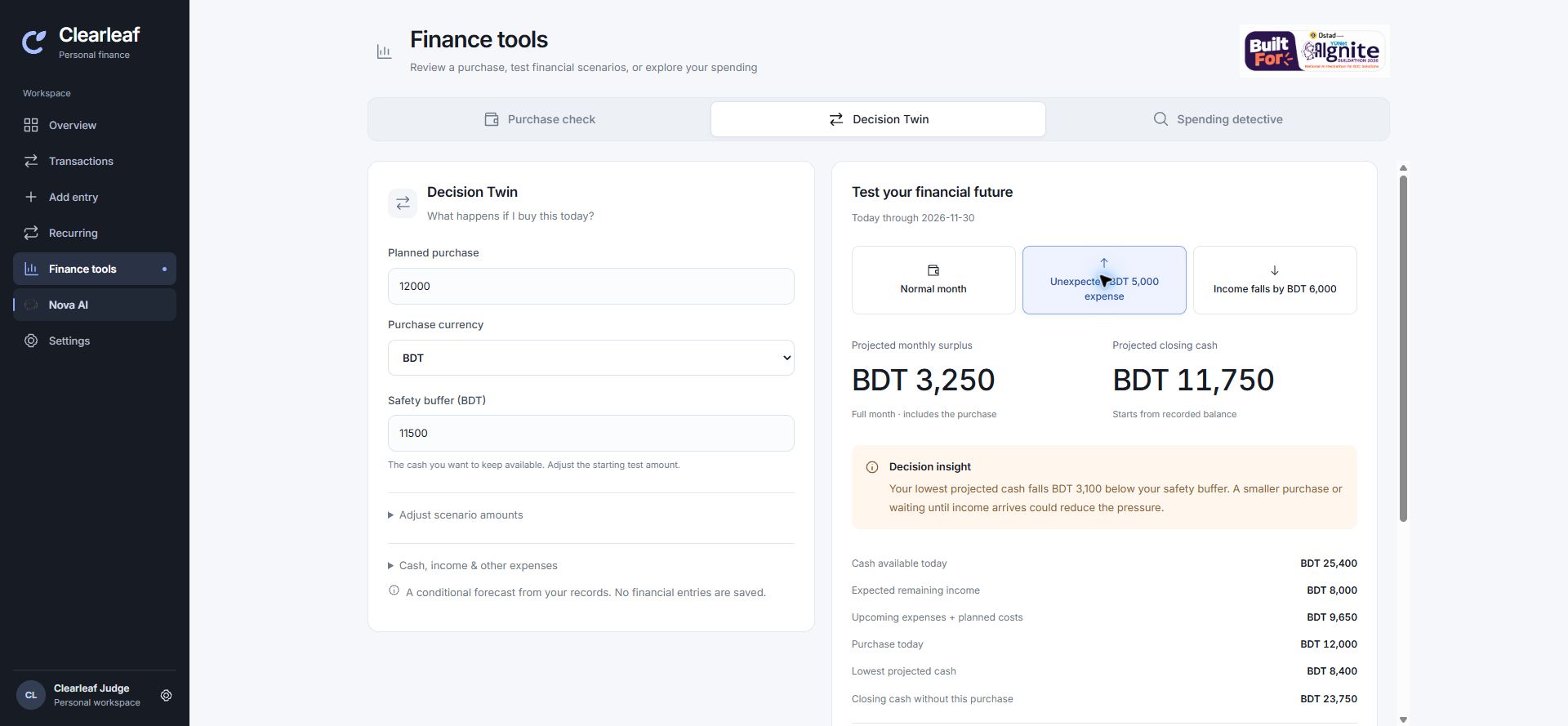
4. Purchase planning and Decision Twin
Clearleaf goes beyond tracking previous spending by helping users explore future financial decisions.
Purchase Check evaluates affordability using recorded cash and upcoming expenses.
Decision Twin allows users to stress-test financial decisions by introducing hypothetical situations, including unexpected expenses or reduced future income.
For example, a user can explore the impact of a BDT 12,000 purchase combined with a BDT 5,000 unexpected expense.
Nova evaluates the resulting cash position, identifies potential risks, and explains relevant assumptions. Simulated decisions do not change actual financial records.
5. Additional capabilities
- Voice dictation with editable transcription before submission.
- Multiple currency support and country-based default currency selection.
- Income and expense tracking with budget management.
- Recurring transactions with clearly defined starting dates.
- Conversational financial queries grounded in saved records.
- User review and approval before AI-prepared entries are saved.
How I built it
I built Clearleaf as a browser-based application with authenticated, owner-isolated financial records and server-side management of private AI credentials.
The main technical challenge was connecting conversational AI with reliable financial operations.
AI and tool calling
Nova uses LLM tool calling and retrieval-augmented responses to interact with financial data.
It can retrieve transactions, compare spending periods, inspect budgets and recurring commitments, process extracted document text, and prepare structured financial entries.
Rather than relying on the language model to perform every calculation, Clearleaf uses application tools for financial arithmetic. Nova then explains the calculated results.
Voice and document processing
Voice requests are first converted into text using speech transcription. The AI model then interprets the user's instructions and prepares structured drafts.
For receipt processing, a vision model extracts text through OCR. Subsequent questions use the extracted information without repeatedly processing the original image.
User-controlled financial actions
AI-generated entries are displayed as editable review cards before saving.
Multiple selected entries can be saved together after approval, keeping users in control of changes to their financial records.
The interface also displays tool activity and supporting records to help users understand how Nova produces its answers.
Challenges I faced
Accurate receipt calculations
Receipts contain quantities, line totals, service charges, and taxes that can make bill splitting complicated.
For example, treating the total price of five identical items as the price of one item would produce an incorrect result.
I addressed this by implementing quantity-aware calculations and proportional allocation of printed service charges and VAT.
Handling recurring transactions
Recurring income and expenses introduce timing challenges.
A salary expected next month should not appear as money already received, and a future subscription should not reduce today's recorded balance.
I made recurring start dates explicit in both manual entry and AI-generated review flows.
Reliable AI tool execution
Language models do not always generate valid tool arguments or successfully complete every requested operation.
To improve reliability, I implemented argument validation, bounded retries, and a fallback model. The application also avoids presenting failed checks as successful results.
Keeping AI decisions transparent
Financial applications require more than convincing explanations. Calculations and assumptions must be understandable.
I focused on separating AI-generated explanations from deterministic calculations and requiring user approval before saving financial changes.
What I learned
Building Clearleaf taught me that useful financial AI needs a clear separation between understanding, calculation, and action.
Retrieval makes AI responses relevant to the user's actual financial situation. Deterministic tools make calculations verifiable. Review cards ensure users retain control over their information.
I also learned that displaying tool activity, identifying missing assumptions, and acknowledging uncertainty can be more valuable than generating overly confident responses.
Most importantly, I learned how AI can support practical financial decision-making rather than functioning only as a conversational interface.
What's next
I plan to improve Clearleaf through:
- More reliable receipt extraction across different layouts and languages.
- Better conversational memory and follow-up questions.
- Expanded purchase simulations and financial stress-testing.
- More advanced cash-flow forecasting and proactive financial insights.
- Improved support for users with irregular income and recurring financial commitments.
My goal is to continue developing Clearleaf into an accessible personal finance companion that helps people track their money, understand their spending, and make informed financial decisions.
Try Clearleaf
Live application: https://clearleaf-tanusree.vercel.app/
Built by Tanusree Sarker
BBA Student, Major in Finance, Minor in MIS
BRAC University
Receipt demonstration source: Instagram example, image 17.
Built With
- artificial-intelligence
- large-language-models
- natural-language-processing
- ocr
- speech-to-text
- vercel
- web
