-
-
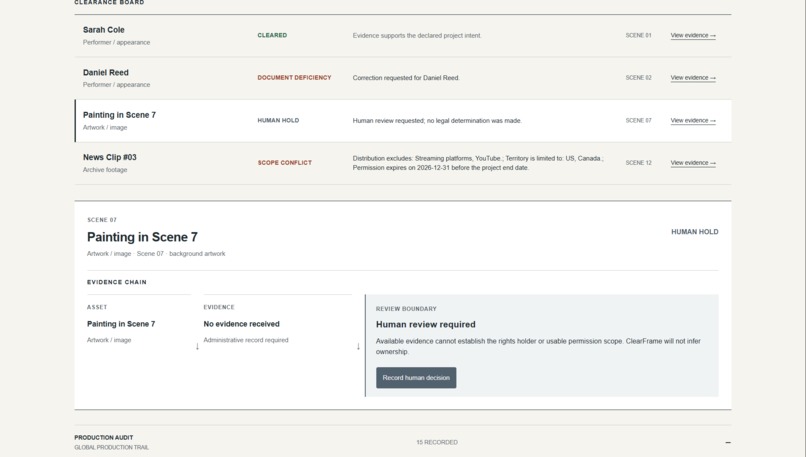
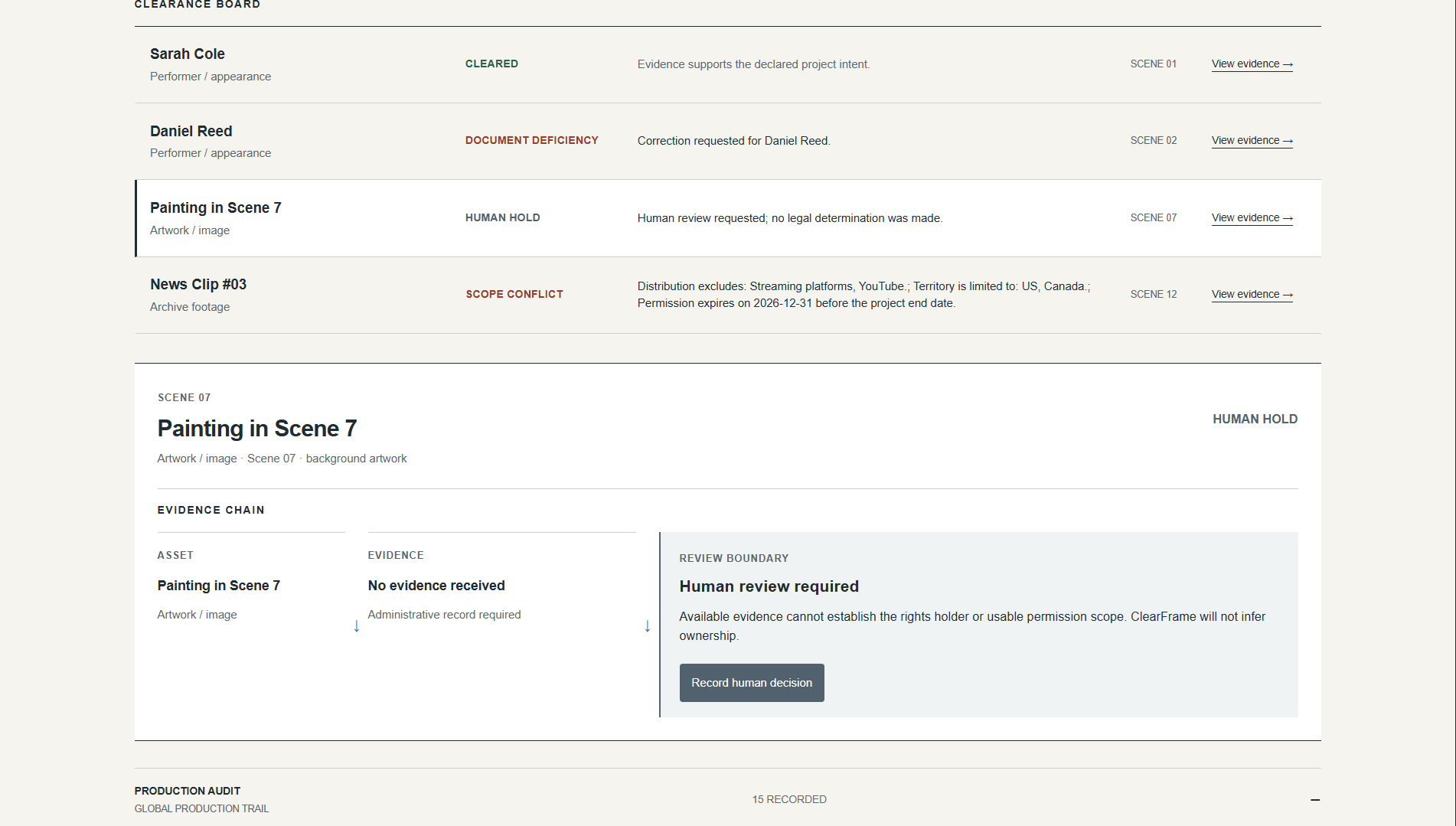
ClearFrame stops at ambiguity and escalates the artwork case for an explicit human decision.
-
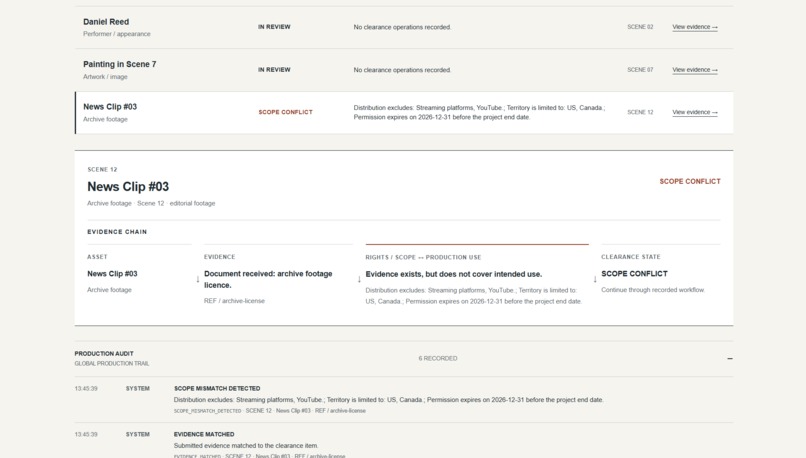
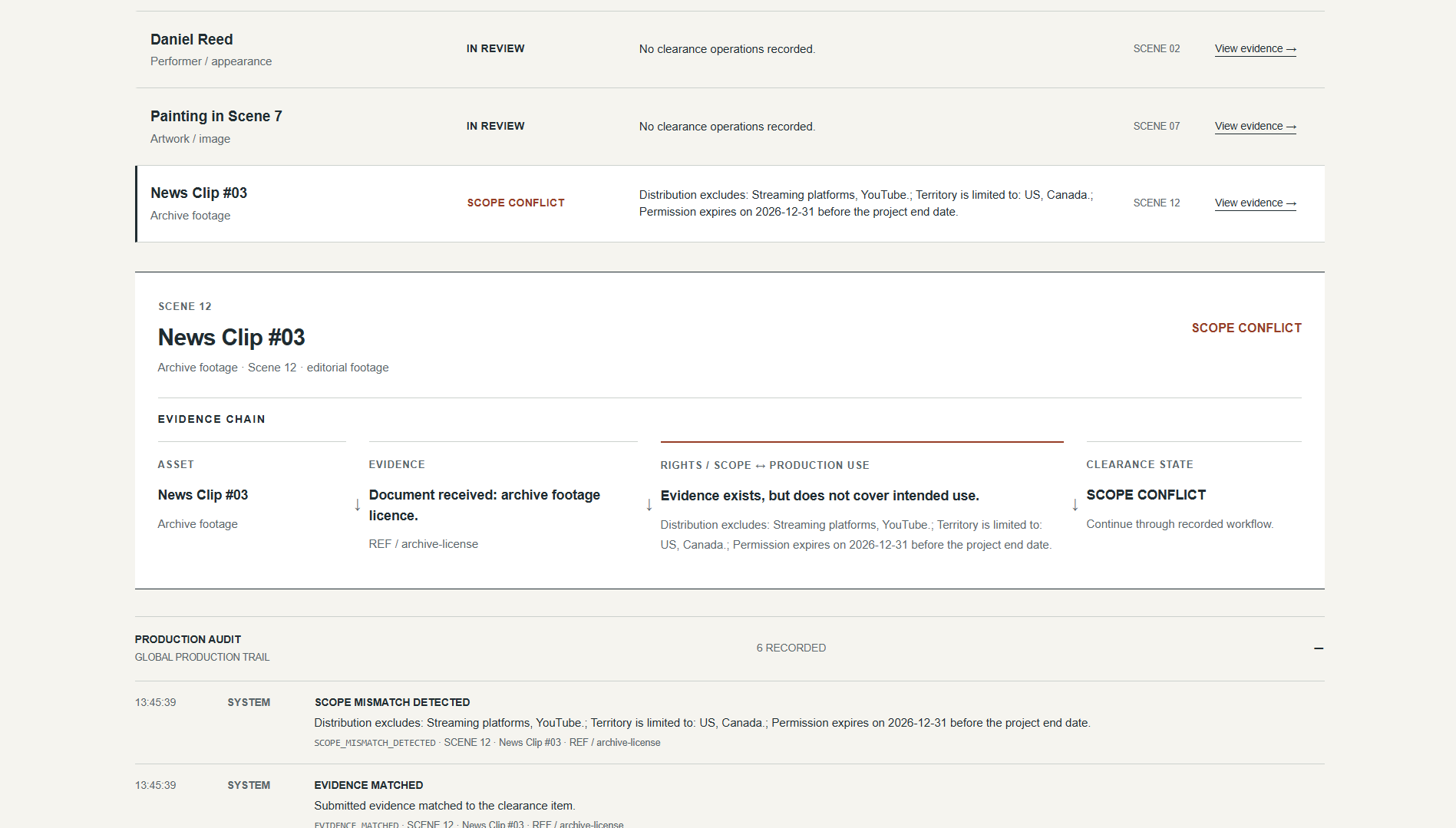
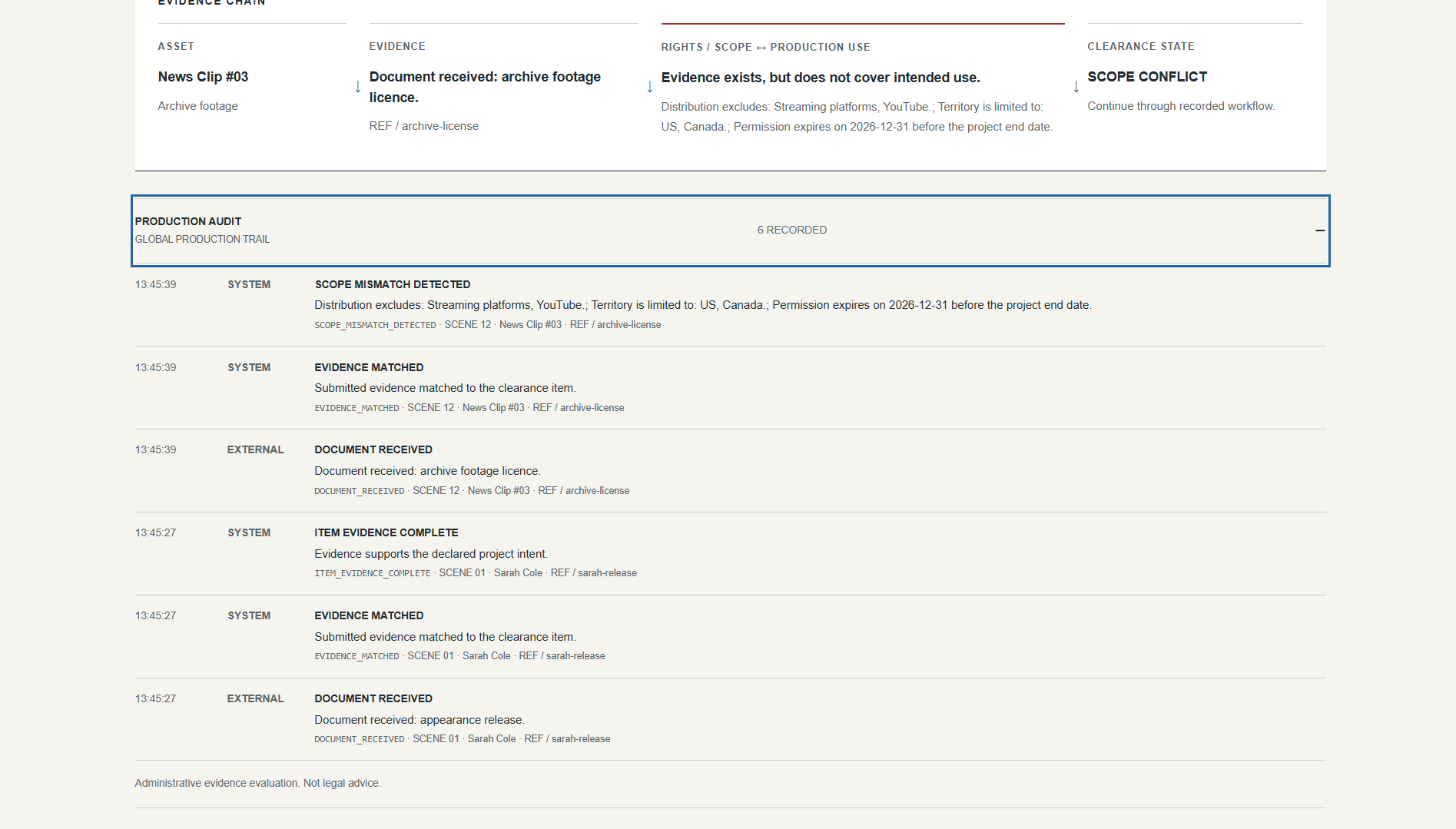
Evidence exists, but ClearFrame detects platform, territory and expiry conflicts with the intended use.
-
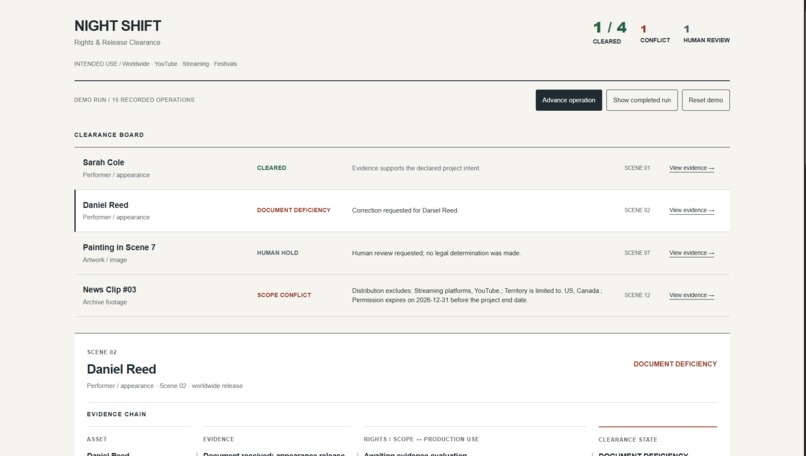
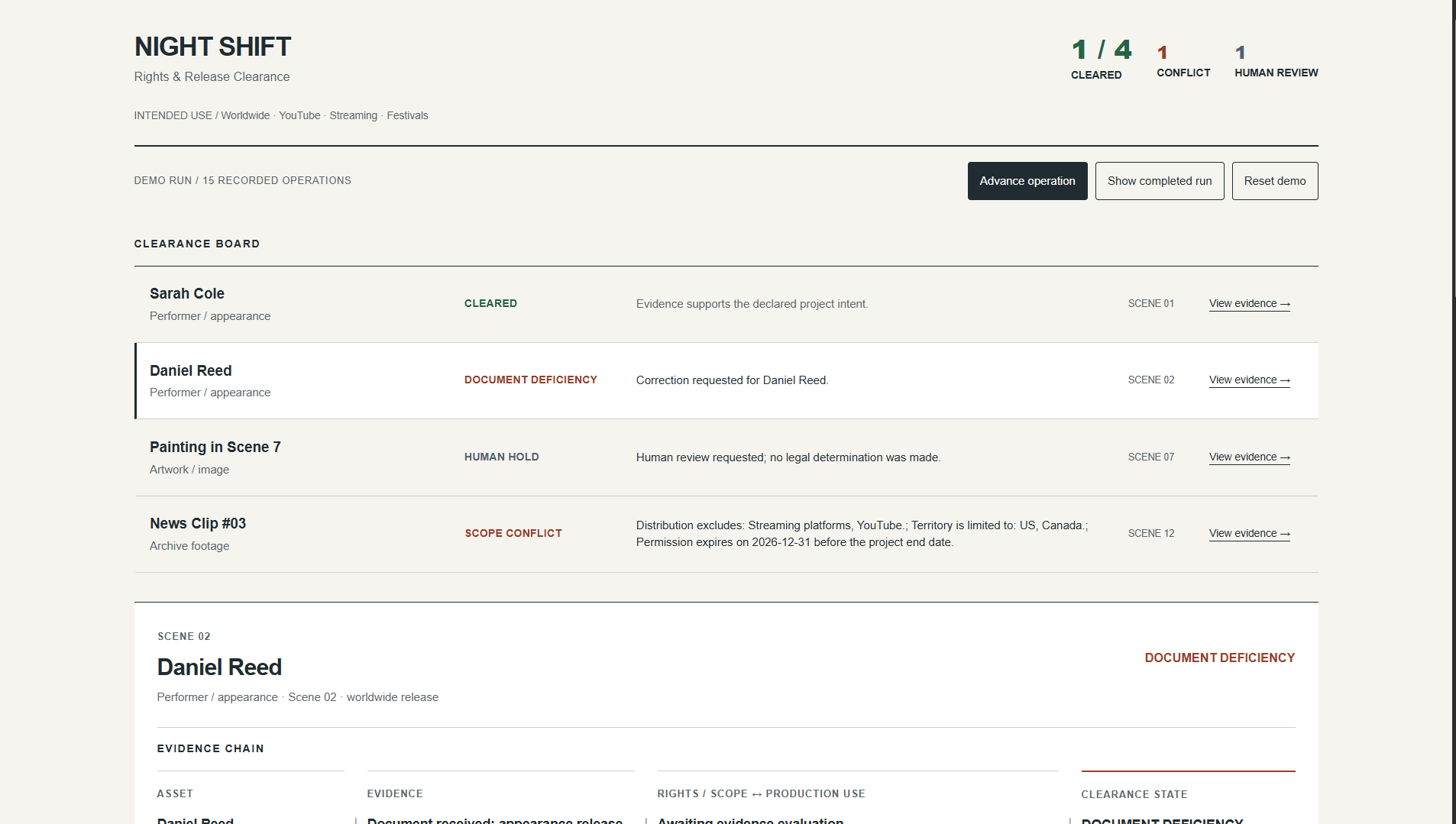
An incomplete performer release triggers a document deficiency and correction workflow.
-
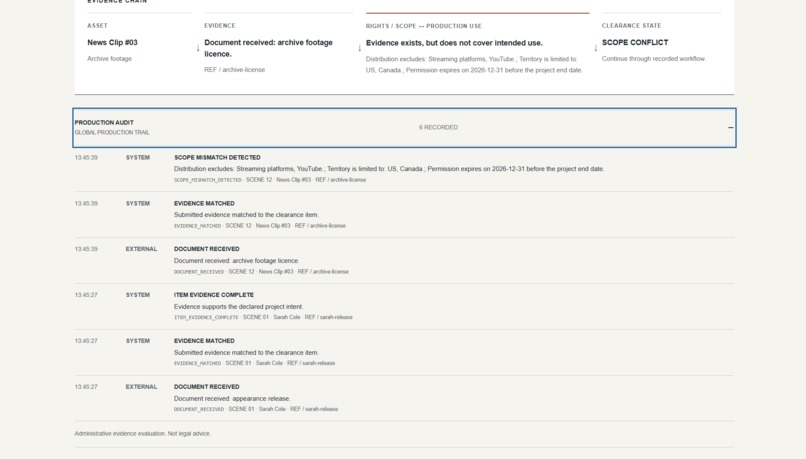
Every evidence event, match and scope conflict is preserved in an auditable production trail.
-
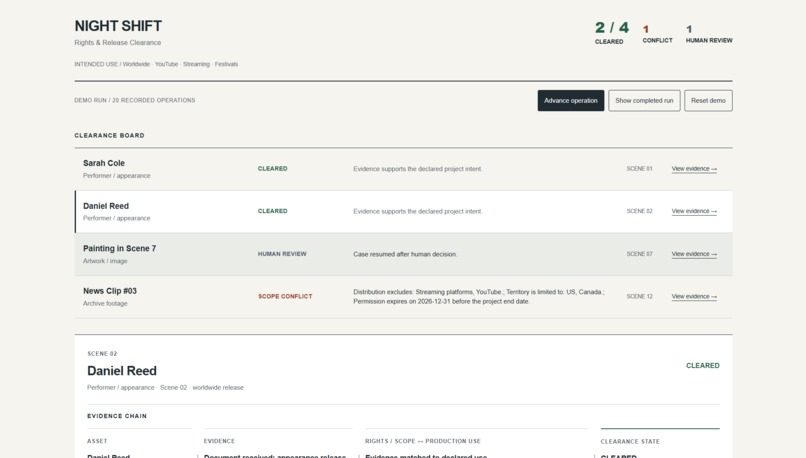
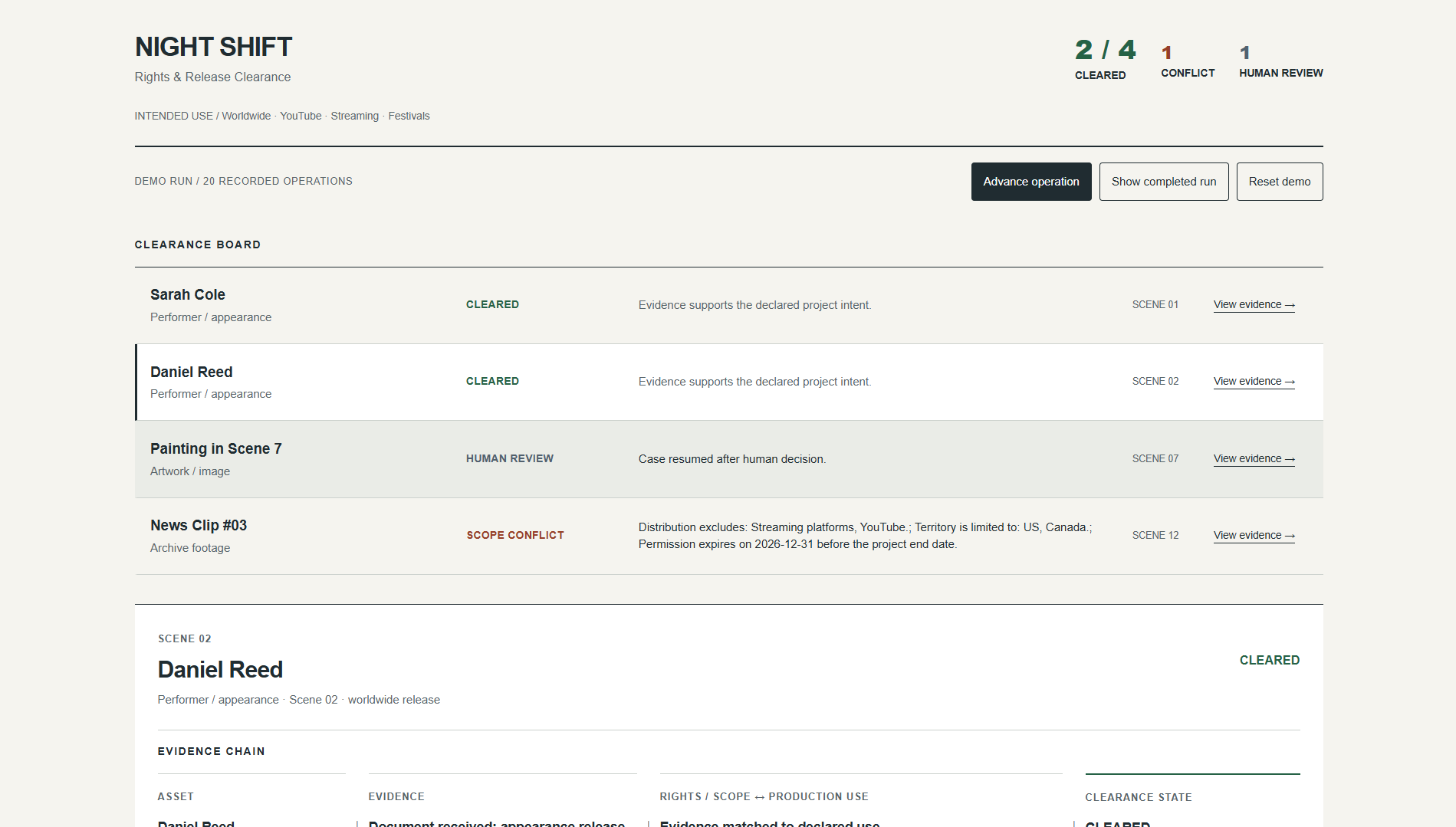
NIGHT SHIFT clearance board showing evidence-backed states, conflicts and cases requiring human review.
Inspiration
Film and creative productions depend on releases, licenses, permissions, and other evidence before assets can safely move through production and distribution. The problem is that simply having a document does not mean the intended use is actually supported.
A performer release may be unsigned. An archive license may exclude the required platforms or territories. Artwork may have no reliable evidence identifying the rights holder at all.
ClearFrame was built to turn that fragmented clearance work into an evidence-led operational workflow.
What it does
ClearFrame is a production clearance operations agent that tracks subjects and assets against the evidence required for their intended use.
For each clearance item, it follows an explicit chain:
Asset → Evidence → Rights / Scope ↔ Production Use → Clearance State
ClearFrame can:
- track releases, licences, and permissions
- identify missing or deficient evidence
- request and process corrections
- compare recorded permission scope against intended production use
- detect scope conflicts
- maintain an auditable production trail
- stop and escalate ambiguous cases for human review
The NIGHT SHIFT demo contains four deliberately different cases:
- Sarah Cole — evidence supports the declared use
- Daniel Reed — an incomplete release triggers a deficiency and correction workflow
- News Clip #03 — evidence exists, but its territory, platform, and time scope conflict with the intended use
- Painting in Scene 7 — insufficient evidence triggers a human-review boundary
ClearFrame performs administrative evidence evaluation. It does not provide legal advice, determine fair use, infer copyright ownership, or manufacture conclusions when evidence is insufficient.
How we built it
ClearFrame separates agent orchestration from deterministic clearance state.
The application uses a provider-neutral AgentProvider boundary with:
- a deterministic local provider used by the public demo
- a Strands Agents SDK provider for agent orchestration with Amazon Bedrock
- provider-neutral application services
- a deterministic core responsible for evidence evaluation and workflow transitions
- a Next.js frontend
- a Python API
- persisted workflow and audit events
The Strands agent is restricted to approved application-service tools rather than directly mutating clearance state. Human decisions are also kept outside the agent tool surface.
This lets the agent coordinate evidence operations while deterministic application logic remains responsible for facts, transitions, and recorded outcomes.
Challenges we ran into
One major design challenge was deciding what the agent should not be allowed to decide.
Rights and release workflows can contain genuine ambiguity. We did not want the system to turn missing evidence into confident legal conclusions. This led to an explicit human-review boundary: when available evidence cannot establish the required administrative facts, ClearFrame stops rather than guessing.
We also encountered an AWS account-level daily token quota during final Amazon Bedrock validation. The Strands/Bedrock execution path is implemented and reaches Amazon Bedrock, but final live execution was blocked by the account quota. To keep the public demonstration reliable, the deployed demo currently uses the deterministic local provider.
Accomplishments that we're proud of
We built a complete, auditable clearance workflow rather than a generic AI chat interface.
ClearFrame distinguishes between missing evidence, deficient documents, scope conflicts, successful evidence completion, and cases requiring human judgment.
We are particularly proud of the human-review boundary. ClearFrame is designed to recognize when automation should stop.
The NIGHT SHIFT workflow also preserves the reasoning trail behind each operational state, giving production teams more than a simple red or green result.
What we learned
Building ClearFrame reinforced that useful agents need boundaries as much as capabilities.
Agent orchestration is valuable for coordinating multi-step work, but important state transitions should remain explicit, inspectable, and testable. Separating the agent layer from deterministic domain logic made the system easier to reason about and reduced the risk of an AI model silently changing production facts.
We also learned that human escalation should be treated as a first-class workflow state rather than as an automation failure.
What's next for ClearFrame
Next, we want to expand ClearFrame beyond the NIGHT SHIFT demonstration into real production workflows with secure evidence ingestion, persistent production storage, team permissions, notifications, and integrations with existing production-management systems.
We also want to complete hosted Strands + Amazon Bedrock execution once the AWS account quota is available, while preserving the same deterministic evidence rules and human-review boundaries.
The long-term goal is simple: give small creative teams a reliable operational layer for knowing what evidence they have, what is missing, what conflicts with intended use, and what genuinely requires a human.
Built With
- amazon-bedrock
- amazon-web-services
- next.js
- python
- react
- render
- rest-api
- strands-agents-sdk
- typescript
- vercel

Log in or sign up for Devpost to join the conversation.