-
-
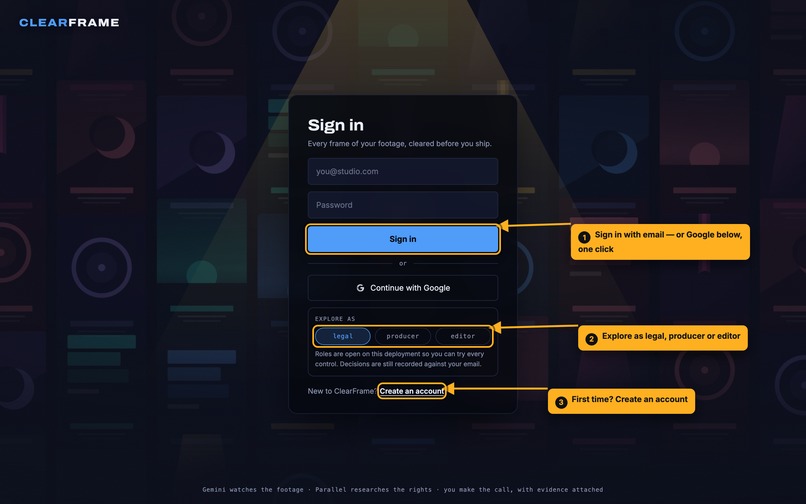
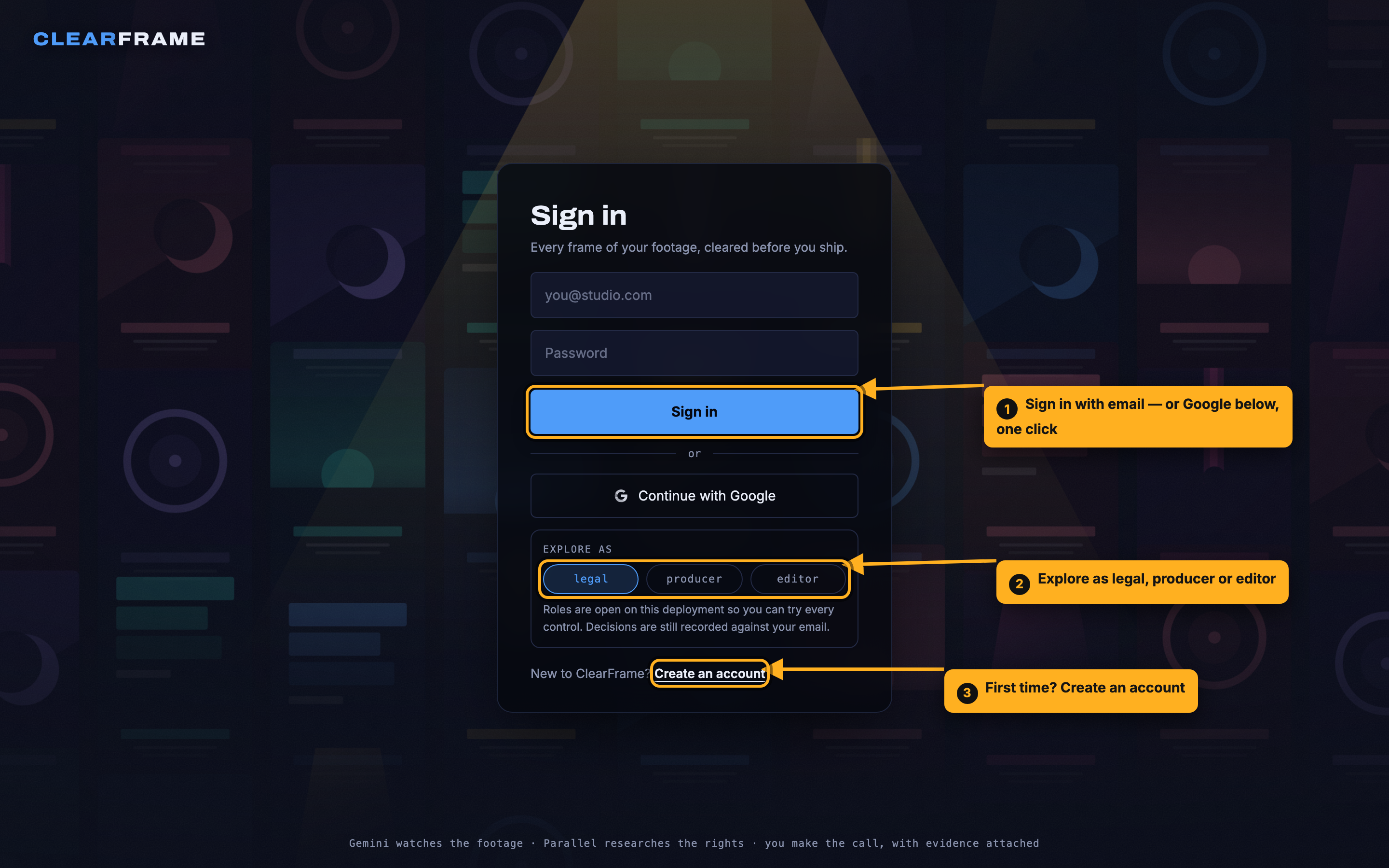
Sign-In
-
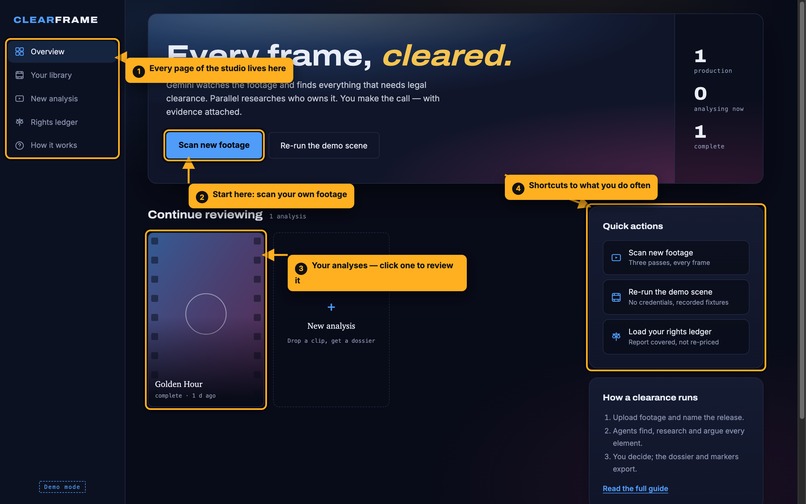
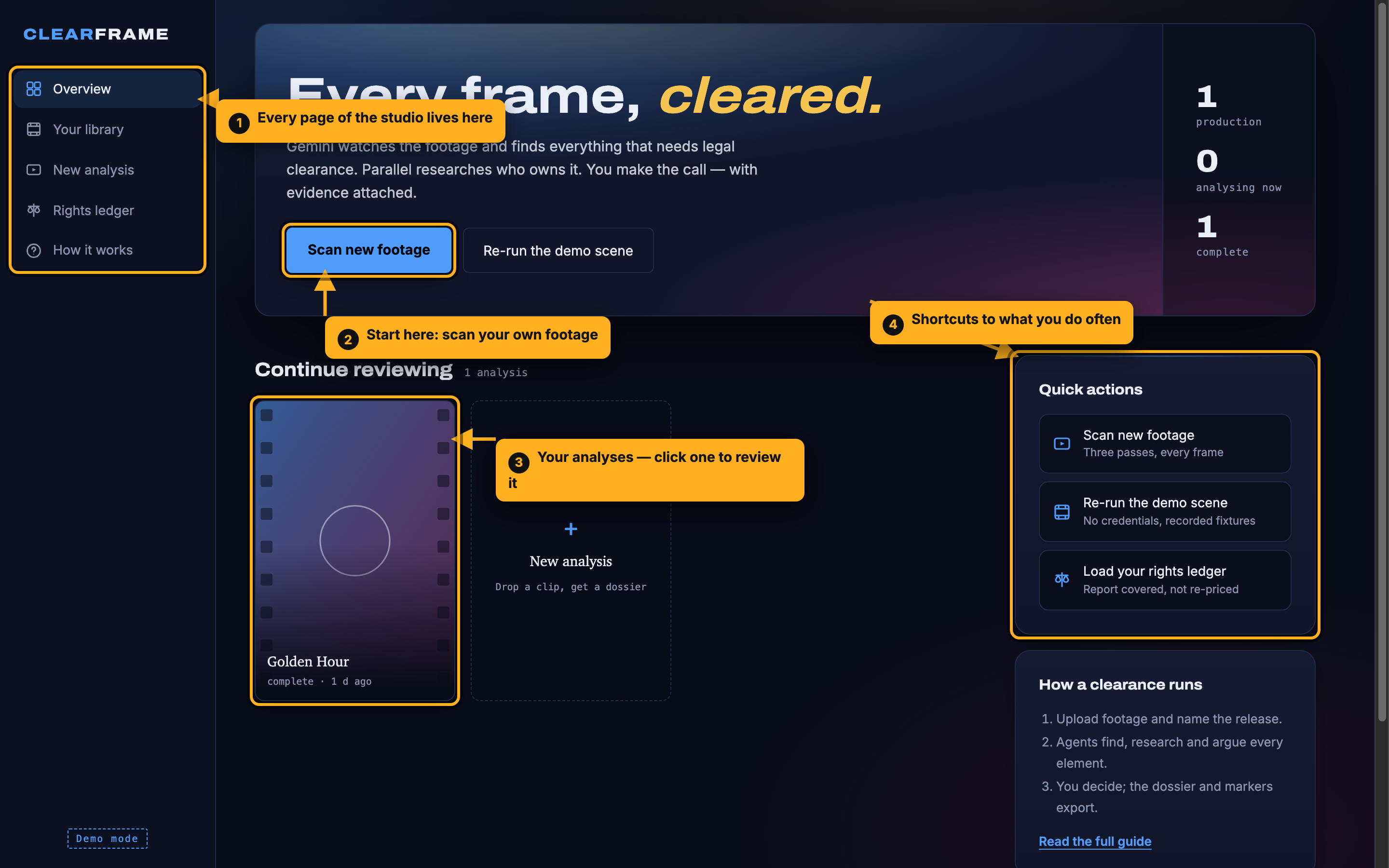
Dashboard-Overview
-
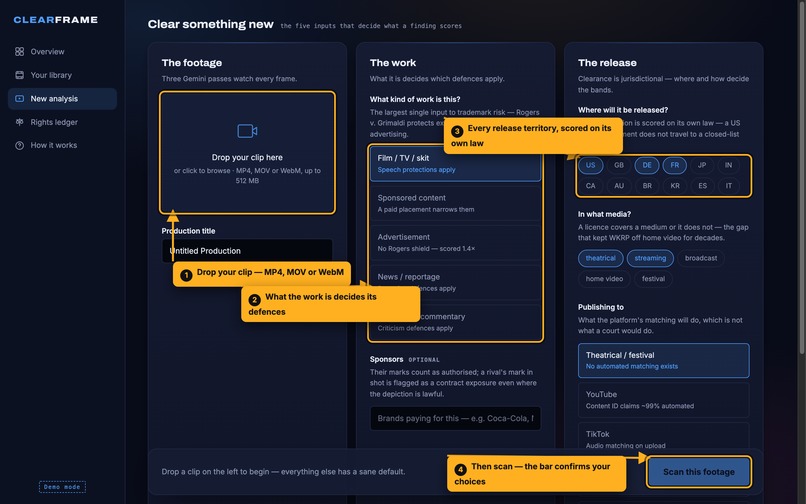
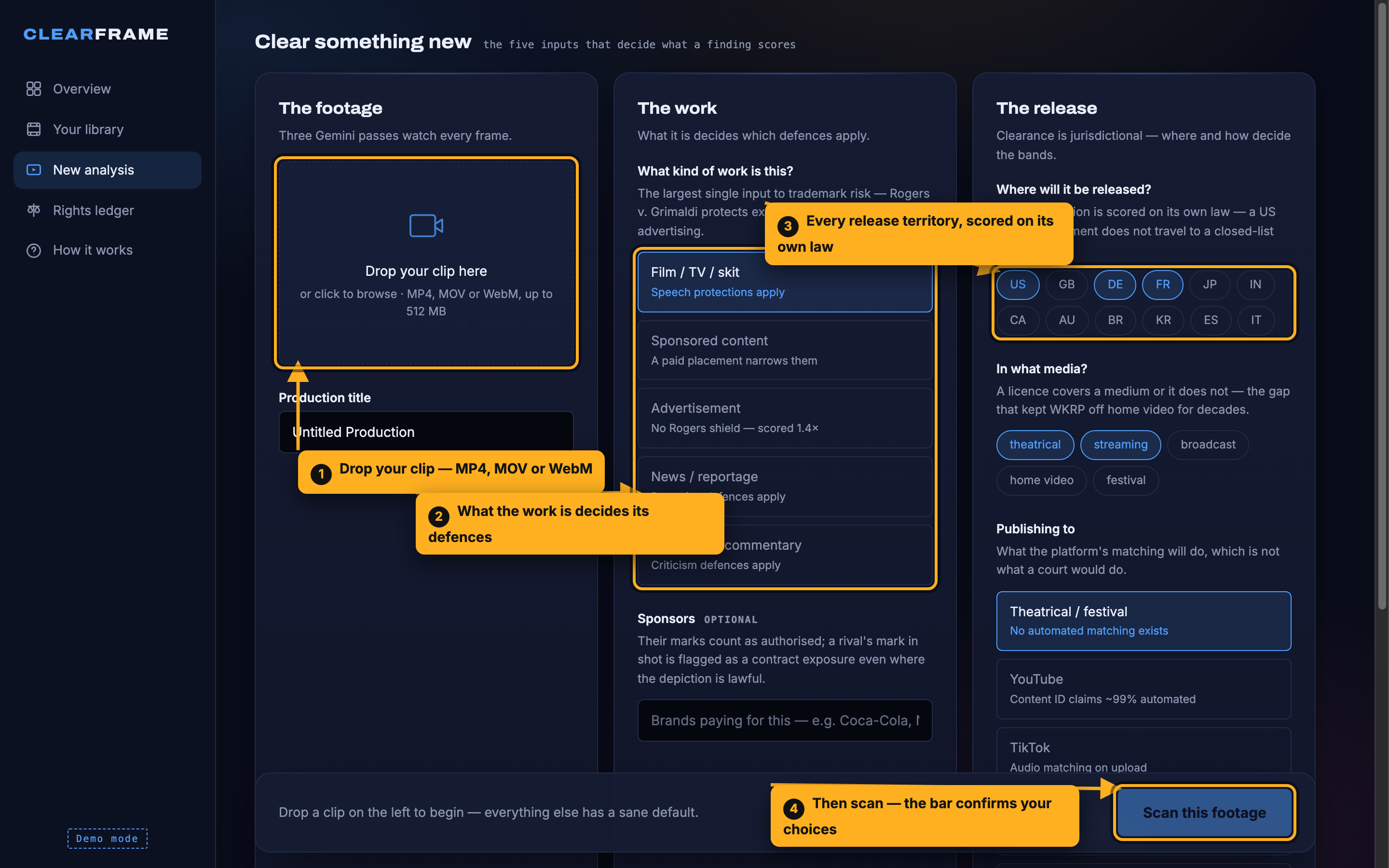
New-Analysis
-
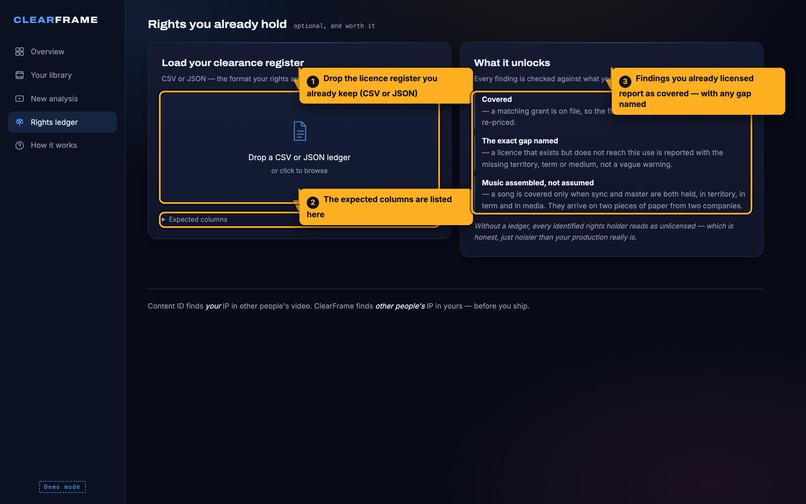
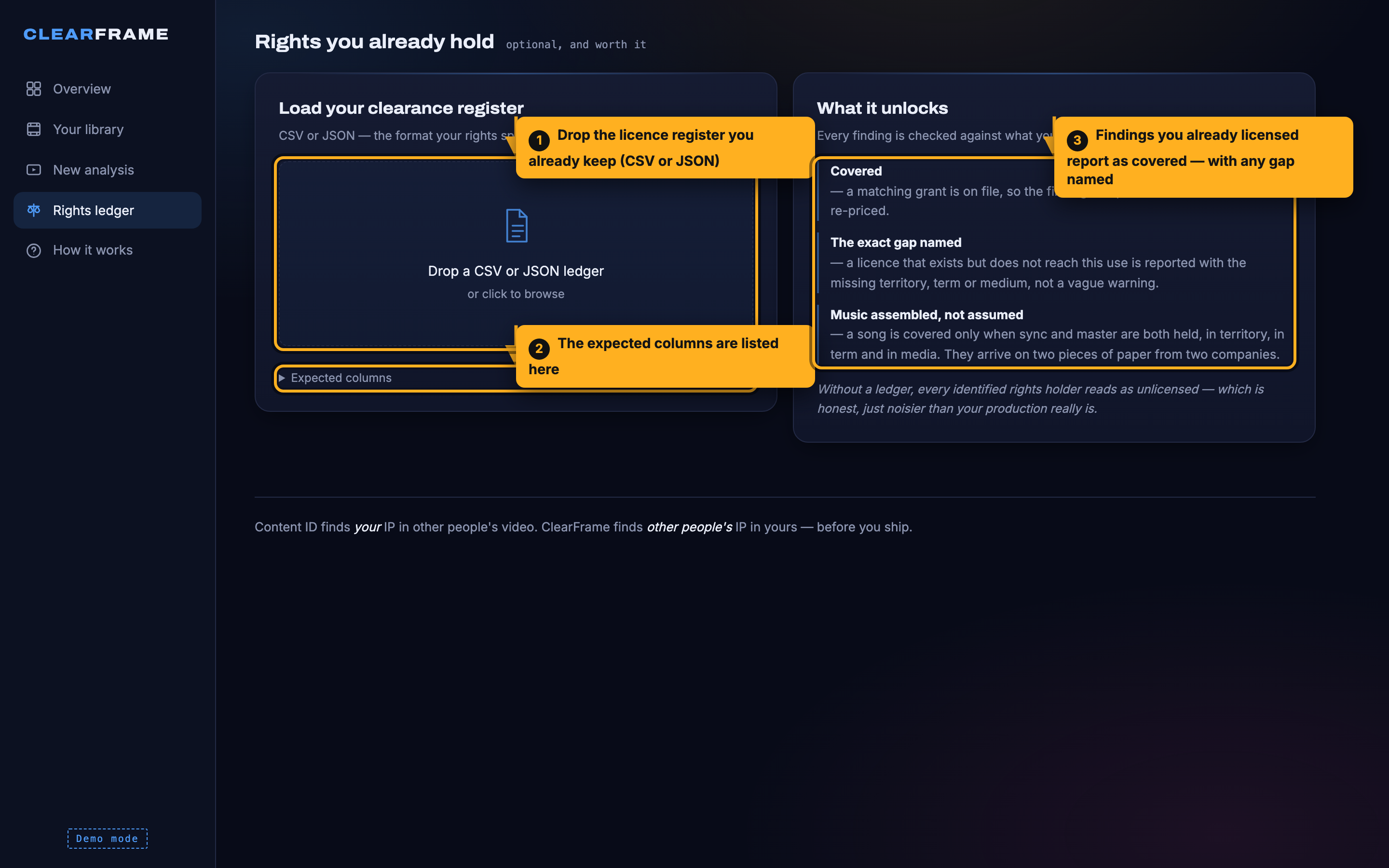
Right-Ledger
-
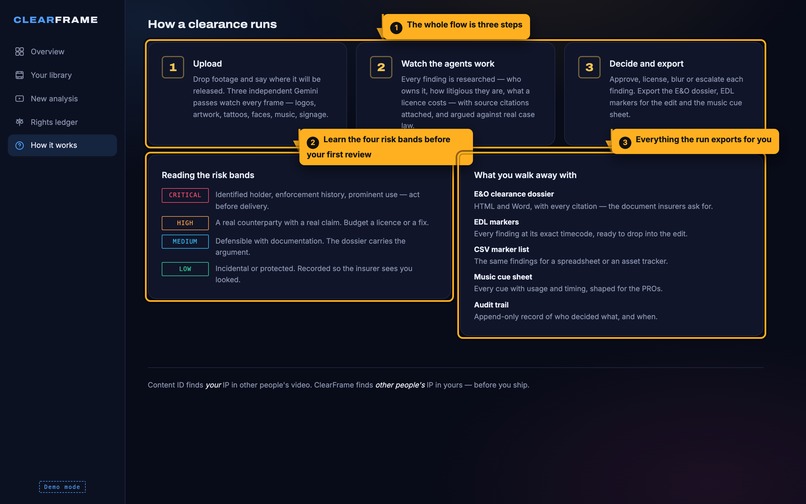
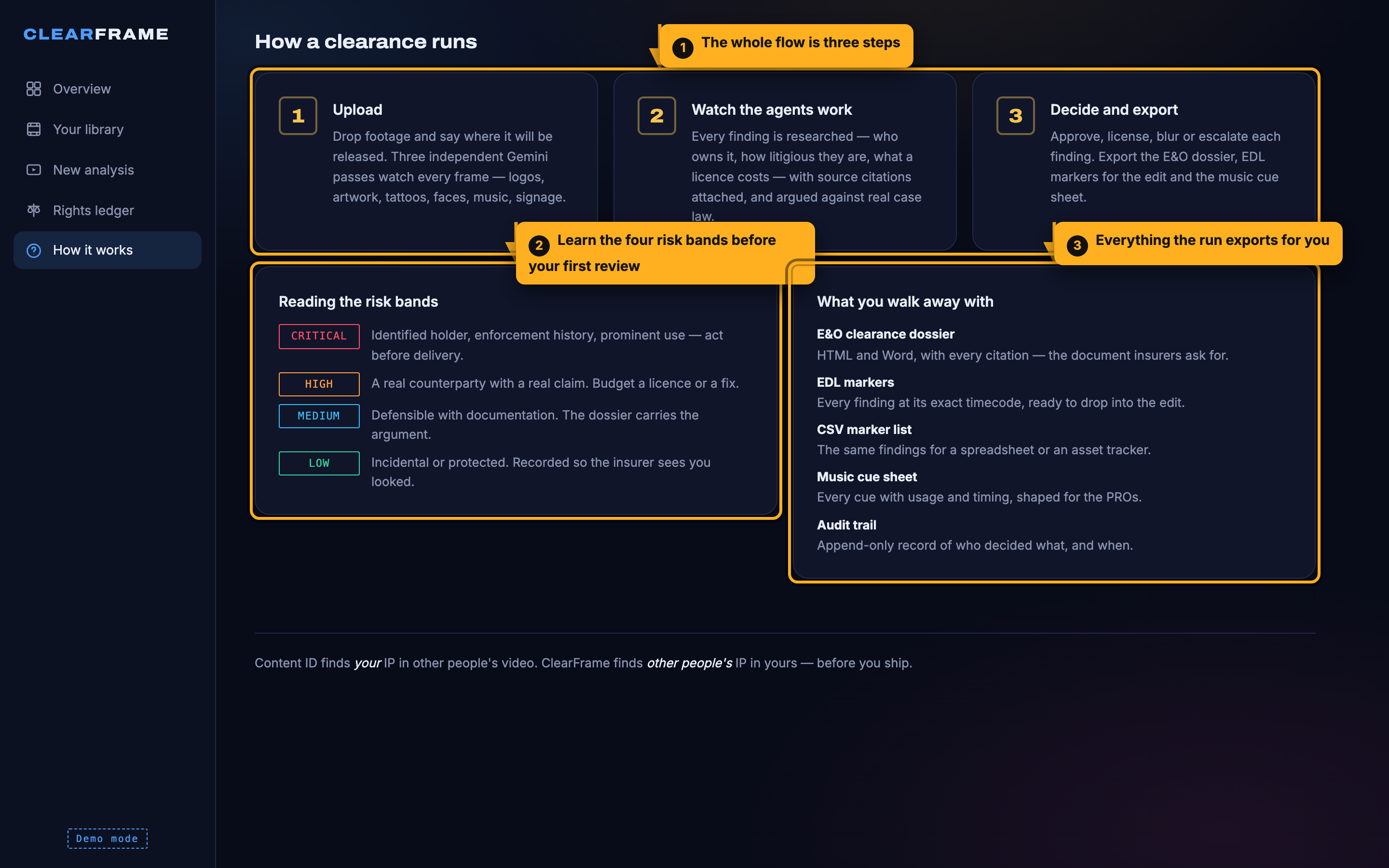
How-it-works
-
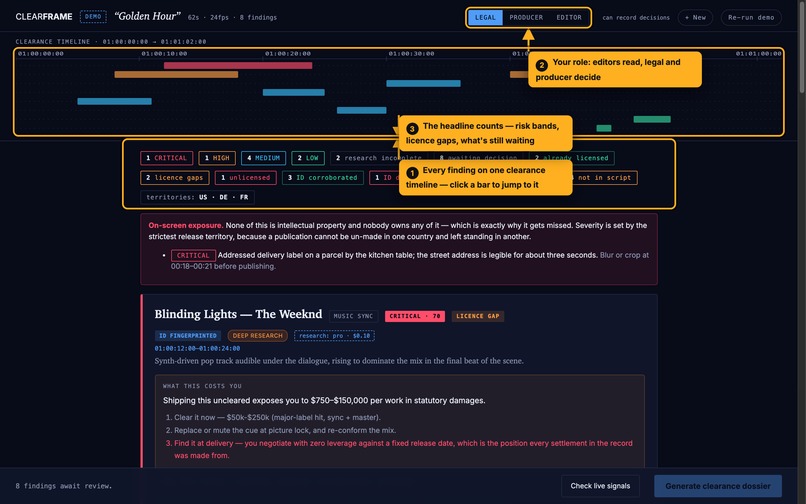
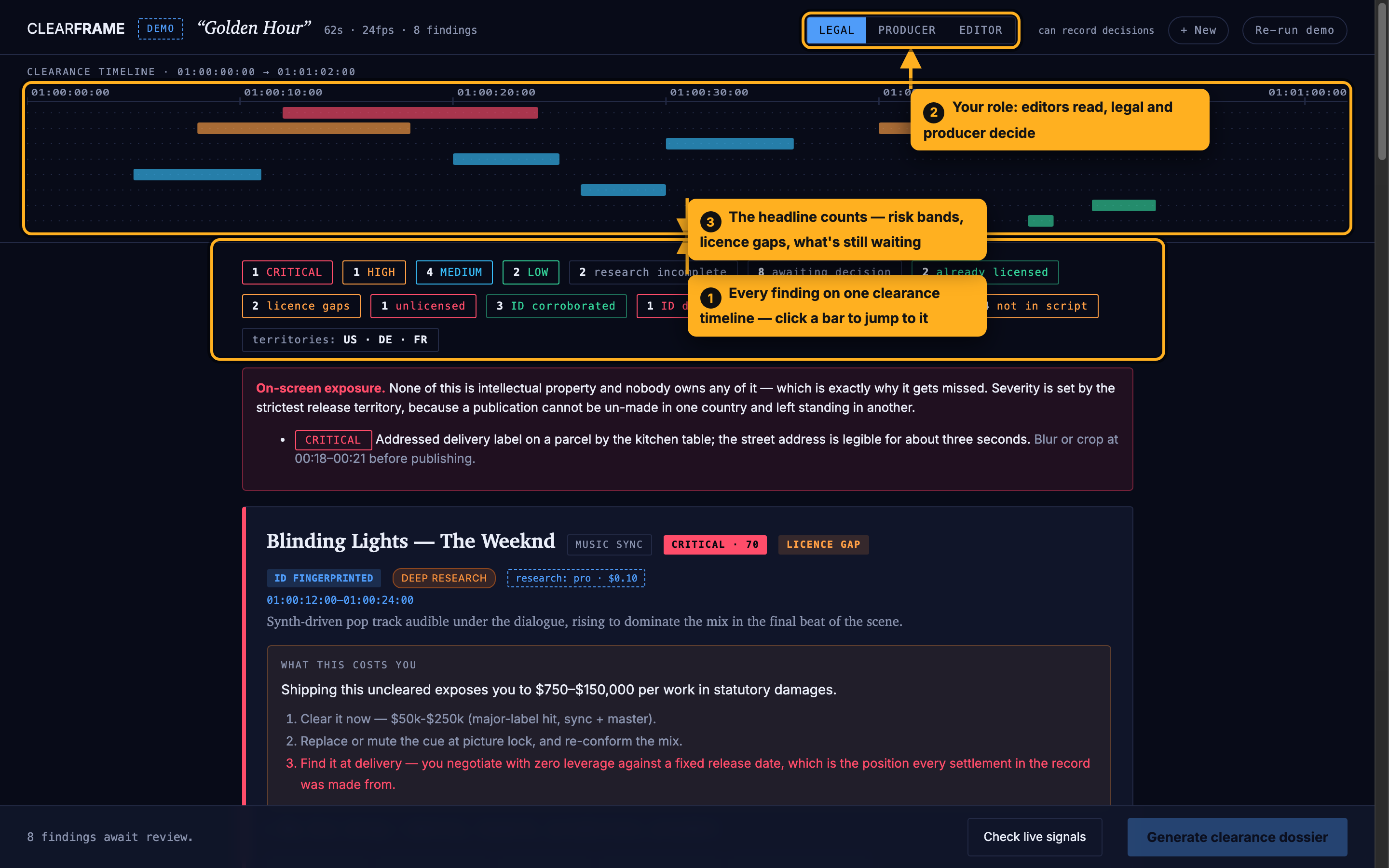
Review-timeline
-
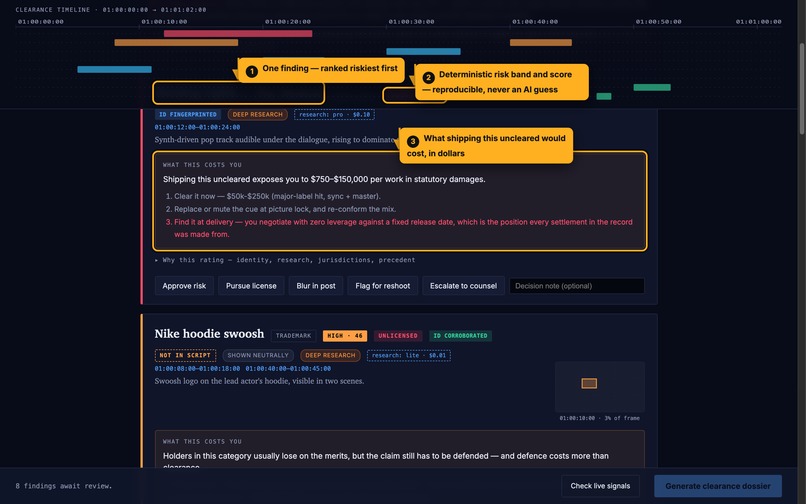
Finding-Card
-
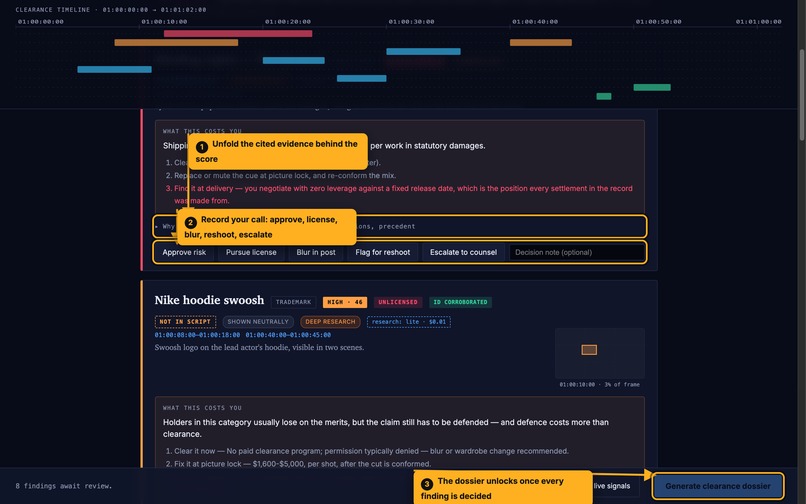
Record-Decision
-
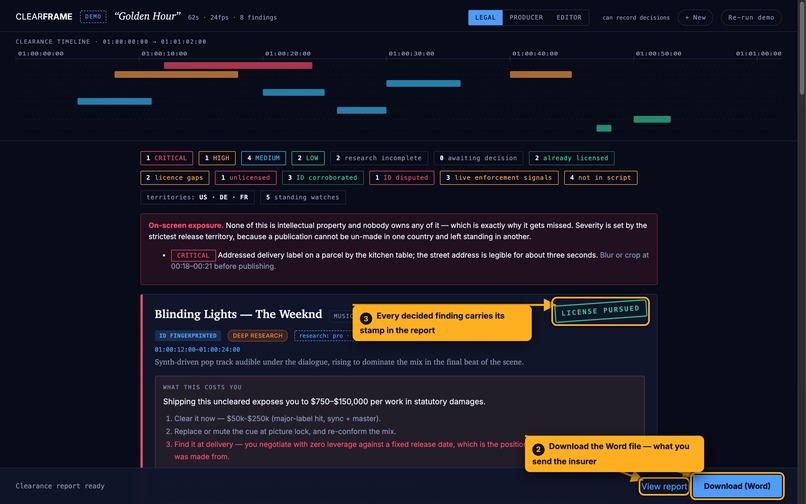
Dossier-Ready
-
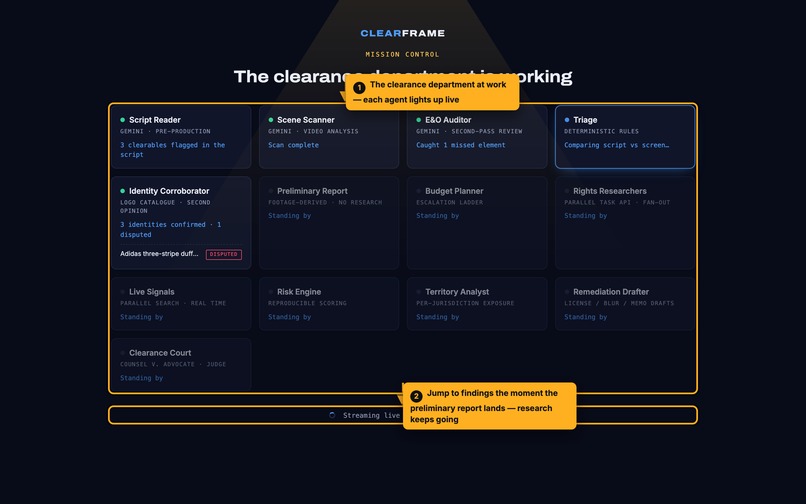
Mission-Control
Devpost Submission Draft
Track: Parallel Project name: ClearFrame Tagline: Ship the film, not the lawsuit.
Inspiration
In 2011, Warner Bros. nearly lost the release date of a $580M film over a tattoo. The artist behind Mike Tyson's face tattoo filed for a preliminary injunction against The Hangover Part II weeks before opening (Whitmill v. Warner Bros.). In 1996 an architect actually got an injunction against 12 Monkeys while it was in theatres (Woods v. Universal). A story quilt visible for 27 seconds of background made BET liable (Ringgold). And music clearance gaps shelved The Wonder Years for twenty years and WKRP in Cincinnati for decades.
Every film must clear everything visible and audible in frame — logos, artwork, music, tattoos, faces — before an E&O insurer will underwrite it and a distributor will touch it. In 2026 this is still done frame-by-frame, by hand. Studios have clearance departments; independent filmmakers and documentarians have a choice between a multi-thousand-dollar report and never releasing at all.
Meanwhile YouTube's Content ID processed 2.5 billion claims last year — all in the wrong direction. Content ID finds your IP in other people's video. Nothing finds other people's IP in yours — before you ship. So we built it.
What it does
Upload raw footage and a screenplay; get back the document an insurer asks for, with every claim cited.
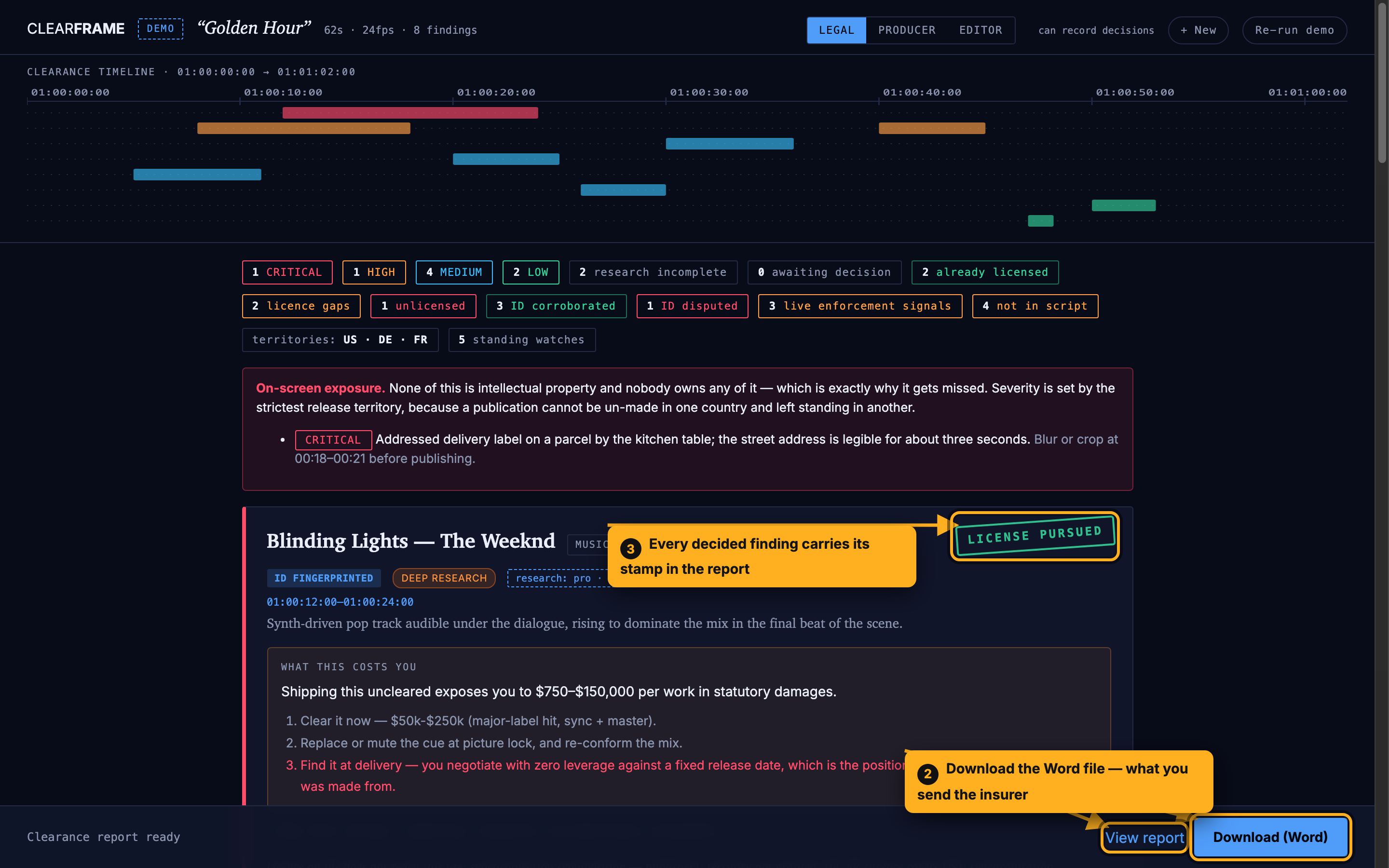
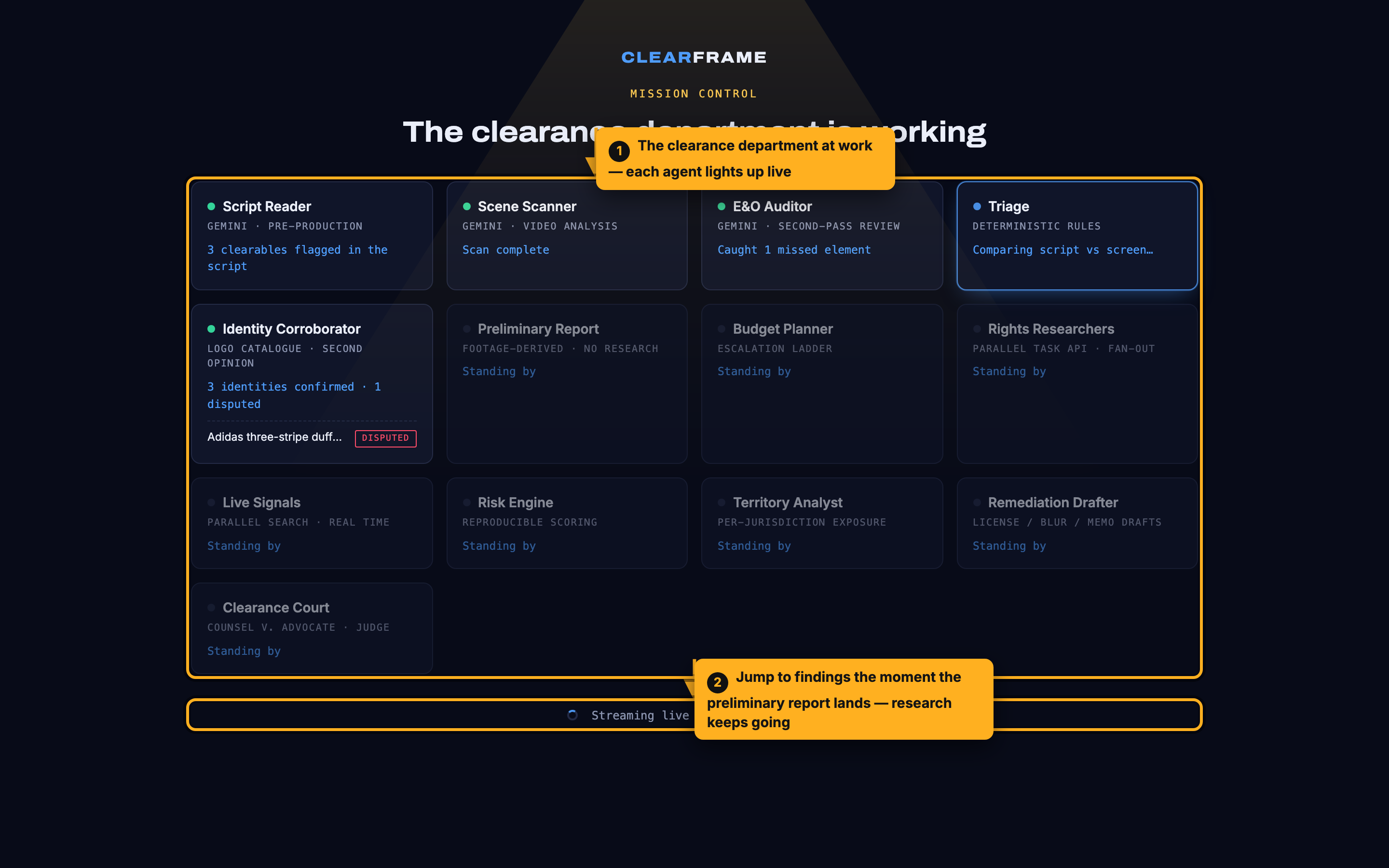
A deterministic 13-stage pipeline: script pre-scan → three independent Gemini video passes → triage → corroboration → script-vs-screen drift → a preliminary report → Parallel deep research → live enforcement signals → risk → territory → licence coverage → remediation → an adversarial Clearance Court — then a human review app and an E&O dossier in HTML and Word.
The design decisions that matter:
- Detectors observe; code decides. Risk is a pure-code rubric, never an LLM opinion:
$$\text{score} = B_{\text{category}} \cdot f_{\text{prominence}} \cdot f_{\text{duration}} \cdot f_{\text{posture}} \cdot f_{\text{context}} \cdot f_{\text{territory}}$$
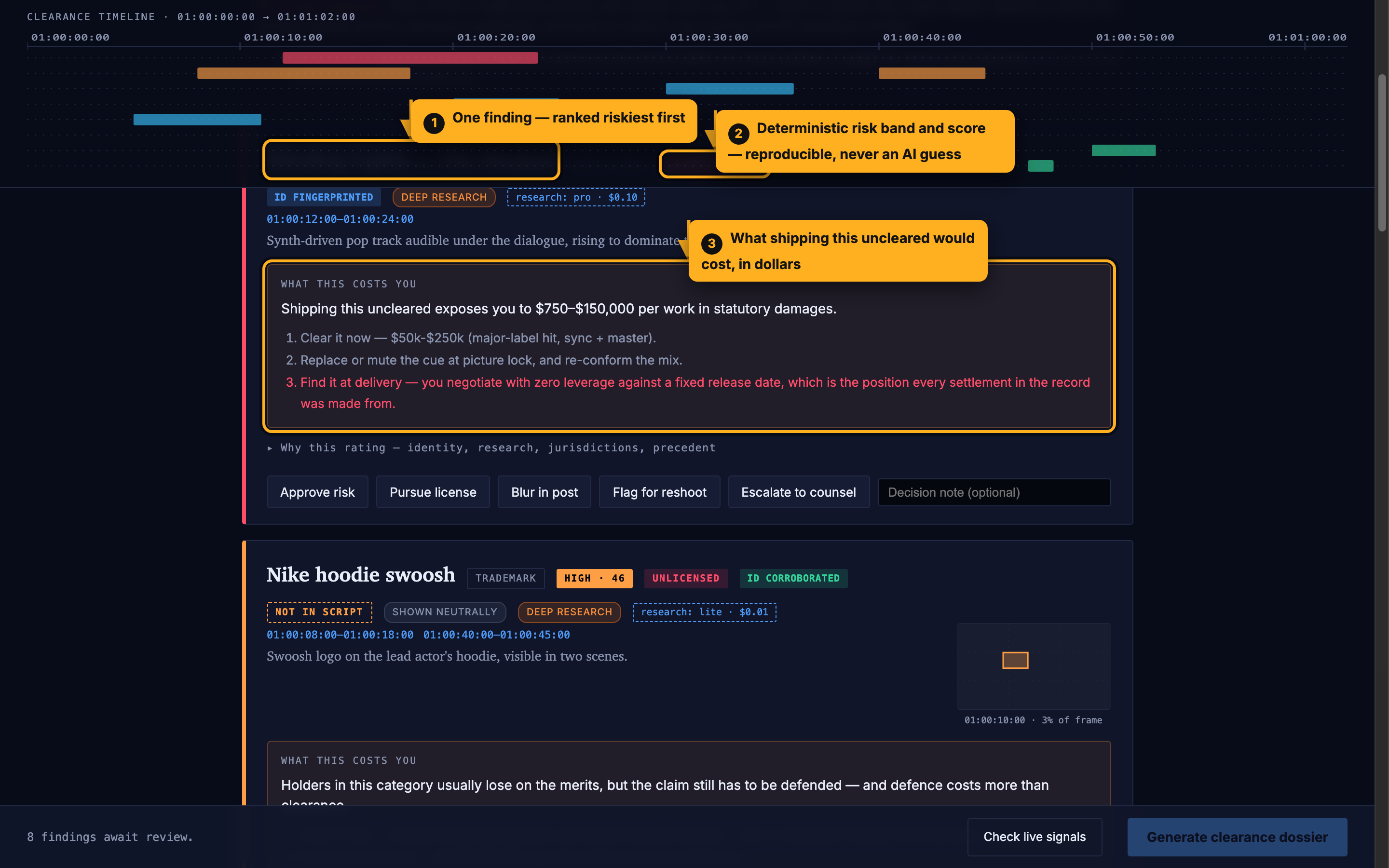
Every factor is recorded with the score, so any band is re-derivable from stored inputs. A preliminary score pins rights-holder posture at worst case, so a band can only fall when research lands — never fall because a lookup failed.
An escalation ladder decides what each finding costs. LOCAL (rights table, \$0) → STATUTE (settled law, \$0) → SEARCH (Parallel Search, ~\$0.005) → DEEP (Parallel Task, up to \$0.30). Ownership of a famous mark is a lookup; ownership of an anonymous mural is the question, so art goes deep. The record splits on real litigation: brand owners mostly lose against expressive works (Rogers, Caterpillar v. Disney, Louis Vuitton v. WB) and win against adverts (Falkner v. GM) — so an advertisement scores 1.4× and a film gets the Rogers shield.
Identity is corroborated, not guessed. Cloud Video Intelligence logo recognition and acoustic fingerprinting independently confirm what Gemini saw. A conflict blocks research — we won't bill you to investigate the wrong brand.
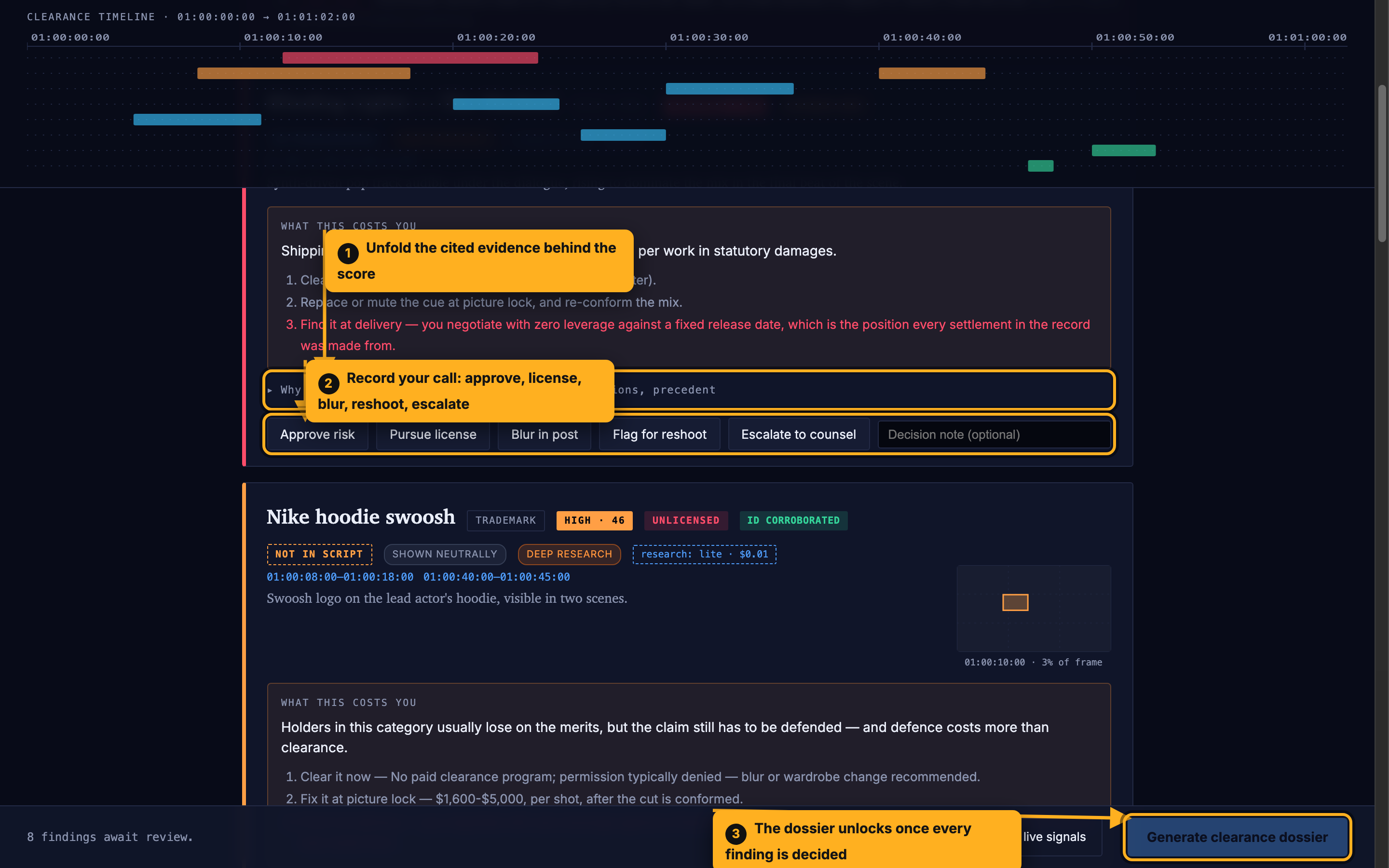
Evidence, in dollars and citations. Every Parallel research result carries Basis citations as the audit trail. Every HIGH finding gets a cost block — statutory range (17 U.S.C. §504(c): \$750–\$150{,}000 per work), clear-now vs fix-in-post, and injunction risk read from the actual litigation record. The Clearance Court argues each contested finding — studio counsel vs a fair-use advocate, a judge ruling with precedent.
Pause the video, get a measured box. Gemini samples video coarsely and returns union rectangles, so we re-measure every paused frame with a grounding call on the still — warmed in advance, ~900ms cold, 7ms warm.
A human signs everything. Role-gated review, append-only audit trail naming a verified email, and the dossier exports with signatories. The system's job is evidence, not verdicts.
How we built it
Google Cloud end to end: Gemini on Vertex AI (three concurrent video passes + an adversarial audit pass + frame grounding), Cloud Video Intelligence, two Cloud Run services (public API + private worker) with a Cloud Tasks queue between them, Firestore, Cloud Storage, Firebase Authentication, Cloud Build CI/CD, and an ADK SequentialAgent wrapper over the pipeline. A measured deployed run: 42s clip, preliminary report in ~3 minutes, full dossier in 9, about \$0.03 of compute — Gemini video is ~\$0.019 per minute per pass.
Parallel at runtime, load-bearing: the Task API with per-finding processor tiers chosen by a Budget Planner with recorded rationale; Parallel Search for the live "is this holder enforcing right now" pass; run-based FindAll to enumerate candidate owners of unidentifiable works. We deliberately never assert litigation posture from a local table — whether a rights holder is suing people this quarter is exactly what a static database cannot know, and exactly what keeps Parallel on the critical path of every material finding.
Engineering: a framework-free deterministic core; fixture/live client twins sharing one parser, so demo mode replays recorded responses through the identical code path with zero credentials; 937 tests, a full-transport smoke script, and a 25-check probe run against the deployed site with two real accounts.
Challenges we ran into
- A prompt is not a contract — four times. The model wrote "replicating" where we matched "replicated", answered x-first to a y-first bbox spec, phrased cast attribution three ways, and labelled subtitles with their own dialogue. Every check that reads model prose now has a code guard for how the model actually writes.
- Recall is the product's central claim, so we measured it: ~60% per scan pass across identical runs, and no video parameter fixed it (we tested and rejected two). The fix was three independent passes — on a live clip, three real findings were each caught by exactly one pass.
- Two processes are not one. The split topology silently broke things a green suite couldn't see: Cloud Tasks' default 600s deadline severing long runs, a heartbeat that went quiet during the scan, a rights ledger written to one container's disk and read from another's. Each was found by running the real deployment.
- Security before the URL went public: five ways one account could reach another's clearance work — including an XSS through the dossier itself — found, fixed, and re-probed over the network.
What we learned
A green test suite is not a working product — every important defect was found by uploading a real clip and clicking. Latency tracks the number of findings, not the input, so "faster" usually means "found less." And in legal automation, the deliverable isn't the answer — it's the provenance: citations, reproducible scores, and a named human signature are what make an AI-generated document usable.
What's next
Differently-primed scan passes to push recall past the three-pass ceiling; feeding script-vs-screen drift back as a targeted second look; USPTO TSDR as a free registry rung on the ladder; and a pilot with a documentary team — the people for whom \$0.50 of research versus a \$3,000 report is the difference between releasing and not.
Built With
- agent-development-kit
- cloud-build
- cloud-run
- cloud-storage
- cloud-tasks
- fastapi
- ffmpeg
- firebase
- firestore
- gemini
- google-cloud
- jinja
- model-context-protocol
- parallel
- pydantic
- python
- python-docx
- react
- typescript
- vertex-ai
- video-intelligence-api
- vite


Log in or sign up for Devpost to join the conversation.