-
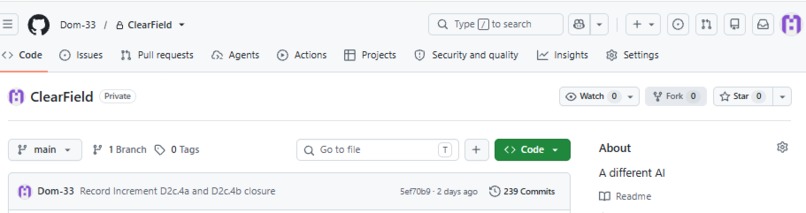
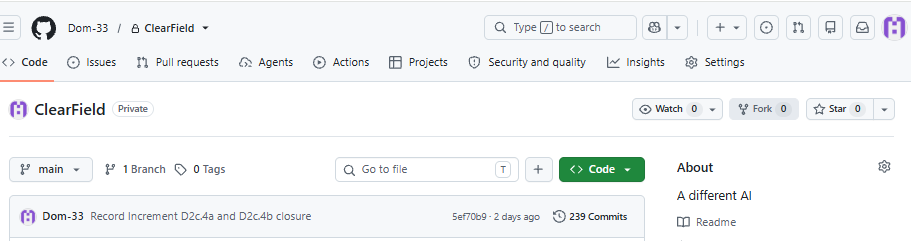
ClearField Private Repository — Active Development
Inspiration
ClearField started from a question: can an AI agent gain continuity, initiative, and greater operational capability without allowing its authority to expand implicitly?
Many AI systems remain essentially model + prompt + context. I wanted to explore a different architecture in which continuity, memory, self-assessment, authority, tool access, and auditability are explicit components of the system.
The goal is not simply to make an agent more autonomous, but to make autonomy verifiable and bounded.
What it does
ClearField is an experimental local AI agent architecture.
It is designed around explicit operational boundaries: the agent can reason, maintain controlled continuity, assess its own outputs and actions, use authorized tools, and preserve auditable state without being able to create new authority for itself.
Its architecture includes an Agent Kernel, explicit external-authority boundaries, a verified tool registry, action journaling, self-assessment, continuity mechanisms, state restoration, and independent verification.
A central rule is:
Collective capability may scale; collective authority must not self-scale.
Internal consensus, delegation, or agent-generated instructions cannot create authority that does not already exist at the external authority boundary.
How I built it
ClearField is being built incrementally as a local Python system.
Instead of starting with an open-ended autonomous loop, I separated the architecture into bounded subsystems and defined contracts for each of them before expanding agent capability.
The implementation includes explicit interfaces for authority resolution, tool access, action verification, journaling, continuity, state restoration, and self-assessment.
Each increment is tested before the next layer of autonomy is added. The repository is private because ClearField is still an active research and development project.
The development process is AI-assisted, with architecture, implementation, testing, and critical review performed through an iterative human–AI workflow.
Challenges I ran into
The main challenge has not been making the agent more capable. It has been deciding what capability should mean operationally.
An AI agent can become more useful by gaining memory, tools, persistence, initiative, or collaboration with other agents. But each of those features can also create hidden paths through which authority expands.
This required separating concepts that are often treated as one problem: capability, authority, delegation, continuity, memory, operational state, and verification.
Another challenge has been preventing architectural drift as the system grows. ClearField therefore uses explicit contracts, incremental milestones, tests, and audit mechanisms rather than relying only on emergent model behavior.
Accomplishments that I'm proud of
ClearField has progressed from a conceptual prototype into an incrementally validated agent architecture with explicit operational boundaries.
The current implementation separates credentials from authority, keeps action selection explicit, requires fresh authorization immediately before external effects, supports deliberate non-action, and treats provider output as an untrusted transient candidate rather than an automatic final response.
I have also deliberately rejected several common agent patterns, including credential-as-authority, provider-as-agent-identity, provider-managed continuity, and direct provider-response-to-user paths.
The current development increment is not yet closed: the next step is binding provider results into the reviewed evaluator, response gate, independent audit, and final response-visibility path before the increment can be considered complete.
What I learned
I learned that AI autonomy is not a single feature.
Memory, persistence, initiative, tool use, self-evaluation, delegation, and collaboration create different kinds of capability and different kinds of risk.
I also learned that many problems that initially appear to require restrictions on intelligence can instead be addressed by separating capability from authority and verifying concrete actions at the system boundary.
This changed the project from an experiment in AI behavior into an experiment in AI architecture.
What's next for ClearField
The immediate next step is to complete the path that takes an external model result through evaluation, response gating, independent audit, and final response visibility.
The goal is to ensure that provider completion can never bypass ClearField's internal verification controls.
After this path is fully validated, the next stages will explore controlled initiative, longitudinal self-evaluation, adaptive continuity, and later multi-agent collaboration while preserving the same externally verified authority boundary.

Log in or sign up for Devpost to join the conversation.