-
-
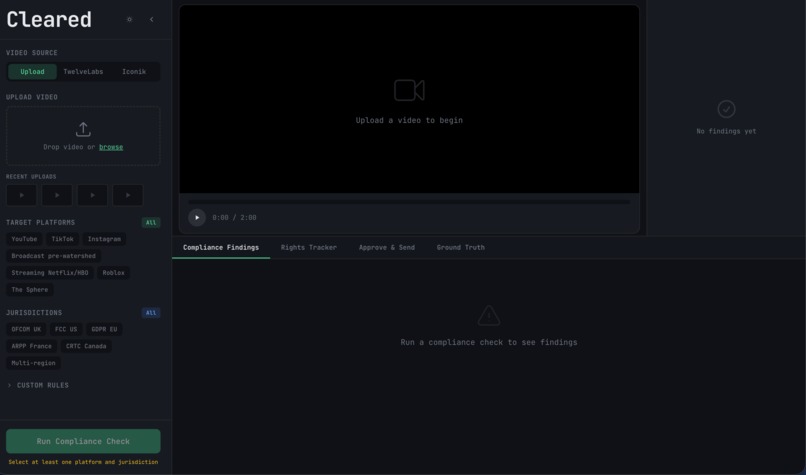
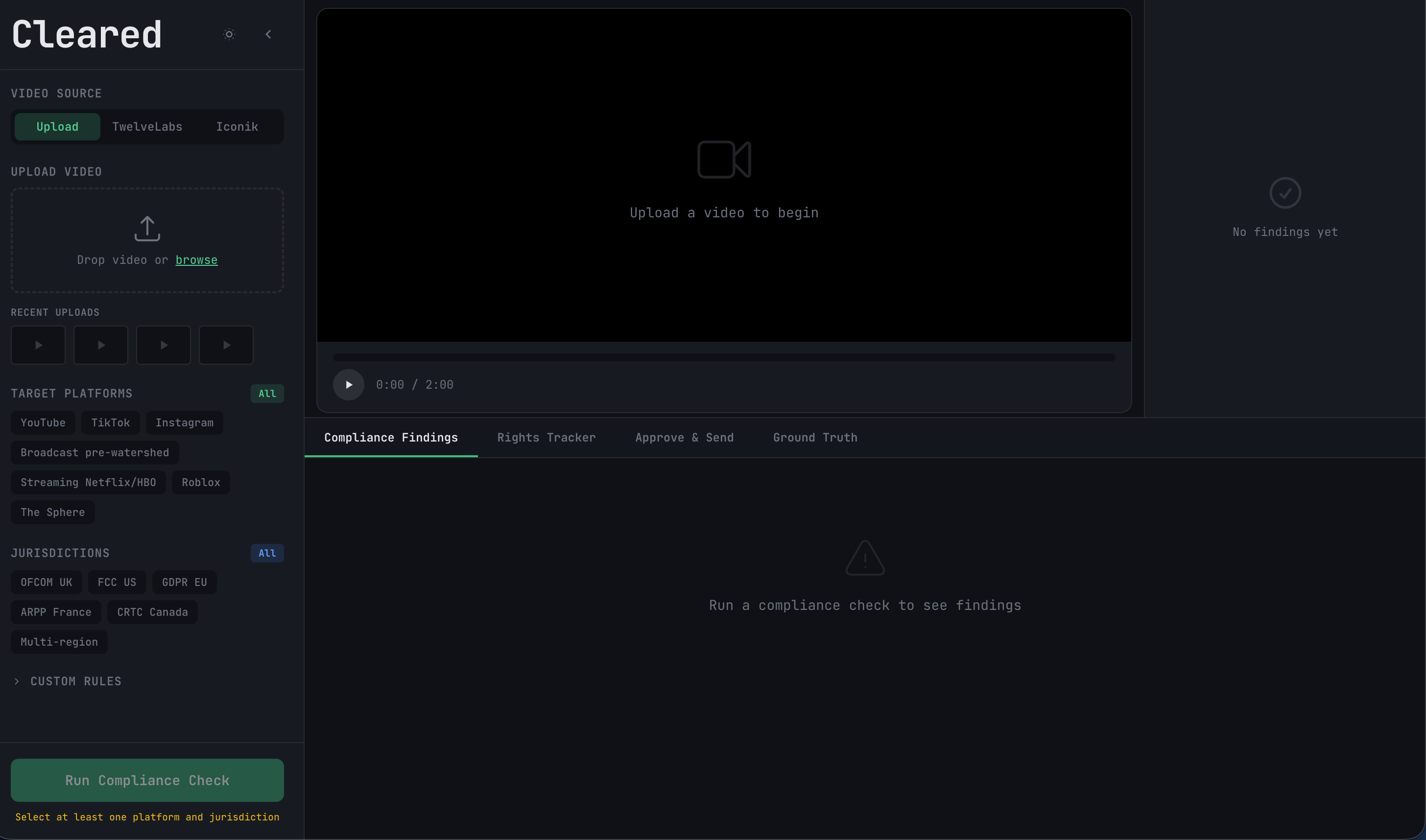
dark mode pre video
-
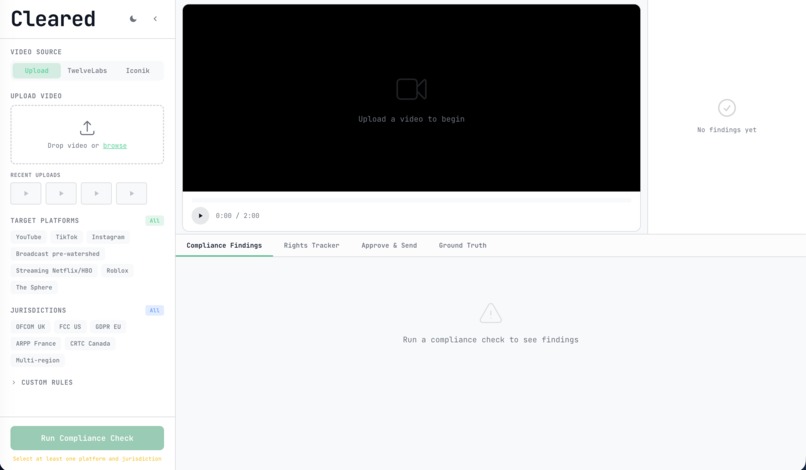
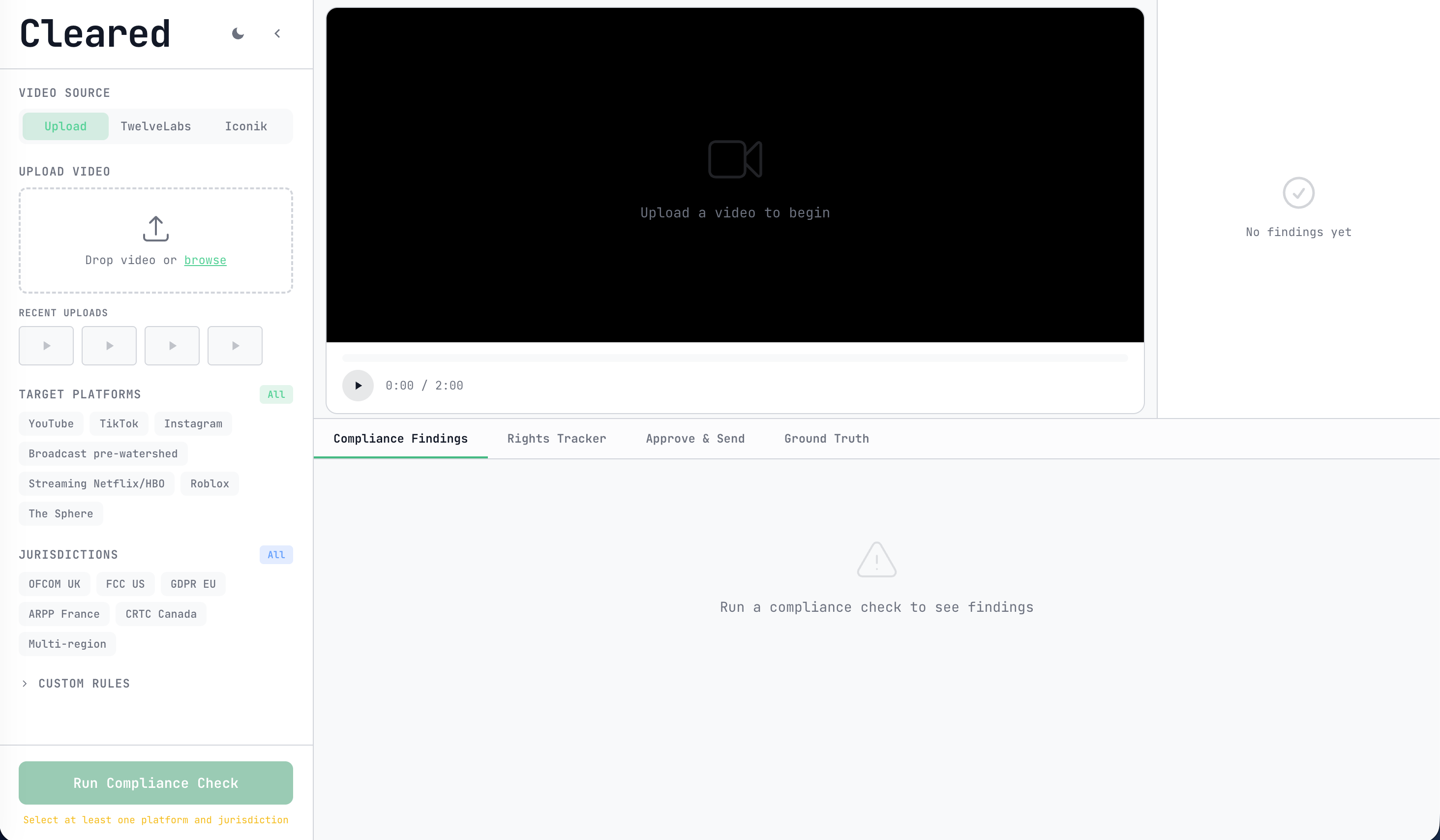
light mode pre video
-
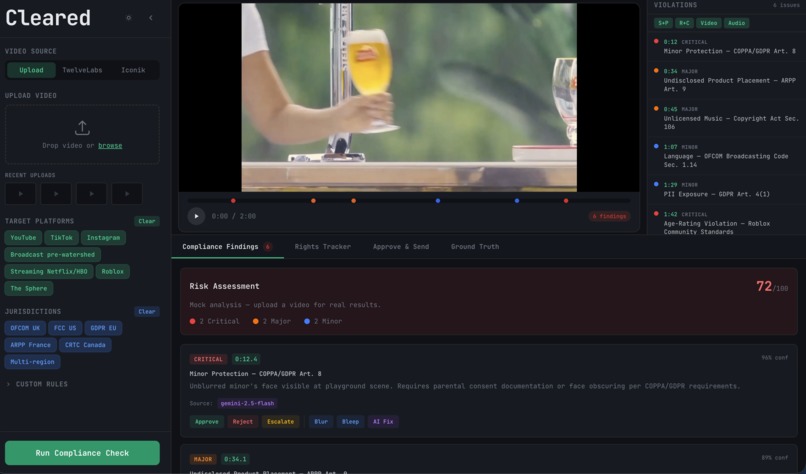
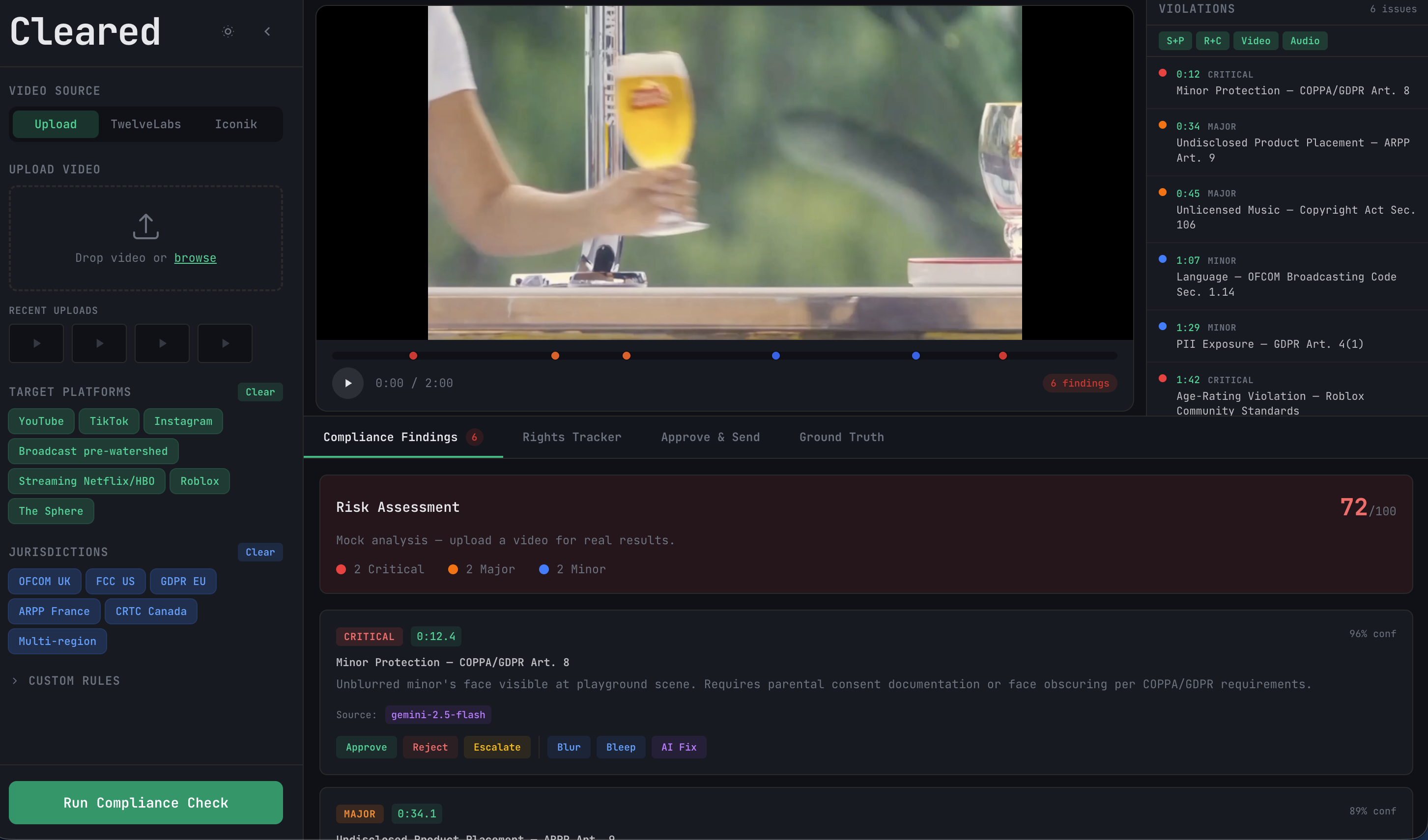
post video dark mode
-
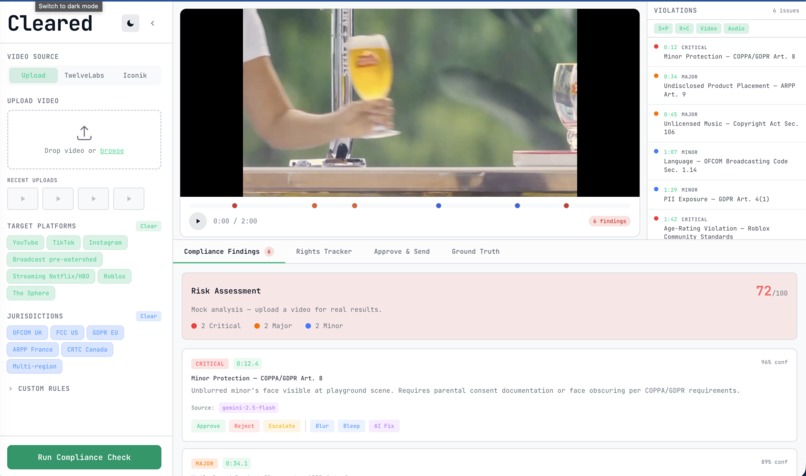
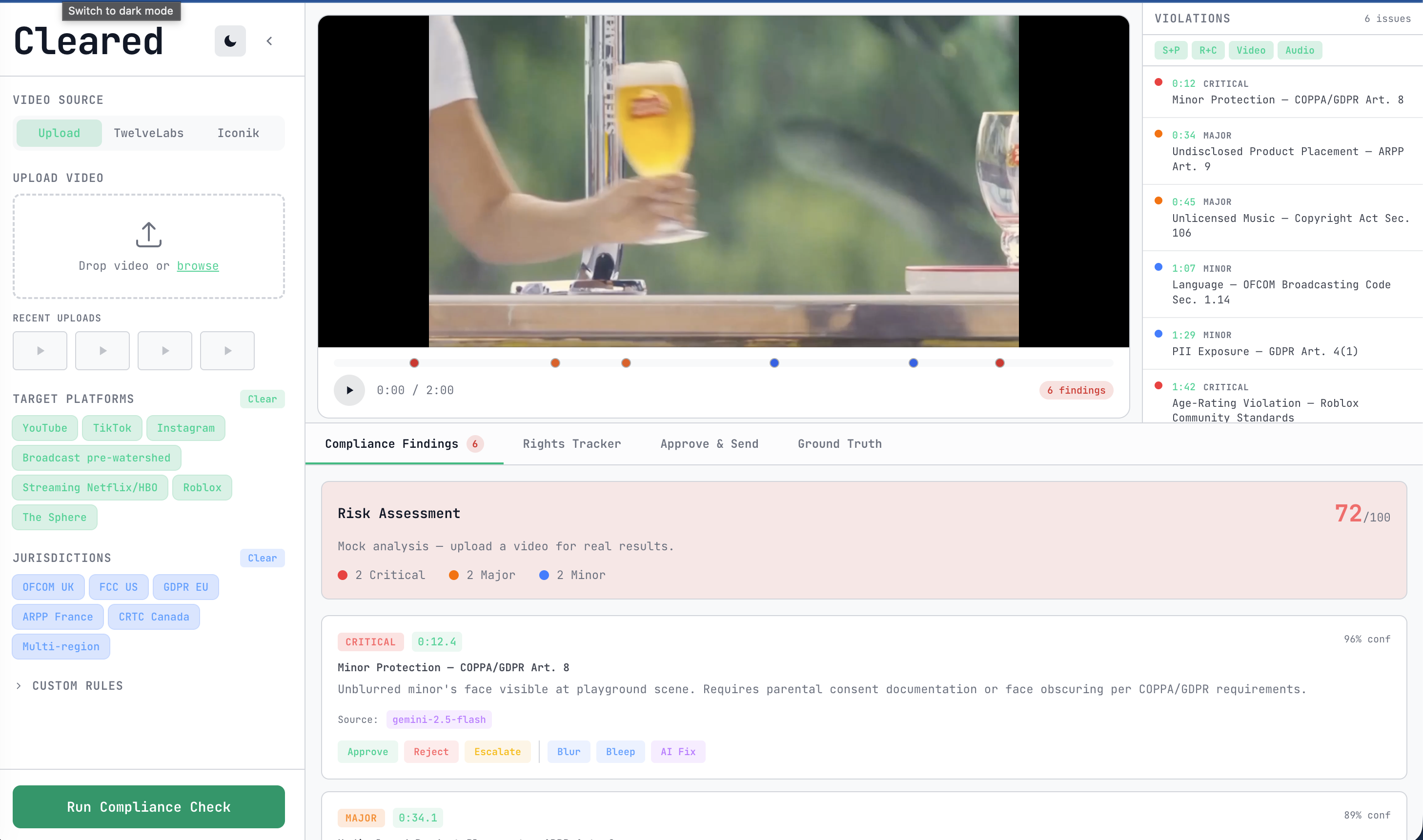
post video light mode
The Problem
Compliance violations cost money at every scale — a solo YouTube creator loses monetization the moment a video gets struck, and Warner Bros. or Sony loses days of time-to-market and risks \(\$10\text{M+}\) fines when a violation clears QC undetected. Both operate without adequate tooling: the creator can't afford it, and the studio's manual review runs at a 1:1 ratio.
The people doing this work aren't cheap. A Standards & Practices or Rights & Clearances reviewer at a major studio or network bills at \$600–\$900/day (senior salaried equivalent, often contractor-backed). When violations are found late, an Assistant Editor must manually locate, blur, bleep, or patch each moment, then re-export and QC a clean version — at \$350–\$550/day (IATSE Local 700 scale). A single flagged episode can burn 2–3 days of combined labor across both roles before it's cleared for delivery.
| Role | Day Rate | Time Per Flagged Asset | Cost Per Asset |
|---|---|---|---|
| S&P / R&C Reviewer | \$600–\$900/day | 4–8 hrs (1:1 review ratio) | \$300–\$900 |
| Assistant Editor (fix + re-export + QC) | \$350–\$550/day | 4–6 hrs per violation pass | \$175–\$412 |
| Combined per flagged episode | \$475–\$1,312 |
At 100 hours of content per week, that's \(\$7{,}500\text{–}\$15{,}000\) in reviewer labor alone — before a single frame gets fixed.
The Solution
Cleared is a monetization protection tool for the entire content ecosystem. For the solo creator, it's the difference between a channel that earns and one that doesn't. For WB and Sony, it's the difference between a title that ships on schedule into Premiere, Avid, or Flame and one that sits in legal.
It replaces manual first-pass review with contextual multimodal AI — reasoning across visual, audio, and editorial context together — then surfaces every finding with a precise timestamp, the rule triggered, and a Marengo-retrieved evidence clip for human validation. Platform targets (YouTube, TikTok, Broadcast pre-watershed, Netflix/HBO) and jurisdictions (OFCOM, FCC, GDPR, ARPP, CRTC) are selectable per run. Rules are configured in plain language without code. Reviewers batch-approve, reject, or escalate with full annotation support. LTX-powered remediation surfaces four contextual replacement options per finding — inline, no round-trip to editorial.
$$ 8\text{ hrs} \rightarrow 12\text{ min} \quad \text{S&P review time per asset} \qquad \$1{,}312 \rightarrow \$150 \quad \text{fully-loaded cost per flagged episode} $$
Who It's For
| Segment | Value | Integration |
|---|---|---|
| Solo UGC creator | Protect ad revenue; catch strikes before upload | Browser, zero setup |
| MCN / agency | Portfolio-scale brand safety | CSV / webhook |
| Mid-market studio | Reduce re-edit and clearance cost | OTIO → Premiere / Resolve |
| Warner Bros. / Sony / SVOD | Ship on schedule; MAM-integrated audit trail | OTIO → Avid / Flame; Dalet / Vantage / Iconik |
No other tool covers this range without a six-figure deployment contract.
Stack
Pegasus via AWS Bedrock (compliance analysis) · Marengo (evidence retrieval) · LTX via Baseten (remediation) · OTIO / JSON / CSV export · Iconik native integration
Built With
- bedrock
- claude
- python
- twelvelabs


Log in or sign up for Devpost to join the conversation.