-
-
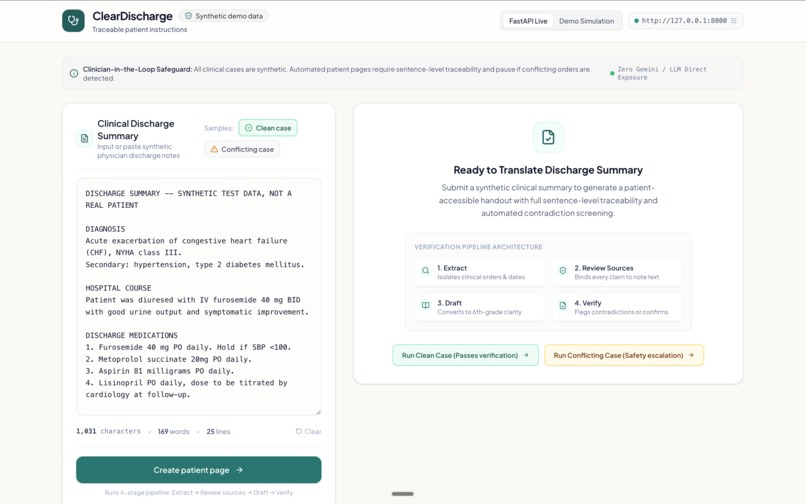
ClearDischarge- Front Page
-
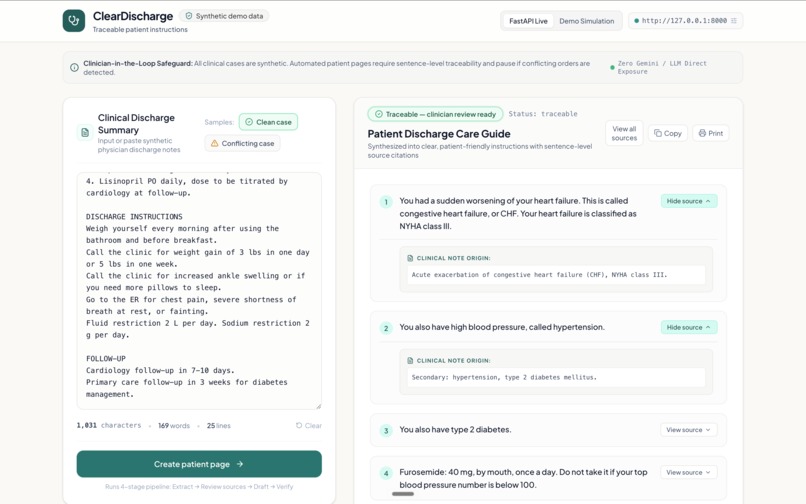
ClearDischarge- Clean Case
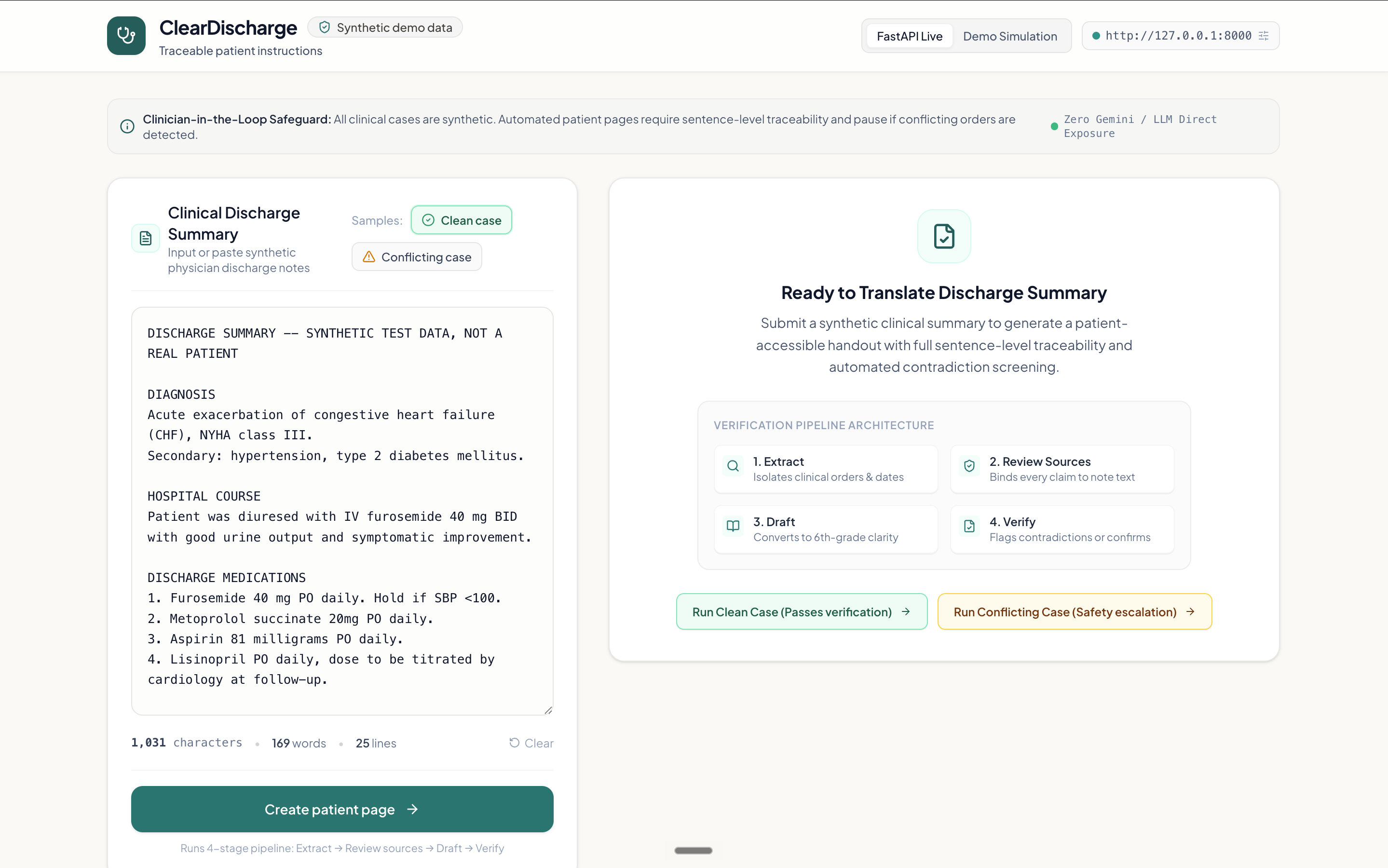
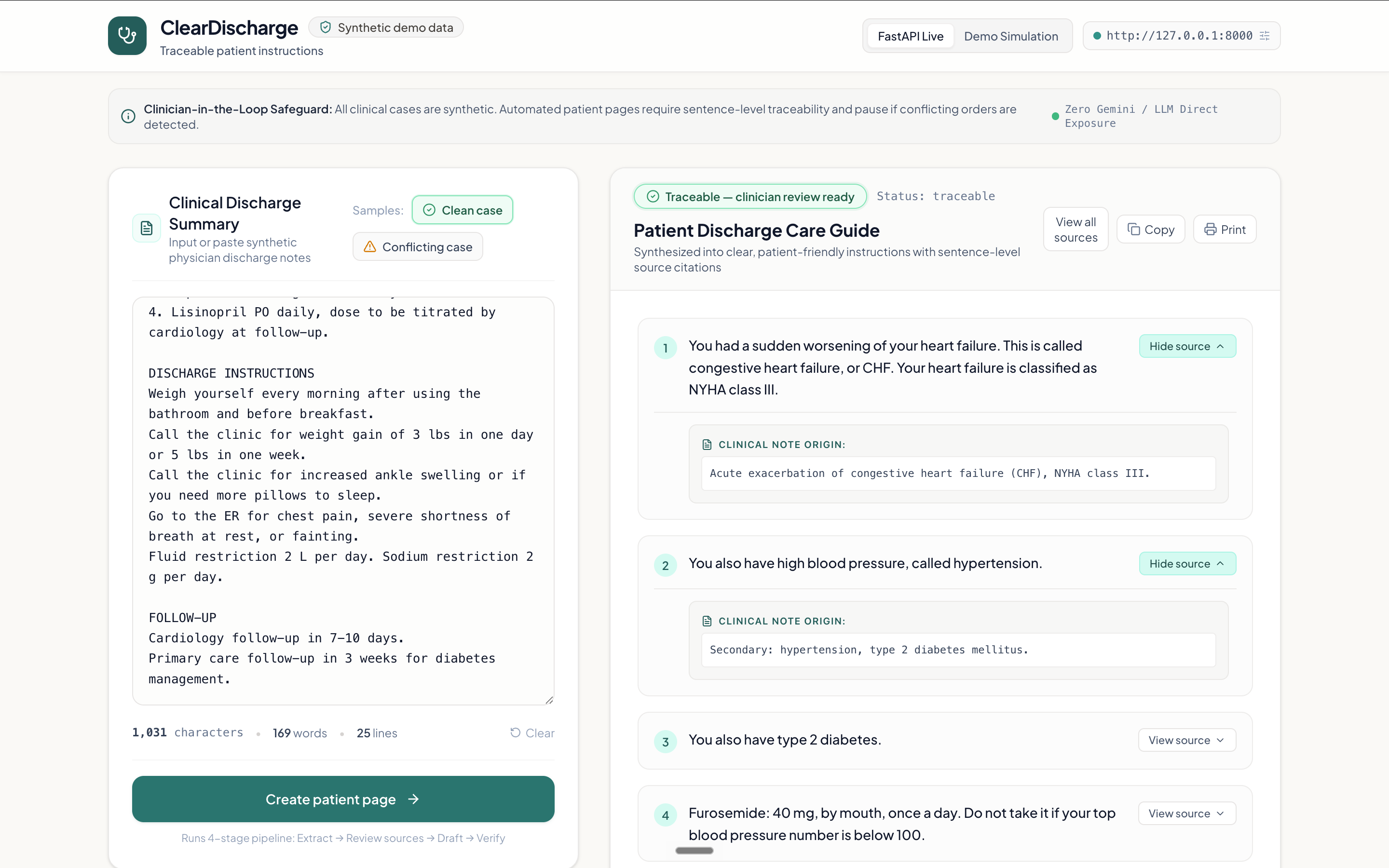
Inspiration
A discharge summary is written by a clinician, for clinicians. The patient gets handed a copy as a side effect.
"Patient presented with acute exacerbation of CHF, diuresed with IV furosemide, discharge on furosemide 40mg PO daily, hold if SBP <100, f/u cardiology 7–10 days."
Nobody outside medicine can act on that. So the medication gets taken wrong, the warning signs get missed, the follow-up never happens — and the patient is readmitted. Hospitals are financially penalised for exactly that readmission.
The obvious move is "ask an LLM to simplify it." That's also the dangerous move: a fabricated dose in a patient handout is worse than no handout. So the interesting part of this project was never the translation. It was the proof.
What it does
Discharge summary in → plain-language patient page out, plus evidence that nothing was invented.
The output page has four sections:
- What happened
- Your medicines
- Warning signs — split into call the clinic vs go to the ER
- Follow-up
Every item is traced to a verbatim source_line from the original note. The UI shows
that trace alongside the plain-language text, and it shows the agent's run timeline —
extract → review sources → draft → verify → render — so a reviewer can see what the
agent did, not just what it produced.
When the source can't be safely translated, it stops. It does not guess.
Positioning, stated plainly: a nurse or discharge coordinator runs this, reviews the output, and hands it to the patient. Clinician-side, not patient-side. The agent makes no clinical decisions — the treatment plan already exists, and is being translated, not authored.
All data in the demo is synthetic. No real patient data was used.
How I built it
One agent. No sub-agents — the branching is genuinely a graph, and sub-agents would have added orchestration bugs without adding capability. "I didn't need the complexity" was a deliberate call.
The LangGraph pipeline:
discharge summary
      │
      ▼
  [extract] ─────────► grounded JSON, verbatim source_line on every item
      │
      ▼
[review_sources] ────► deterministic safety rules on the extracted evidence
      │                   contradictory doses · non-positive doses ·
      │                   unsupported schedule vocabulary
      ▼
   [draft] ──────────► plain-language patient page
      │
      ▼
  [verify] ──────────► every claim rechecked against the extracted JSON
      │                   fails? rewrite once, then re-verify the whole page
      ▼
   clean ──► patient page        still unverifiable, or a source conflict
                                            │
                                            ▼
                                ESCALATE — stop, show the evidence,
                                           flag for human review
Two design decisions that carry the whole project:
Extraction runs exactly once. A rewrite cannot quietly change the evidence it is being judged against. Without this, the verifier can be talked into agreeing with itself.
Verification re-checks the entire page after a repair, including sentences kept from the first draft — not just the sentence that failed.
Stack: Python · LangGraph · Anthropic SDK (claude-sonnet-5) · FastAPI · React 19 +
Vite + Tailwind · pytest. No database, no auth — it runs from a laptop.
Built solo, in gated chunks: Claude Code built one tool at a time, and each chunk was handed to a second model with one narrow question — "what breaks this?" — which generated adversarial inputs and ran them, rather than reading the code. Only demo-breaking findings got fixed.
Challenges I ran into
Making the safety check strict without making it cry wolf. The clean test case moves a patient from IV furosemide 40 mg BID to furosemide 40 mg PO daily. That's a normal route change, not a contradiction — but a naive "same drug, two mentions" check escalates on it, and would escalate on nearly every real discharge summary. A safety net that fires constantly gets switched off. Getting case 1 to run clean while case 2 still escalates was the hardest single constraint in the build.
Deciding what the agent is not allowed to infer. Alendronate 70 mg PO weekly is
a perfectly valid prescription, but "weekly" sits outside the formatter's supported
schedule vocabulary. The tempting fix is to have the model phrase it. The correct fix
is to escalate — because the failure mode of guessing patient-facing wording is
silent and unbounded.
Accomplishments that I'm proud of
The escalation path. It's roughly ten lines of logic and it's the most grown-up part of the demo — it's the part that says this was built by someone who thought about being wrong.
Concretely, on the seeded-flaw case the same drug appears at two different doses for the same phase of care — 40 mg in the medication list, 20 mg in the instructions. Nothing in the note says which is right. The agent doesn't pick one. It stops and asks for a human.
What I learned
In a clinical context the verifier is the product. Plain-language rewriting is the easy half and largely solved; the half that decides whether anyone can actually deploy this is the traceability and the refusal to guess. I spent the build accordingly.
What's next for ClearDischarge
Deliberately out of scope today, and named as such rather than omitted:
- Plain-language drug information from openFDA, held to the same verification standard
- Readability scoring against a target reading level
- Translation into the patient's own language
- Memory across a patient's admissions
- Push into the patient portal, and follow-up appointment booking
- A clinician review queue, so escalations land somewhere rather than just stopping
Built With
- anthropic
- claude
- fastapi
- langgraph
- pydantic
- python
- react
- tailwindcss
- typescript
- uvicorn
- vite

Log in or sign up for Devpost to join the conversation.