Inspiration
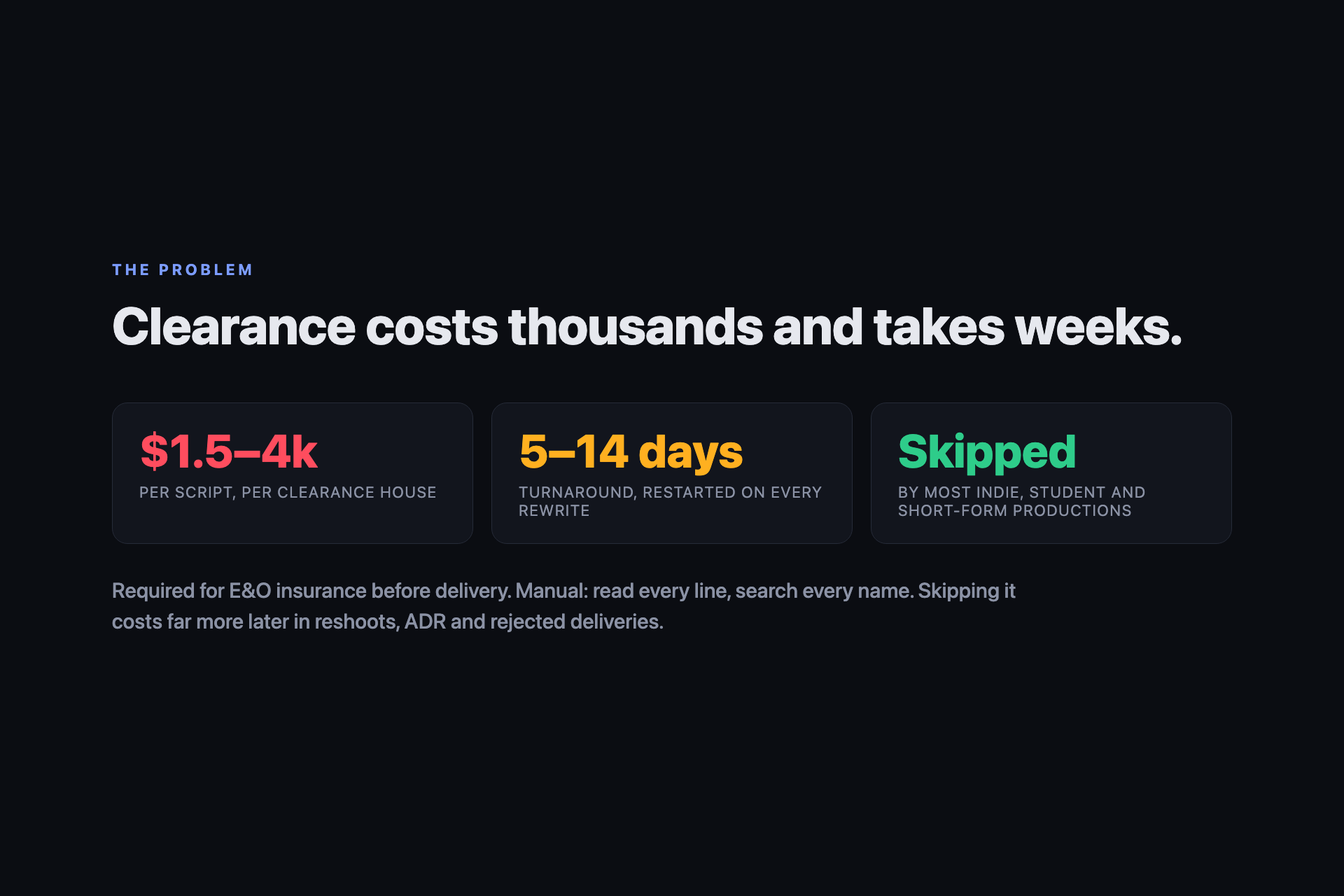
Before any film or series can be delivered to a distributor or streamer, it must carry Errors & Omissions insurance, and E&O insurers require a script clearance report: a line-by-line review that flags every name, brand, song, business, address and identifier that could get the production sued. A clearance house charges $1,500–$4,000 per script, takes five to fourteen days, and starts over on every rewrite. So indie, student and short-form productions skip it, then pay far more later in reshoots, ADR, blurred logos and rejected deliveries.
Nobody has automated it because it isn't a database lookup. A name that was safe last year can belong to a newly famous person this year; a company can rebrand; a song can change hands. Clearance needs live web research with traceable sources for every entity, then legal judgment on each one. That is exactly the shape of work agents are now good at, and exactly what Parallel's Search API was built for.
What it does
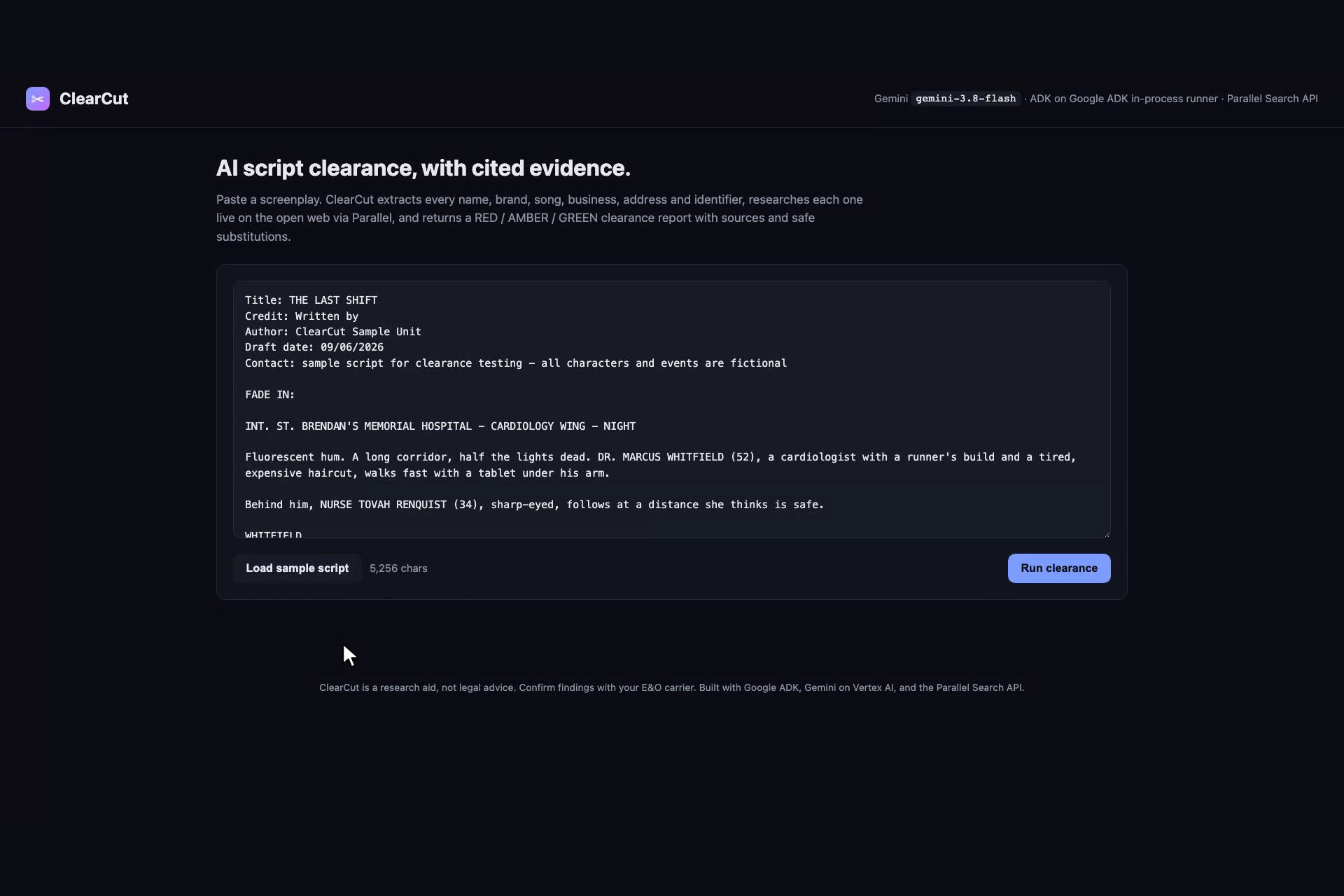
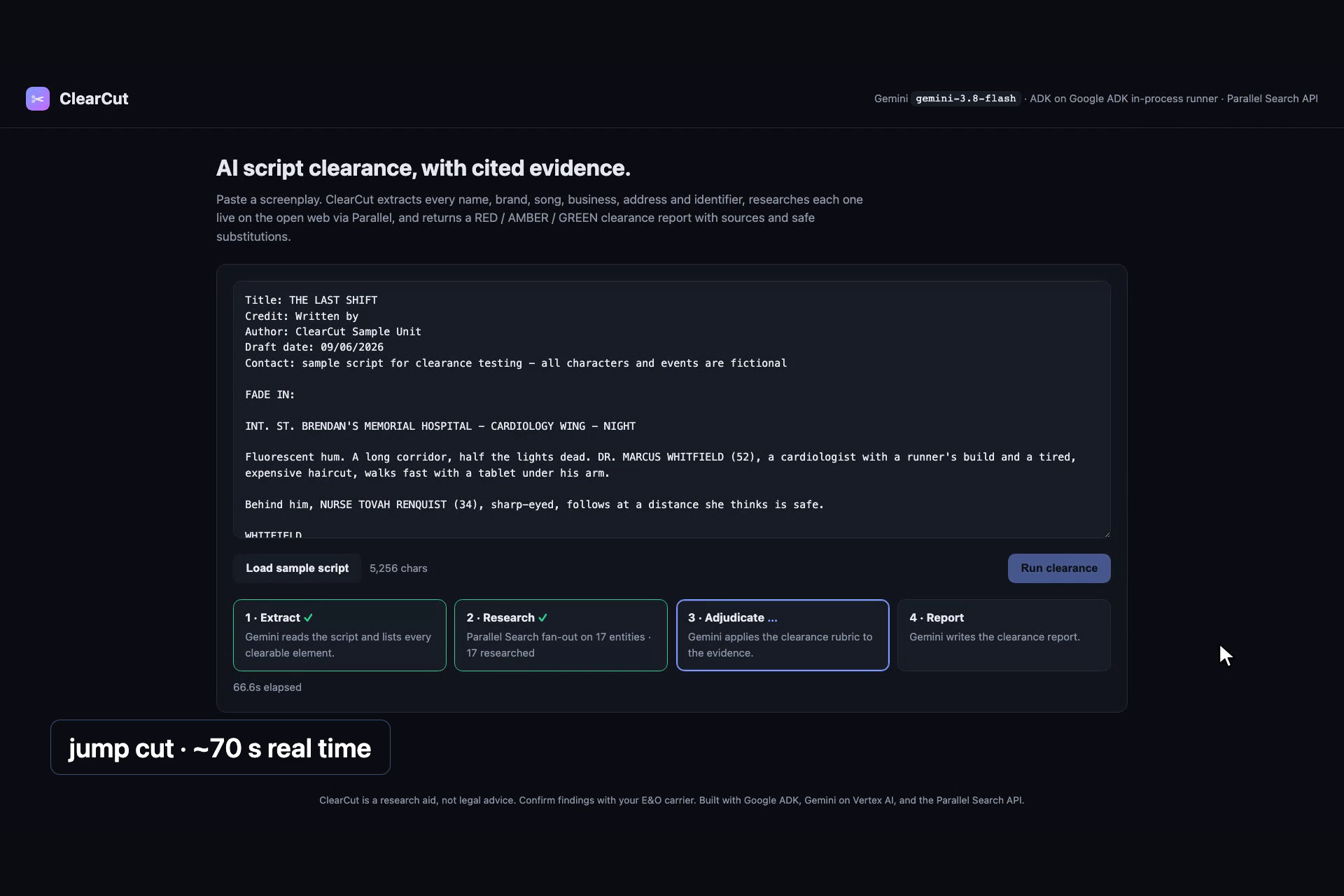
Paste a screenplay (plain text or Fountain). ClearCut:
- Extracts every clearable element with its scene and the exact line it appears in, choosing the occurrence with the greatest legal exposure (a brand thrown at a villain beats a brand sitting on a desk).
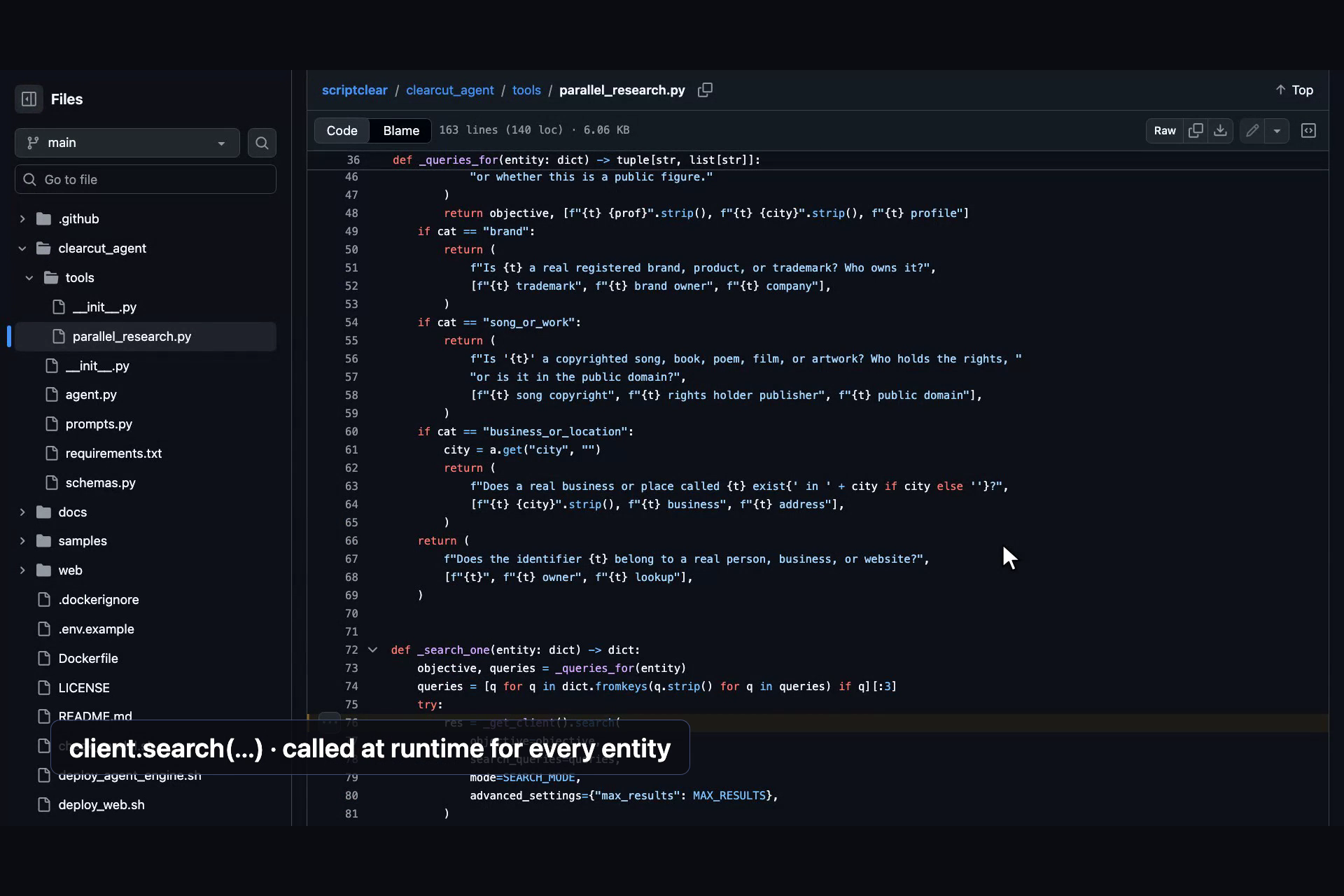
- Researches each one live on the open web through the Parallel Search API, with category-specific query strategies: name + profession + city for people, owner + context for brands, rights holder or public-domain status for songs and works.
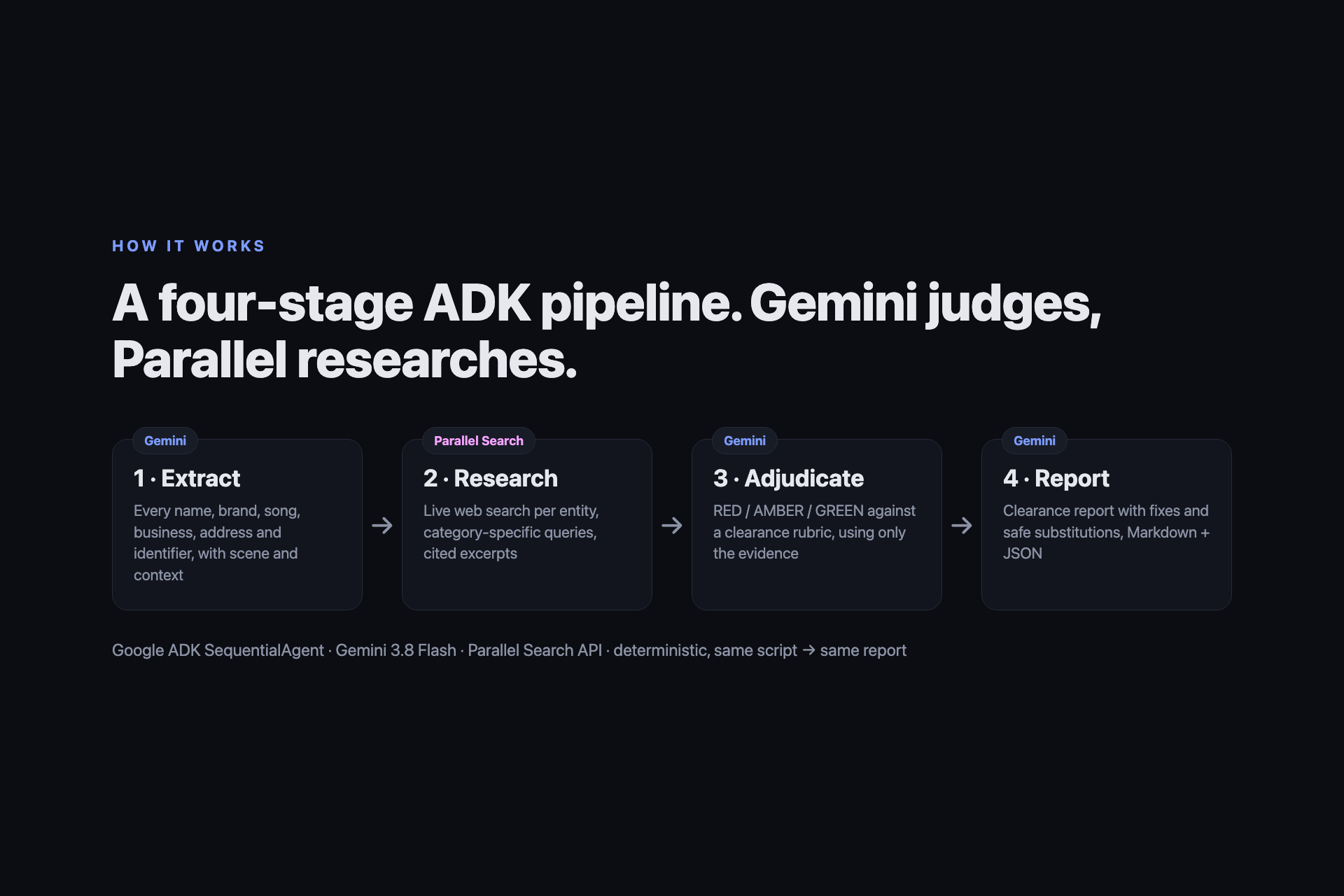
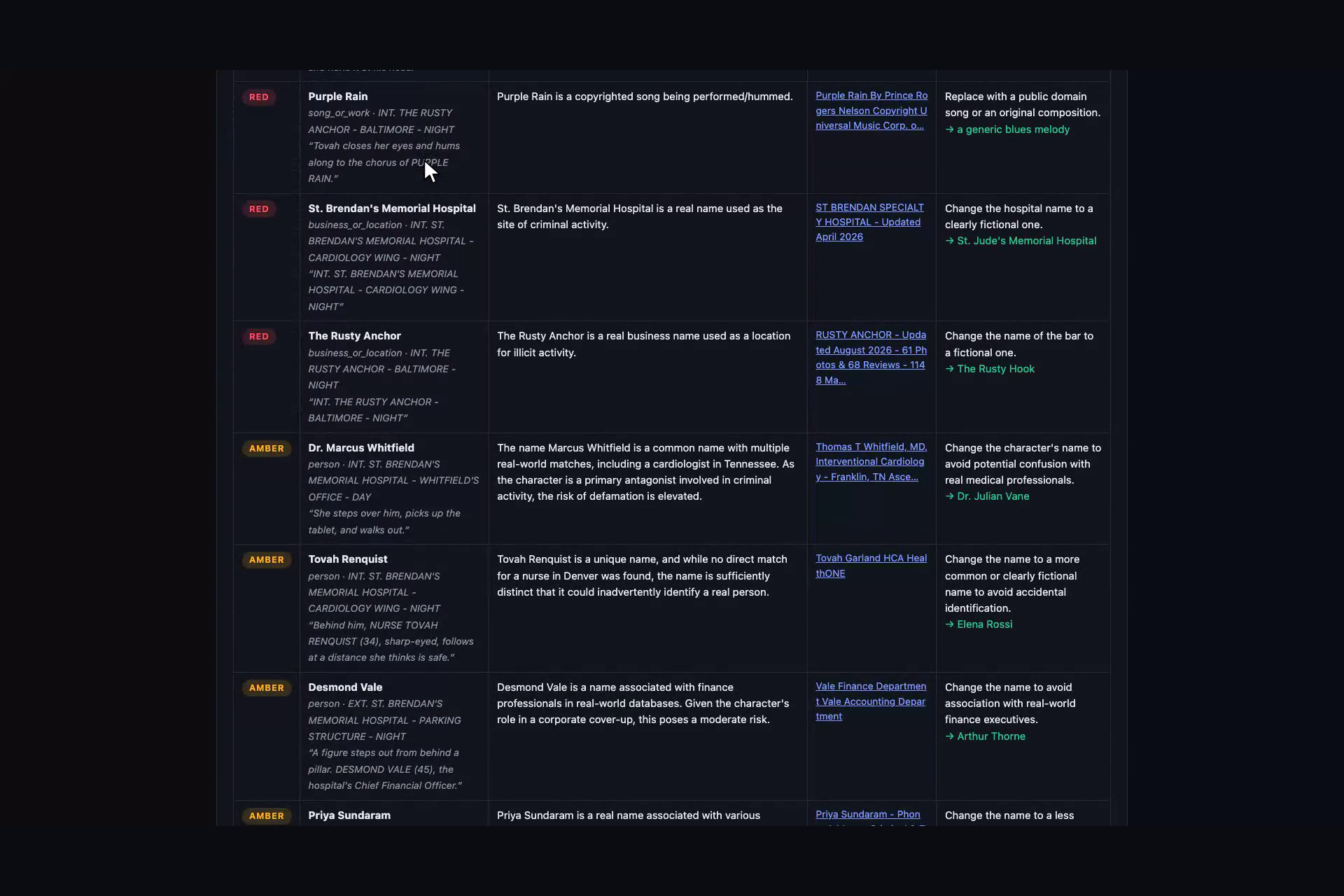
- Adjudicates each entity RED / AMBER / GREEN against a clearance rubric, using only the retrieved evidence, and cites title and URL for every flag.
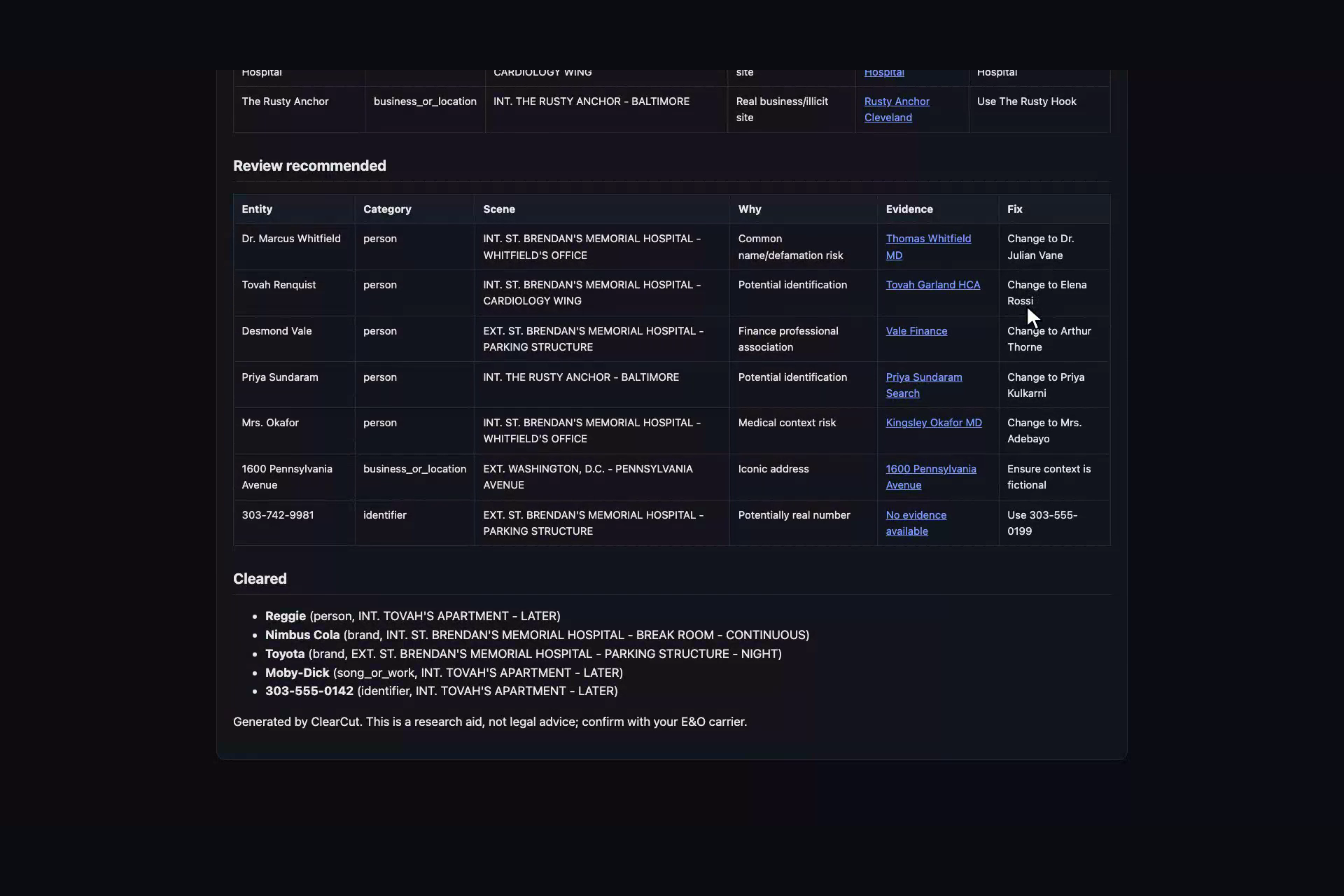
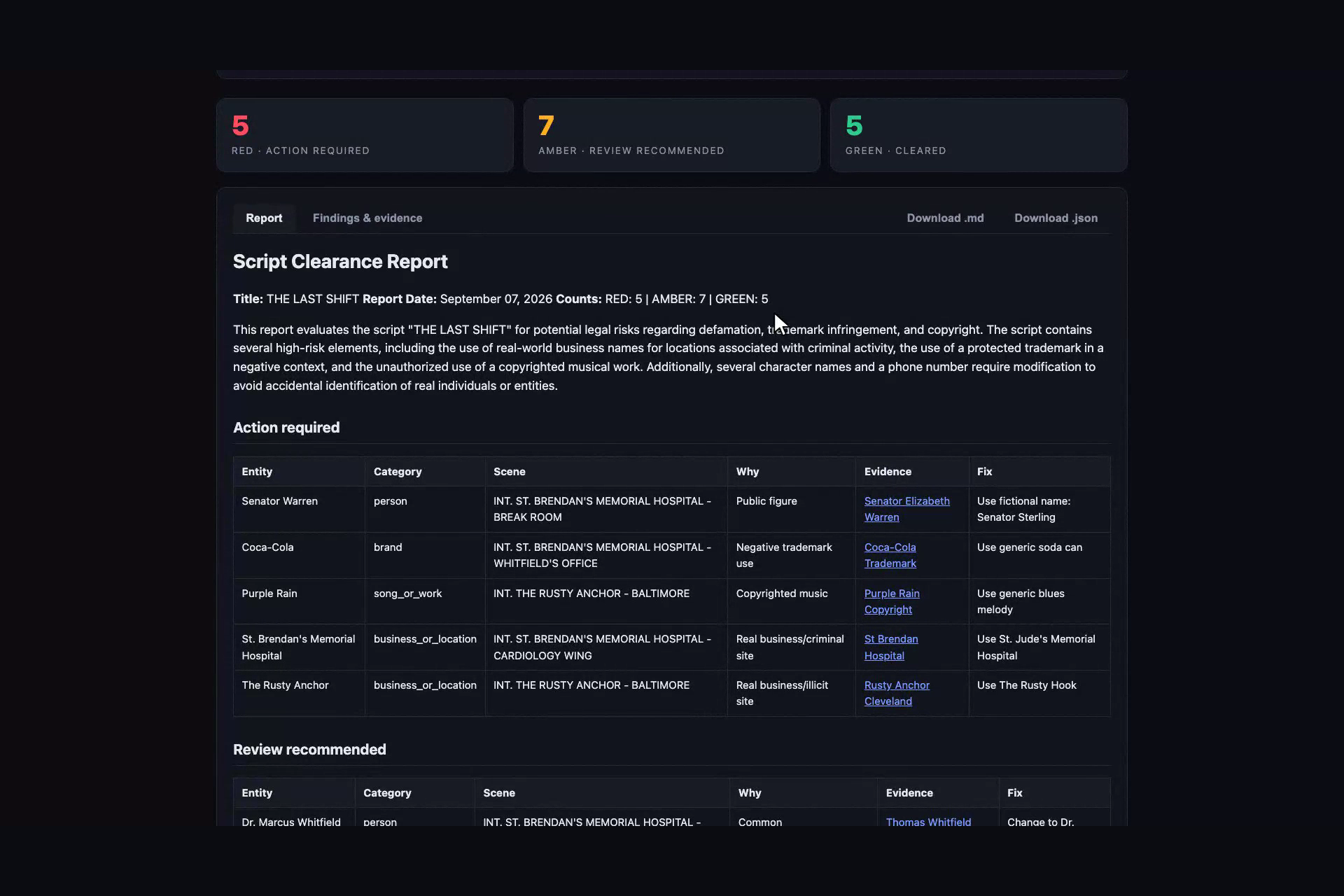
- Reports: an action-required table, a review-recommended table, a cleared list (E&O reviewers need to see the work, not just the flags), a recommended action and a tone-preserving substitution for every flag, downloadable as Markdown and JSON, reopenable by link.
On our sample script it finds the planted risks: Coca-Cola hurled at a villain (RED, negative trademark use), a character humming "Purple Rain" (RED, with the publisher's copyright record as evidence), Senator Warren (RED, public figure), a common doctor's name in Denver (AMBER, live partial matches), and clears Moby-Dick, a fictional cola and a 555 number.
How we built it
- Google ADK
SequentialAgentwith four stages:extractor(LlmAgent, JSON),researcher(a customBaseAgent: deterministic Python, no LLM in the loop),adjudicator(LlmAgent, JSON) andreporter(LlmAgent, Markdown), passing results through session state. - Gemini 3.8 Flash for extraction, adjudication and the report, temperature 0 for reproducible output. The model ID is read from an environment variable after checking Vertex AI Model Garden, never hard-coded.
- Parallel Search API (
parallel-webSDK) called at runtime for every entity, eight concurrent searches, excerpts and URLs stored for the adjudicator. - FastAPI web app with live stage progress, a RED/AMBER/GREEN summary, evidence links, and downloads; Docker image deployed publicly, with
adk deploy agent_engineand Cloud Run scripts for a billed Google Cloud project. - Quota-aware model scheduling: a model chain and API-key pool that rests exhausted or saturated slots and never lets a run die mid-pipeline.
Challenges we ran into
- Query design per category. A person check needs name + profession + city; a brand check needs owner and the context of use; a song check needs the rights holder. Generic queries returned noise; category-specific ones returned the publisher record.
- Evidence you can put in a table. Real page titles contain pipes, quotes and brackets that broke Markdown tables, so titles are sanitized at the source and link text is truncated in the UI.
- Context selection. Deduplicating entities by first appearance made the adjudicator judge Coca-Cola on a neutral desk shot. The extractor now keeps the highest-exposure occurrence.
- Free-tier reality. Without a billing account we ran on free Gemini quotas of 20 requests per day per model, with peak-hour saturation. That forced a research stage with no LLM call, a 60-second request timeout, and a scheduler that walks models and keys. The result is a pipeline that survives conditions a paid deployment never sees.
- Keeping the demo warm on free hosting: the app pings its own public URL so judges never hit a cold start.
Accomplishments that we're proud of
- A complete, public, end-to-end product: paste a script, get a cited clearance report in about a minute and a half.
- Every flag is traceable to a real URL. The video shows a live click-through to the copyright record Parallel found.
- The cleared list. Showing what was checked and passed is what makes the report usable for an E&O application.
- An original sample screenplay with a planted risk in every category, so anyone can reproduce the demo.
What we learned
Clearance is a research problem before it is a legal problem: freshness and citations matter more than model size. A deterministic fan-out stage beats an LLM tool loop for reliability. And the report that a professional will trust is the one that shows its evidence and its cleared items, not just its verdicts.
What's next for ClearCut — AI Script Clearance Agent
- Parallel's Monitor API to re-flag a script automatically when the web changes.
- Draft-to-draft diffing so writers' rooms see only new exposure on each revision.
- PDF and Final Draft ingestion, per-territory rules, and export to E&O application format.
- Pricing: per script for indies ($49 a draft, first draft free), monthly for writers' rooms, per-seat for clearance houses who use it to triage instead of starting from a blank page.

Log in or sign up for Devpost to join the conversation.