Inspiration
What it does
How we built it
Inspiration
AI agents that "buy things for you" are everywhere — but they're black boxes. You're supposed to hand over your credit card and just trust them. We wanted the opposite: an agent that shops autonomously yet proves every step, and can never spend a cent you didn't explicitly approve.
What it does
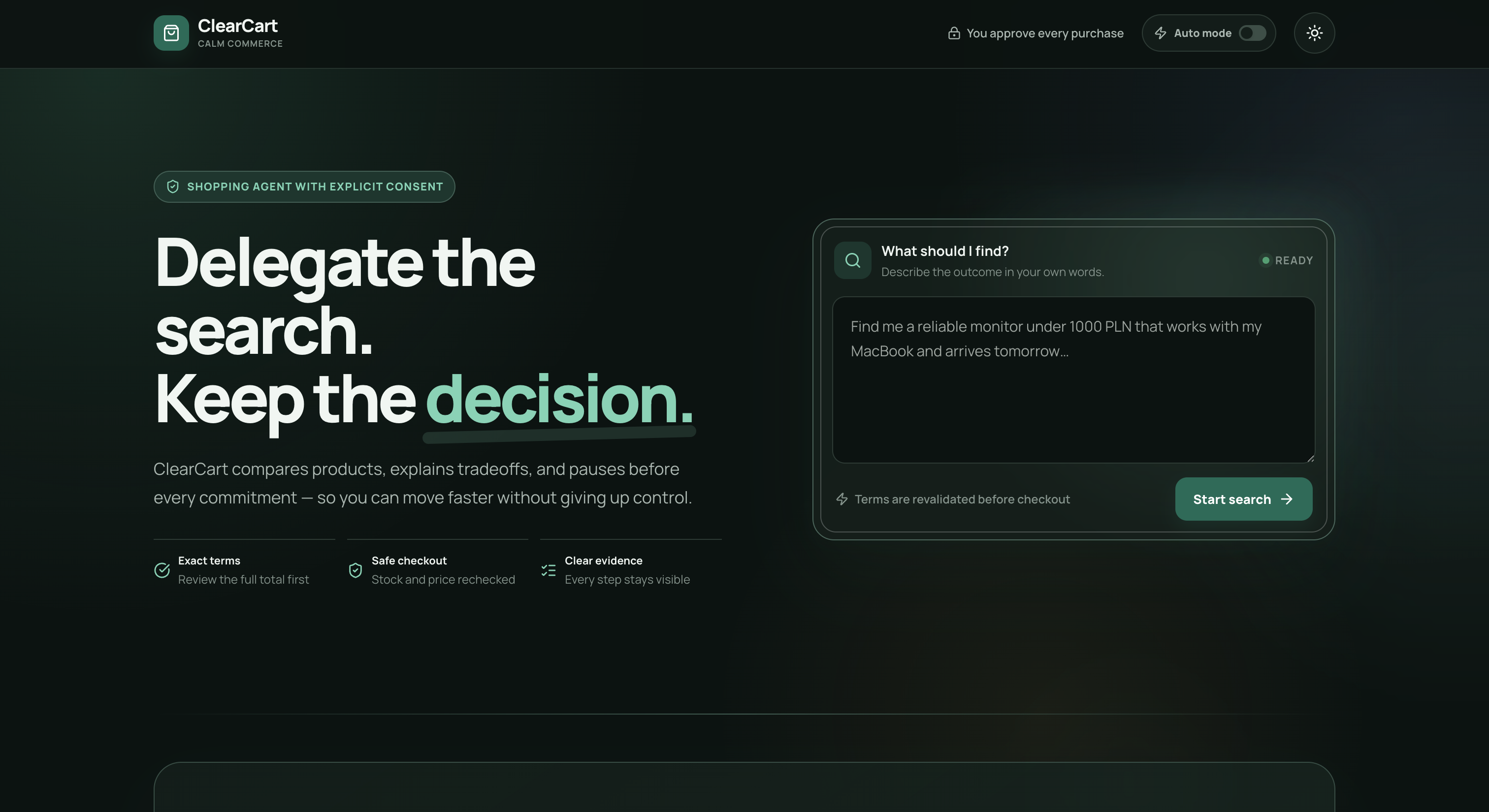
ClearCart turns a plain-language request — "find me the best monitor under 1000 PLN that works with my MacBook and arrives this week" — into a real, trustworthy purchase:
- Understands & guards the request (intent extraction + safety policy).
- Researches real products live on the web — real merchants, real PLN prices.
- Compares them transparently, showing exactly which of your requirements each offer meets (budget, delivery, compatibility, returns) instead of a vague score.
- Builds an exact, tamper-proof checkout proposal that you must approve.
- Checks out and tracks the order.
You approve every purchase, and that approval is cryptographically bound to the exact price you saw — change the price by 1 PLN and the approval is rejected.
How we built it
- Backend: FastAPI + Python with a hexagonal ports/adapters design, so every capability (intent, research, comparison, payment) swaps between a deterministic mock and a real implementation via one env flag.
- AI: OpenAI Responses API — structured outputs for intent, the
web_searchtool for live product research, and a model-written rationale for the comparison. - Trust layer: every proposal is hashed (SHA-256 over the priced terms); approval is bound to that hash; a full audit trail / revision graph records every decision.
- Payments: Stripe test-mode PaymentIntents behind the same contract as the mock.
- Frontend: React + Vite + TanStack, with a live "watch the agent think" progress view, an auto mode, and a branching revision graph.
Challenges we ran into
- Live web search is slow and messy. Models sometimes returned products with no price (0 PLN). We fixed it by dropping price-less offers and tightening the prompt to only return offers with a real, page-verified price.
- Keeping the agent honest. We replaced a fake "97% confidence" badge with a real checklist of which requirements the chosen offer actually meets, computed from its facts.
- Shipping fast, in parallel. Multiple people and AI agents on one repo — we used git worktrees and clean module contracts to build features simultaneously without conflicts.
What we learned
- A strong system prompt plus structured outputs does most of the work — the hard part is grounding and verifying what the model returns.
- Trust is a feature, not a footnote. Provable, approval-bound autonomy is what makes an AI that spends money actually usable.
What's next
Faster research via caching and parallel search, multi-user accounts with saved spending policies, real merchant checkout, and shareable purchase receipts.

Log in or sign up for Devpost to join the conversation.