-
-
-
ClearCare
Inspiration
In the United States, insurance companies deny 250 million claims per year. Most patients receive a cryptic code like CO-4 with no explanation. I built ClearCare to bridge this information asymmetry. I wanted to create a tool that doesn't just "summarize" text, but acts as a clinical and legal advocate, translating 300-page policy documents into actionable steps for both doctors and patients.
What it does
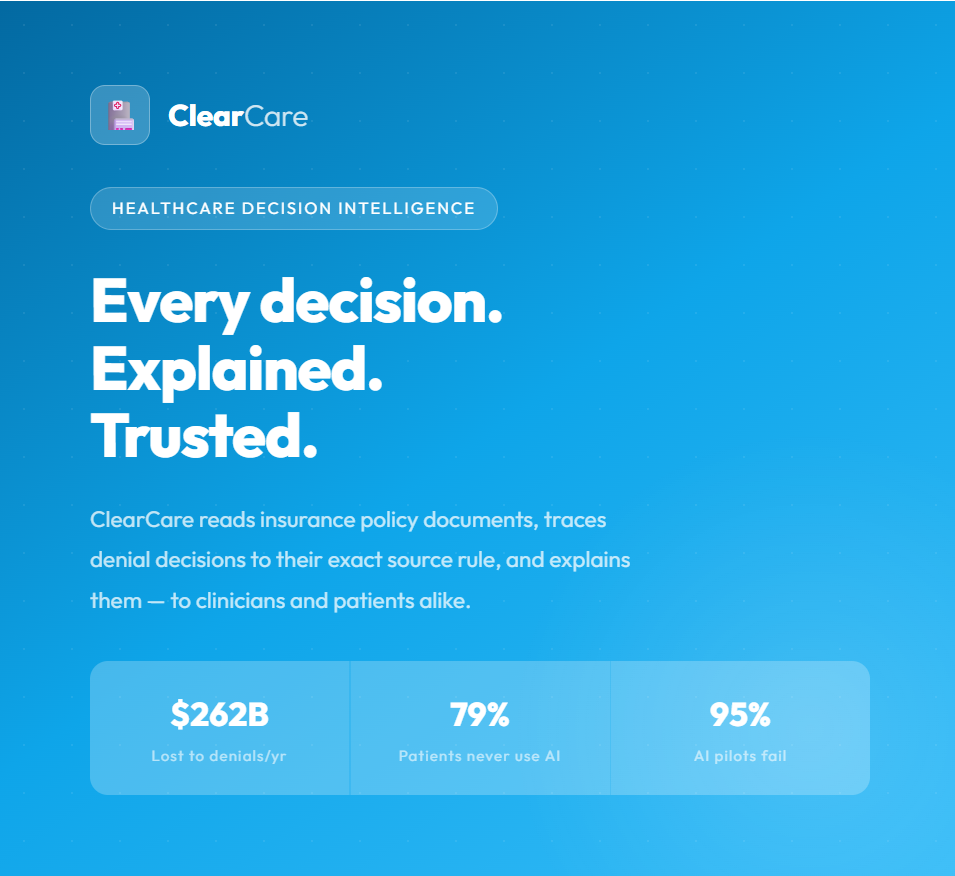
ClearCare is a Healthcare Decision Intelligence platform that automates the "translation" of insurance denials.
For Clinicians: It provides a clinical-grade analysis, citing specific policy sections and suggesting medical necessity justifications.
For Patients: It explains the denial in empathetic, plain English and outlines their rights.
The "Kill" Feature: It doesn't just draft an appeal; it uses Auth0 Token Vault to send that appeal directly from the patient’s real Gmail account. This ensures the appeal has legal standing and doesn't get filtered as "AI spam."
How we built it
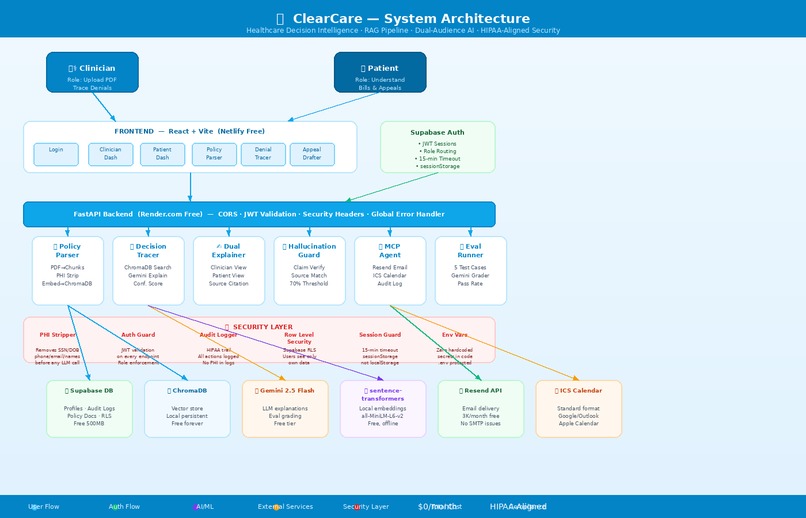
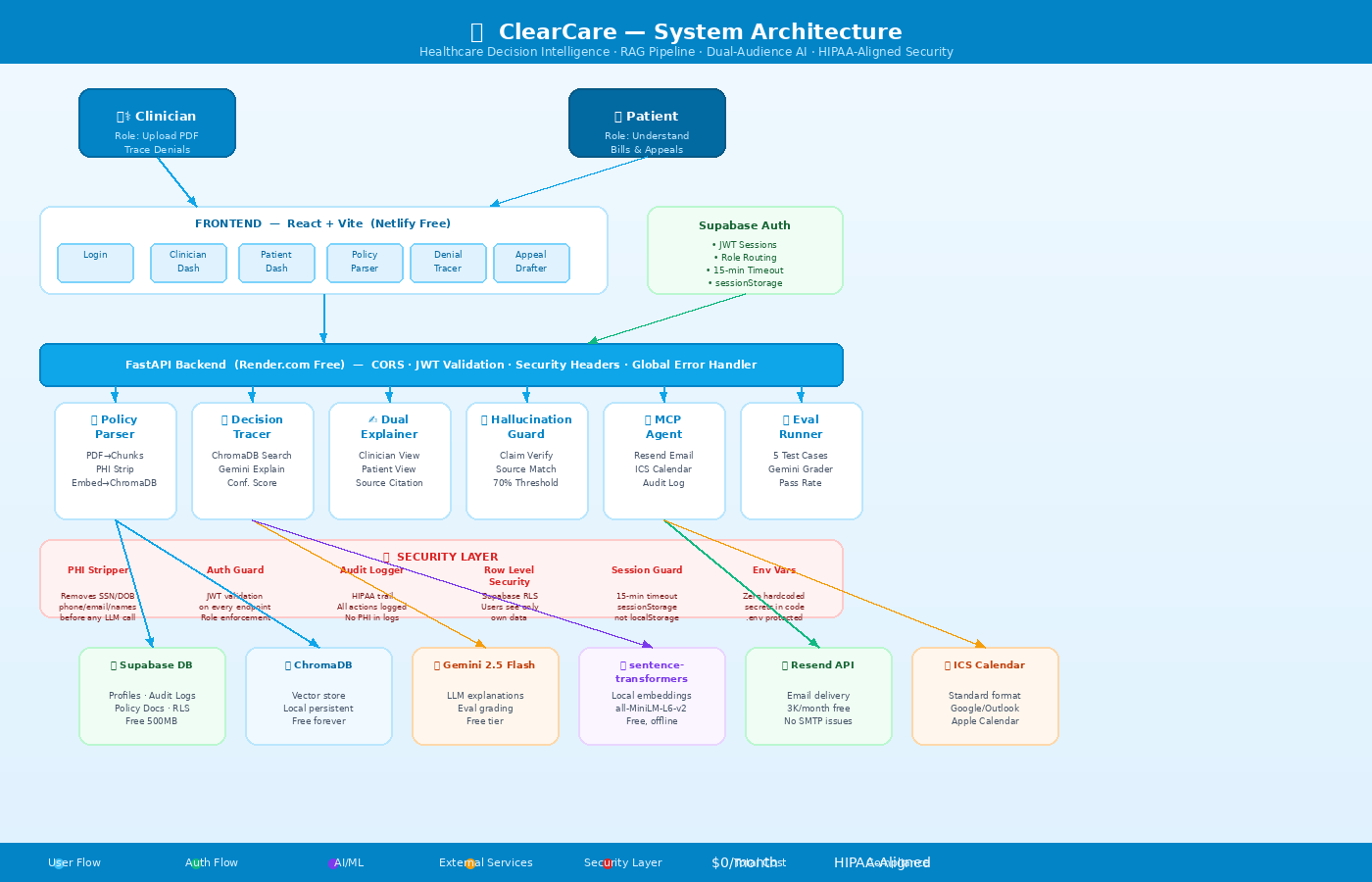
The project is built on a FastAPI backend and a React (Vite) frontend.
RAG Pipeline: I built a custom retrieval-augmented generation flow without using high-level frameworks like LangChain to maintain full control over the chunking and embedding logic.
Vector Store: I used ChromaDB to store embedded policy sections, allowing for high-accuracy semantic search when a user enters a denial code.
Security Layer: A custom PHI Stripper regex engine ensures all sensitive patient data is removed locally before hitting the Gemini API.
Identity: I leveraged Auth0’s Token Vault to securely exchange session tokens for Google OAuth tokens, facilitating the Gmail and Google Calendar integrations.
Challenges we ran into
The biggest technical hurdle was hallucination management. In healthcare, an LLM making up a policy rule is dangerous. We solved this by building a Hallucination Guard—a secondary verification step that extracts section citations from the AI's response and cross-references them against the original PDF metadata. If the verification score falls below 70%, the response is flagged for human review.
Accomplishments that we're proud of
The "Zero-Storage" Security Model: I successfully built a feature that sends emails from a user's private account without ClearCare ever storing a single Google credential in our database.
Dual-Persona Prompting: Engineering a single LLM call that outputs two distinct, structurally valid JSON objects (one for the doctor, one for the patient) while maintaining perfect medical consistency between them.
What we learned
I learned that in the regulated world of healthcare, Identity is the ultimate feature. An AI agent is only as powerful as its ability to act on behalf of a human. By integrating Auth0 Token Vault, we realized that the "last mile" of AI—actually taking action in the real world—is what separates a toy from a tool.
What's next for ClearCare
OCR Support: Integrating Google Vision API to support scanned physical denial letters, not just digital PDFs.
State-Level Nuance: Adding a database of state-specific insurance laws to automatically include legal "magic words" in appeal letters that vary by region.
Predictive Denial: Building a "pre-submission" check for doctors to see if a claim will be denied before they even send it to the insurance company.
Built With
- auth0
- chromadb
- fastapi
- gemini
- gmailapi
- googlecalenderapi
- javascript
- langfuse
- python
- resend
- supabase
- tailwind

Log in or sign up for Devpost to join the conversation.