Inspiration
When a patient leaves the hospital, they are handed 10 to 15 pages of dense medical jargon, shorthand instructions (like "q6h PRN"), and conflicting medication lists. For elderly patients, non-native English speakers, and overwhelmed caregivers, this paperwork is practically unreadable. This confusion directly causes medication errors and millions of preventable readmissions every year. We asked ourselves: What if we could instantly translate these dense documents into a safe, bilingual, plain-language care plan that patients can actually understand?
What it does
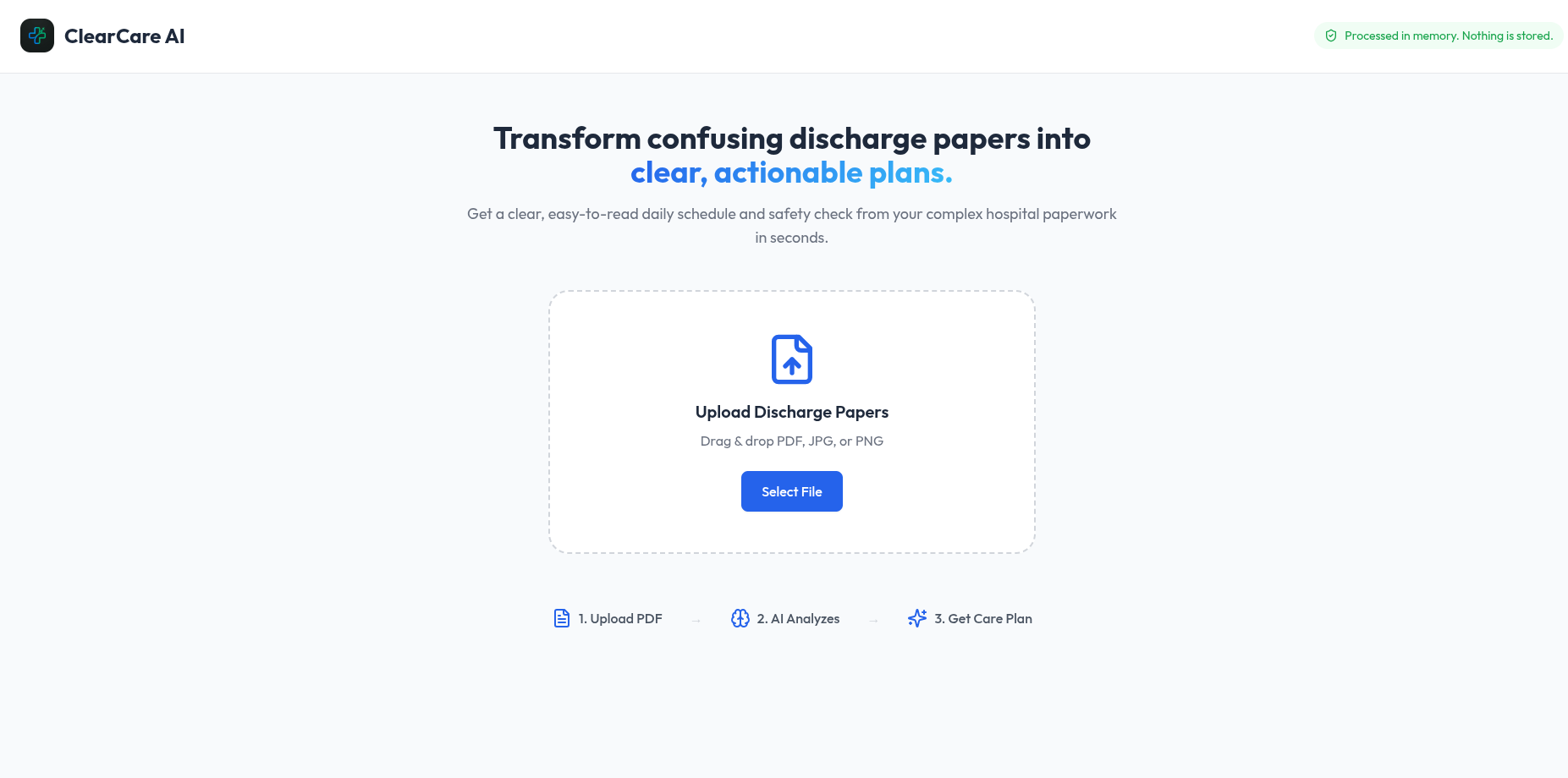
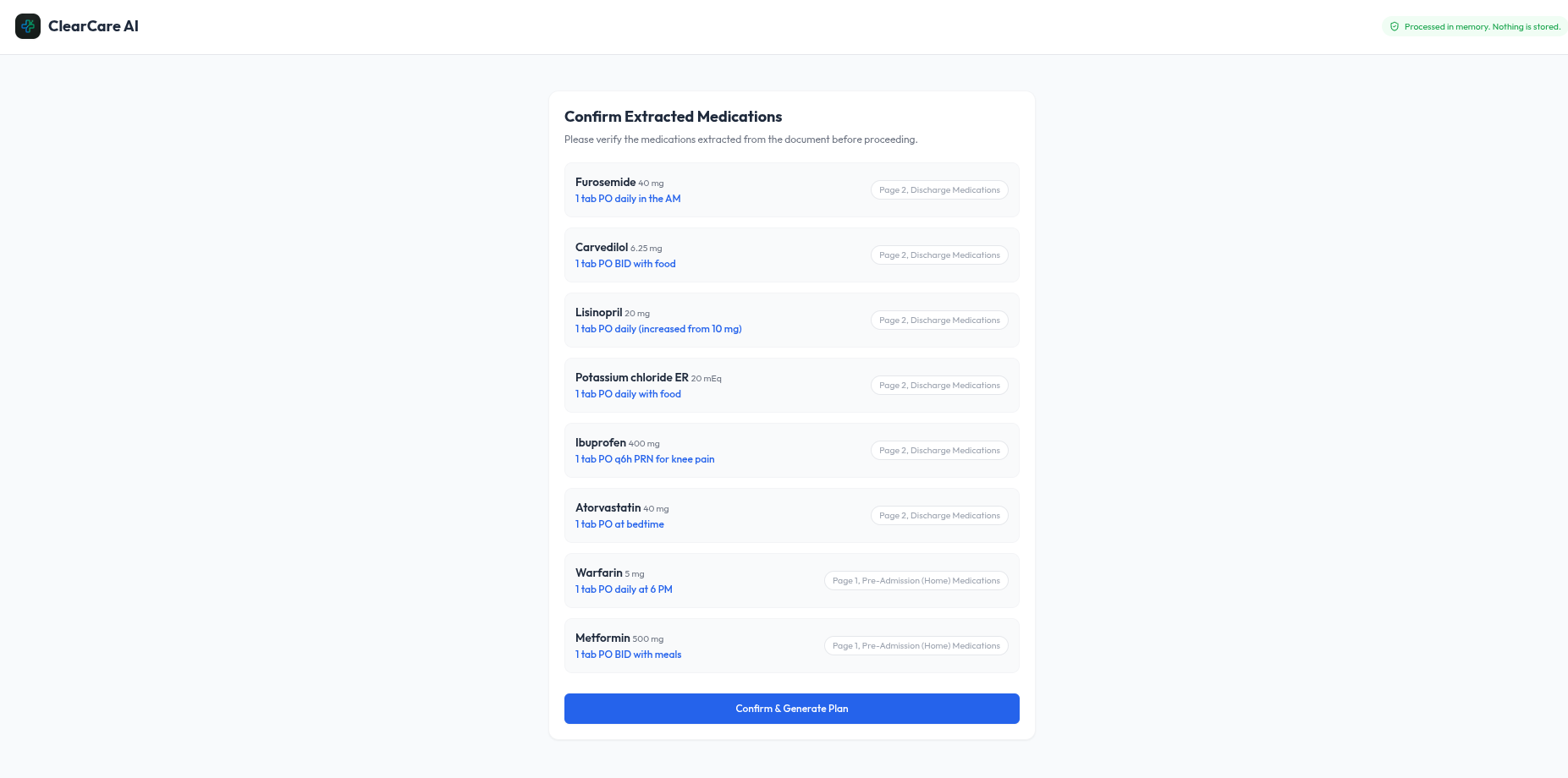
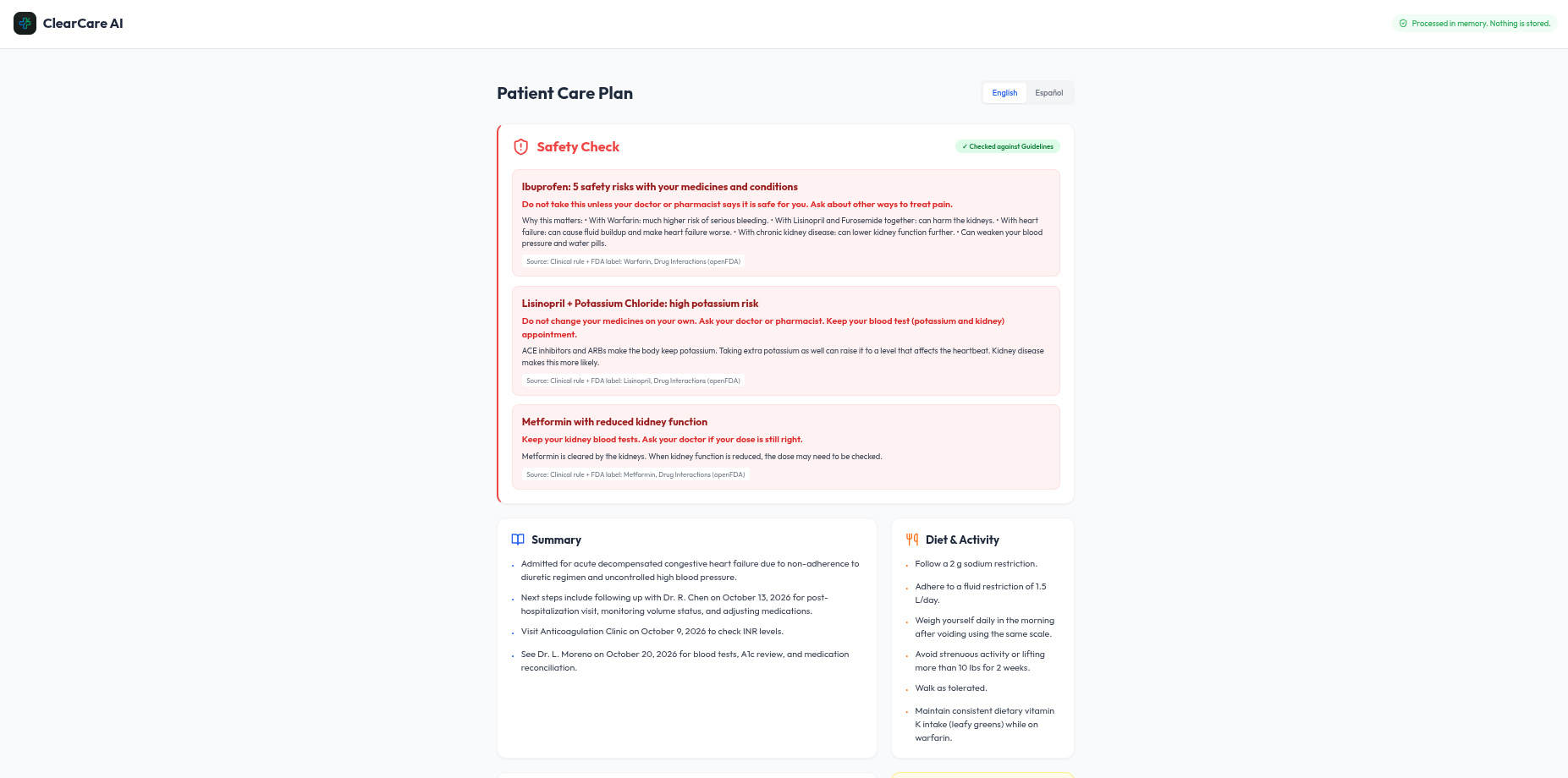
ClearCare AI is an intelligent medical discharge dashboard designed to keep patients safe. You simply drag and drop a discharge PDF into the app. In seconds, it processes the file in memory and generates a clean, easy-to-read dashboard featuring:
- Fail-Safe Safety Checks: It instantly cross-references all new and home medications against the patient's diagnoses. If it detects a dangerous interaction (e.g., an NSAID prescribed to a Heart Failure patient), it flags it with a high-severity warning backed directly by openFDA labels.
- Plain-Language Summary: Explains exactly why the patient was in the hospital and what they need to do next at a 6th-grade reading level.
- Smart Daily Schedule: Automatically maps out all medications into a clock-based daily routine (Morning, Dinner, Bedtime).
- Bilingual Support: With a single click, the entire dashboard and schedule seamlessly toggles between English and Spanish.
How we built it
We built ClearCare AI with a strictly separated modern architecture:
- Frontend: A beautiful, responsive Single Page Application (SPA) built with React, Vite, Tailwind CSS, and Zustand for state management. It features a "Bento grid" style layout that makes scanning critical health information easy.
- Backend: A high-speed Python FastAPI server that orchestrates the AI agents concurrently.
- AI Orchestration: We utilized Featherless AI (running the incredibly fast and accurate
Qwen2.5-7B-Instructmodel) to power a multi-agent system. The backend spins up 3 parallel agents: an Extractor (for Pydantic schema validation), an Explainer (for translation and simplification), and a Scheduler (for timeline generation). - Deterministic Rules Engine: To prevent AI hallucinations in medical advice, we built a hardcoded clinical safety engine that queries the U.S. openFDA API for verified interaction labels.
Challenges we ran into
Getting Large Language Models to strictly adhere to complex JSON schemas for medical extraction was a massive hurdle. Initially, we faced timeout errors and malformed outputs from larger, slower models. We overcame this by switching to a faster, highly-optimized 7B model on Featherless AI and building a "self-healing" retry loop—if the AI hallucinates a bad JSON structure, our backend catches the Pydantic validation error and feeds the exact error trace back into the LLM prompt, forcing it to correct its own mistake on the second attempt!
Additionally, we realized that relying strictly on an LLM for critical medical safety warnings is dangerous. We solved this by architecting a hybrid system: deterministic Python rules catch the critical interactions, openFDA


Log in or sign up for Devpost to join the conversation.