-
-

Actual conflict notes with exact quotations from two distinct source lines. A draft interpretation for a person to review.
-
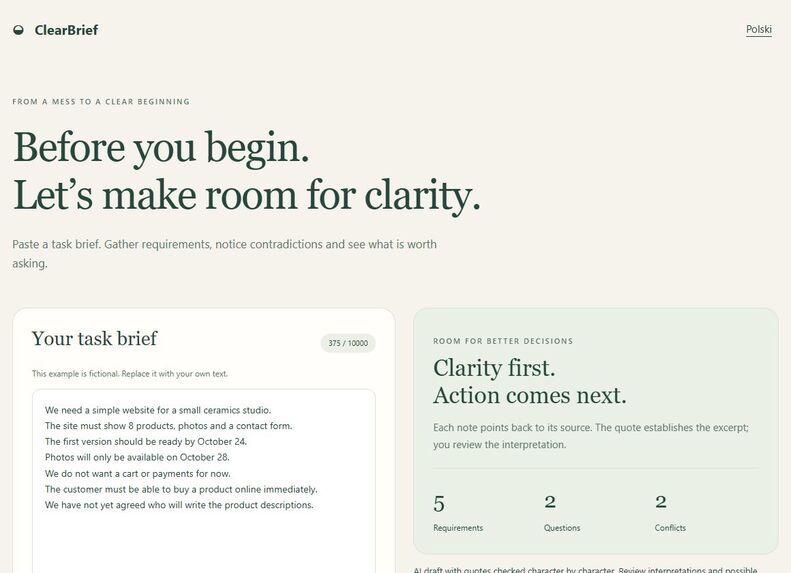
Actual English NVIDIA response: source-linked requirements and review controls. Fictional brief; real provider output.

Inspiration
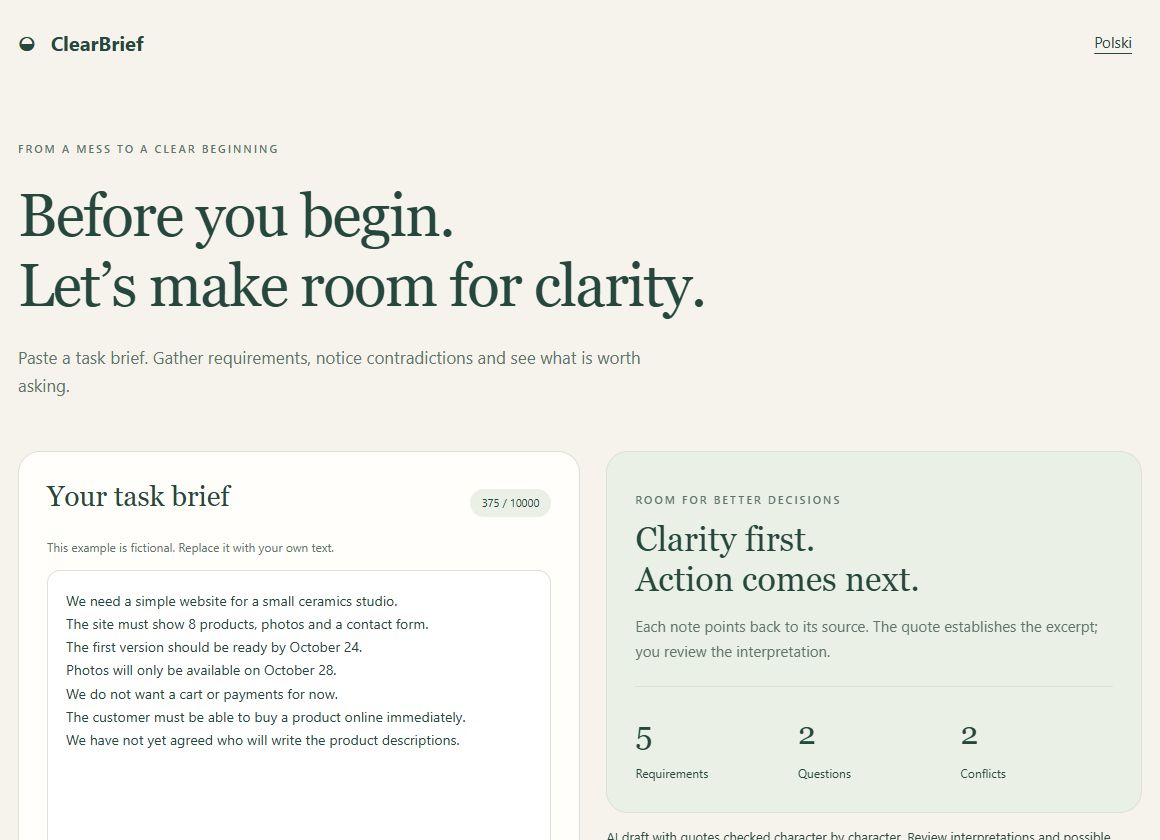
A project can look clear until two sentences disagree. A small studio may need product photos before those photos will exist, or ask for immediate purchases while excluding payment functionality. ClearBrief makes these conversations easier to start, with a calm review workspace and visible source evidence. The example shown in this submission is fictional; we do not claim real customer validation.
What it does
ClearBrief accepts an English or Polish project brief and, with explicit permission, sends the selected text to NVIDIA Nemotron through Nebius Token Factory. The response becomes a draft of requirement notes, question topics and possible conflicts. Every item needs an exact source quotation and line number. A conflict needs evidence from at least two different lines. Locally enforced validation rejects unsupported quotations, duplicate evidence and incomplete output.
People can inspect each note, mark review selections and download a self-contained JSON record. Editing the input or changing the language clears previous results and resets cloud consent. The application does not send messages, schedule work or accept commitments. Its separate local notes mode preserves source lines verbatim and is clearly labeled as not AI.
How we built it
The application uses dependency-free Node.js and a vanilla browser interface. A small core module handles source lines, citation checks, validation and exports. The server keeps the key in process memory, accepts only loopback requests with the expected Host and Origin, bounds request size and requires explicit permission for model calls. The browser never receives the key.
The runtime integration makes a real chat-completions request to https://api.tokenfactory.nebius.com/v1/chat/completions with model nvidia/Nemotron-3_5-Lightning. No Nebius AI Cloud GPU, dedicated endpoint or fine-tuning service was provisioned. The model is part of the brief-review workflow, not merely mentioned in the interface.
The code was built solo with AI coding assistance. Model weights were not trained or redistributed. Original application code is MIT licensed.
Challenges
Nebius onboarding required a bank card even though older billing documentation described a card-free promotional-credit path. The participant eventually completed onboarding themselves and activated promotional credits. The project does not claim that credits create a hard account spending limit.
Our first real model request returned an incomplete result with a 2,400-token output ceiling; its exact stop reason and token usage were not retained. We rejected it without retrying. After explicitly disabling the documented default thinking mode, the next real English response completed within the same ceiling. A persistent four-attempt allowance survives process restarts and counts failures before sending. This limits this installation's requests; it does not replace provider billing controls.
Grounded quotations are also different from complete interpretation. Earlier runs did not flag every ambiguity, and some question titles were topics rather than complete questions. Those limitations remain visible instead of being hidden behind an accuracy claim.
Accomplishments
Three of four real provider attempts returned complete locally validated results. The first successful English API response used 664 total tokens; the Polish browser run reported 866; the final English browser run reported 823. In the final English run, the model returned five requirements, two question topics and both the photo/deadline and purchase/payment conflicts. Earlier runs were less complete.
Twenty-three offline checks passed for citation validation, persistent attempt accounting, input/output bounds, cancellation, HTTP boundaries, export provenance, stale results and consent reset. Injected transports and simulated DOM tests are documented separately from actual provider/browser evidence. JSON download completion was confirmed by the participant; automation did not independently read the downloaded file.
What we learned
A useful AI review needs visible evidence, permission before transmission, clear failure handling and an easy way to disagree with an interpretation. Small bounded requests made the live integration practical within promotional credits, while deterministic checks kept invented quotations out of accepted results. This is a small development validation, not an independent benchmark.
What's next
Evaluate more independently annotated briefs, improve the phrasing and completeness of clarification questions, and add convenient navigation from a note to its source. A hosted version would need an explicitly approved account budget and durable shared limits; none is represented as deployed here.
Try the project
Download the runnable test build or clone the MIT source. Node.js 22.19+ is required; no npm install. Run node build.mjs, then node server.mjs and manually open http://127.0.0.1:8820/ for local notes without an account or model calls.
Live NVIDIA analysis requires your own active Nebius Token Factory account, credits and API key. Stop the local server, run node nebius-local.mjs (or Podlacz-Nebius.cmd on Windows) and enter the key in the hidden local prompt. Follow the README and use fictional input. No shared entrant key or hosted inference is included. Four attempts per installation, including failures; no automatic retries. This is not a provider-enforced spending cap.
Demo disclosure
The public English video is an explicitly labeled edit of authentic app captures with synthetic local narration and English subtitles. It shows real model results on a fictional brief; it is not continuous screen recording. Source citations passing validation do not prove interpretation accuracy.
