-
-
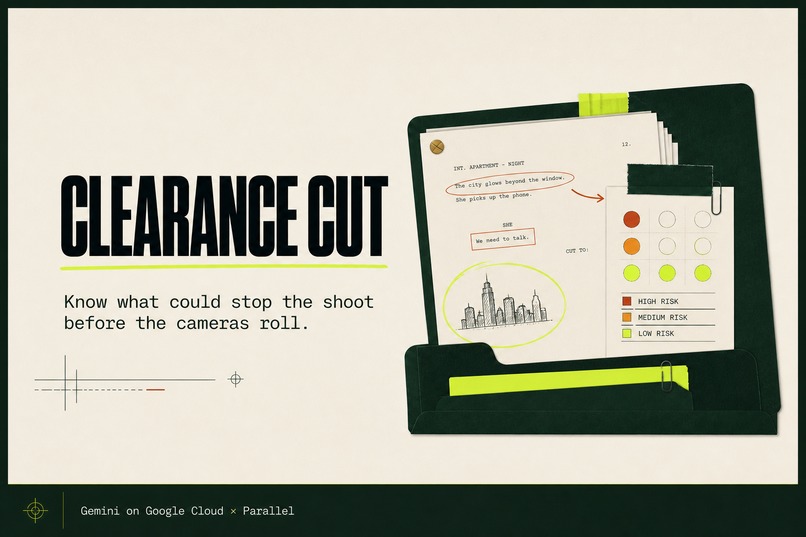
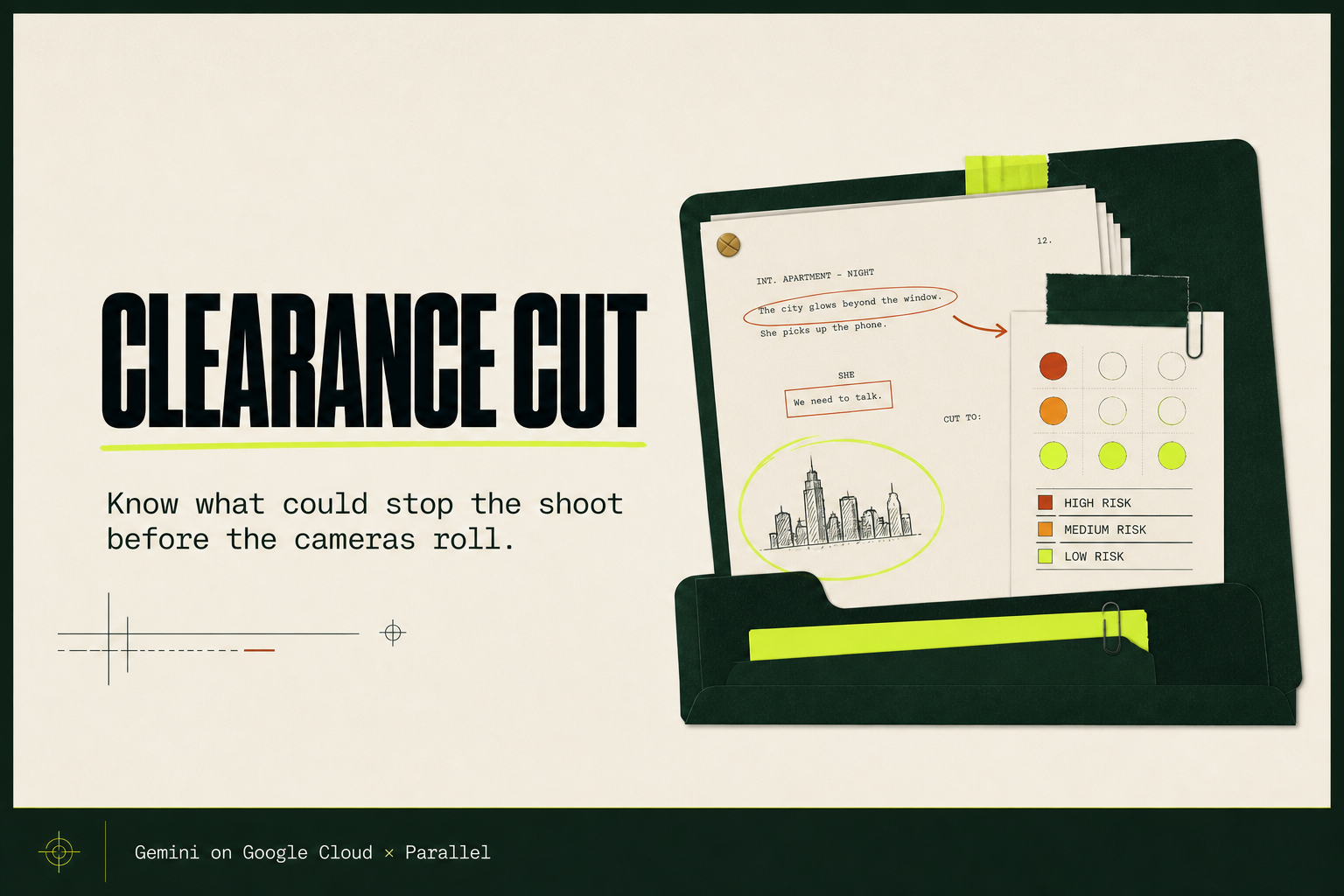
Clearance Cut — a live, evidence-grounded pre-production clearance agent powered by Gemini on Google Cloud and Parallel Web Search.
Inspiration
A screenplay can be creatively finished and still be impossible to shoot. A real trademark shown in a damaging context, an uncleared recording, or an inaccurate factual claim can trigger expensive rewrites after the cast, locations, and schedule are already locked.
Clearance research is essential, but the work is often fragmented across scripts, search tabs, emails, and spreadsheets. We built Clearance Cut to give production teams an earlier, evidence-backed view of what could stop the shoot.
What it does
Clearance Cut is an agentic pre-production clearance crew for film and television.
The agent:
- analyzes a scene for clearance-sensitive elements;
- decides when current external research is required;
- uses Parallel Web Search to retrieve traceable web evidence;
- uses Gemini to evaluate the evidence and rank the production risk;
- proposes practical actions or minimal scene changes;
- routes the final decision to a qualified human reviewer.
The live demonstration examines a fictional crime scene in which a real luxury fashion logo appears prominently on a blood-stained handbag. Clearance Cut identifies the potential trademark risk, explains its reasoning, presents the grounded sources, and recommends production-safe alternatives.
Clearance Cut provides production decision support—not legal advice—and never grants rights or automatically declares a scene legally cleared.
How we built it
The agent workflow is implemented with Google ADK and Gemini Enterprise on Google Cloud.
Gemini handles risk analysis, evidence synthesis, and production recommendations. When fresh external evidence is needed, Gemini invokes Parallel Web Search at runtime. The returned grounding metadata is preserved and displayed as clickable sources in the product.
The live API is built with Python and FastAPI and deployed on Google Cloud Run. The Parallel credential is stored securely in Google Cloud Secret Manager. The responsive interface is built with React and TypeScript.
The implemented flow is: Scene → Gemini reasoning → Parallel Web Search → grounded evidence → clearance recommendation → human review
Challenges we ran into
The main challenge was avoiding a generic “AI lawyer.” We constrained the system to production-specific risks and designed every result around a practical filmmaking decision.
We also needed to make the difference between generated reasoning and external evidence visible. Parallel is therefore called inside the live runtime—not merely referenced in the documentation—and its sources remain inspectable in the interface.
Finally, we preserved a human authority gate. Clearance Cut can investigate, rank, and recommend, but consequential clearance decisions remain with producers, counsel, and other qualified reviewers.
Accomplishments that we're proud of
- A functioning live agent rather than a static mock-up or chat interface.
- Runtime integration of Gemini and Parallel Web Search.
- Traceable evidence displayed directly beside each recommendation.
- A production-focused workflow with concrete actions such as replacing, obscuring, or digitally removing a risky branded prop.
- Secure deployment on Google Cloud using Cloud Run and Secret Manager.
- Explicit safeguards against automatic legal approval.
What we learned
The strongest agentic systems are not necessarily the least constrained. Autonomous research is valuable when information must be current, while deterministic workflow stages and human approval are essential when decisions must remain accountable.
The most useful output is not a long AI answer. It is a clear production action: the exact risk, the supporting evidence, and what the crew should do next.
What's next for Clearance Cut
Future versions will:
- Accept complete PDF, Fountain, and Final Draft screenplays;
- Compare screenplay revisions and re-run only affected findings;
- Support music, locations, likeness, factual claims, and international territories;
- Add collaboration tools for producers and clearance counsel;
- Generate an auditable clearance report for each production.
Know what could stop the shoot before the cameras roll.

Log in or sign up for Devpost to join the conversation.