-
-
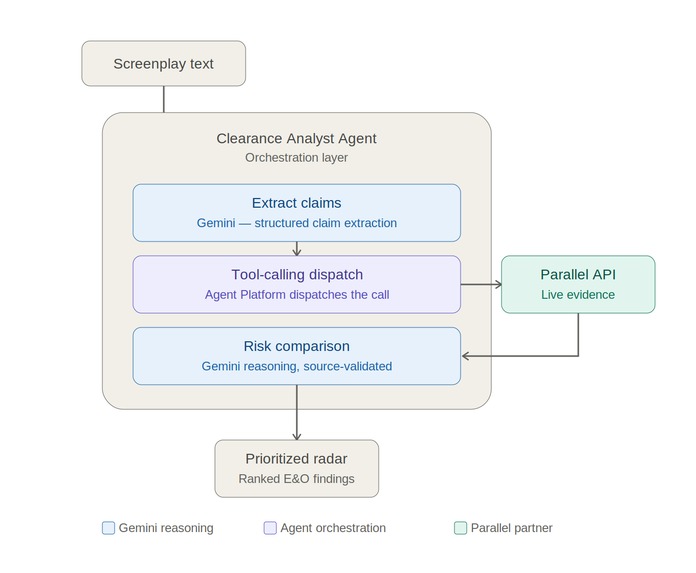
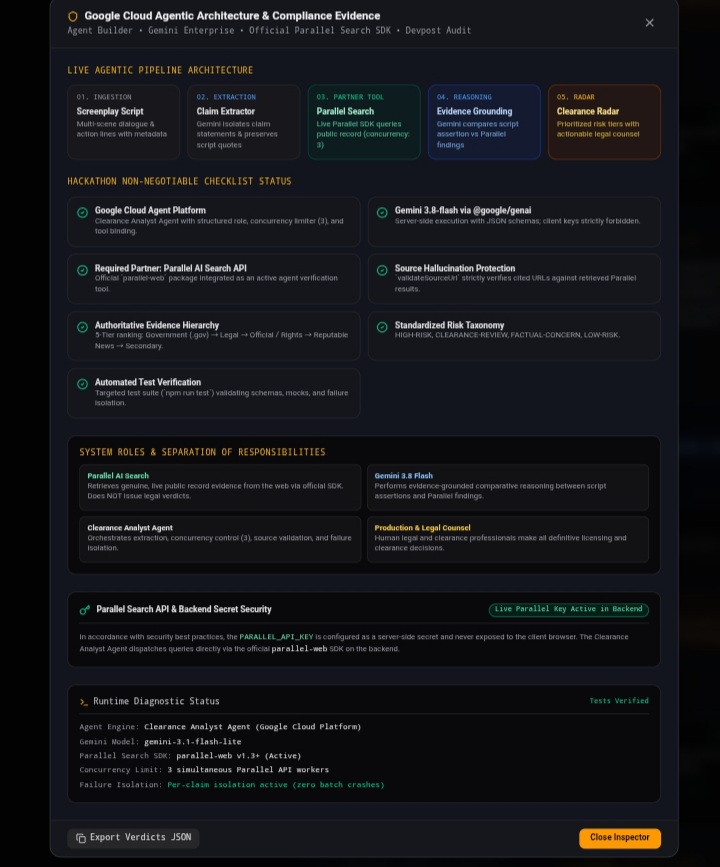
Architecture Diagram
-
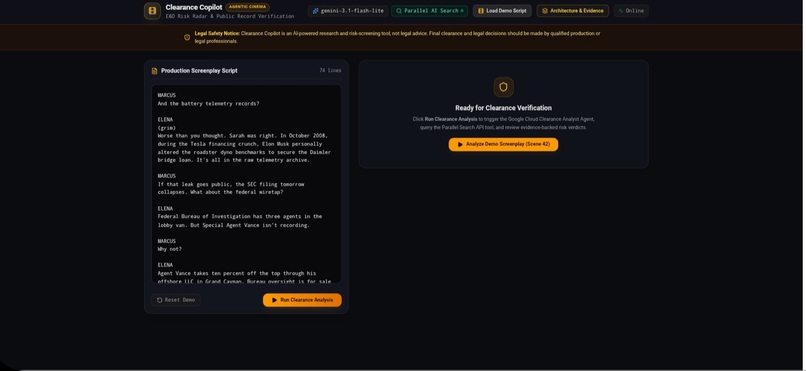
Home Page
-
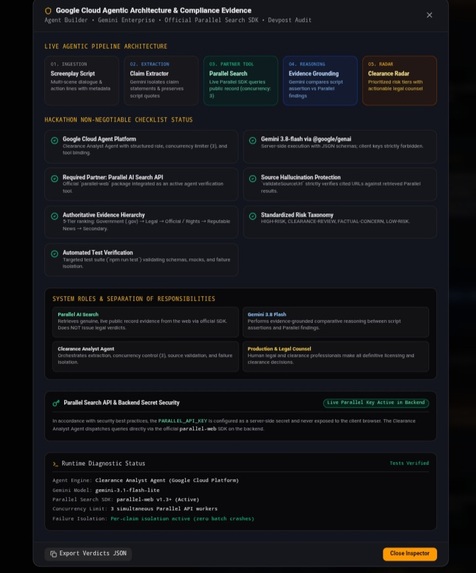
Google Cloud Agentic Architecture and Compliance Evidence
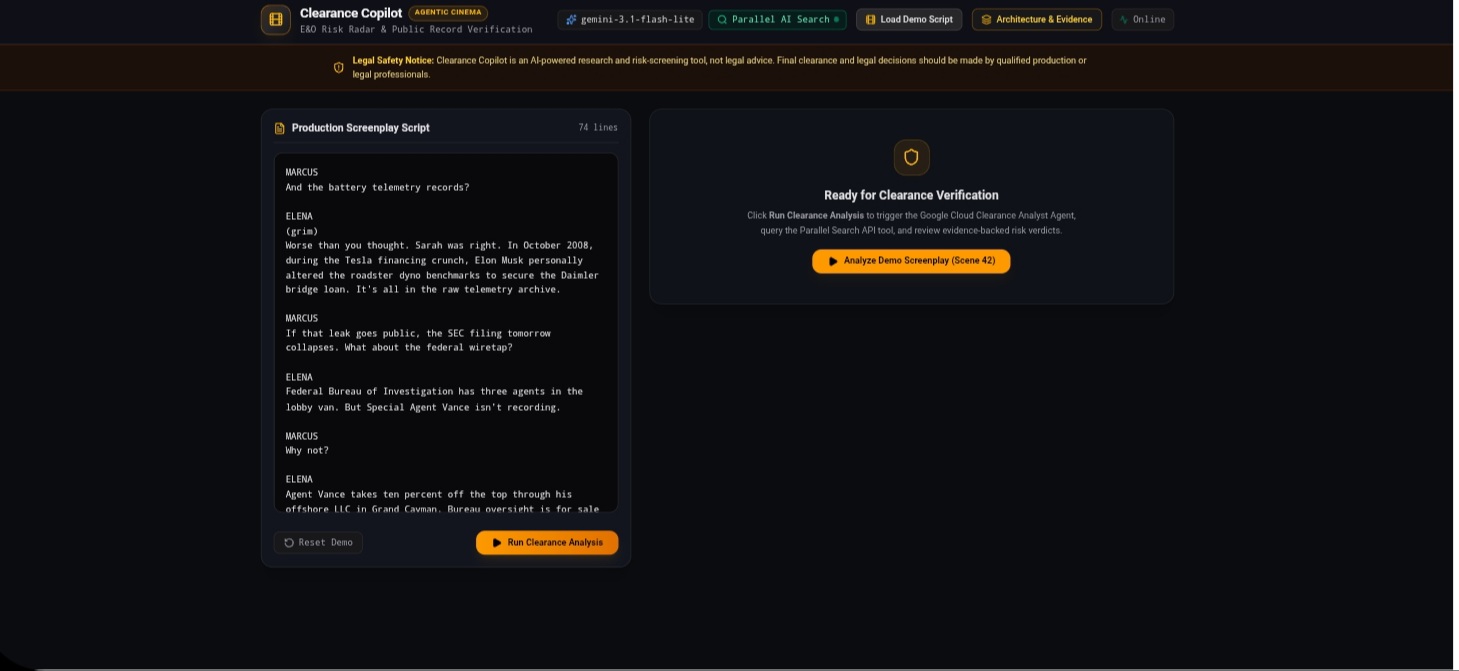
Clearance Copilot
An evidence-grounded AI agent that turns screenplay clearance research from a manual slog into a traceable, prioritized workflow.
Inspiration
A screenplay can contain hundreds of references to real people, organizations, products, locations, events, and factual claims. But identifying a name is not the same as understanding what the screenplay is actually asserting about that entity.
For production teams, the difficult question is:
What exactly does the screenplay claim, what does the public record support, and which claims deserve human clearance review before cameras roll?
Traditional first-pass clearance research is slow because researchers must manually identify factual assertions, search public records, compare sources against the screenplay, and decide which findings deserve escalation.
We built Clearance Copilot to turn that process into an evidence-grounded agentic workflow.
The goal is not to replace lawyers or clearance professionals. It is to make the first pass faster, more traceable, and easier to prioritize.
What it does
Clearance Copilot analyzes a screenplay as a collection of checkable real-world claims, rather than treating the entire script as one prompt.
For each claim, the Clearance Analyst Agent:
- Extracts the factual assertion and screenplay context.
- Uses Parallel Search at runtime to retrieve relevant live public-web evidence.
- Validates the returned source before allowing it into the evidence chain.
- Uses Gemini to compare the screenplay assertion against the validated evidence.
- Classifies the finding by clearance risk.
- Produces an evidence-backed clearance radar for human review.
The output distinguishes between:
- HIGH-RISK — urgent human clearance/legal review
- CLEARANCE-REVIEW — material production or rights concern
- FACTUAL-CONCERN — the screenplay claim may be unsupported or inconsistent with available evidence
- LOW-RISK — no significant issue surfaced in the available evidence
Every finding retains the claim, evidence, source, validation status, reasoning, risk score, and recommended next step.
The key design principle:
Parallel Search retrieves evidence. Gemini reasons over that evidence.
The model is not allowed to invent a convincing-looking citation and have it automatically become verified evidence.
How we built it
Clearance Copilot is built as a multi-stage evidence pipeline using Google Cloud Agent Platform, Gemini, and Parallel Search.
Agent orchestration The Clearance Analyst Agent acts as the workflow coordinator. It manages claim extraction, tool dispatch, evidence handling, validation, comparative reasoning, and structured risk output.
Evidence retrieval
We integrated the official parallel-web SDK as the live external evidence layer. For each screenplay claim, Parallel Search retrieves public-web sources that may include government records, regulatory information, official organization pages, court/public records, reputable publications, and other relevant sources.
Evidence integrity A major part of the implementation is the source-validation boundary. A URL is not considered evidence merely because an AI model produced it. The application checks that the source was actually returned by the Parallel Search response before it can enter the reasoning pipeline. This gives us two separate checks:
- Source authenticity — Was this source actually returned by the retrieval layer?
- Evidence relevance — Does the returned source actually provide evidence relevant to the screenplay claim?
Gemini reasoning Gemini receives the screenplay assertion together with validated evidence and performs the comparative reasoning required to identify support, contradiction, uncertainty, or potential clearance concerns. This keeps the reasoning layer grounded in retrieved evidence instead of relying solely on model memory.
Product layer The application is built with:
- React
- TypeScript
- Vite
- Tailwind CSS
- Express
- Zod
The backend keeps API credentials server-side and exposes structured results to the frontend.
The resulting experience is a clearance radar, not a generic chatbot: production teams can immediately see which claims deserve attention and why.
Challenges we ran into
The hardest challenge was not extracting entities from a screenplay. It was preserving the distinction between a screenplay claim, a retrieved source, and an AI interpretation of that source.
A naive implementation could allow an LLM to generate a plausible citation and then treat that citation as verified evidence. For a clearance workflow, that creates exactly the type of false confidence the system is supposed to prevent. We therefore introduced an explicit source-validation boundary between retrieval and reasoning.
Another challenge was designing the workflow so that Parallel Search and Gemini had clearly separated responsibilities: Parallel is responsible for finding external evidence; Gemini is responsible for reasoning over the evidence. Neither component is presented as the final legal authority.
We also had to handle the reality that public-web evidence can be incomplete, contradictory, or ambiguous. The system therefore treats its risk score as a screening signal, rather than a legal conclusion.
Finally, we had to make the workflow understandable to a human reviewer. A technically impressive agent is not useful if a production team cannot quickly understand what claim triggered a flag, what evidence was found, and why the finding matters.
Accomplishments that we're proud of
- Built an end-to-end screenplay clearance workflow rather than a generic question-answering chatbot.
- Integrated Parallel Search as a real runtime evidence-retrieval layer.
- Integrated Google Cloud Agent Platform and Gemini into the reasoning workflow.
- Created a source-validation boundary that prevents arbitrary model-generated URLs from becoming verified citations.
- Preserved the relationship between the screenplay claim, retrieved evidence, reasoning, and final risk classification.
- Designed a prioritized clearance radar that focuses human attention on the claims most deserving of review.
- Added explicit legal-safety boundaries so the system communicates screening risk without pretending to provide legal advice.
- Open-sourced the implementation with a public MIT license and runnable project structure.
- Built a complete user-facing workflow that demonstrates the concept from screenplay input through evidence-backed risk assessment.
What makes us most proud is the evidence chain:
Screenplay assertion → Parallel Search → Retrieved evidence → Source validation → Gemini comparison → Risk prioritization → Human review
That chain is the core product, not simply the presence of an LLM.
What we learned
We learned that an agent becomes significantly more useful when its tools have clear responsibilities and trust boundaries. Retrieval and reasoning should not be treated as the same operation.
We also learned that in high-consequence workflows, provenance is a product feature. A user should be able to understand where an assessment came from, what evidence was considered, and where human judgment is still required.
Most importantly, we learned that the best use of an agent is not necessarily to make the final decision. For Clearance Copilot, the higher-value role is to perform the repetitive research, organize the evidence, surface inconsistencies, and tell a human reviewer where to look first.
What's next for Clearance Copilot
The next version will move from first-pass screening toward a more complete production clearance workspace. Planned improvements include:
- Persistent project and screenplay workspaces
- Claim-level evidence history and provenance tracking
- More specialized clearance categories for defamation, trademark, copyright, publicity, and factual portrayal
- Source-quality and confidence scoring
- Automated re-checks when public evidence changes
- Collaboration between writers, producers, researchers, and legal reviewers
- Exportable clearance reports for production workflows
- Human feedback loops that allow reviewers to accept, reject, or override individual findings
- Stronger audit trails for every research decision
The long-term vision is simple:
Before cameras roll, every consequential factual claim should have a traceable evidence trail—and every uncertain claim should reach the right human reviewer.
Built With
- gemini
- google-cloud
- google-cloud-agent-platform
- parallel-search
- react
- typescript
- zod

Log in or sign up for Devpost to join the conversation.