-
-
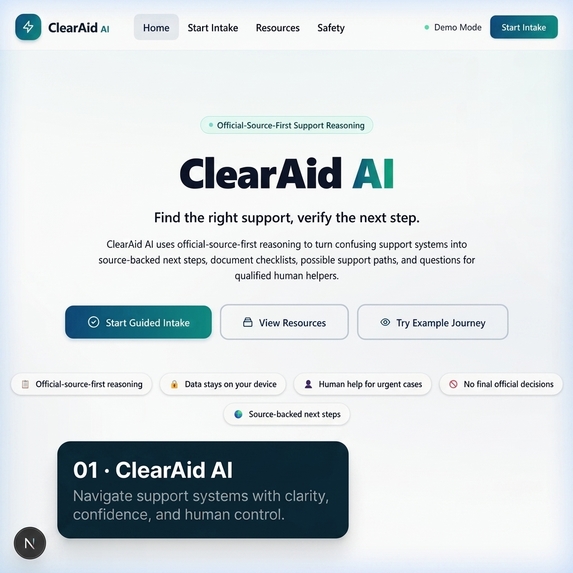
Landing Page
-
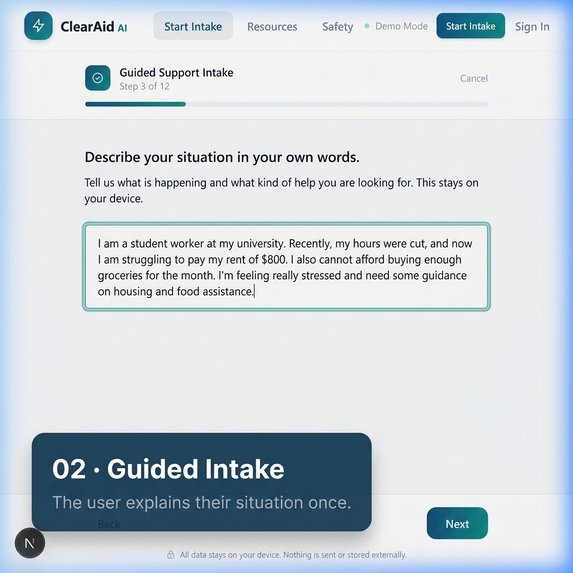
Guided Intake
-
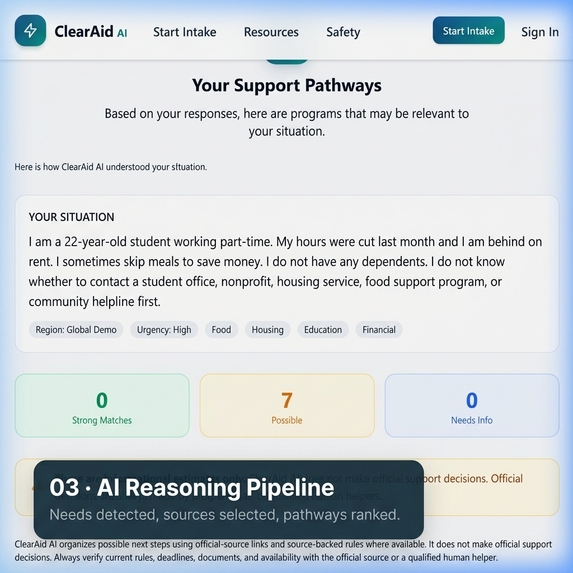
AI Reasoning Flow
-
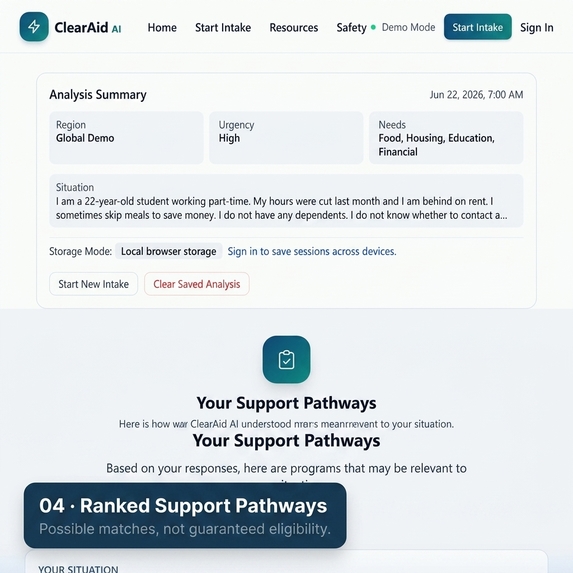
Ranked Group Support Pathways
-
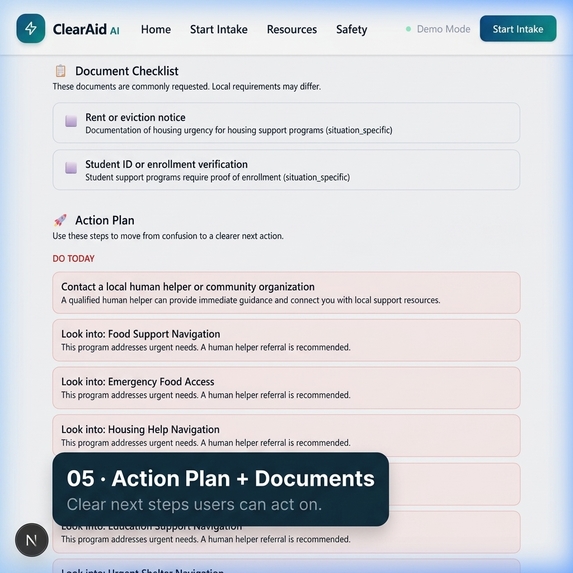
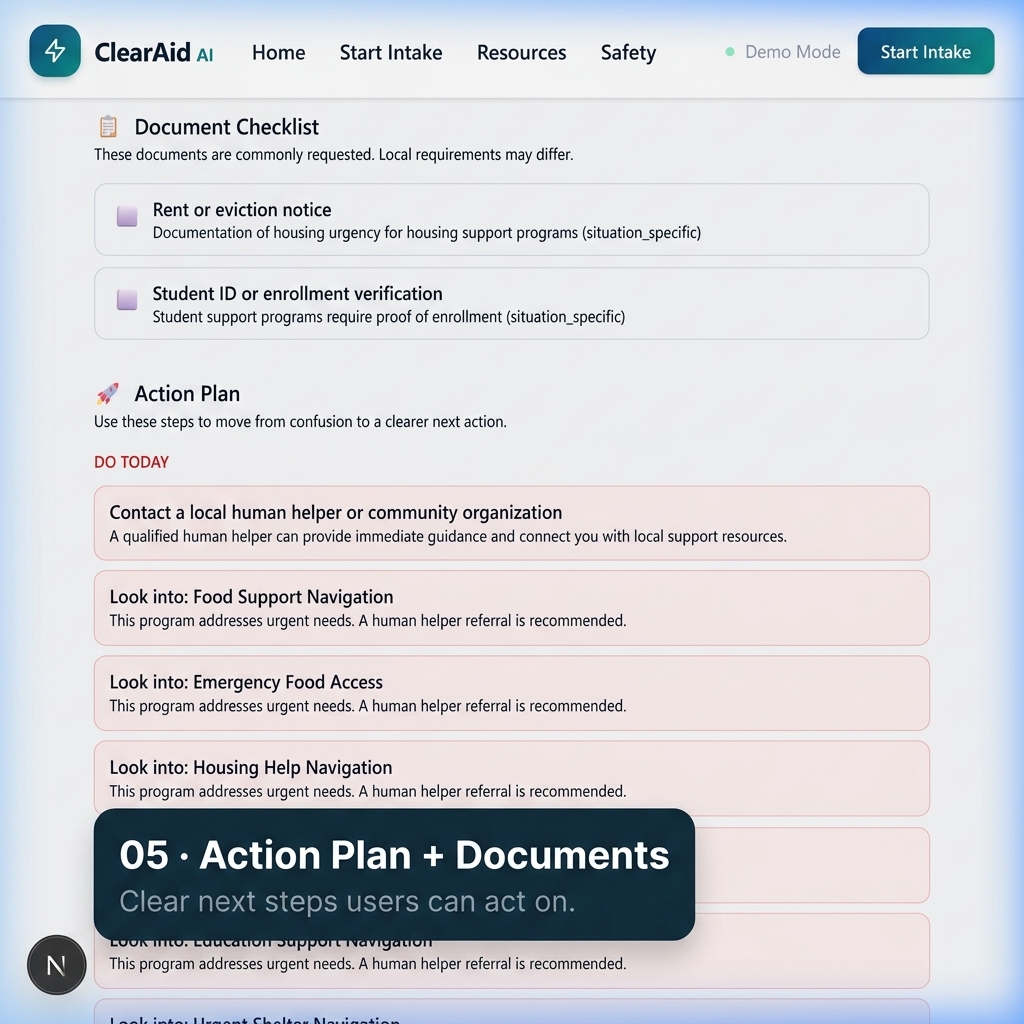
Action Plan Documents
-
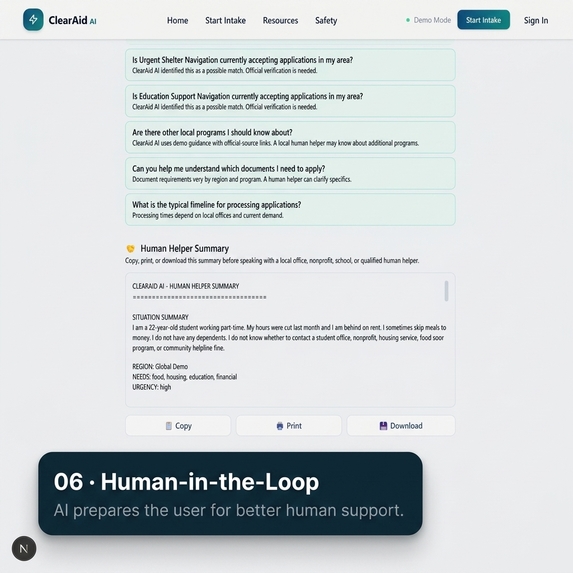
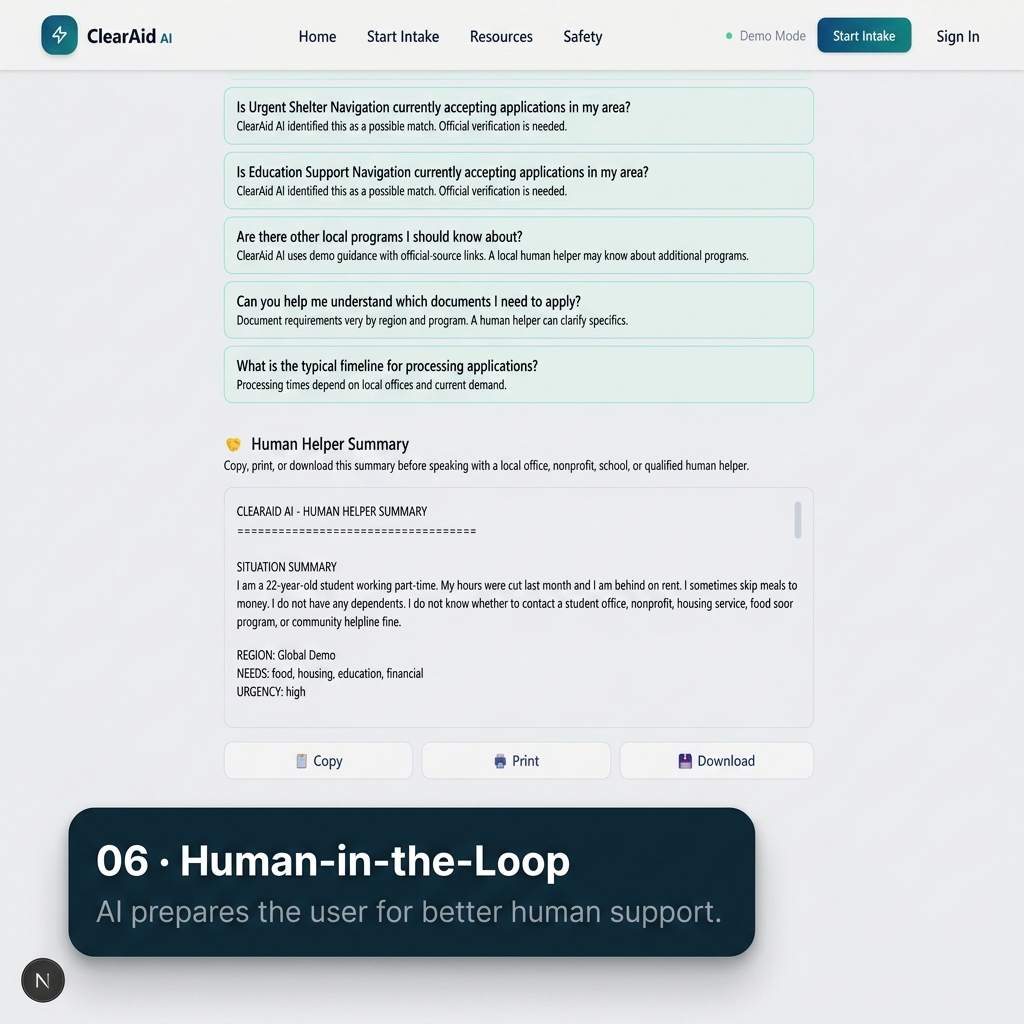
Human Helper Summary
-
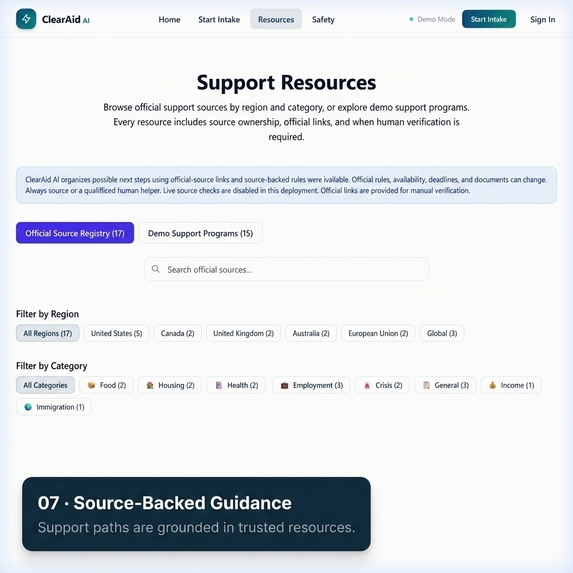
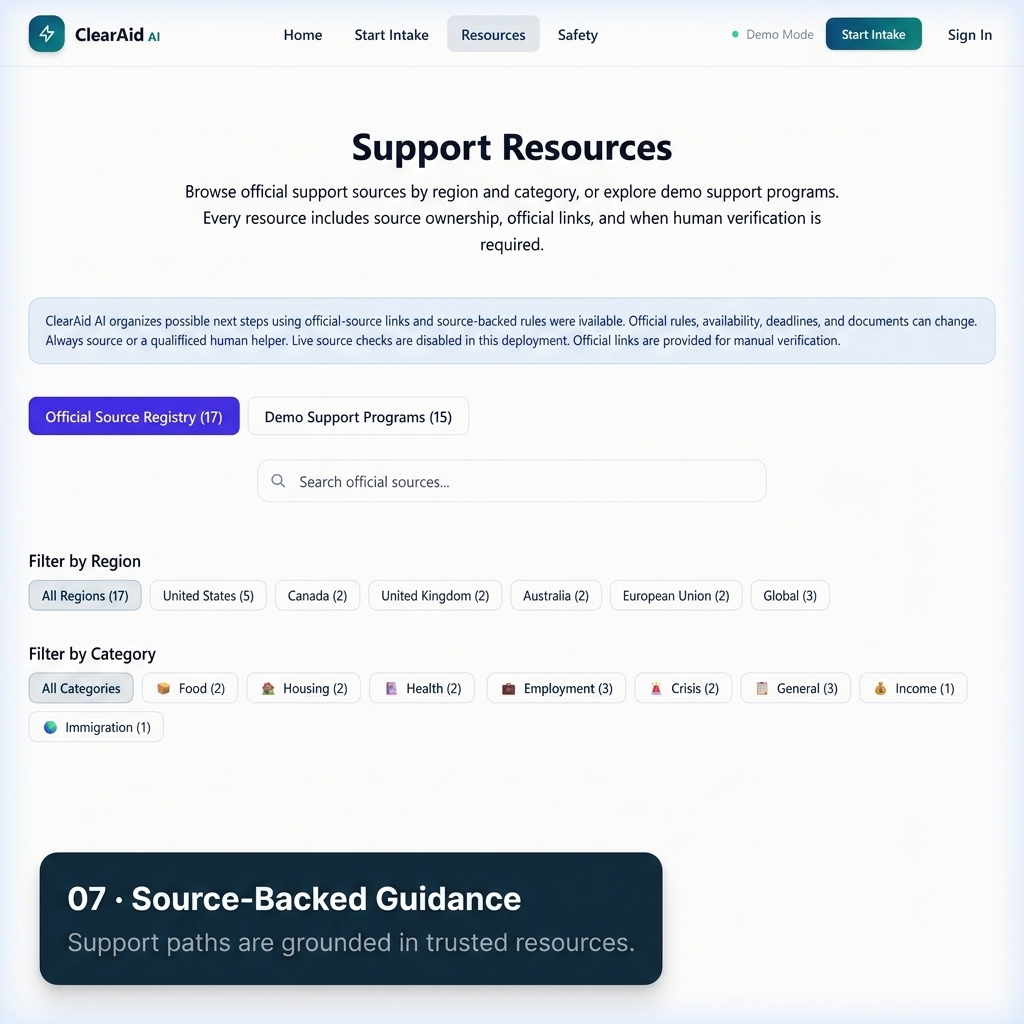
Source Backed Resources
-
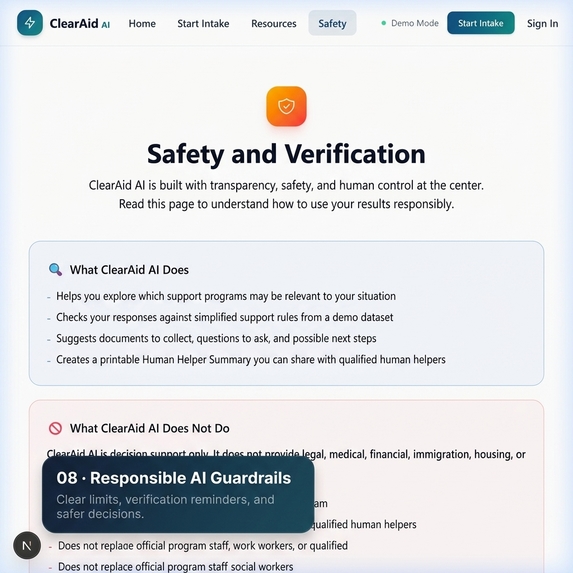
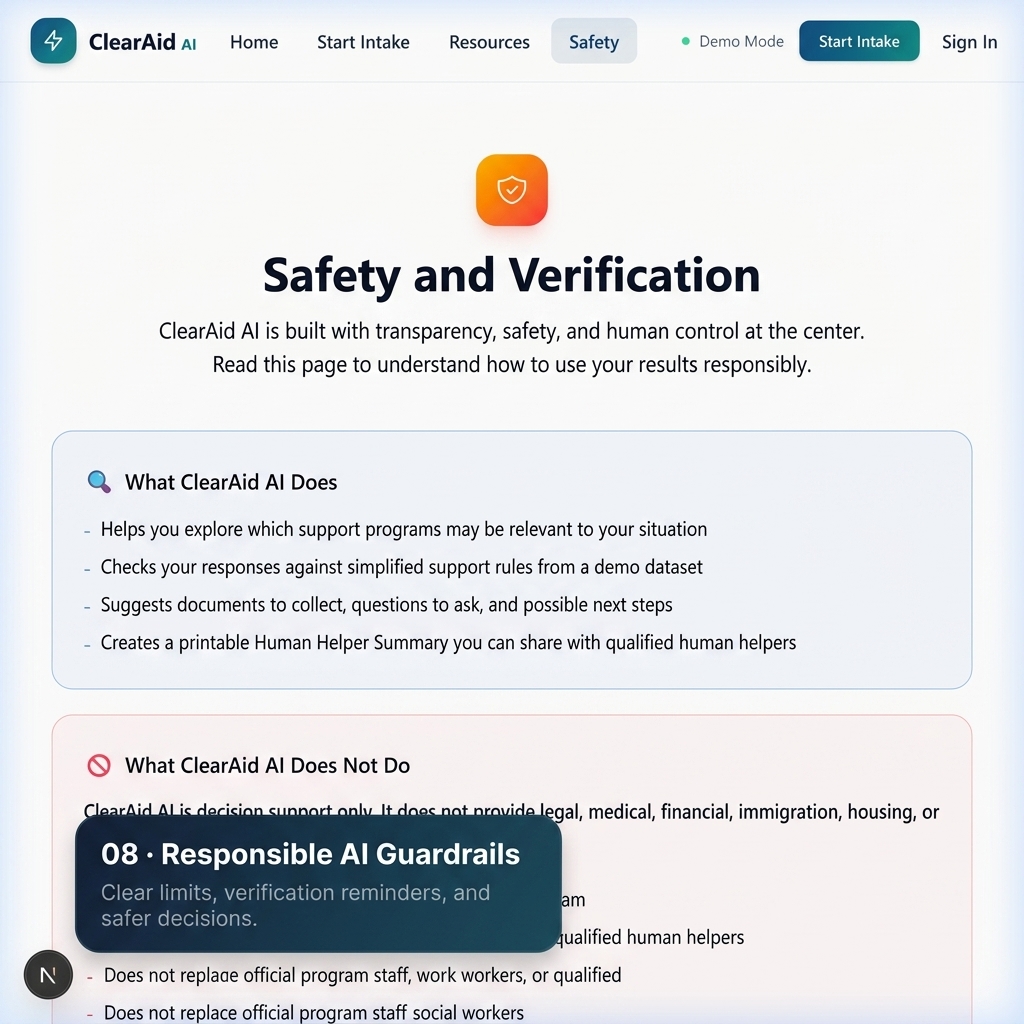
Safety Gaurdrails
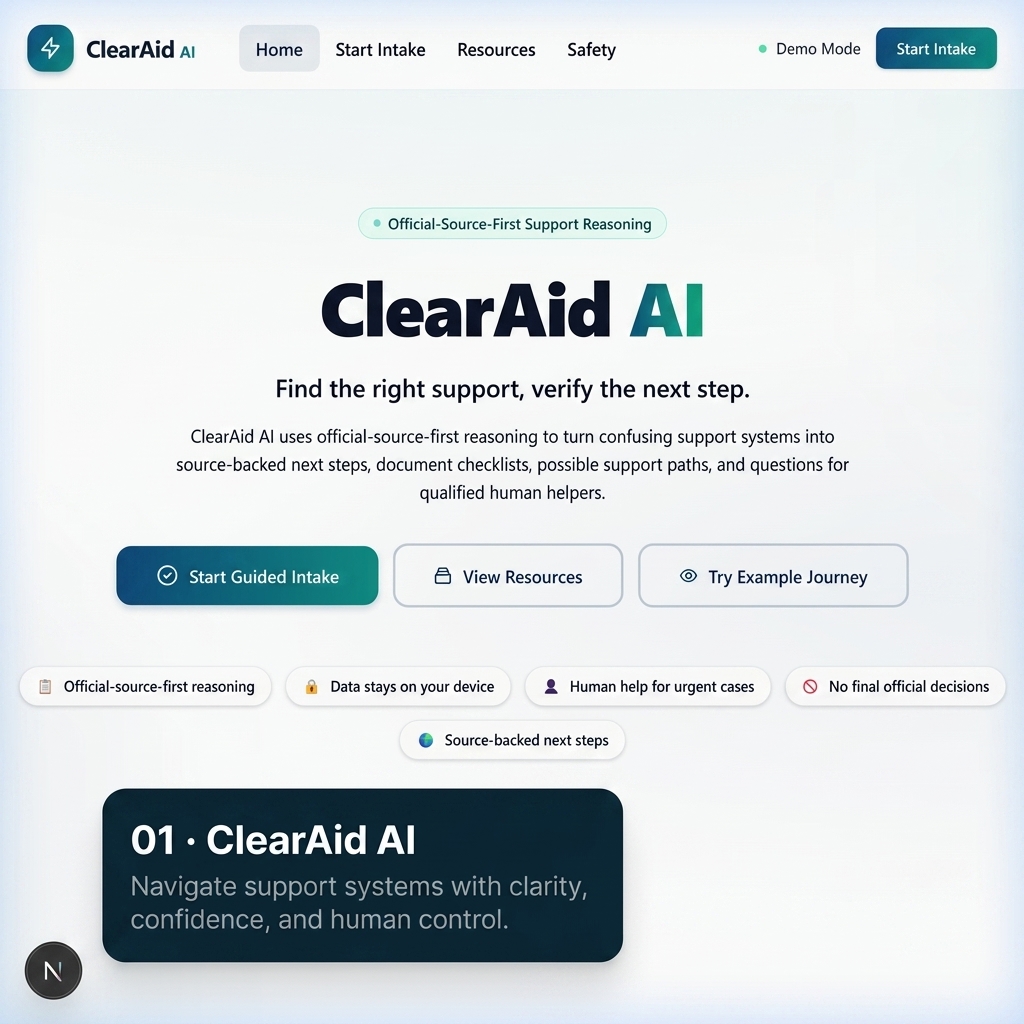
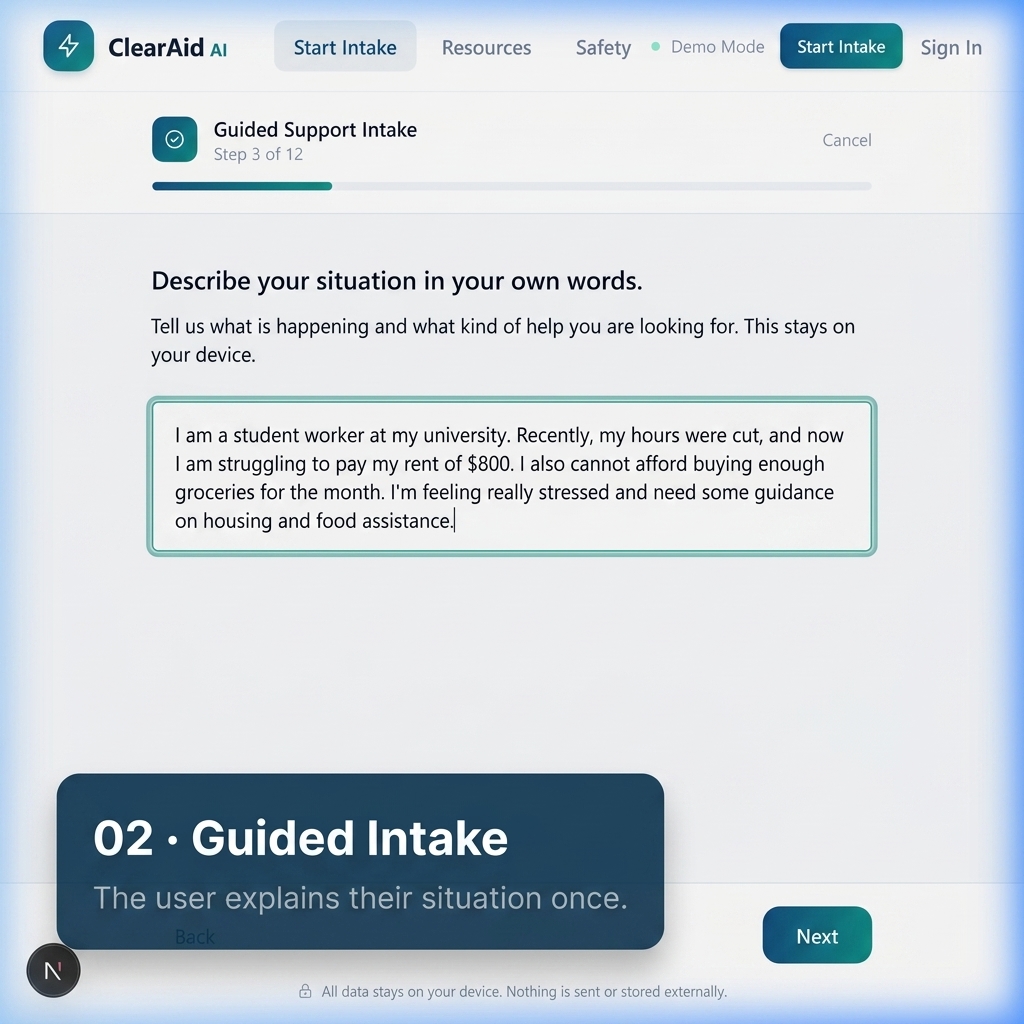
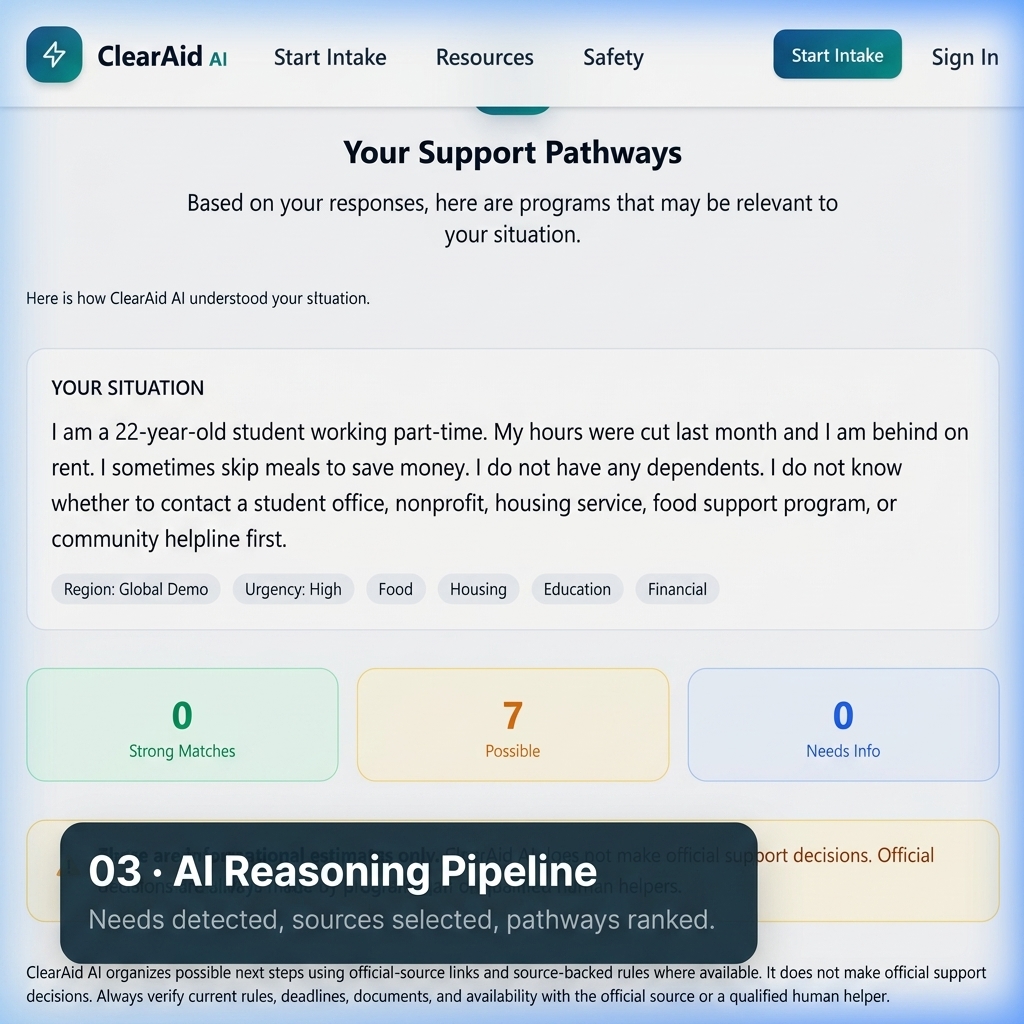
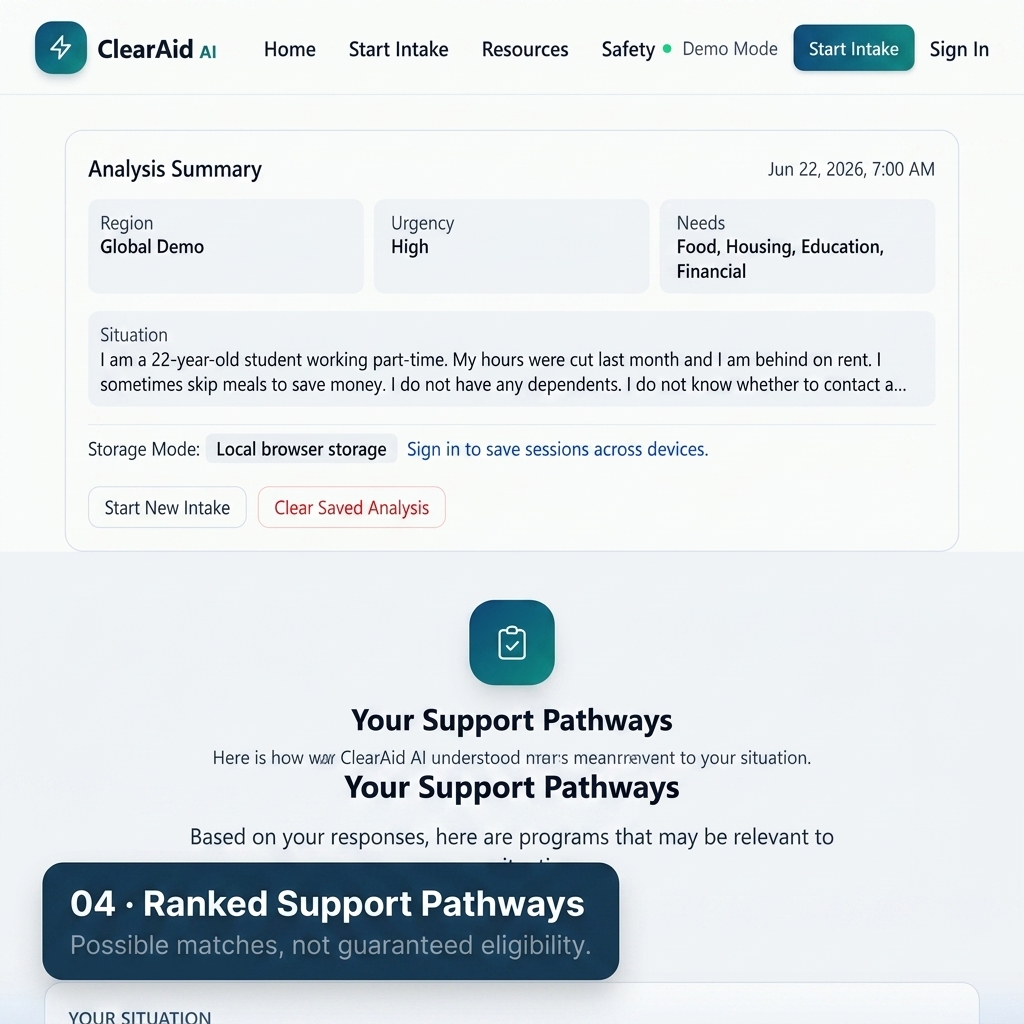
Inspiration
People often miss support not because help does not exist, but because the system is too confusing to navigate.
A student under financial stress may not know where to start. A renter facing instability may not understand which housing pathway applies. A caregiver may need food, healthcare, childcare, or emergency support but feel overwhelmed by forms, deadlines, documents, and unclear rules.
ClearAid AI was inspired by one simple question:
What if a person under stress could describe their situation once and receive clear, safe, source-backed next steps without being misled into thinking an AI made an official decision?
We built ClearAid AI to turn confusion into clarity for people navigating essential support systems. It is not a generic help portal and it is not just a list of links. It is a responsible AI support navigator that helps users understand possible pathways, prepare documents, ask better questions, and stay in control of final decisions.
What it does
ClearAid AI helps people navigate public, nonprofit, community, student, housing, healthcare, emergency, migrant, and social support systems.
The user completes a guided intake describing their situation, location or region, support needs, urgency, household context, and document readiness. ClearAid AI then transforms that information into a practical support plan.
The app provides:
- A plain-language summary of the user's situation
- Ranked possible support pathways
- Missing information that could improve accuracy
- Document checklists
- Step-by-step action plans
- Source-backed guidance and verification reminders
- A human-helper summary that can be copied, printed, or downloaded
- A reasoning trace explaining why each pathway was suggested
For example, a student worker facing food and rent pressure can move from “I do not know where to start” to a structured plan showing possible housing assistance, food support, healthcare access, benefits and cash aid, and human guidance.
ClearAid AI is designed to help users move from confusion to clarity to action.
How we built it
ClearAid AI is built around a source-first decision-support architecture.
The core workflow is:
- The user enters a plain-language situation through a guided intake.
- The system converts the intake into structured facts such as need type, urgency, region, support category, and document readiness.
- A deterministic support reasoning engine detects relevant support needs.
- The system compares the user's facts against a support taxonomy and source-backed resource registry.
- Pathways are ranked using relevance, urgency, missing information, document readiness, and safety triggers.
- The user receives possible support paths, document checklists, next steps, source guidance, and questions for human helpers.
- The system clearly keeps humans in control for final eligibility, legal, medical, housing, and benefits decisions.
The deterministic reasoning engine is the backbone of the app. It makes the support logic more explainable, testable, and safer than relying only on a free-form chatbot response.
Gemini is used as an optional conversational assistant, while the core navigation workflow remains controlled and structured. Supabase supports authentication and persistence features. The app also includes local session handling, safety copy checks, source validation, deployment checks, and route tests.
The result is a working prototype that demonstrates the full journey from intake to AI reasoning to actionable output.
Challenges we ran into
The biggest challenge was balancing helpfulness with responsibility.
A support navigator must be useful enough to reduce confusion, but careful enough not to overclaim. If an AI says “you qualify,” a user may treat it as an official decision and skip verification. That could harm people who are already under stress.
To solve this, we designed ClearAid AI with strict responsible-AI boundaries:
- It uses “possible match” and “may be relevant” instead of guaranteed eligibility claims.
- It never says a user officially qualifies, is accepted, or will receive support.
- It shows missing information when more details are needed.
- It provides source transparency and verification reminders.
- It creates a human-helper summary so users can confirm next steps with qualified people.
- It keeps final decisions with official staff, local offices, nonprofits, schools, healthcare workers, legal professionals, or other qualified human helpers.
Another challenge was making the AI reasoning visible. A judge or user should not have to guess how the system works. That is why the results page includes ranked pathways, missing information, document checklists, action steps, and a reasoning trace.
Accomplishments that we're proud of
We are proud that ClearAid AI is not just a chatbot interface. It is a complete decision-support workflow for essential services.
Our strongest accomplishments include:
- Building a guided intake that reflects real stress, urgency, and uncertainty
- Creating a deterministic support reasoning engine for explainable pathway ranking
- Designing ranked possible support pathways across food, housing, healthcare, benefits, education, employment, emergency, migrant, disability, and human-guidance needs
- Adding document checklists so users know what to prepare before seeking help
- Creating a human-helper summary that users can copy, print, or download
- Including responsible AI safeguards directly inside the product experience
- Keeping the AI useful while avoiding false certainty
- Building safety, source, route, persistence, deployment, and copy-audit checks
- Creating a working prototype that can be tested end to end
The part we are most proud of is the human-control design. ClearAid AI does not try to replace people. It helps users prepare for better human conversations and better decisions.
What we learned
We learned that responsible AI is not just a disclaimer. It has to be designed into the product.
In ClearAid AI, responsibility appears in the wording, ranking logic, missing-information prompts, document checklists, source transparency, and human-helper workflow. The system is intentionally designed to guide, not decide.
We also learned that impact does not always mean doing everything for the user. Sometimes the most valuable AI product is one that helps a person understand their situation, organize their options, prepare the right documents, and take the next step with confidence.
Finally, we learned that explainability matters. For high-stakes public support navigation, users and judges need to see why the system suggested a pathway. That is why ClearAid AI shows its reasoning instead of hiding it behind a black-box answer.
What's next for ClearAid AI
Next, we want to make ClearAid AI more local, more source-grounded, and more useful for real organizations.
Our next steps are:
- Expand official source coverage by country, city, and program type
- Add stronger source freshness checks for deadlines, documents, and availability
- Improve multilingual access for users who are not comfortable with English
- Add community organization dashboards for counselors, nonprofits, and student support offices
- Improve accessibility for mobile users and low-bandwidth environments
- Add safer escalation flows for crisis, housing risk, medical urgency, and emergency needs
- Pilot the tool with student support offices, community organizations, or public-interest groups
- Continue improving the reasoning engine with clearer confidence scoring and better source validation
Our long-term vision is for ClearAid AI to become a trusted first step for people who need help but do not know where to begin.
Built With
- deterministic-support-reasoning-engine
- github
- google-antigravity
- google-gemini-api
- local-session-persistence
- next.js-16
- official/source-backed-support-registry
- react-19
- supabase-auth
- supabase-database
- synthetic-demo-scenarios
- tailwind-css-4
- typescript
- vercel

Log in or sign up for Devpost to join the conversation.