Inspiration
Compliance issues within global trade transactions are not exceptions, they happen on an everyday basis. Numerous companies have been hit with penalties reaching into the hundreds of millions for transactions with entities which were under sanction, and violations related to labeling or compliance requirements are even more frequent. However, the issue is that there isn't any solution which would bring together all necessary information into one comprehensive workflow.
What it does
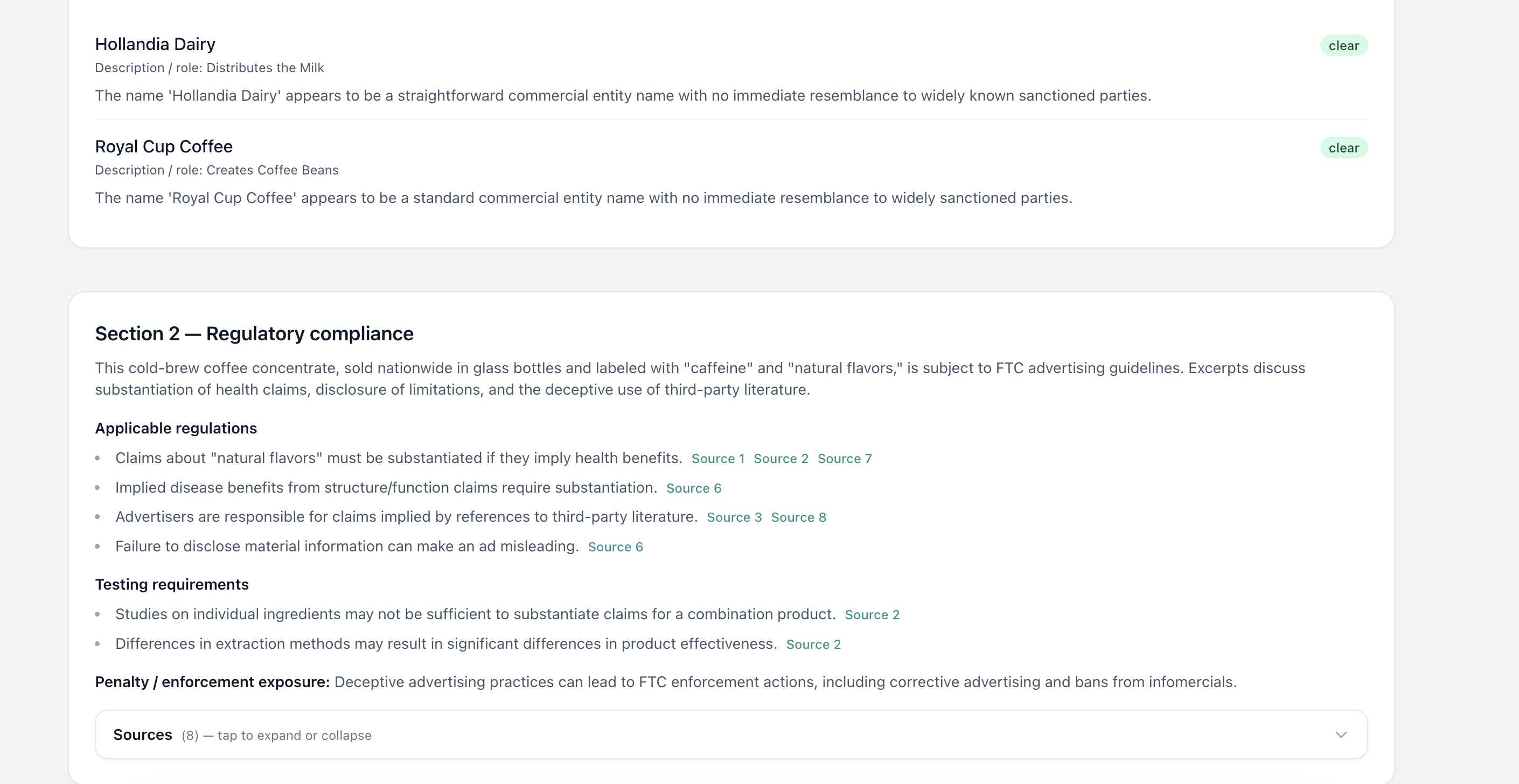
You give ClearPath a product name and a list of suppliers, and it gives you back a report that answers three essential questions: Are any of these suppliers flagged?
- It checks every name against the U.S. government’s Trade.gov Consolidated Screening List in real time. ClearPath first attempts exact name and alias matching, then fuzzy matching to catch spelling/format discrepancies. Each supplier is marked as “clear,” “needs review,” or “flagged,” and an explanation of why.
What regulations apply to this product?
- ClearPath searches through a vector database built from real FDA, CPSC, and FTC documents and pulls out the rules that are relevant to your product–labeling requirements, testing standards, import restrictions, and potential penalties–along with the respective citations that link to the source PDF.
Where does each supplier sit in my supply chain?
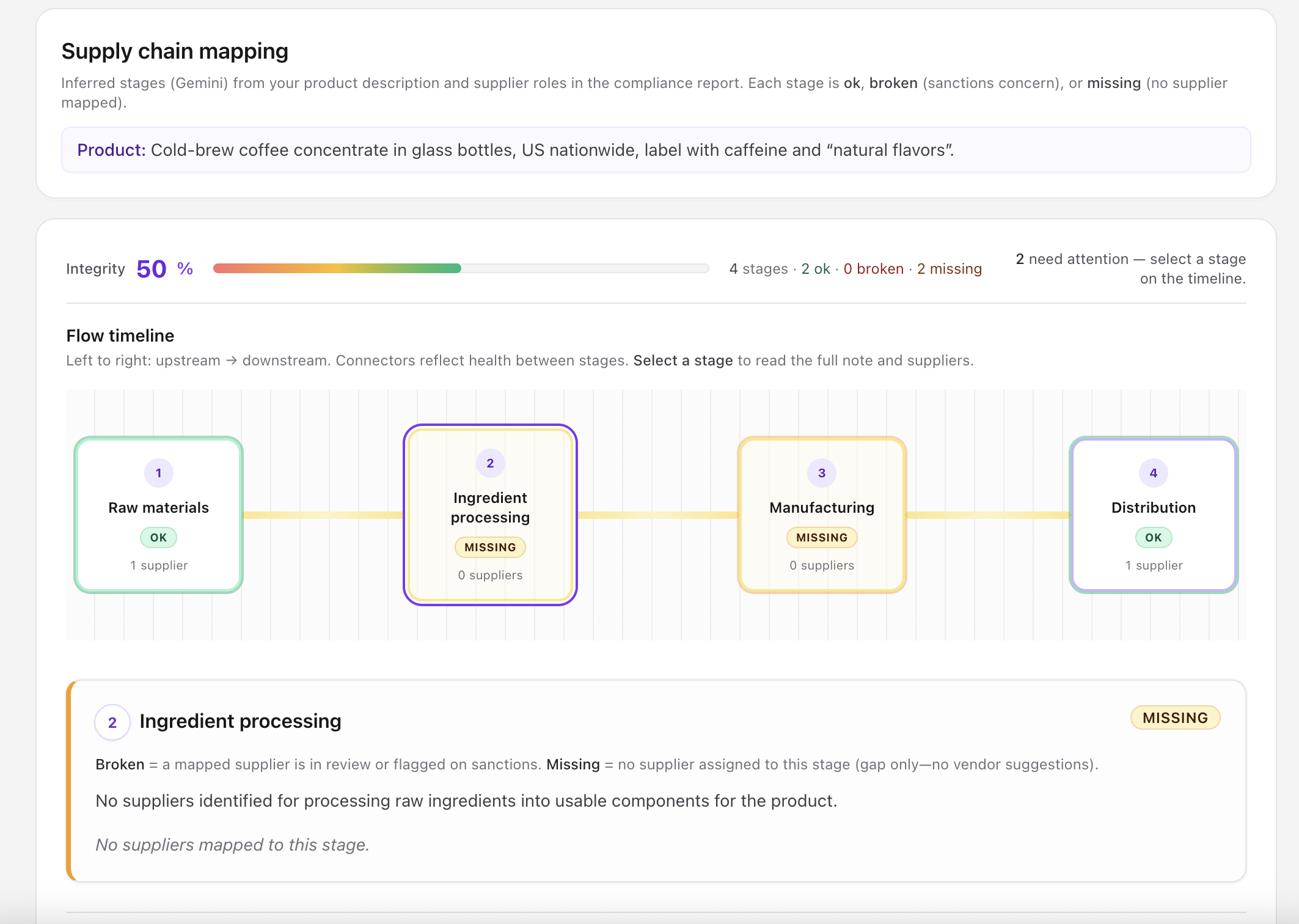
- ClearPath maps suppliers onto an inferred supply-chain timeline (raw materials to distribution) and flags stages that are broken (sanctioned suppliers) or missing (no supplier covers that stage). It provides an integrity score that encapsulates the entire chain.
After the initial report, you can edit the supply chain map inline, re-run sanctions checks on individual stages, and download the full report as a formatted PDF.
How we built it
Backend (FastAPI + Python): FastAPI orchestrates the entire pipeline. When a report request comes in, three independent tasks run in parallel using asyncio.gather. The three tasks are sanctions screening, regulatory RAG, and supply chain inference. The Trade.gov Consolidated Screening List API handles real-time sanctions lookups, with RapidFuzz providing the fuzzy name matching for cases where exact string comparison is insufficient. If the screening list yields nothing, Gemini 2.5 Flash is fallen back upon. The regulatory layer is built on ChromaDB, a local vector database indexed from FDA, CPSC, and FTC PDFs using sentence-transformer embeddings. When a product description comes in, it’s embedded and semantically searched against it. The top retrieved chunks are passed to Gemini and are synthesized into an easy-to-read regulatory summary with hyperlinked citations. Supply-chain inference is a separate Gemini call that takes the product ,supplier list, and sanctions results and produces an ordered stage mapping. After the initial report, any stage edits will cause a re-screening of the affected suppliers, with Gemini remapping the full chain.
Frontend: The frontend is a Next.js 14 app with three main tabs: Compliance Report, Supply Chain, and Browser Agent. The Compliance Report tab handles product and supplier input (including CSV upload via PapaParse), triggers report generation, and renders the full results with inline citation links that open the source PDFs at the exact reference page. The Supply Chain tab surfaces the inferred timeline as an interactive map with an integrity score, inline stage editing, and the ability to trigger re-screening from the UI. The Browser Agent tab connects to a Browser Use Cloud agent. When the flagged supplier needs action taken on an external dashboard, progress streams back to the frontend in real time via Server-Sent Events and embeds a live session URL directly in the UI.
Challenges we ran into
Our initial goal was to build an intelligent agent that monitored the dashboard in real-time, detected all supplier errors marked in red, and automatically fixed them without any additional user interaction, all in one pass. But due to technical constraints with Browser Use operations, this was not realistically achievable. The cycle of the agent, from understanding the current state of the dashboard, determining which supplier errors should be addressed first, going to the right fields to edit their data, and saving the changes, was simply taking too long to do efficiently with multiple open supplier errors. As a result, the agent was unable to maintain its state of mind and make consistent updates sometimes, and would leave the dashboard loading for long periods of time with no updates to the user. To deliver a functional product on schedule, we chose to simplify the system and allow the agent to address only one supplier error at a time, ensuring a reliable outcome after each change, focusing on practicality rather than what was seemingly ideal.
Accomplishments that we're proud of
The end-to-end pipeline works very smoothly. One product description and supplier list enters our pipeline and results in a sanctions verdict, regulatory summary with real citations, and a visual supply chain map. We're especially proud of our RAG pipeline, which grounds every regulatory claim in real source material rather than relying on the AI's general knowledge. To implement this, we built a local vector database from FDA, CPSC, and FTC documents so that when Gemini generates the regulatory summary, every claim is tied to a retrieved chunk from an actual agency PDF.
What we learned
Hard constraints matter when you're asking an LLM to produce structured output repeatedly. For example, "Update the suppliers but don't change the supply-chain stage names" only works consistently if you make the prompt explicit and enforce it in the response format. We also learned incremental development is key when working with others, as developing each feature fully and then merging creates many bugs within the code. Focusing on building the minimal viable product via incrementally developing each feature and merging our work periodically led to the best results.
What's next for ClearPath
Simulation engine for real world disruptions:
- Understanding future situations is key in optimizing supply chain flows. Users should be able to understand what would happen when, for example, a particular port closes, new geopolitical sanctions arise, or a major supplier drops off the grid is crucial. Through the graph-based modeling of the supply chain, ClearPath should be able to model the impact of a particular event across the supply chain, identify bottlenecks or single points of failure, and provide alternative options ahead of time, so that users are better informed and well-prepared.
Automated news monitoring and supplier surveillance:
- Instead of having to initiate compliance checks when needed, ClearPath should have the ability to continuously monitor news sources, labor rights and regulation sources, and other relevant media outlets for any information about the suppliers on file for that company. It should trigger alerts whenever there is a potential problem and update the database accordingly. If, for example, a certain supplier shows up in a news piece concerning some sort of labor violation or fraud or sanctions issues, the system would immediately flag the supplier, allowing for constant supervision.
Parallelization of agents' tasks:
- Reengineering the layer of agent coordination to allow running multiple agents in parallel, with each of them taking care of a different supplier issue within an independent environment would allow us to better inform our users. The coordinator will take care of merging the results obtained from different agents, dealing with any conflicts that arise. Having parallel agents would allow us to come significantly closer to the initial concept of our automation solution.
Built With
- browseruse
- chromadb
- fastapi
- gemini
- next.js
- papaparse
- pymupdf
- python
- rag
- rapidfuzz
- react
- reportlab
- restapi
- sse
- tailwind
- typescript
- uvicorn


Log in or sign up for Devpost to join the conversation.