-
-
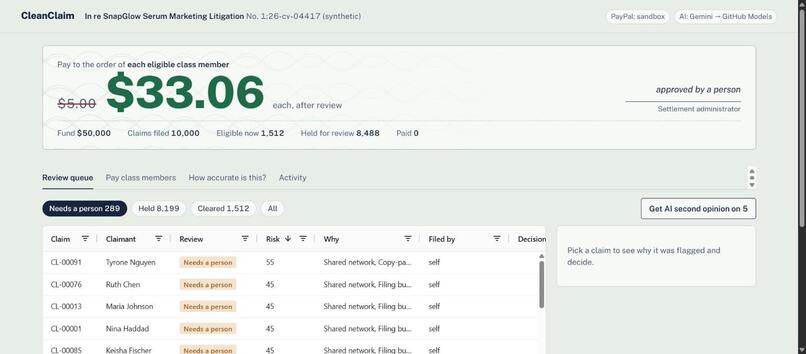
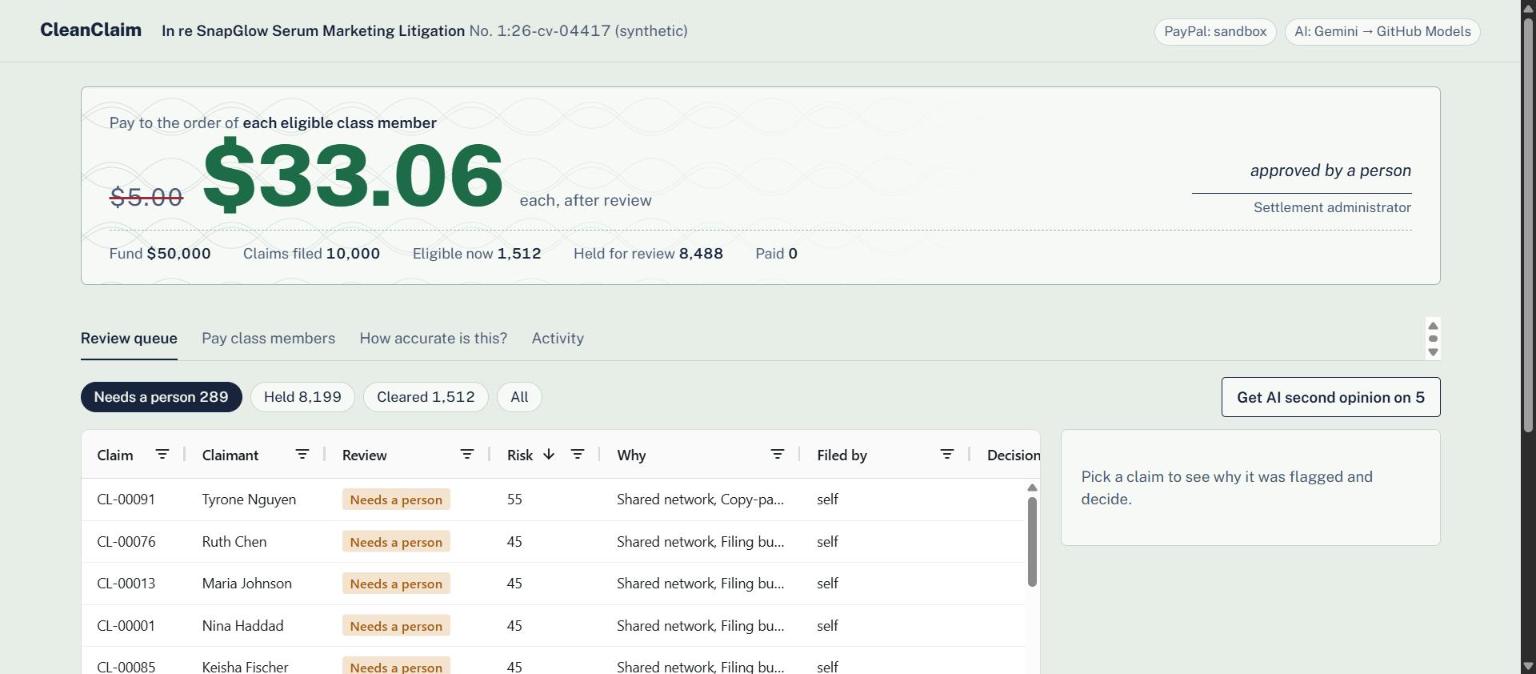
Settlement dashboard: $5.00 per claim becomes $33.06 for real class members after review
-
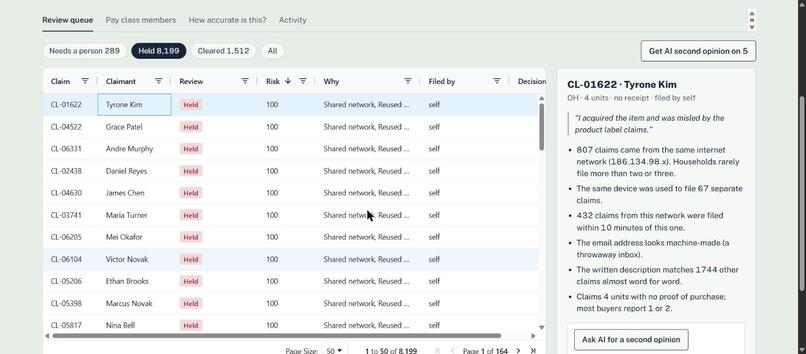
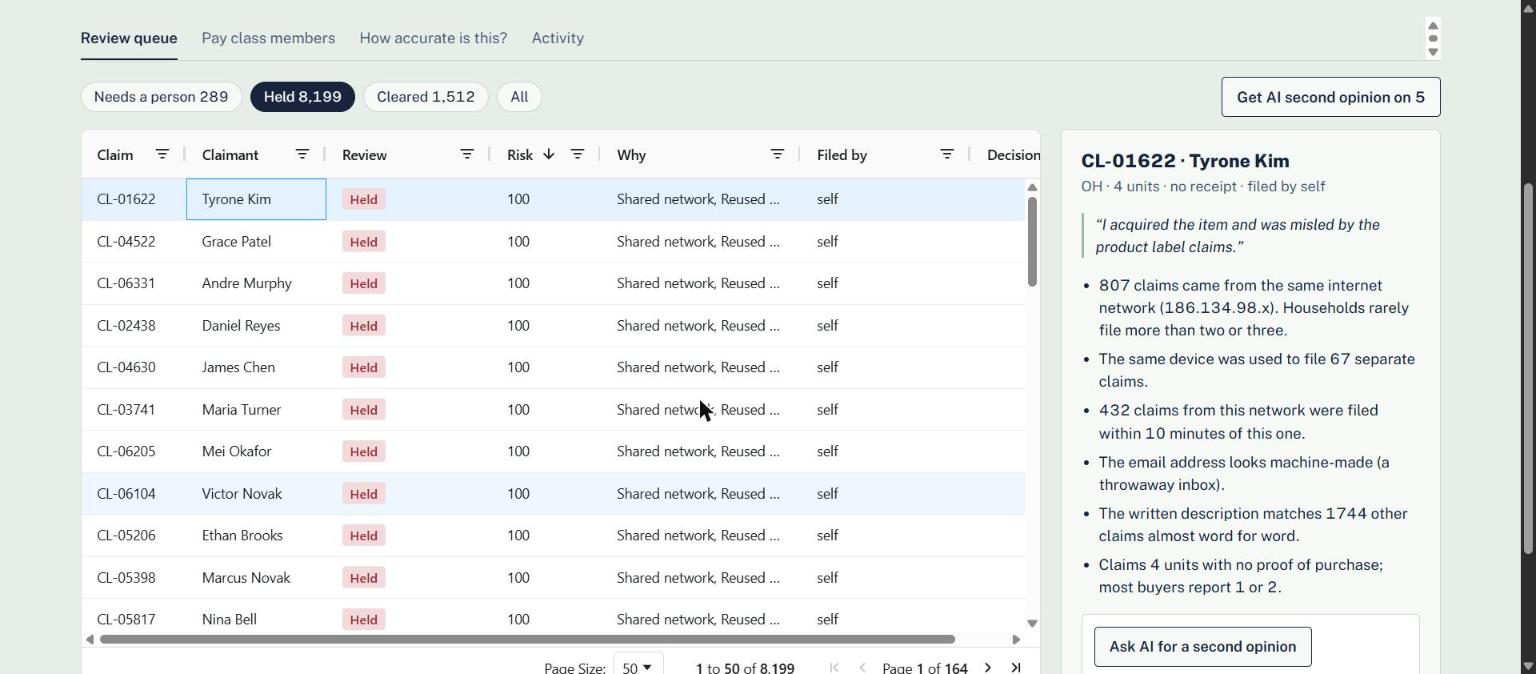
Every held claim explained in plain English
-
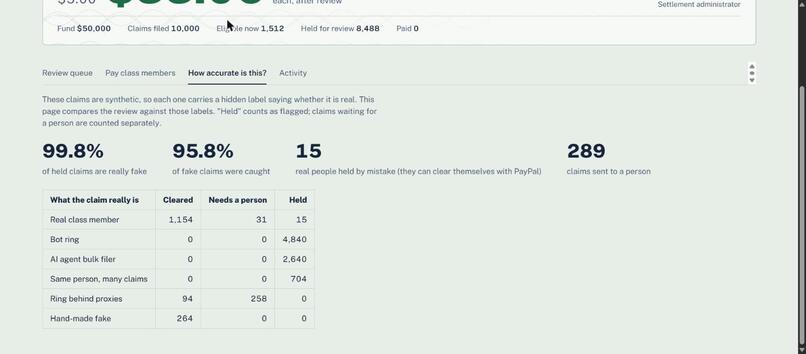
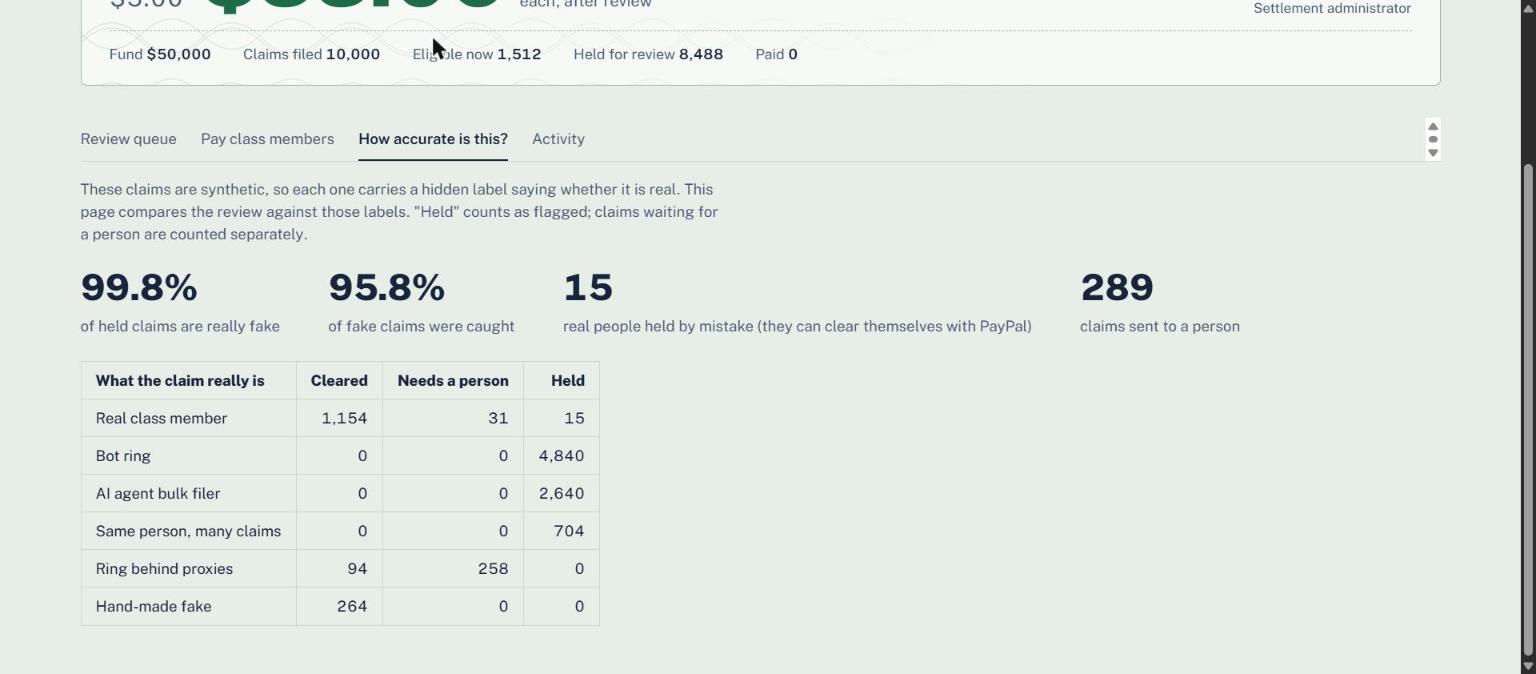
Honest accuracy against labelled data, including our mistakes
-
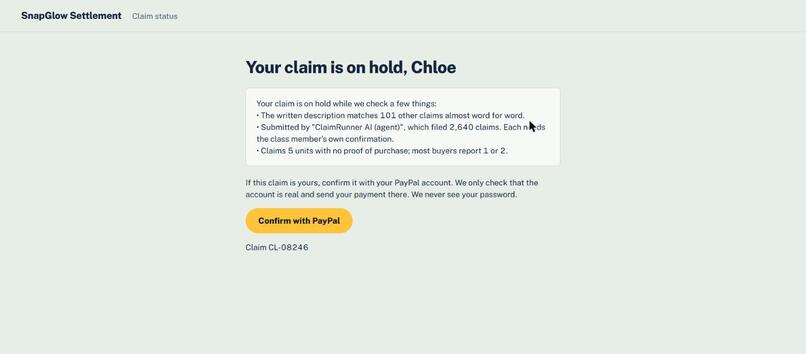
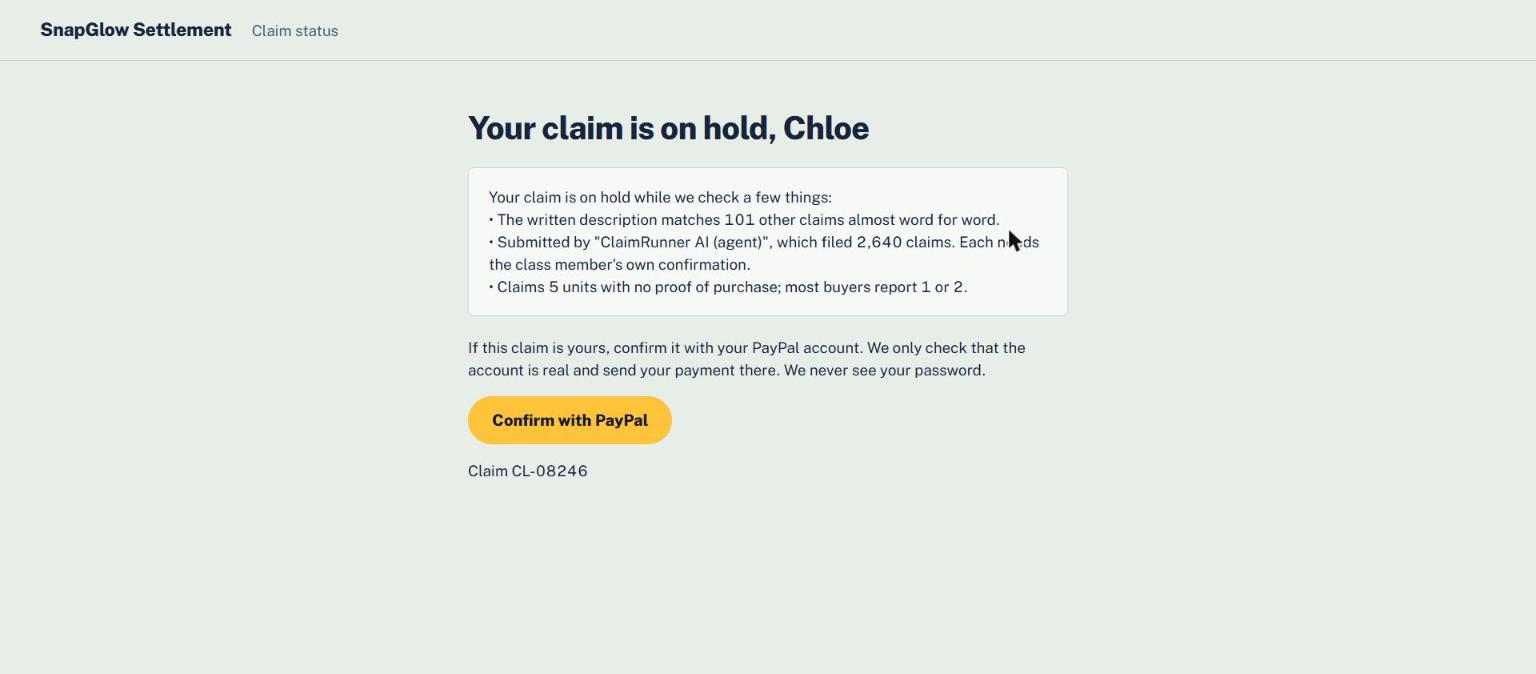
Wrongly held claimants clear themselves with Log in with PayPal
Inspiration
When a company settles a class action, anyone affected can file a claim online, and the money is split among the claims. That makes every fake claim a direct theft from real people. One payment processor reported 80 million fraudulent claims across its clients in 2023, up 19,000% since 2021. In the Juul/Altria settlement, the administrator said about 80% of 14 million claims were likely fake. In October 2026 a new wave began: AI agents filing claims in bulk "on behalf" of thousands of people.
Commercial tools already score claims for fraud. What we saw missing was the other side: the real person who gets held by mistake, with no idea why and no way to prove they are real. CleanClaim is built around being fair to that person while still stopping the bots.
What it does
- Screens every claim for warning signs: shared networks, reused devices, filing bursts, throwaway emails, copy-paste stories, the same person filing many times, and bulk filing by automated agents.
- Explains every flag in plain English so an administrator, a judge, or the claimant can read it.
- Asks an AI for a second opinion on borderline claims. The AI reads the claimant's own words and recommends approve or hold with a reason. It never decides; a person does.
- Lets wrongly held people clear themselves with Log in with PayPal. One PayPal account can confirm only one claim.
- Pays eligible class members through PayPal Payouts, only after a person types a confirmation. PayPal rejects a repeated batch, so nobody is paid twice. Each payment is tracked to SUCCESS, UNCLAIMED or RETURNED.
In our demo case ($50,000 fund, 10,000 filed claims), paying everyone would give $5.00 each. After review, 1,512 real class members get $33.06 each.
How we built it
- Backend: Node.js + Express. The detector builds network, device, identity, wording and filer clusters across all claims and turns each signal into a sentence.
- PayPal: Payouts API for batch payments (with
sender_batch_idas the retry key), payout status polling and verified webhooks, Log in with PayPal (OpenID Connect) for claimant identity, OAuth client credentials on the server. - AI: A fallback chain: Gemini (several models) → GitHub Models → Groq → OpenRouter → Claude → rules. Each provider gets 15 seconds; on quota limits or errors the next one answers. Answers are cached so a claim never costs quota twice.
- Front end: AG Grid for the 10,000-row review queue; plain HTML/CSS for the rest, designed to look like settlement safety paper.
- Data: 10,000 synthetic, labelled claims, including the hard cases: a campus email blast, families without receipts, a ring hiding behind residential proxies, and hand-made fakes.
Challenges we ran into
- Being honest about accuracy. Our first detector scored 100%, which only meant the fake data was too easy. We added realistic hard cases until it made human-like mistakes, then built the "How accurate is this?" page to show them.
- The AI was too harsh at first. It called a dorm student a fraud at 95% confidence. We rewrote the instructions to describe what is normal for honest claimants, and now it approves the student and still holds the scripted ring.
- Free-tier AI quotas. Gemini's free tier allowed 20 requests a day for one model, so we built the multi-provider fallback and answer cache.
- Sandbox limits. Venmo payouts are rejected in the PayPal sandbox, so the demo pays PayPal accounts. Venmo works the same way in production.
Accomplishments we're proud of
- Real PayPal sandbox payouts from the app, end to end, with statuses tracked per claim.
- 99.8% of held claims are truly fake and 95.8% of fake claims are caught on our labelled data, and the 15 real people we wrongly hold can clear themselves in one step.
- No money is ever held by CleanClaim and no claim is ever denied by the AI.
What we learned
Fraud tools usually measure how many fakes they catch. The harder and more important number is how many real people they hurt, and what those people can do about it.
What's next
- Live settlement data with a claims administrator partner.
- Venmo payouts in production, and a court-ready report export.
- Detecting AI-agent filings by asking each class member to confirm their own claim through PayPal.
Built With
- ag-grid
- claude
- css3
- express.js
- gemini
- github-models
- groq
- html5
- javascript
- node.js
- openrouter
- paypal
- render
