-
-
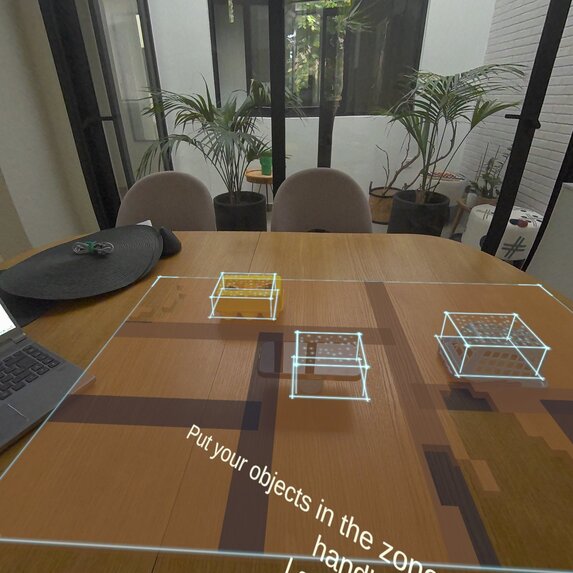
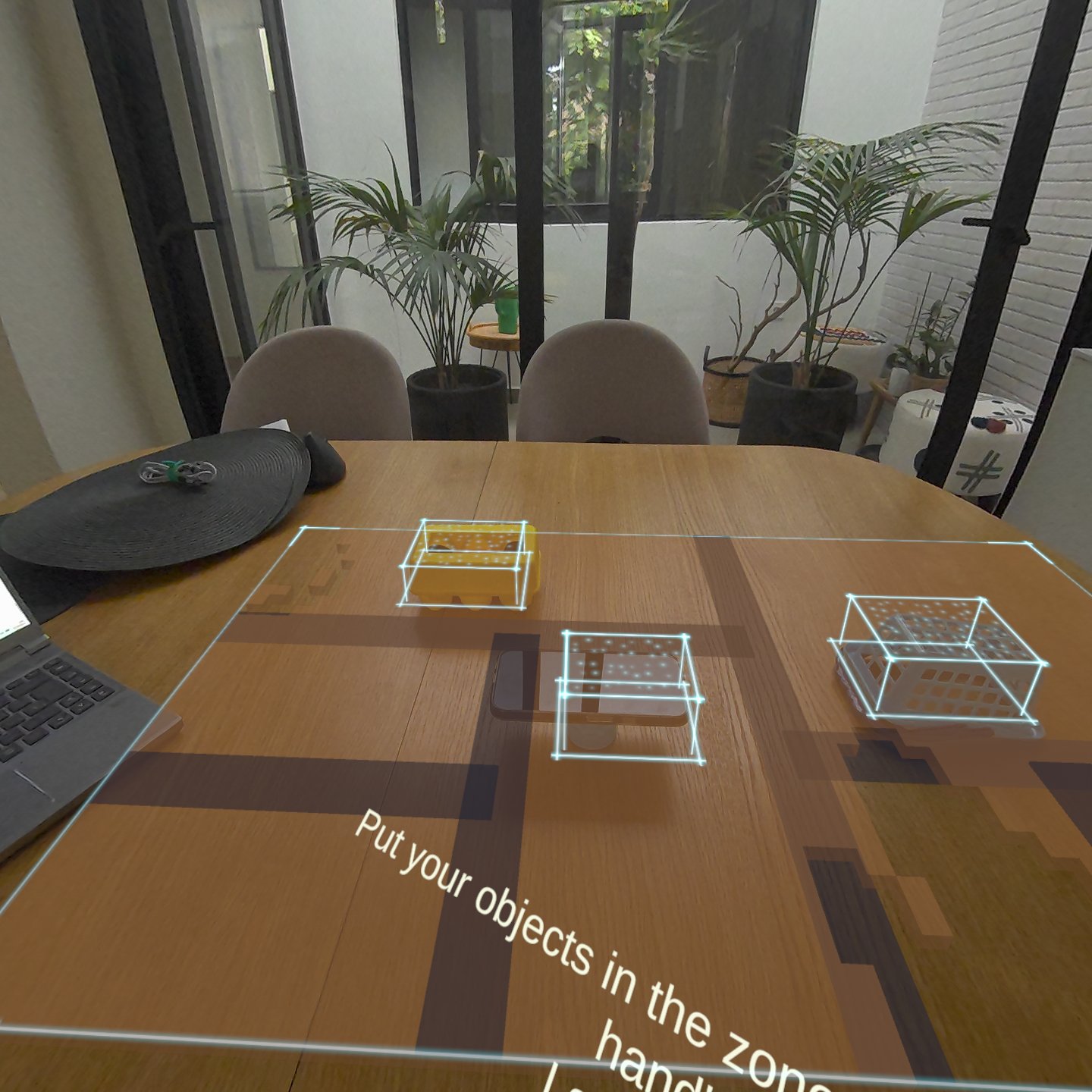
Free play can use any object and create a new city for you.
-
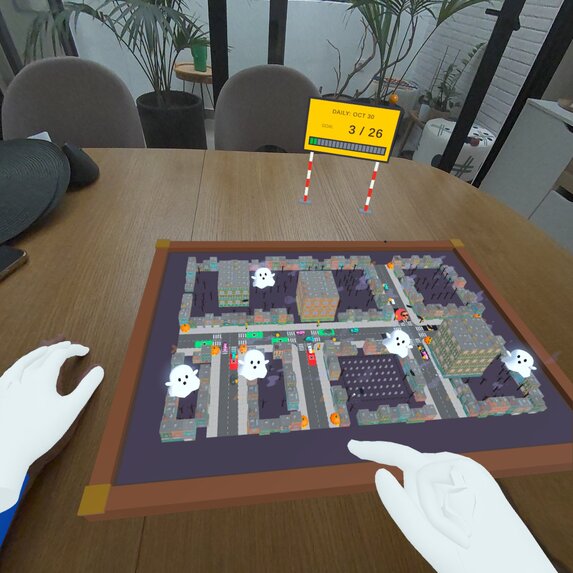
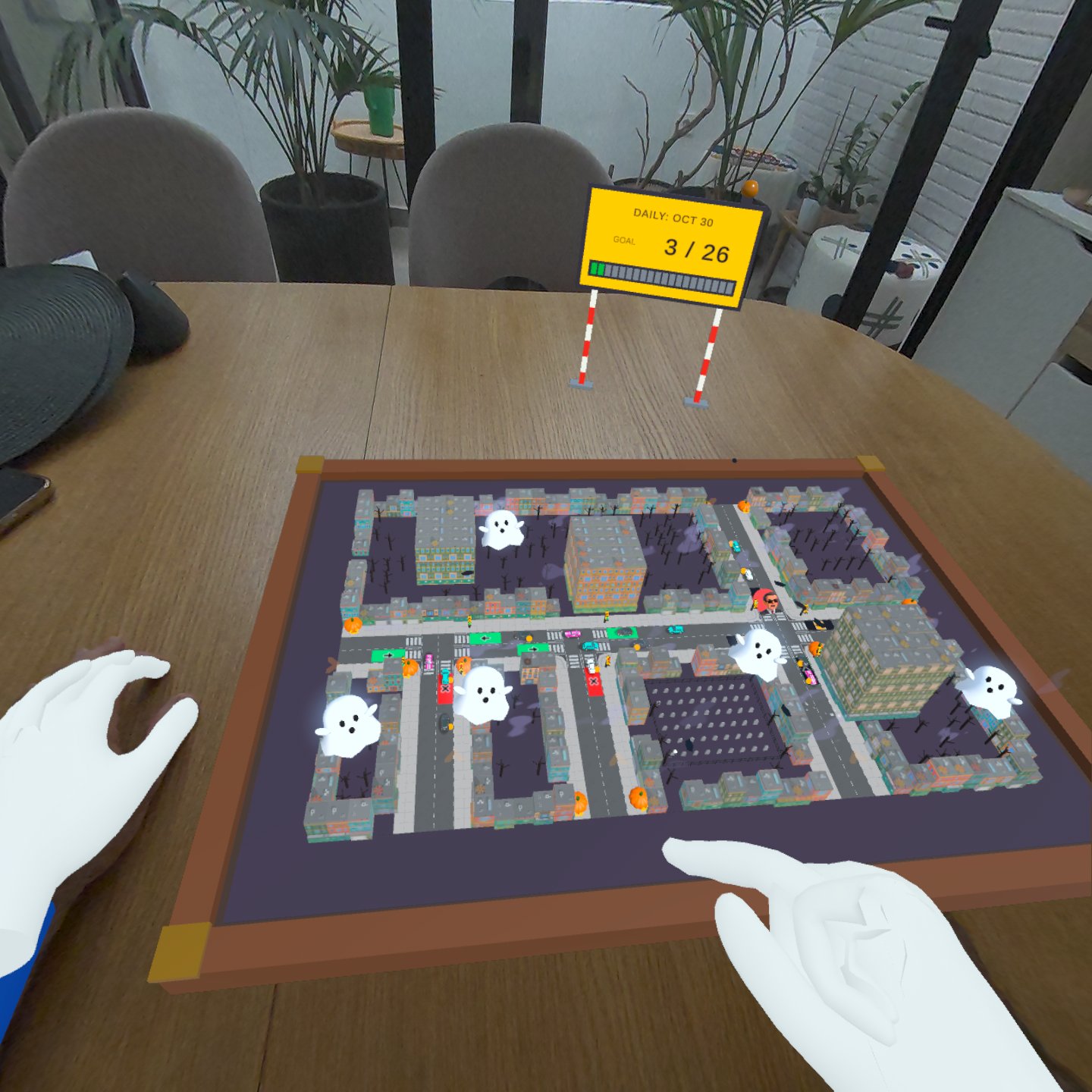
Daily Challanges! Every day a new city, also customized by the hollidays and special days!
-
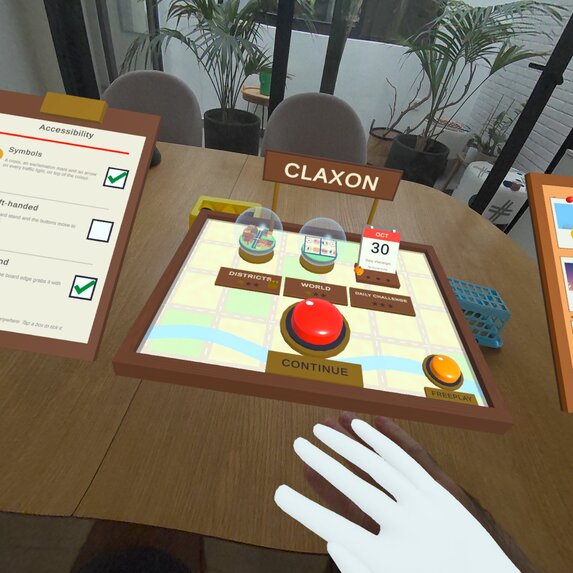
All UI has been improved!
-
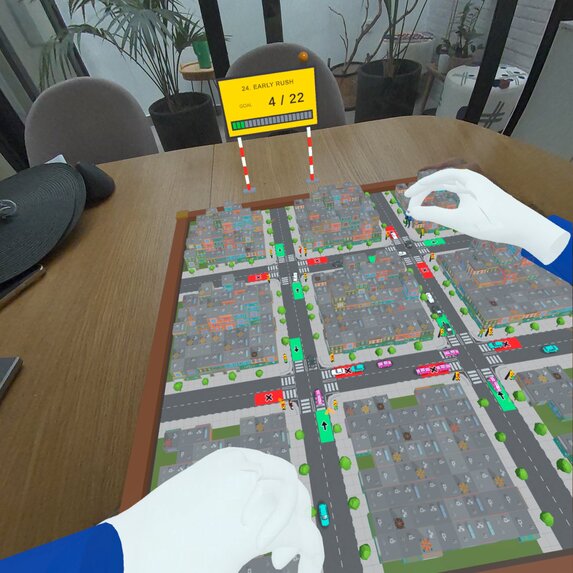
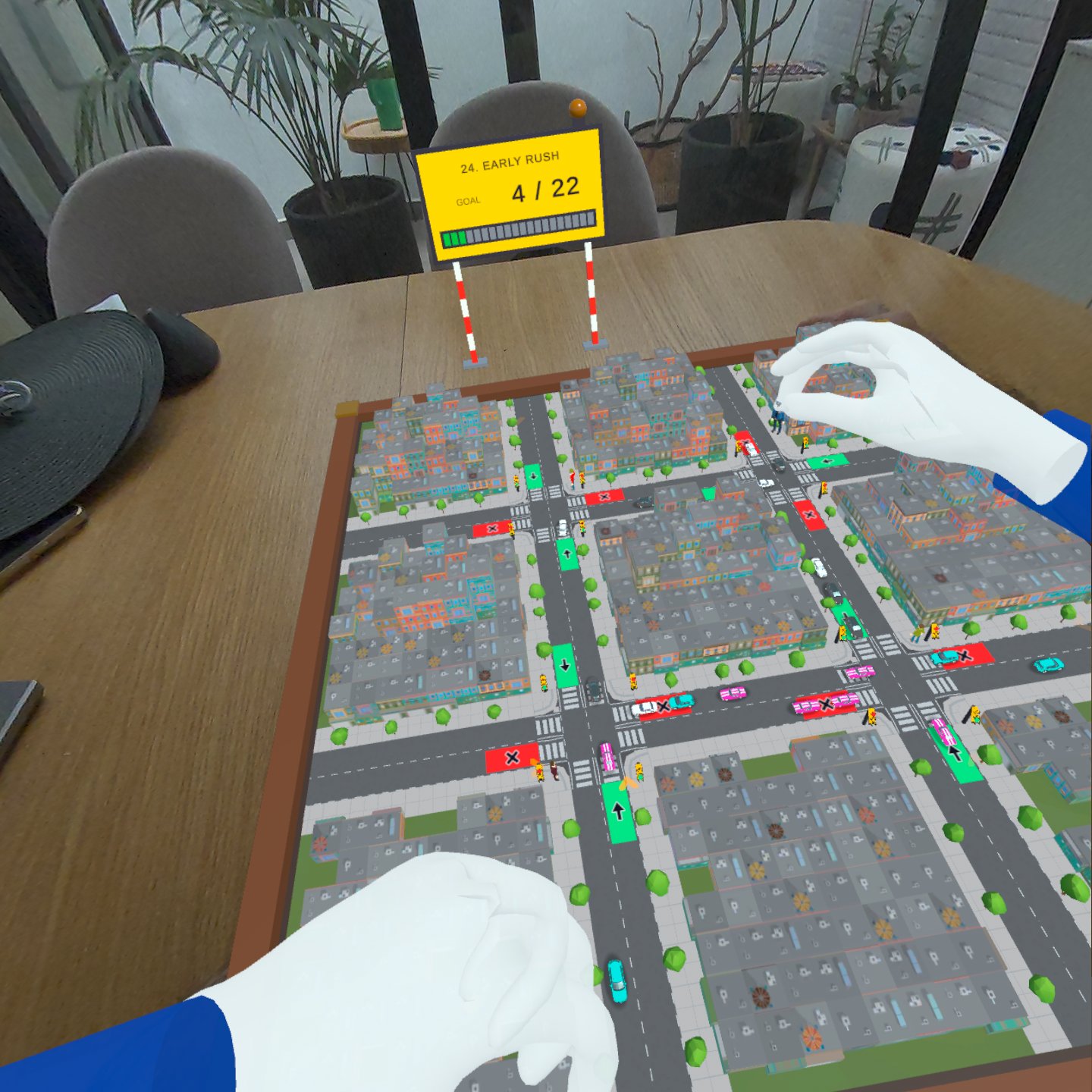
Uses one or both hands! Switch the traffic lights!
Inspiration
I have always been curious about managing traffic. We all carry a little traffic officer inside: stuck at a red light, everyone is sure they would do it better than the lights or the police. And on my island, Tenerife, traffic is a real problem: many cars per family and a lot of daily trips. The idea came on its own. That is also why one of the world crossings in the game is built around the Padre Anchieta junction, from my own island.
What it does
Claxon is a casual puzzle and traffic-simulation game where you are the traffic lights. A small city sits on your table as a living diorama: cars queue, honk and lose patience, pedestrians wait to cross, and every junction is yours to open and close. Pinch a light to switch it. Pick up a traffic officer with your hand and drop him on a junction to take it over. Let an ambulance wait more than three seconds, or let the city's fury reach 100, and you lose. The fury is a flame that creeps along the frame of the board.
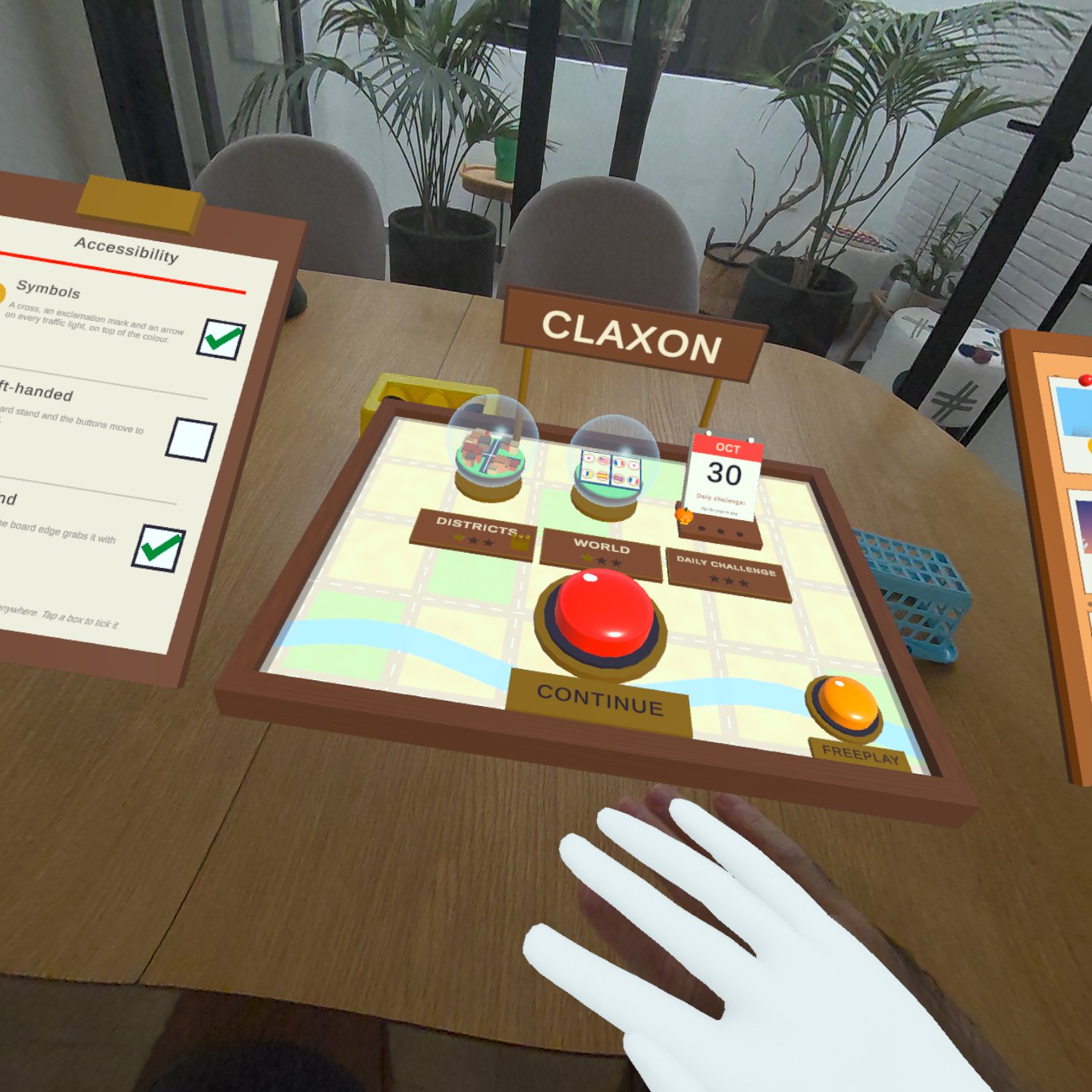
Everything is played with your hands. No controllers, and no menus floating in the air: the menu is a planner's desk with four crystal balls (three neighbourhoods and the world), and the passport you fill with stamps is a real object on the table.
Freeplay is the part that cannot exist on any other device. Point at your table and the headset reads your room with its depth sensor. Put a mug, a book or a bottle on it, and a laser scans each object. When you press BUILD, streets are laid around everything you placed, each object becomes a building in the right place and size, and the city rises from the table like a time-lapse. Move the mug and the city is redrawn around it. If your hand gets close to a real object, the building above it fades away so you can see exactly what you are about to touch.
The campaign has 32 levels across three neighbourhoods and eight levels in a trip around the world: Shibuya, Times Square, the Eiffel Tower, the Arc de Triomphe, Abbey Road, Gran Vía and Padre Anchieta in Tenerife. Each city plays by its own rules; in Tokyo and London traffic drives on the left.
You play seated, within arm's reach, and a level takes about three minutes: a bus stop, not a sofa evening.
What is new in VR
Claxon began as a touch game for Android phones, published on Google Play. This is not a port. Of the phone game, only the code that moves the cars survives; everything the player sees, touches and hears was rebuilt for a headset, to the point that it could be a new game made from scratch.
- A new interface. No screens and no panels in the air: a planner's desk with crystal balls as the menu, a passport stamped with each world city, a construction sign as the objective, and the frame of the board burning as the fury meter.
- New gameplay. Hands instead of taps: pinch lights, carry a traffic officer to a junction, lift and turn the whole board.
- New modes. Freeplay, which builds a city around the objects on your real table. A daily challenge: a new city every day, the same for everyone, with a calendar on the table, a streak that never punishes you, and seasonal cities (Halloween, Christmas, New Year's Eve fireworks).
- A reason to come back. A cork board of polaroids taken from your own games, which fills up as you progress.
- Accessibility and settings on the table. Traffic lights readable without colour, a mode to play with one hand, a left-handed mode in a folder on the desk instead of a menu.
How I built it
Claxon is made in Unity 6 by one person: the first game of Chopi Studio. It launched on Google Play for Android phones, and this is the version for Meta Quest 3.
The traffic runs on its own simulation, separate from what you see, so the rules stay the same whatever the screen. The simulation is untouched in VR; everything around it was rebuilt: the city is a tabletop diorama in mixed reality, taps are pinches and pokes, and menus are objects on a desk. Most of the work was playing it in the headset, again and again, and changing whatever did not feel right: the size of a light, how far a finger has to go, where the board sits, how a building fades.
Hands. OpenXR with Meta OpenXR and XR Hands, with my own layer on top. A fingertip pokes and a pinch grabs. Every gesture has a guard so a hand resting near the board does not play for you: a finger under the board does not count, and when tracking is lost the grabbed officer is returned to his tray instead of staying glued to a ghost hand.
Understanding your room, with Meta's Mixed Reality Utility Kit (MRUK). The game loads your saved room scan with MRUK and looks for a surface labeled TABLE within 2 m of you, using its real outline, rounded corners included. It places the board on it, inside its edges and aligned with the edge facing you; the table's id persists between sessions, so the board returns to the spot where you left it. If there is no scanned room, the game offers the headset's own room-setup screen; if you decline, or there is no table nearby, nothing breaks: the board floats within arm's reach, seated, the same as always. In Freeplay, the table's outline fits the play area, and Freeplay tells you when a table is too small.
Freeplay uses the headset's environment depth, not a camera image and not an AI model. The depth texture is read on the GPU; the table is levelled from the depth itself; and the objects are found by subtracting the empty table from what is on it. Objects are tracked one by one, so a new object is scanned, a fixed one stays, and a hand passing over does not leave a ghost behind. Transparent bottles and black objects are handled; a street generator cuts the table between the objects and places crossings, zebra crossings and exits on a fixed grid, and the game's own city builder constructs the result.
Performance. 72 fps in the headset on the largest cities, with light buildings and MSAA 2x.
Challenges I ran into
Tall buildings kept hiding cars, so buildings that block the view now fade to a ghost of themselves while traffic passes behind them.
Driving on the left was not hand-made: conflicts between turns are computed from geometry, so Tokyo and London rearranged themselves the moment the lanes switched sides.
Hands are noisy: a hand resting on the table can look like a hand pressing a button. Most of the interaction work was deciding what does not count: a finger below the board is ignored, buttons only arm once your finger has left them, the board stays where it was if tracking is lost, and a grabbed officer is returned to his tray.
Freeplay was the hardest part. A depth sensor sees the table, the objects and your arm, and a transparent bottle gives depths halfway between its surface and the table behind it. The scan had to ignore arms, find the foot of each object, and stay still while you move things around.
Accomplishments that I'm proud of
Claxon went from an idea to a published game on Google Play and then to a headset, made entirely by one person: design, code, levels, art direction and sound.
- An interface that is part of the game. The biggest change from the phone was leaving the flat UI behind. There are no menus: the planner's desk, the passport, the construction sign and the burning frame of the board are objects in the world, and using them is playing.
- A model city on your table. The feeling of a miniature sitting on your own table, with cars and people living in it, is something a screen cannot give.
- Freeplay: build a city out of whatever you have at hand. Mugs, books, bottles. Your table is the level, and the mug is a building.
- Recognising your table. With Meta's MRUK the game finds the table, its real outline and its edge, and builds on it. This is what makes Freeplay work in a real room.
- Freedom, and the "wow" of the fireworks and ghosts. Victory fireworks and ghosts light up over the real room seen through passthrough. In a headset that lands in a way a flat screen never would.
- Almost no tutorial. A ghost hand shows one touch on a light, and you understand the game.
What I learned
That a traffic game is really a game about attention. Players do not lose because a junction is hard; they lose because they were looking at the wrong one. Most of the design work went into making trouble visible before it happens: a car that starts to honk, a queue that grows, a pedestrian who gets angry.
And that VR is not a phone game with a bigger screen. On a phone the player never leaves the screen: the world ends at its edge, and a tap is a tap. In a headset the player is inside the room, and everything changes. Scale matters: a traffic light that is fine on a phone is too small to pinch. Distance matters: a board too far feels dead, too close is tiring. Even a hand resting on the table is an input. I learned to design for the body, not the picture, and to ask of every object "does it feel good to touch?" before "does it look good?". The best moments came from the real room: a mug that becomes a building, a table that becomes the level. I would not go back to the flat screen to make that feel.
What's next for Claxon VR
Target launch: December 2026 on the Meta Horizon Store for Quest 3, as soon as the store review allows, with a release for the new Meta VR glasses the same spring, where a hands-first traffic board feels at home. This is a finished game, not a prototype: the build submitted to the competition is the base of the one I will ship, with more special-date content and sharper textures on top.
After launch: a global ranking for the daily challenge, more cities around the world, and more ways to use your room.
Made by Chopi Studio. Design, code, levels, art direction and sound by one person. Low-poly city pieces by Synty Studios; Cartoon FX by Jean Moreno; GUI by Layer Lab; DOTween by Demigiant.


Log in or sign up for Devpost to join the conversation.