Inspiration
We were inspired by a simple problem: small businesses need automation, but most owners do not have the time or technical background to wire together tools, prompts, workflows, memory, deployment, and safety policies.
Our main use case is small businesses. We actually talked with a local business owner at Pleasure Pizza and implemented ClawForge around their real needs. A business like Pleasure Pizza could use custom AI agents to answer customer questions, handle booking or catering requests, draft replies, remember customer preferences, and escalate important tasks to a human.
That conversation shaped the product. We realized small businesses do not just need another chatbot. They need a way to create custom agents for their exact workflow, while still keeping control over what the agent can do.
What it does
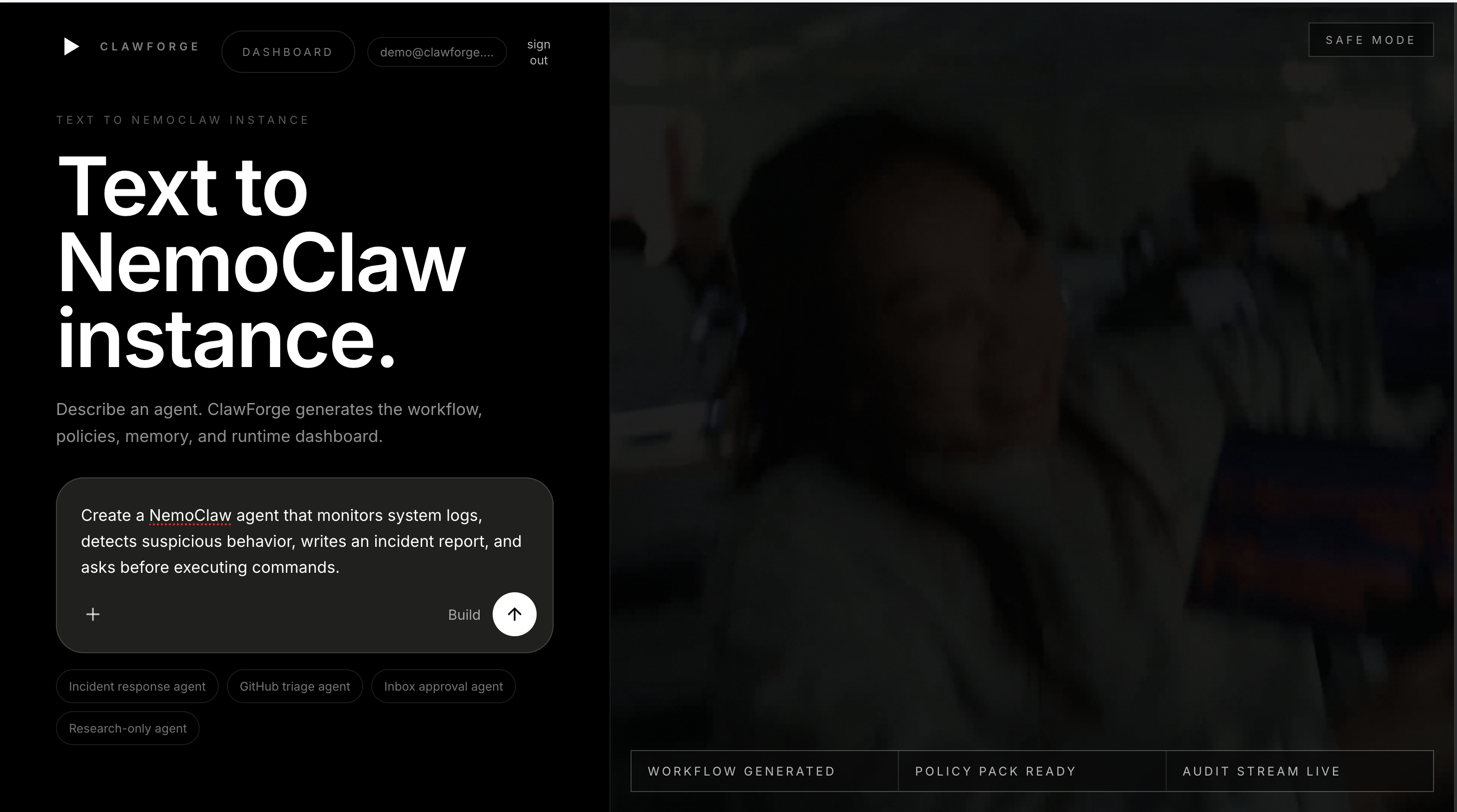
ClawForge helps small businesses create custom AI agents for any purpose, powered by NemoClaw safety, from calls and bookings to support and daily operations, without needing to code.
The user describes what they want in plain English, and ClawForge generates an agent blueprint. That blueprint includes the agent’s workflow, tools, memory, policies, approval gates, and runtime plan.
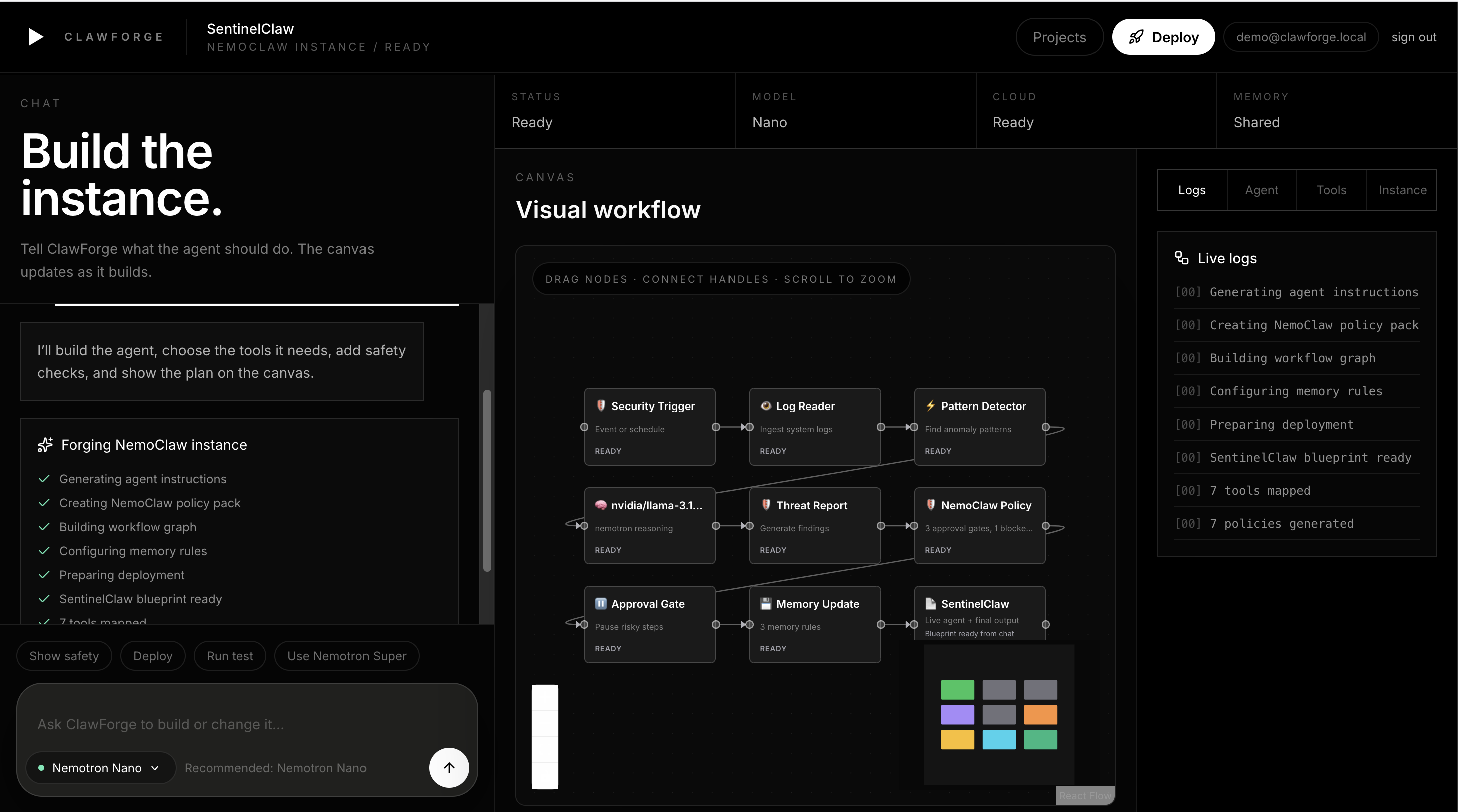
Inside the workspace, ClawForge shows a visual canvas of how the generated agent is connected. The goal is for a small business owner to understand what the agent will do before it runs.
How we built it
We built ClawForge as an agent that builds agents.
The frontend is built with React, TypeScript, Vite, TanStack Router, and Tailwind CSS. The workspace includes a chat interface on the left and a visual workflow canvas on the right. The canvas shows the generated agent architecture, including triggers, tools, reasoning steps, memory, safety checks, and outputs.
For the reasoning layer, we used NVIDIA Nemotron to generate structured agent blueprints from user prompts. We also built fallback provider support so the product can still run safely in mock mode during demos or when provider keys are missing.
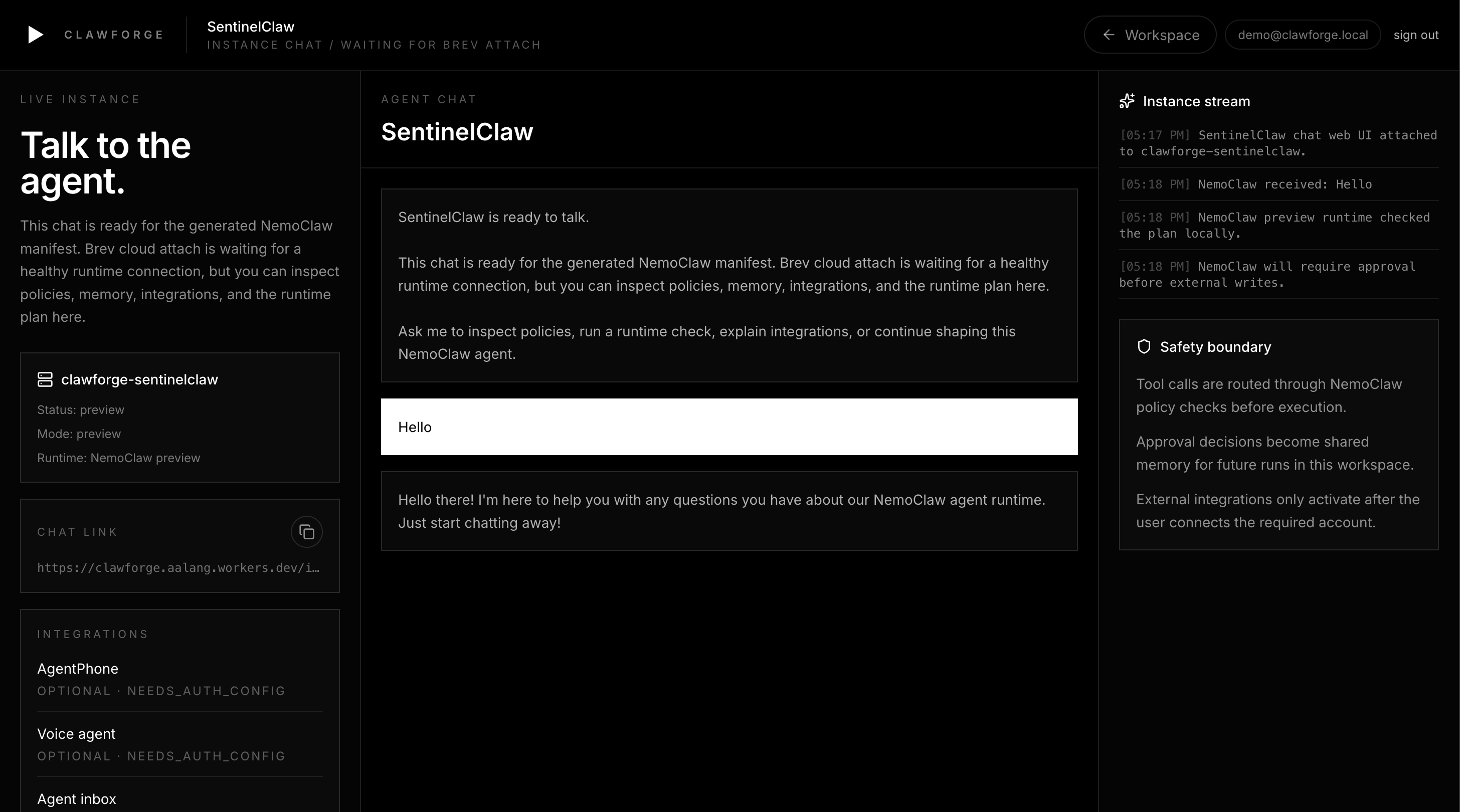
NemoClaw is used as the safety layer. Instead of letting an agent act recklessly, ClawForge can generate policies, approval gates, audit logs, and memory rules around the agent.
We also built deployment and runtime paths using Railway, Cloudflare Workers, Brev, Supabase, mem0, and server-side APIs.
Challenges we ran into
The biggest challenge was making agent creation feel real instead of templated. It is easy to generate text, but much harder to generate a structured agent architecture that can be visualized, reviewed, edited, and eventually deployed.
We also had to balance a lot of moving parts: model output, workflow graphs, safety policies, memory, provider fallbacks, runtime state, and deployment infrastructure.
Another challenge was keeping the product simple. Small business owners should not have to understand agent infrastructure. They should be able to describe the outcome they want and trust ClawForge to build the right agent around it.
Accomplishments that we're proud of
We are proud that ClawForge evolved from a single demo agent into a broader agent-building platform for small businesses.
We built a prompt-first workflow where a user can describe an agent and see the generated architecture visually. We also added safety concepts like approval gates, memory, and auditability so the agent is not just powerful, but controllable.
We are especially proud that we talked to a real local business, Pleasure Pizza, and implemented the product around a realistic small-business use case instead of only building a generic hackathon demo.
What we learned
We learned that the future of agents is not just about making one powerful agent. It is about making it easy to create many safe, customized agents for specific real-world workflows.
We also learned that small businesses care about usefulness, trust, and control. An agent that sends a message, changes a booking, or talks to a customer needs guardrails. Safety cannot be an afterthought.
Technically, we learned a lot about converting natural language into structured software: blueprints, workflow graphs, tools, policies, memory schemas, and runtime plans.
What's next for ClawForge
Next, we want to make the agent creation flow fully reliable with NVIDIA Nemotron, especially using nemotron-3-nano-30b-a3b as the primary model.
After that, we want the workspace chat to become a true agent editor. A user should be able to say things like “add Slack,” “ask before texting customers,” “remove this tool,” or “make this agent handle catering requests,” and the canvas should update automatically.
We also want to expand the small-business use cases: restaurants, salons, repair shops, local service businesses, clinics, and community organizations. The long-term vision is simple: every small business should be able to create its own AI workforce from a prompt.
Built With
- brev
- cloudflare
- css
- fallback
- flow
- mem0
- minimax
- nemoclaw
- nemotron
- nims
- node.js
- nvidia
- provider
- railway
- react
- router
- supabase
- tailwind
- tanstack
- typescript
- vite
- workers


Log in or sign up for Devpost to join the conversation.