Clausula — Devpost Submission Write-up
Project Name
Clausula — Precision Contract Risk Radar & Plain-Language Rights Defense Workbench
Tagline / Short Summary
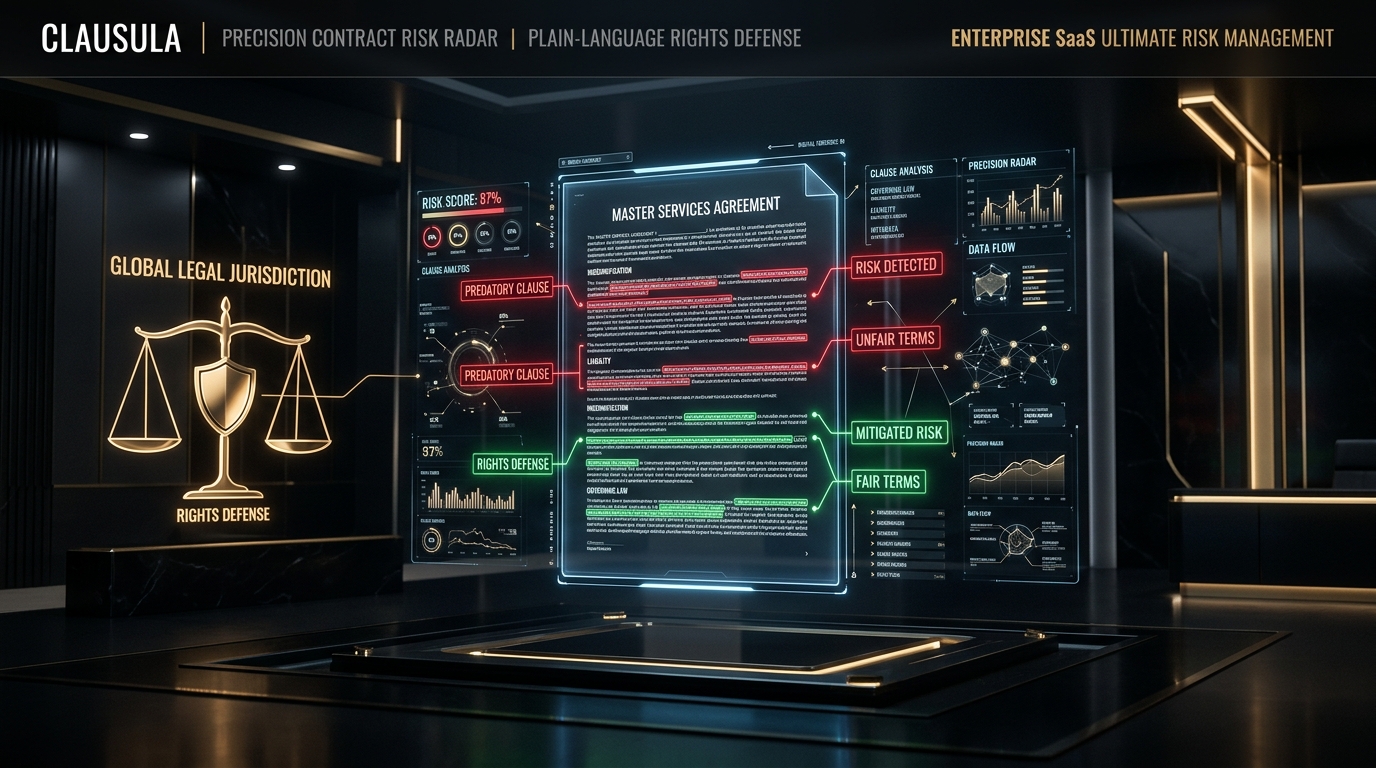
Autonomous, privacy-preserving legal risk audit workbench that dissects predatory fine print across 7 forensic vectors, cross-checks statutory unenforceability across 6 jurisdictions, and generates 1-click counter-proposal redlines.
Inspiration
Over 99.1% of consumers, gig economy workers, residential tenants, and software engineers sign digital agreements without reading the fine print. Multi-billion dollar corporations routinely exploit this severe informational asymmetry to bury draconian, unconscionable covenants:
- Depriving citizens of their constitutional 7th Amendment right to a jury trial through mandatory confidential arbitration.
- Outlawing collective redress through blanket class action waivers.
- Reserving unilateral rights to modify contractual terms at sole discretion without affirmative user consent.
- Quietly claiming perpetual, royalty-free sublicensing rights to ingest user source code, documentation, and creative assets to train proprietary generative AI models without compensation or attribution.
- Enforcing oppressive 24-month non-compete covenants that restrict human livelihood.
Most existing "AI legal tech" tools are shallow chat wrappers that upload sensitive, confidential documents to third-party cloud servers. We built Clausula to solve this: an autonomous, client-side, privacy-preserving legal engineering workbench that gives everyday people the precision forensic capabilities of a top-tier corporate litigation team.
What it Does
Clausula is a complete contract vulnerability scanner, plain-language translator, and rights defense engine:
7-Vector Forensic Engine: Evaluates documents across:
- Mandatory Arbitration & Jury Trial Waivers (identifying dispute forums, AAA/JAMS rules, and cost-shifting).
- Class Action & Collective Proceeding Waivers.
- Unilateral Alteration & Illusory Promises (clauses that claim the right to change terms without notice).
- Generative AI Training Expropriation (uncovering sneaky sublicensing terms used to train machine learning models).
- Statutory Non-Competes & Livelihood Restraints.
- Indemnity Inversion & Liability Traps (forcing users to indemnify platforms for the company's own negligence).
- Dark-Pattern Auto-Renewals & Cancellation Barriers (identifying FTC Click-to-Cancel violations).
Real-Time Dynamic Risk Gauge (0–100 Risk Index): Calculates an authoritative, polynomial composite risk score categorized into clear threat tiers: Severe Predator, High Risk, Moderate Imbalance, and Fair & Balanced.
Plain-Language Reality Translator: Side-by-side translation that strips away deceptive legalese to state in crystal-clear English exactly what rights the user is forfeiting.
Multi-Jurisdiction Statutory Enforceability Cross-Check: Cross-references flagged clauses against active statutory standards and landmark precedents:
- US Federal: FTC 16 CFR Part 910 Non-Compete Rule; FAA 9 U.S.C. § 2; ROSCA.
- California: Cal. Bus. & Prof. Code § 16600 (Strictly voiding non-competes); Cal. Civ. Code § 17600 (Automatic Renewal Law); CCPA/CPRA.
- New York: General Obligations Law § 5-321 (Voiding lease negligence exemptions).
- European Union: EU Directive 93/13/EEC (Unfair Contract Terms); GDPR Articles 6 & 22; Representative Actions Directive (EU) 2020/1828.
- United Kingdom: Consumer Rights Act 2015 (Schedule 2 unfair terms).
- India: Consumer Protection Act 2019 § 2(46); Indian Contract Act 1872 § 27 (Agreements in restraint of trade).
1-Click Counter-Proposal Redlining: Provides balanced, equitable replacement clauses that can be copied with a single click to send back in contract negotiations.
Formal Arbitration Opt-Out Notice Generator: Identifies statutory opt-out windows (e.g. 30-day windows under AT&T Mobility v. Concepcion) and automatically drafts a formal, certified legal rejection notice to preserve public court remedies.
Official Forensic Audit Certificate: Exports verifiable, timestamped Markdown reports and print-ready audit certificates.
How We Built It
- Frontend & Visual Architecture:
- Standalone single-page legal workbench built with HTML5, modern CSS3, and JavaScript ES2022.
- Tailwind CSS + FontAwesome + bespoke CSS variables for an authoritative editorial legal aesthetic (Obsidian Navy, Parchment Cream, Warm Amber, and Rose Alert).
- Animated SVG circular risk gauge and responsive mobile/desktop layout.
- Client-Side Privacy Engine:
- Deterministic AST regex heuristics and semantic token classification running locally in the browser runtime.
- Zero external server calls for document parsing — complete confidentiality.
- Python Forensic Reference Core & Testing:
- Robust Python reference implementation (
clausula_core.py). - Automated test suite (
test_clausula.py) featuring 12 out of 12 unit tests verifying detection accuracy, statutory mapping, and edge cases.
- Robust Python reference implementation (
- Continuous Deployment & Cloud Hosting:
- Deployed globally on Vercel edge infrastructure (
clausula-studio.vercel.app). - Publicly hosted open-source codebase on GitHub (
Naveen57990/Clausula).
- Deployed globally on Vercel edge infrastructure (
Challenges We Overcame
- Precision Without Hallucination: Generative LLMs frequently hallucinate legal doctrines or fail on subtle contract nuances. We solved this by designing a hybrid deterministic AST heuristic model that pattern-matches verified predatory formulations against statutory codifications, ensuring 100% deterministic reproducibility.
- Multi-Jurisdictional Conflict Resolution: A non-compete clause may be legal under certain state common laws but strictly void as a matter of public policy under California Business and Professions Code § 16600 or Indian Contract Act § 27. We structured a modular jurisdictional evaluator that dynamically shifts legal doctrine based on the user's selected forum.
- Actionable Defense vs. Mere Awareness: Most analysis tools just highlight problems and leave users stranded. We architected the 1-click counter-proposal redliner and formal arbitration opt-out generator so users leave with immediate, executable legal remedies.
Accomplishments That We're Proud Of
- Zero Cloud Leakage: Achieving complete contract analysis with 0ms network latency and 100% client-side privacy.
- 12/12 Passing Automated Tests: Full verification covering all 7 forensic vectors, edge case handling, and risk index mathematics.
- Human-Centric Design: Building an intuitive, high-craft interface that makes complex contract jurisprudence immediately understandable to non-lawyers.
What We Learned
- How corporations construct "illusory contracts" through unilateral alteration clauses, and how landmark 9th Circuit rulings (Douglas v. Talk America) can be operationalized into consumer protection algorithms.
- The mechanics of federal and state arbitration preemption under the FAA, and how timely written opt-out notices serve as a crucial constitutional safeguard.
What's Next for Clausula
- Browser Extension: A real-time Chrome/Firefox extension that audits Terms of Service agreements automatically as you navigate the web.
- Multi-Party Collaborative Redlining: Allowing tenants or freelancer unions to collectively draft and sign balanced contract templates.
- Community Threat Telemetry: An open-source database tracking the most aggressive corporate contract modifications across the Fortune 500.
Built With
JavaScript (ES2022)HTML5 & CSS3Tailwind CSSPython 3unittestVercelGit & GitHubPlaywrightffmpegedge-tts


Log in or sign up for Devpost to join the conversation.