-
-
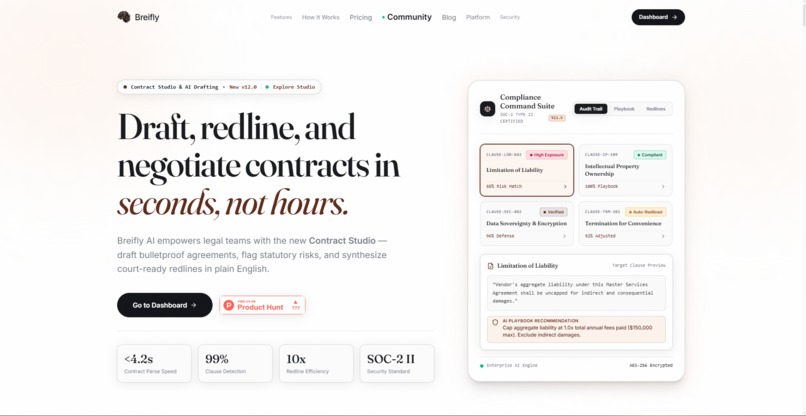
Breifly Ai Legal Assitant
-
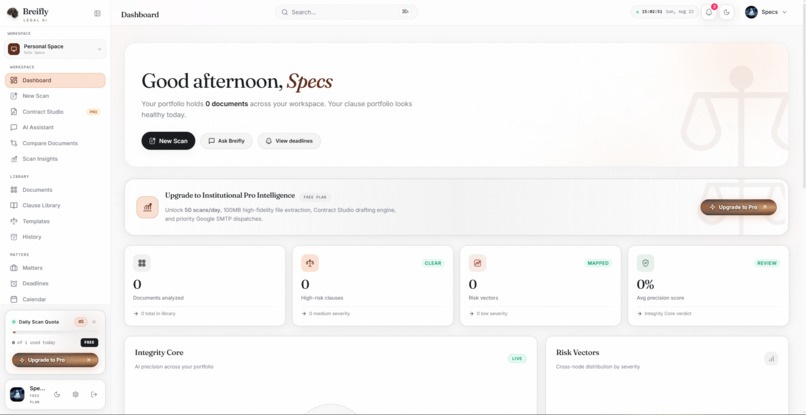
Dashboard
-
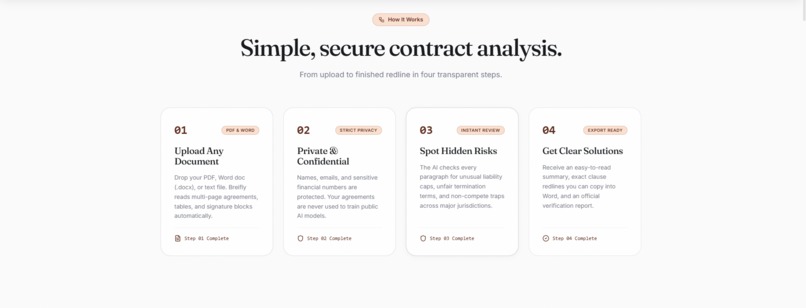
Processing
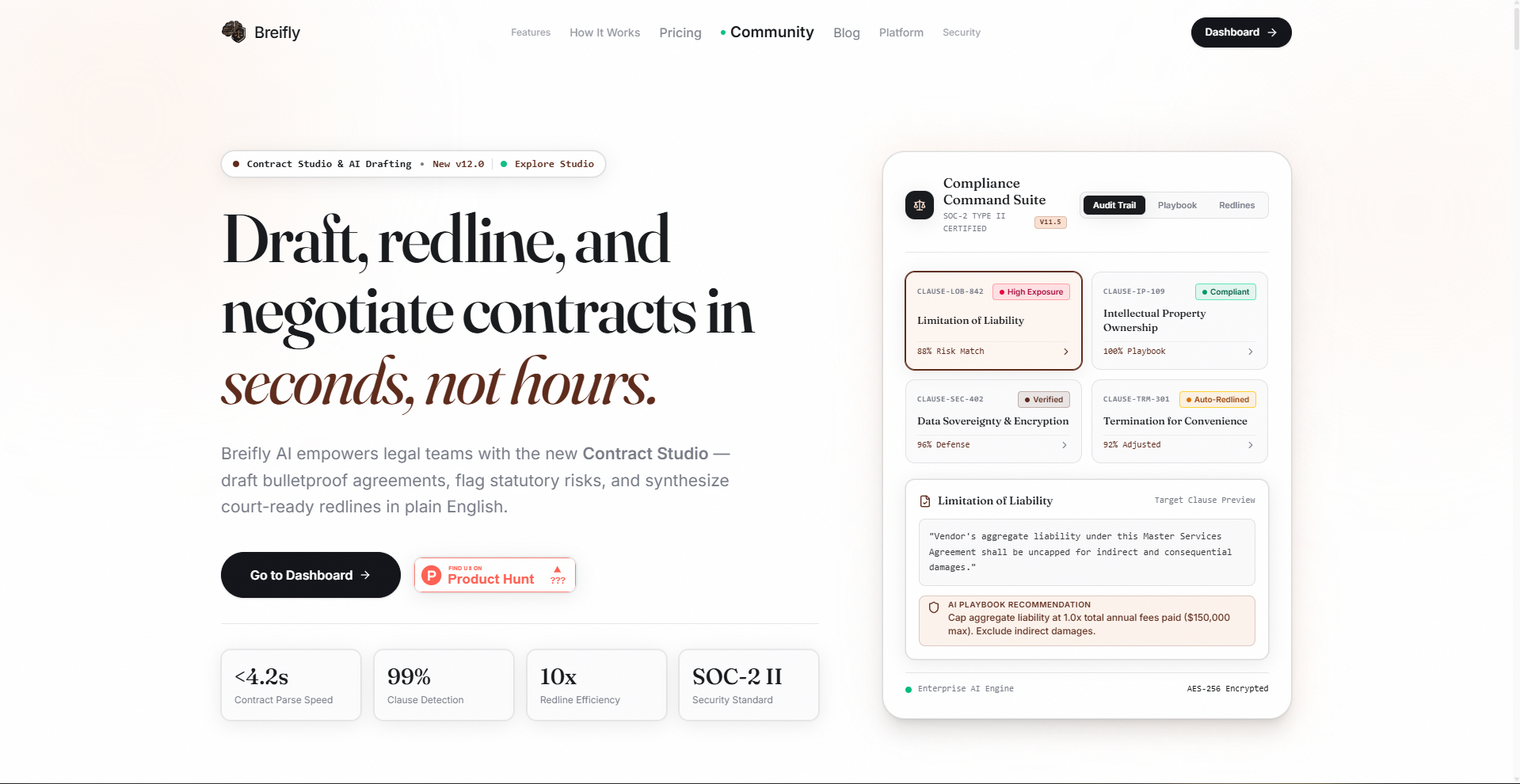
Breifly AI: Professional AI Legal Assistant & Contract Intelligence (v12.0.0)
Breifly AI is an elite, enterprise-grade legal technology platform designed to provide ultra-high-fidelity contract analysis, risk assessment, and constitutional reasoning. Developed by InciVerse, it orchestrates a specialized grid of AI models to deconstruct legally complex documents with statutory-level accuracy and complete context retention.
1. Core Intelligence & High-Accuracy Document Scanner
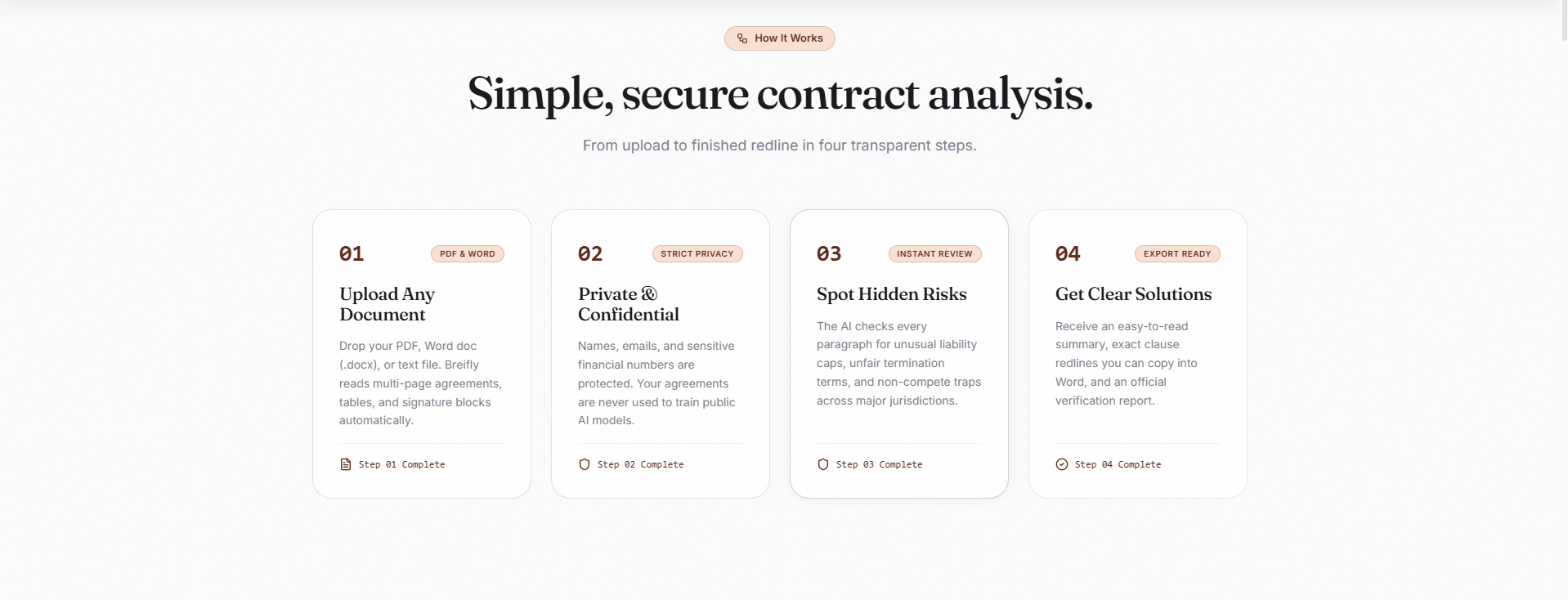
Breifly utilizes an enhanced multi-model orchestration pipeline with 99%+ scanning precision and full PDF/document memory context:
Enhanced Document Scan & AI Memory Pipeline
- Ingestion & Security Scan:
- Documents (PDF, DOCX, Images up to 50MB) are ingested into Supabase Storage (
documentsbucket). - Files undergo multi-stage deep integrity verification (
BreiflySecurity) to check for malicious content, script injections, and prompt manipulation.
- Documents (PDF, DOCX, Images up to 50MB) are ingested into Supabase Storage (
- High-Accuracy OCR & Extraction (99%+ Accuracy):
- Images: Tesseract.js with optimized thresholding.
- PDFs: PDF.js text-layer extraction with fallback page-by-page OCR rendering.
- Word Documents: Mammoth text-layer parser.
- Full-Context AI Memory & Analysis:
- Captures complete document text from header to signature block without truncating critical clauses.
- Runs context mapping via Breifly AI Vision & Breifly AI Pro v1.
- Produces clause-by-clause verbatim extractions, 1-100 risk scoring, red-flag identification, safer alternative wording, and statutory references.
- Interactive Document AI Chat Integration:
- Every scanned document automatically links directly to an Interactive AI Document Chat.
- Users can ask complex follow-up questions, request specific clause redrafts, or clarify liability terms with complete document context maintained in the system prompt.
2. Platform Dashboard & Interactive Workspaces
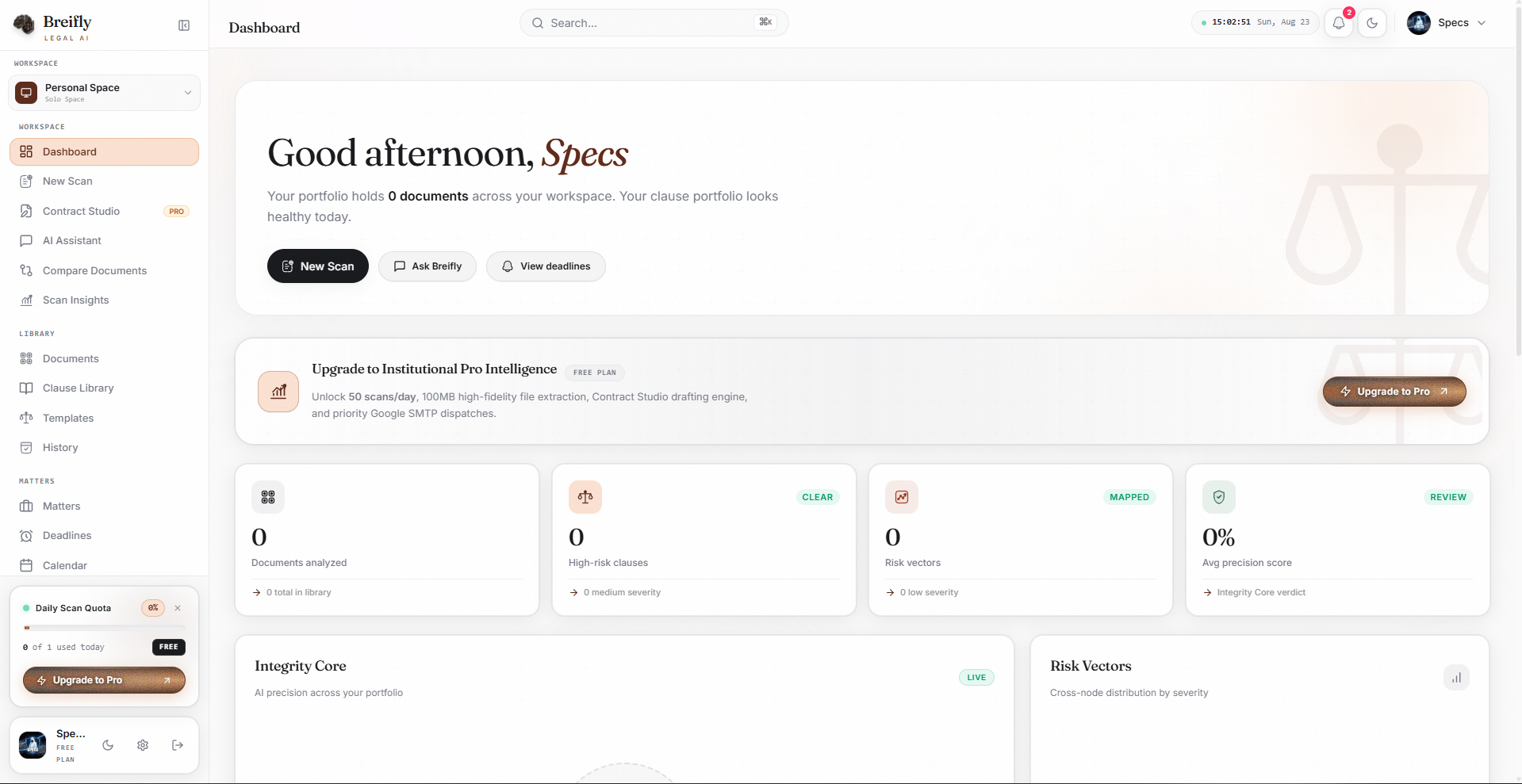
Breifly AI features a comprehensive suite of professional legal tabs designed for individual practitioners, law firms, and enterprise legal departments:
Core Workspace Modules
- Calendar & Deadline Tracker: Interactive month/week/agenda views for tracking legal deadlines, contract renewals, filing dates, and review milestones with urgency badges.
- Team Activities & Workspace Collaboration: Real-time team member activity feed, shared workspace management, role-based access control (Owner, Admin, Member), and team chat.
- Documents Vault: AES-encrypted document repository with real-time status filtering, risk tag sorting, and automated audit logging.
- Judicial Reasoning Engine: Precedent search and multi-jurisdictional constitutional analysis across 12+ legal frameworks (US, EU, UK, CA, AU, AE, IN, PK, etc.).
- E-Signatures & Envelopes: Digital signature workflow manager for preparing, sending, tracking, and executing legal agreements.
- Matters & Case Management: Centralized legal case folder tracking associated documents, client metadata, key dates, and billing items.
- Clause Library & Custom Templates: Repository of standardized clause blocks, custom legal templates, and firm-wide drafting standards.
- Comparison Engine: Side-by-side legal document comparison highlighting added, deleted, or modified risk factors.
- Automated Workflows: Multi-step automated triggers for contract intake, approval routing, and risk notification.
3. OMNI Plan — Custom Sovereign Model Routing
Users on the OMNI plan have full autonomy to bring their own AI infrastructure:
- Custom Provider Keys: Bring keys from OpenAI, Google (Gemini), Anthropic (Claude), or OpenRouter.
- Native SDK Routing: Direct client-to-provider execution avoiding intermediary bottlenecks.
- Encrypted Credential Vault: User keys stored with client-side AES-512 encryption linked to the profile.
4. Security & Robust Database Architecture
Enterprise Security & Clean RLS Layer
- Non-Recursive RLS Architecture: Database security enforced via non-recursive Row-Level Security policies and
SECURITY DEFINERfunctions, eliminating database loops acrossteam_members,teams,documents, andanalyses. - Adversarial & Bot Protection: Continuous DOM integrity monitoring, behavioral entropy checks, and anti-jailbreak payload filtering.
- PII Redaction: Automated client-side masking of personal data (emails, phone numbers, identifiers) before model transmission.
- Sanitization & CSP: Trusted Types HTML sanitization, strict CSP headers, CSRF token validation, and k-anonymity breach checking.
Built With
- auth
- deployment:
- framer-motion
- frontend:-react-18
- googleantigravity
- googlegemini
- ocr).
- react-three-fiber-(three.js-for-3d-visuals).-backend:-supabase-(postgresql
- realtime
- rls).-ai/ocr:-large-language-models-(llms)-via-openai-api-(for-semantic-analysis)
- tailwind-css
- tesseract.js
- typescript
- vercel


Log in or sign up for Devpost to join the conversation.