-
-
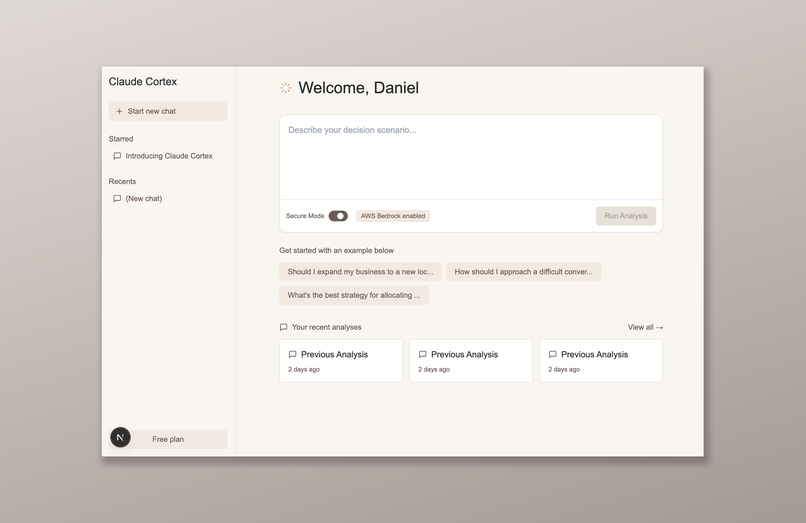
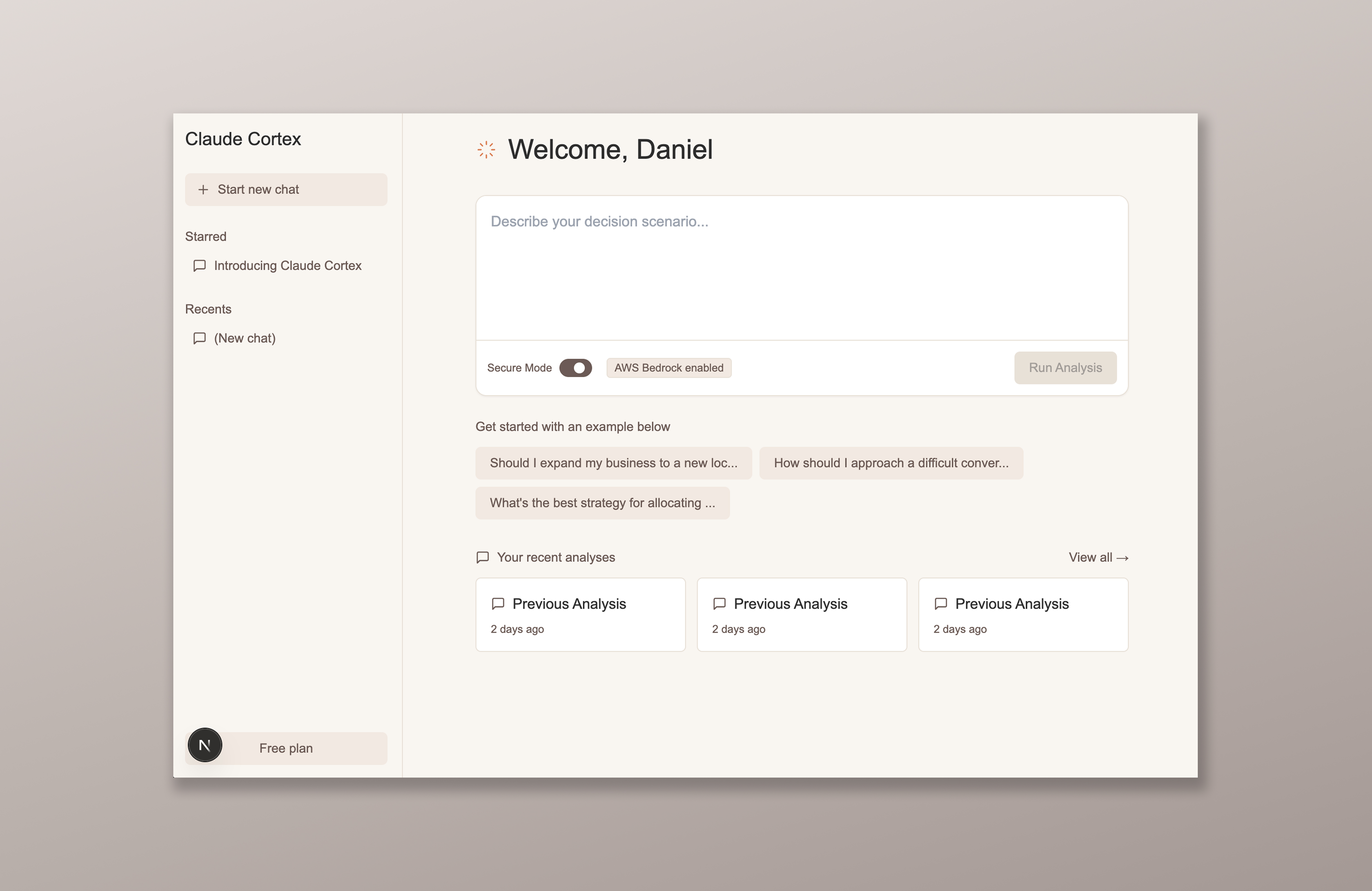
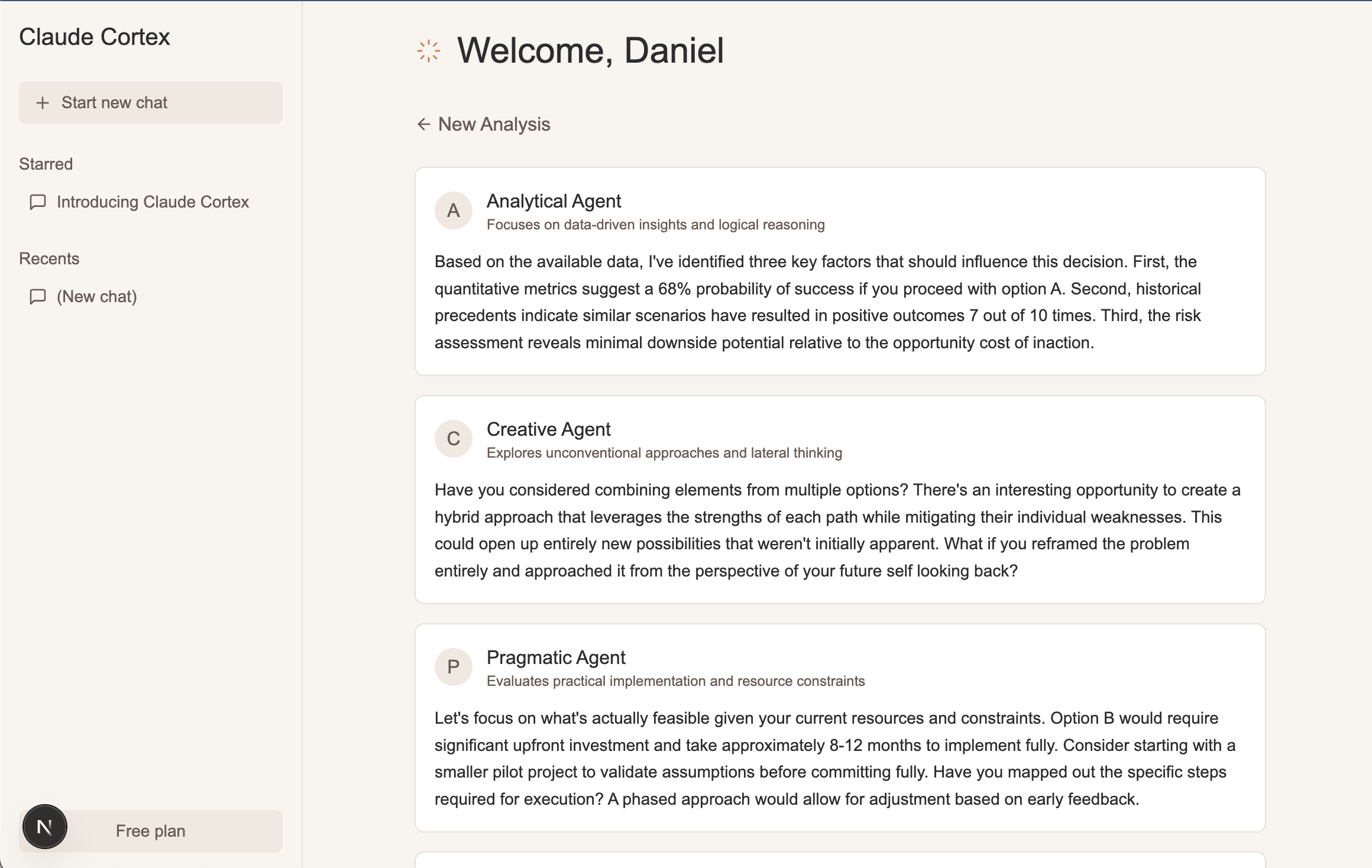
Claude Cortex Main Dashboard
-
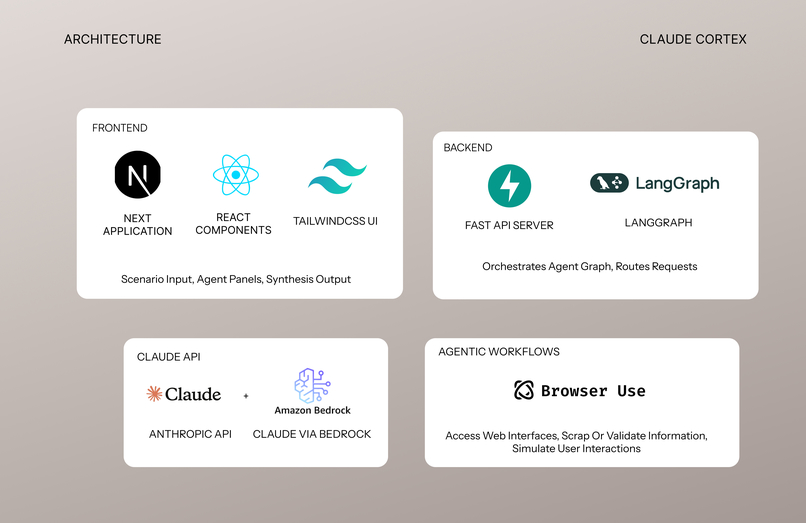
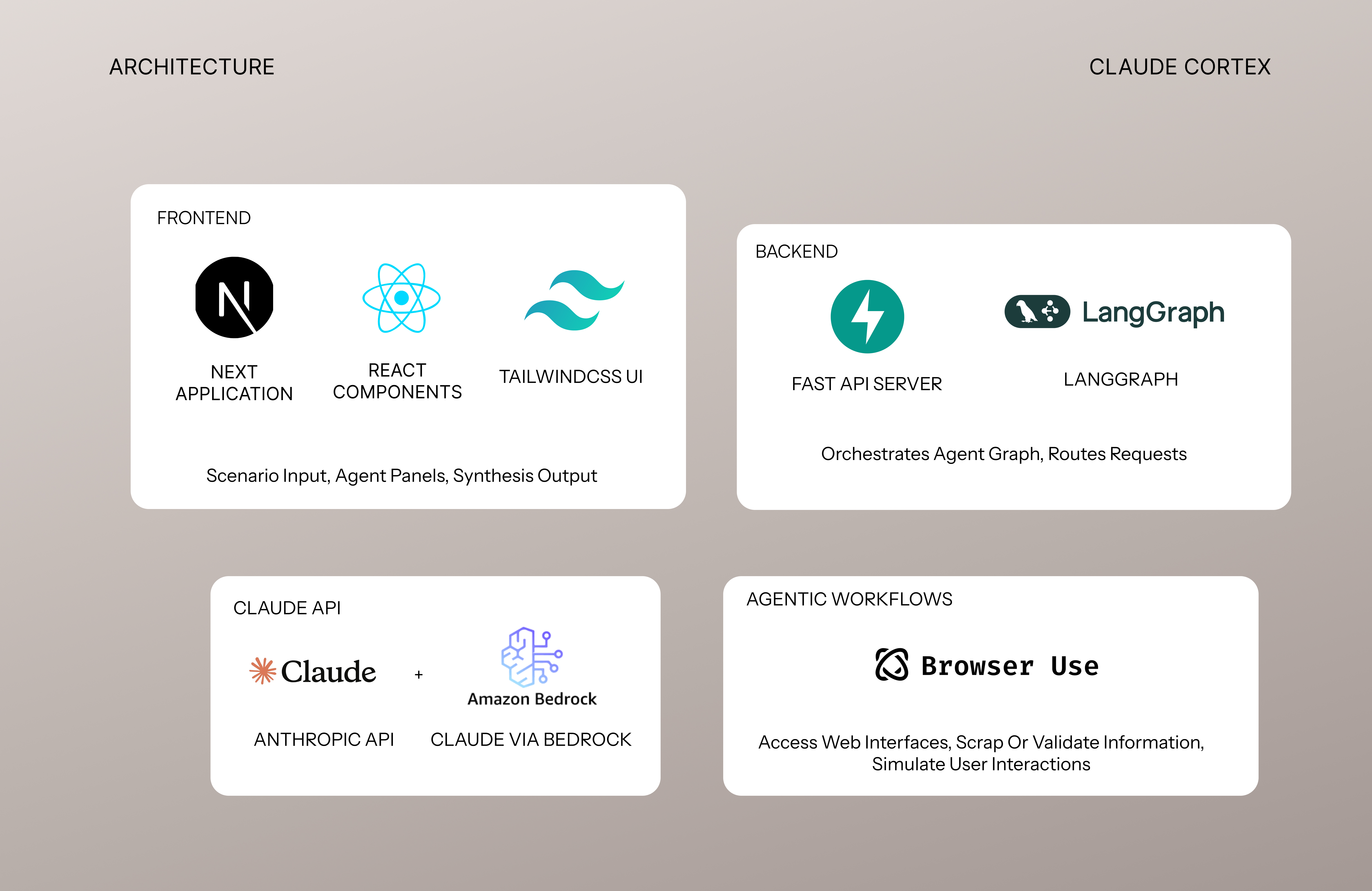
Tech Stack
-
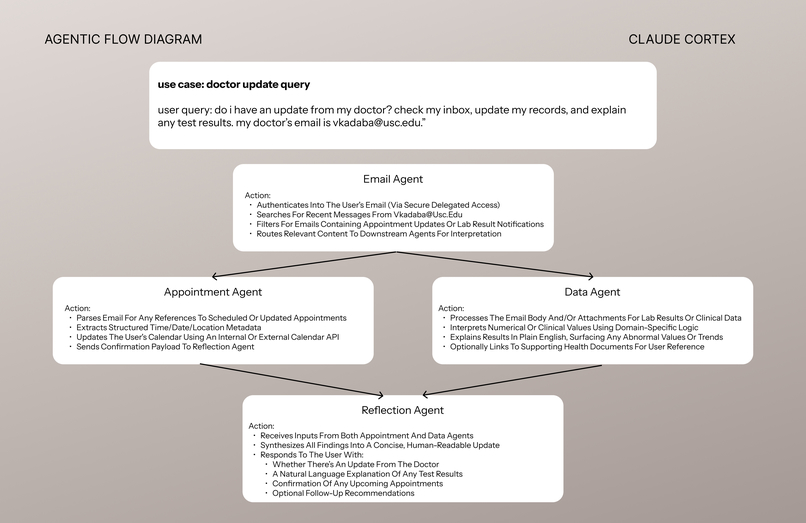
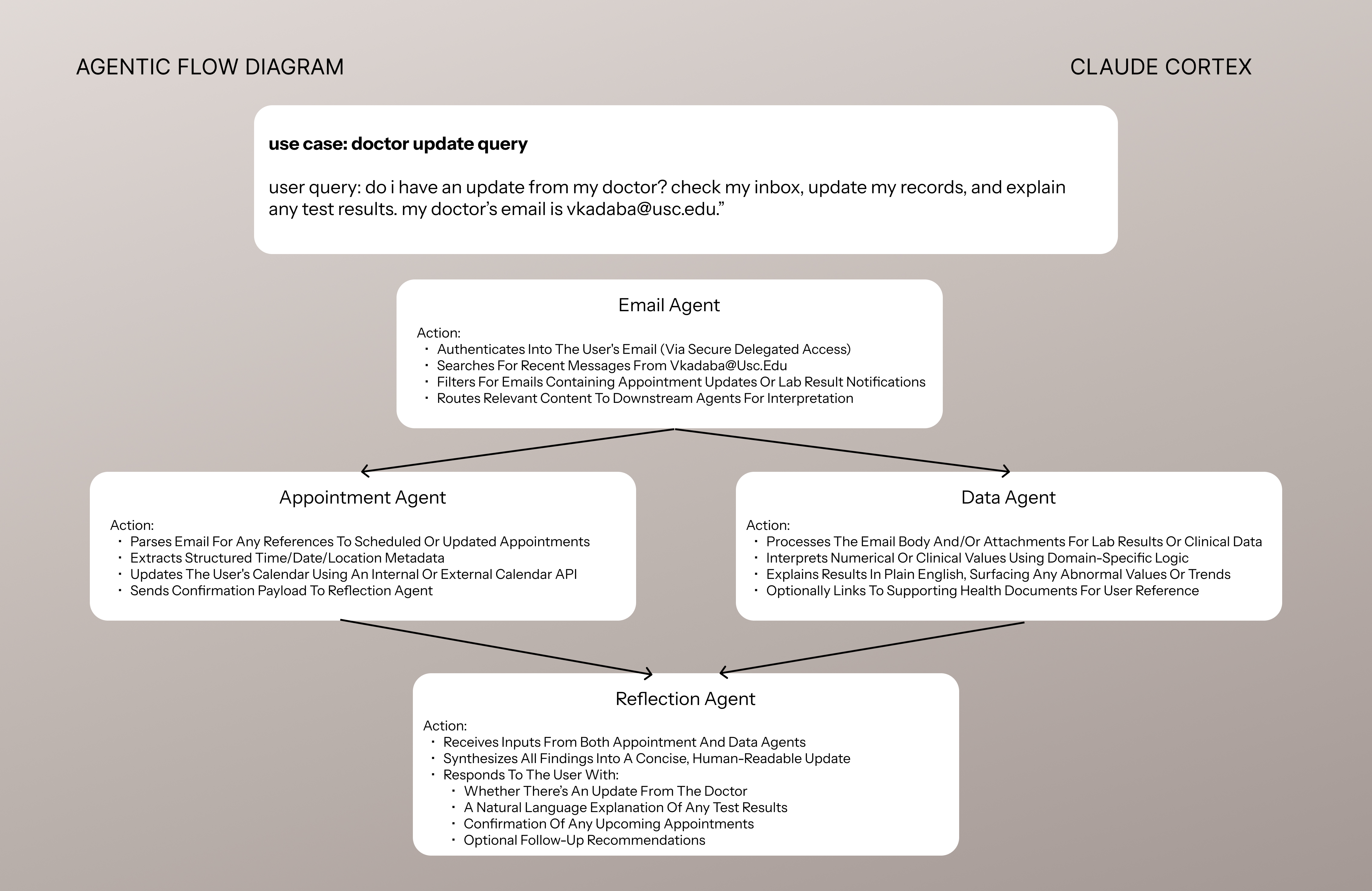
Agent Flow Diagram
-
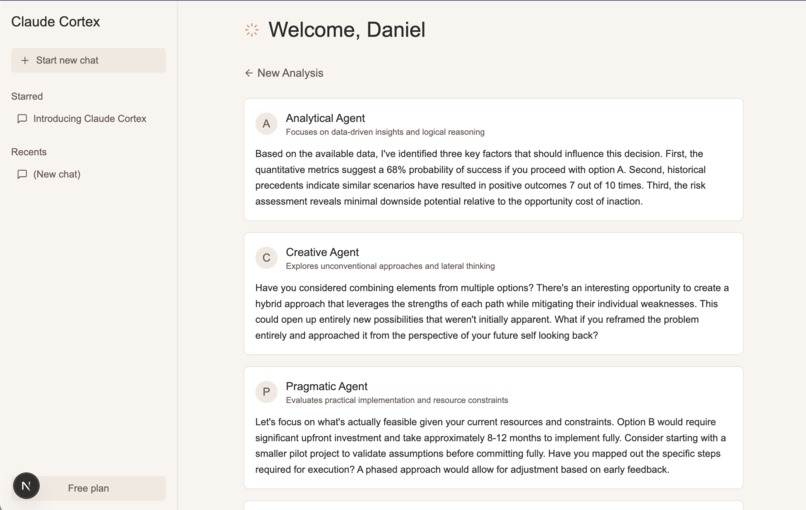
Sample Response Part 1
-
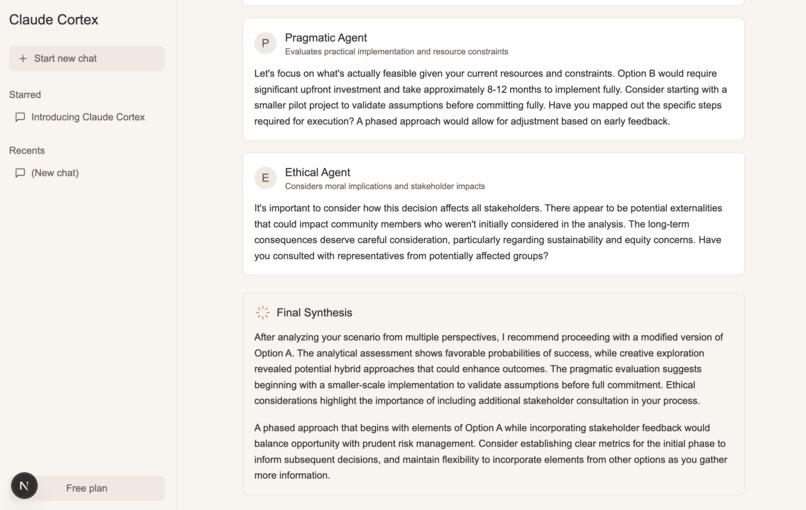
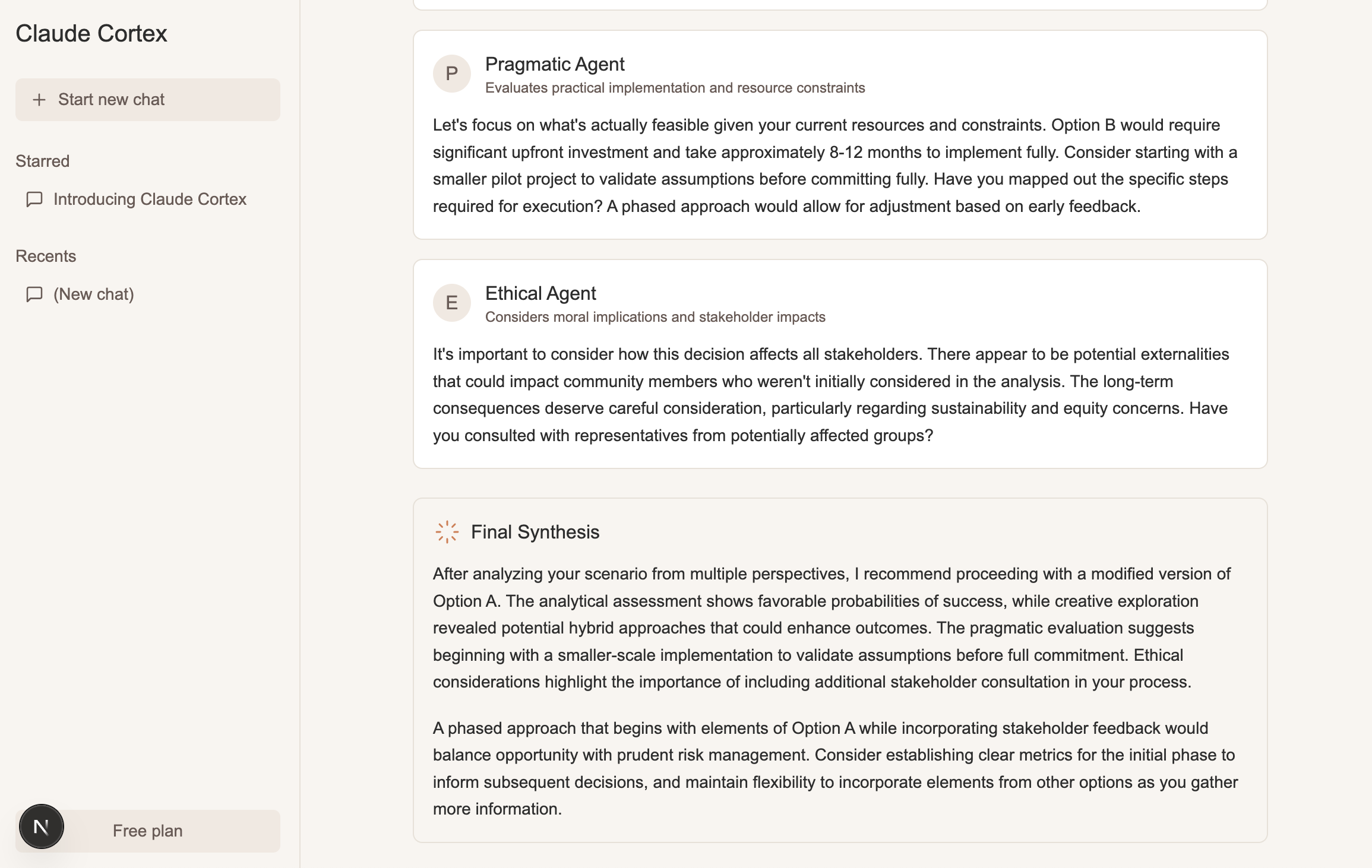
Sample Response Part 2
Claude Cortex – A Secure Multi-Agent Reasoning Engine for High-Stakes Decisions
The Problem
Today’s LLMs are impressive at giving smart answers. But when the stakes are high, one answer isn’t enough. Whether you’re navigating a complex business strategy, a public policy dilemma, or an ethical gray area, you don’t want just a chatbot. You want diverse expert reasoning, risk analysis, ethical reflection, and alternative thinking — fast, secure, and structured.
Right now, people simulate this by prompting Claude multiple times manually. It’s slow, subjective, and inconsistent.
We built Claude Cortex to solve this. It’s a secure, multi-agent reasoning engine powered by Anthropic’s Claude API that helps users think more deeply, from more angles — in seconds.
How It Works
Users input a high-stakes scenario
For example: “We need to reduce operational costs by 20%. What’s the best course of action?”Claude Cortex launches multiple task-based agents in parallel, each responsible for analyzing the problem from a different operational angle. These agents are dynamically generated by a master planning agent based on the nature of the scenario. In this example:
- Spend Analysis Agent – Breaks down current expenditures, identifies major cost centers, and flags inefficient spending
- Optimization Agent – Proposes restructuring strategies, automation opportunities, and process improvements to streamline operations
- Forecasting Agent – Models the impact of different cost-cutting strategies on long-term financial and operational performance
- Workforce Impact Agent – Evaluates the potential implications of each strategy on staffing, morale, and organizational capability
Each agent executes a task-specific prompt, designed to produce structured, actionable output. These tasks are executed concurrently using FastAPI’s asynchronous threading model, allowing high-throughput reasoning without blocking execution or relying on frontend concurrency.
A final Claude moderator agent synthesizes the outputs from all action agents — weighing tradeoffs, identifying synergies and risks, and producing a well-reasoned recommendation tailored to the original goal.
For security-critical use cases, users can enable Secure Mode, which routes all Claude calls through AWS Bedrock. This enables Claude Cortex to operate in sensitive environments such as enterprise infrastructure, healthcare systems, or regulated industries where compliance and data privacy are essential.
Tech Stack
Frontend: Next.js + TailwindCSS A clean, responsive UI for scenario input, multi-agent panels, and synthesis display.
Backend: FastAPI Lightweight, high-performance Python backend to orchestrate multi-agent flows and expose secure REST endpoints for frontend consumption.
Multi-Agent Orchestration: LangGraph (built on LangChain) Claude Cortex leverages LangGraph to manage agent state, role-driven prompts, and structured reasoning paths. Each agent functions as a modular, task-specific node in a directed graph, enabling scalable and flexible inference flows.
LLM Integration:
- Claude via Anthropic API – Primary inference engine for agent and synthesis nodes
- Claude via AWS Bedrock – Optional secure mode for enterprise-grade, compliant deployment
- Parallel Inference – Agents execute concurrently for low-latency multi-perspective reasoning
Browser-Level Agentic Actions: browser-use
Certain Claude agents can interact with live websites via browser-use, enabling dynamic workflows such as reading external data, validating assumptions, or grounding recommendations in real-time content. This allows agents to move beyond static reasoning into web-grounded decision-making.
Deployment:
- Frontend hosted via Vercel
- Backend deployed via Railway
- Secure Claude inference (Bedrock) isolated via env-aware routing
Why It Matters
Claude Cortex is more than an LLM chat interface, it's a multi-agent reasoning architecture. By transforming one scenario into several parallel expert analyses, and then synthesizing those into a final answer, it enables Claude to function like an intelligent decision panel — not a single voice.
This architecture pushes the boundaries of LLM orchestration, exploring what happens when we move from sequential prompting to structured, parallel reasoning and secure deployment. The system is natively built around Claude’s strengths: long-context comprehension, chain-of-thought analysis, and role-driven reflection.
CTA
Claude Cortex demonstrates a new paradigm: one where AI is not just reactive, but structured, secure, and pluralistic in its thinking. As LLMs are increasingly used for real-world decision-making, systems like this show how we can scale thoughtful, diverse reasoning — safely and reliably.
Built With
- amazon-web-services
- bedrock
- claude
- fastapi
- langchain
- nextjs
- python
- tailwindcss


Log in or sign up for Devpost to join the conversation.