Inspiration
Teachers often know which questions students answered incorrectly, but not why. The same wrong answer can come from several different misconceptions, and choosing an intervention too early can reinforce the wrong idea.
We wanted to explore a more useful role for AI in education: not automatically diagnosing students or giving them answers, but helping teachers turn uncertainty into a small, testable experiment.
What it does
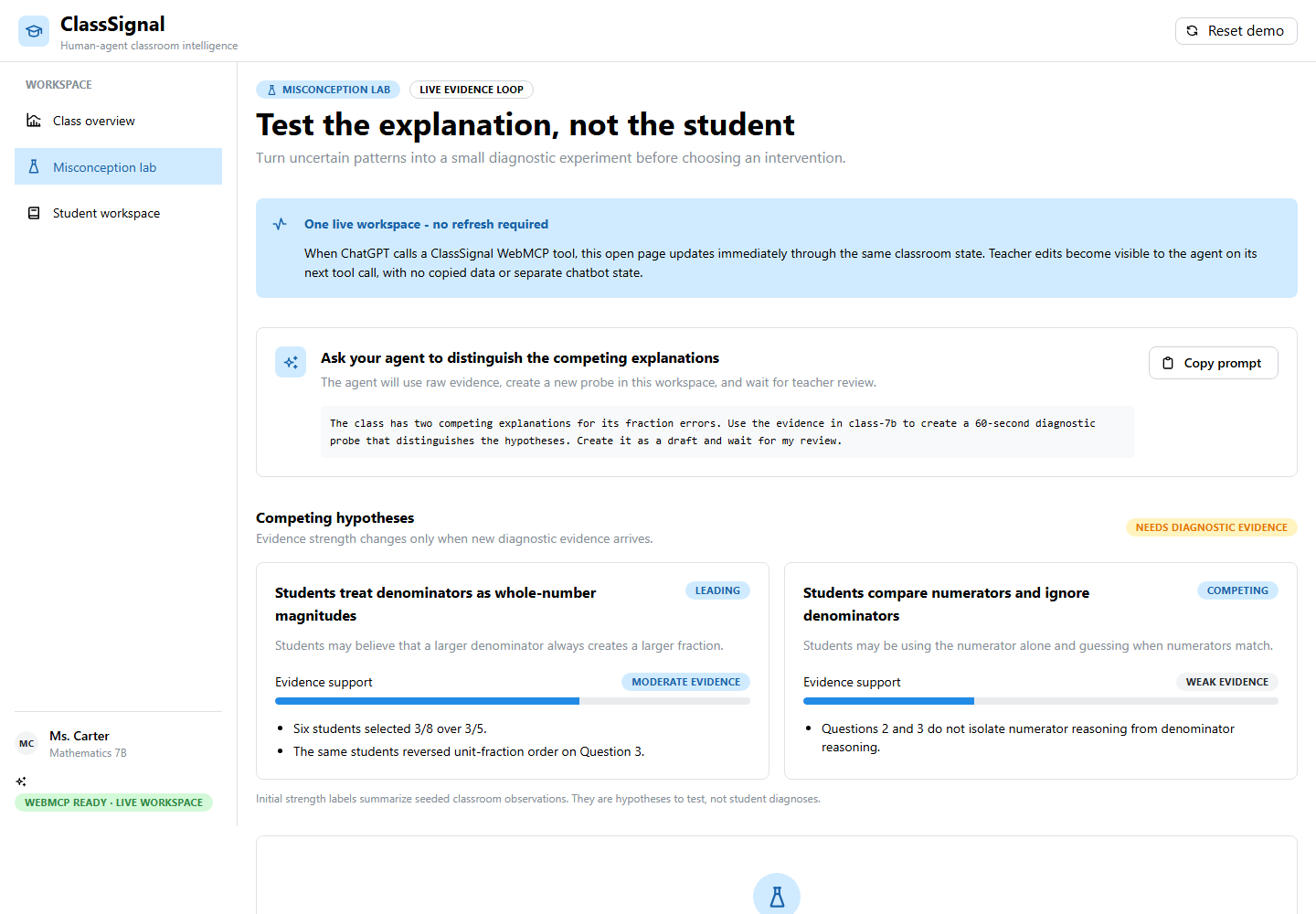
ClassSignal is a shared Misconception Lab where teachers and AI agents investigate student reasoning together.
ChatGPT can use WebMCP to inspect structured classroom evidence, compare competing explanations, and create a 60-second diagnostic probe directly inside the teacher’s workspace. The teacher can edit that probe, and the agent can inspect and reason about the exact revision.
After explicit teacher approval, the probe appears in the student workspace. The student answers and explains their reasoning, producing new evidence that updates the hypothesis ranking and unlocks a targeted intervention for teacher review.
ClassSignal also includes six-question guided practice, Socratic hints that do not reveal assessed answers, saved student reasoning, intervention approval controls, and an activity feed that attributes teacher, student, and agent actions.
How I built it
ClassSignal is built with React 19, TypeScript, Vite, Mantine’s default theme, Mantine Charts, and Recharts.
We implemented WebMCP using @mcp-b/global and @mcp-b/react-webmcp. The application exposes 12 structured tools for:
- Inspecting classroom and student evidence
- Analyzing competing misconceptions
- Creating and inspecting diagnostic probes
- Publishing teacher-approved probes
- Analyzing new student evidence
- Previewing and applying interventions
- Providing answer-safe guided support
- Measuring learning outcomes
The human interface and WebMCP tools operate on the same React state. This means an agent-created probe appears in the open page without a refresh, teacher edits become visible to the agent on its next call, and student responses change what the teacher and agent can do next.
The demonstration uses deterministic fictional data stored in localStorage, allowing the complete experience to be reset and reproduced reliably without collecting real student information.
Challenges we ran into
The hardest challenge was making the project feel genuinely native to WebMCP rather than like a conventional dashboard with a chatbot attached.
Our first version focused too heavily on analytics and tool count. Although the tools worked, the experience was not memorable. We redesigned the product around one collaborative loop: competing hypotheses, an agent-created experiment, a teacher revision, controlled publication, new student evidence, and an unlocked intervention.
We also had to carefully separate preview operations from consequential actions. Publishing student-facing content and applying interventions require explicit confirmation, while student-support tools enforce answer safety inside their execution logic.
Other challenges included keeping browser-local state consistent across teacher and student routes, preventing duplicate actions, handling rapid React form updates, making six questions navigable and reviewable, and maintaining responsive layouts without introducing a custom design system.
Accomplishments that we're proud of
We are most proud that the agent creates something meaningful inside the teacher’s existing workflow instead of only summarizing data.
The teacher can improve the agent-created probe, and that human contribution becomes new context the agent can inspect. The student then contributes evidence that changes the shared state and determines which action becomes available.
We are also proud of the trust boundaries built into the experience:
- Findings are presented as hypotheses rather than diagnoses.
- Evidence strength is not presented as statistical confidence.
- The sample size remains visible.
- Student-facing publication requires teacher approval.
- Intervention application requires separate approval.
- Guided-help tools do not reveal assessed answers.
- Every consequential action is attributed in the activity feed.
- All classroom information is fictional.
What we learned
We learned that exposing many tools does not automatically create a compelling agent experience. The important question is whether people and agents can contribute different capabilities to the same workflow.
WebMCP became most valuable when the website remained the trusted owner of state, the agent contributed structured reasoning and creation, and the teacher controlled consequential decisions.
We also learned that uncertainty can be a product feature. Instead of making the AI appear certain, ClassSignal shows competing explanations and gives the teacher a practical way to collect better evidence.
Finally, we learned that a strong WebMCP demonstration needs visible state transitions. A judge should be able to see that an agent action changed the application, a human edit changed what the agent knew, and a student response changed the next available decision.
What's next for ClassSignal
Next, we would test the workflow with professional teachers and learning-science experts before making stronger educational claims.
We would replace the demonstration heuristic with a validated evidence model that aggregates multiple student responses over time. We would also add secure authentication, server-enforced roles, a production database, separate teacher and student sessions, classroom-management integrations, and longitudinal intervention measurement.
The long-term goal is not to automate teacher judgment. It is to give teachers and their agents a shared laboratory for asking better questions before acting on student data.
Built With
- ai-agents
- chatgpt
- css3
- data
- edtech
- education
- html5
- human-in-the-loop
- javascript
- localstorage
- mantine
- openai
- react
- recharts
- typescript
- vite
- webmcp

Log in or sign up for Devpost to join the conversation.