Inspiration
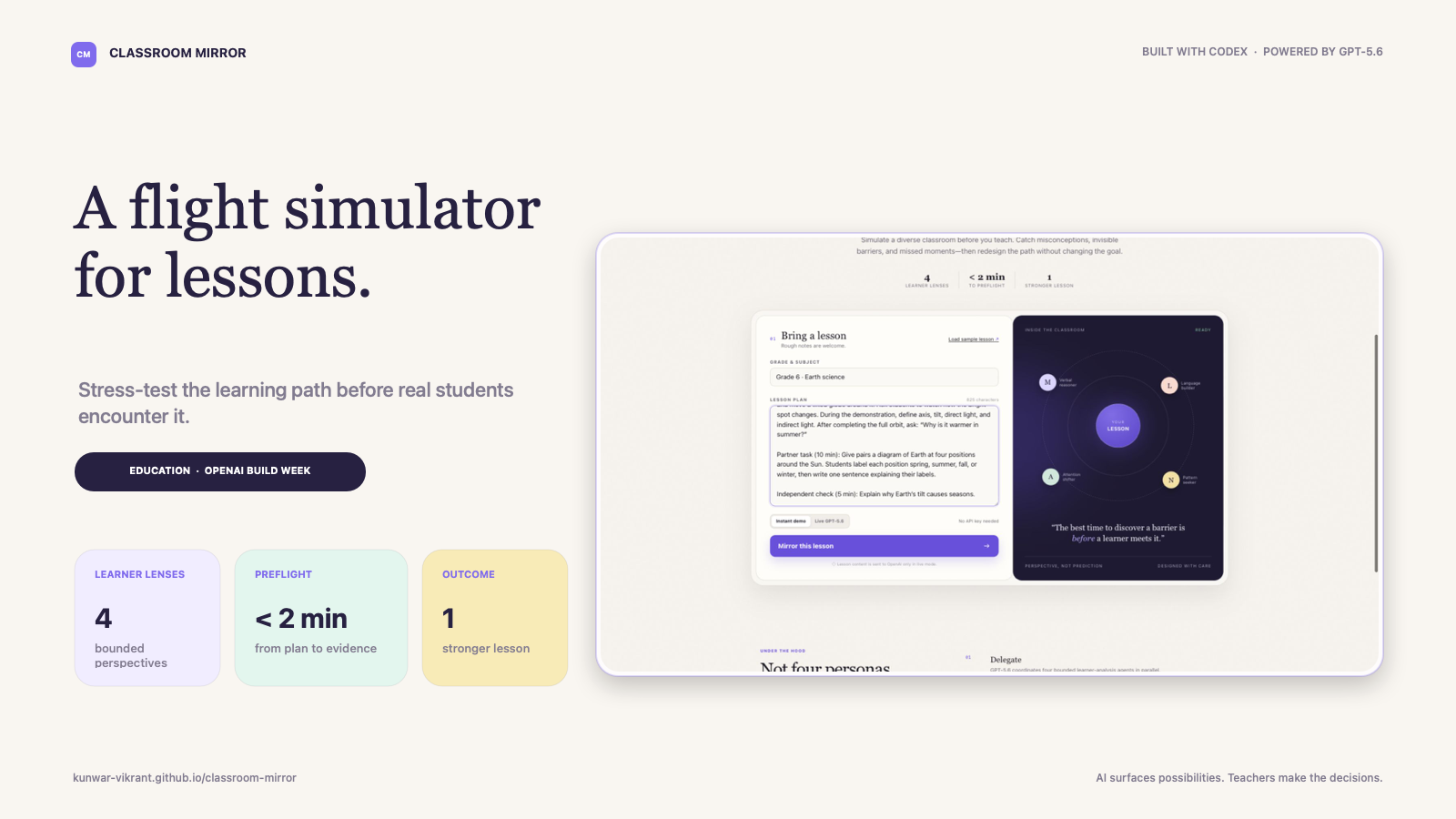
Teachers often discover ambiguity, inaccessible entry points, and misconception-producing examples only after a lesson is already underway. Most AI education tools generate more content. We wanted to build something different: a preflight check for the lesson a teacher already plans to teach.
Classroom Mirror helps teachers find the barrier before a learner does.
What it does
A teacher submits a lesson plan, and Classroom Mirror stress-tests it through four focused instructional lenses:
- Conceptual clarity
- Academic language
- Attention and feedback
- Transfer and challenge
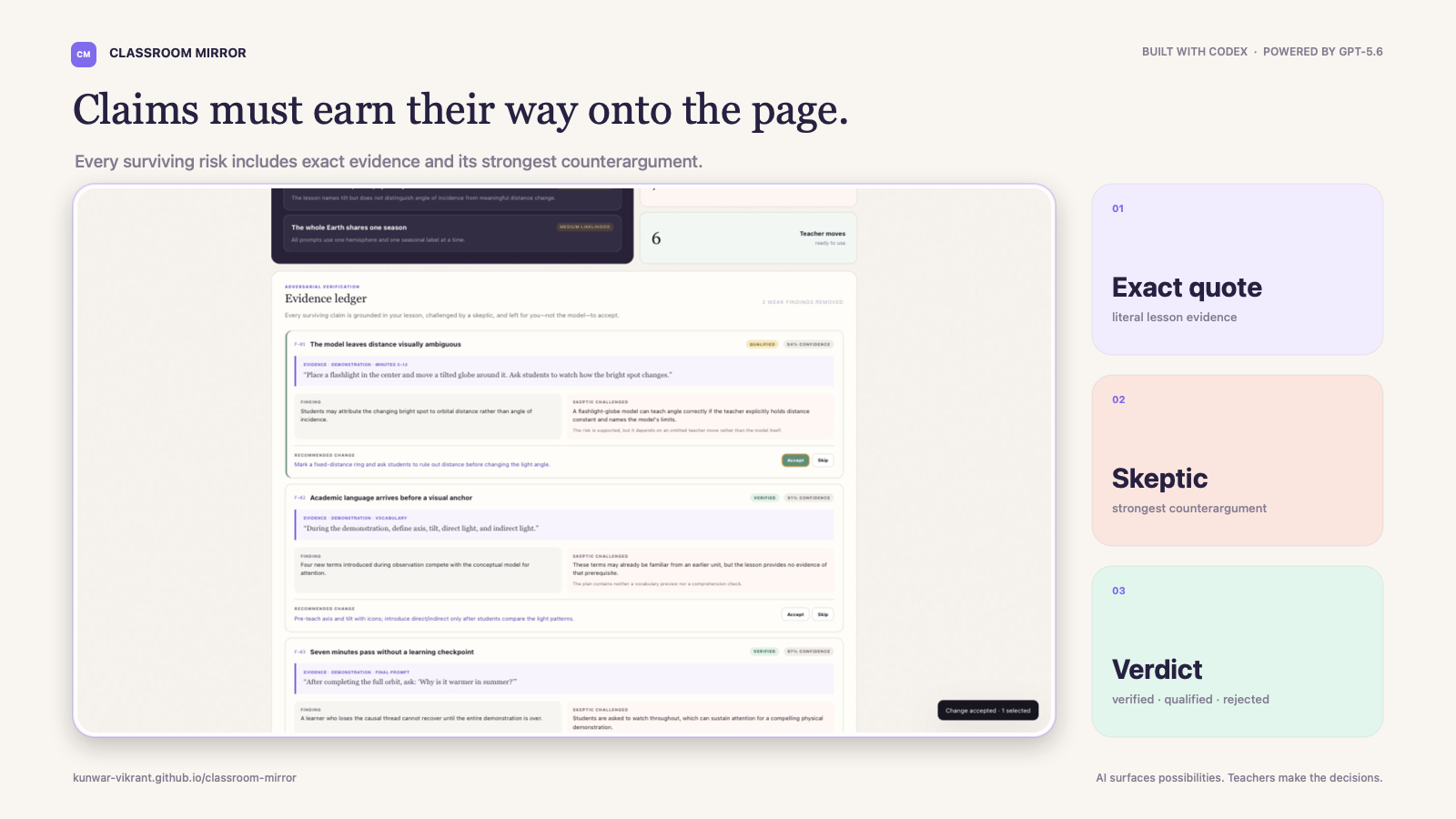
Every finding must cite an exact passage from the submitted lesson. A separate skeptical verification stage then challenges the finding and labels it as verified, qualified, or rejected.
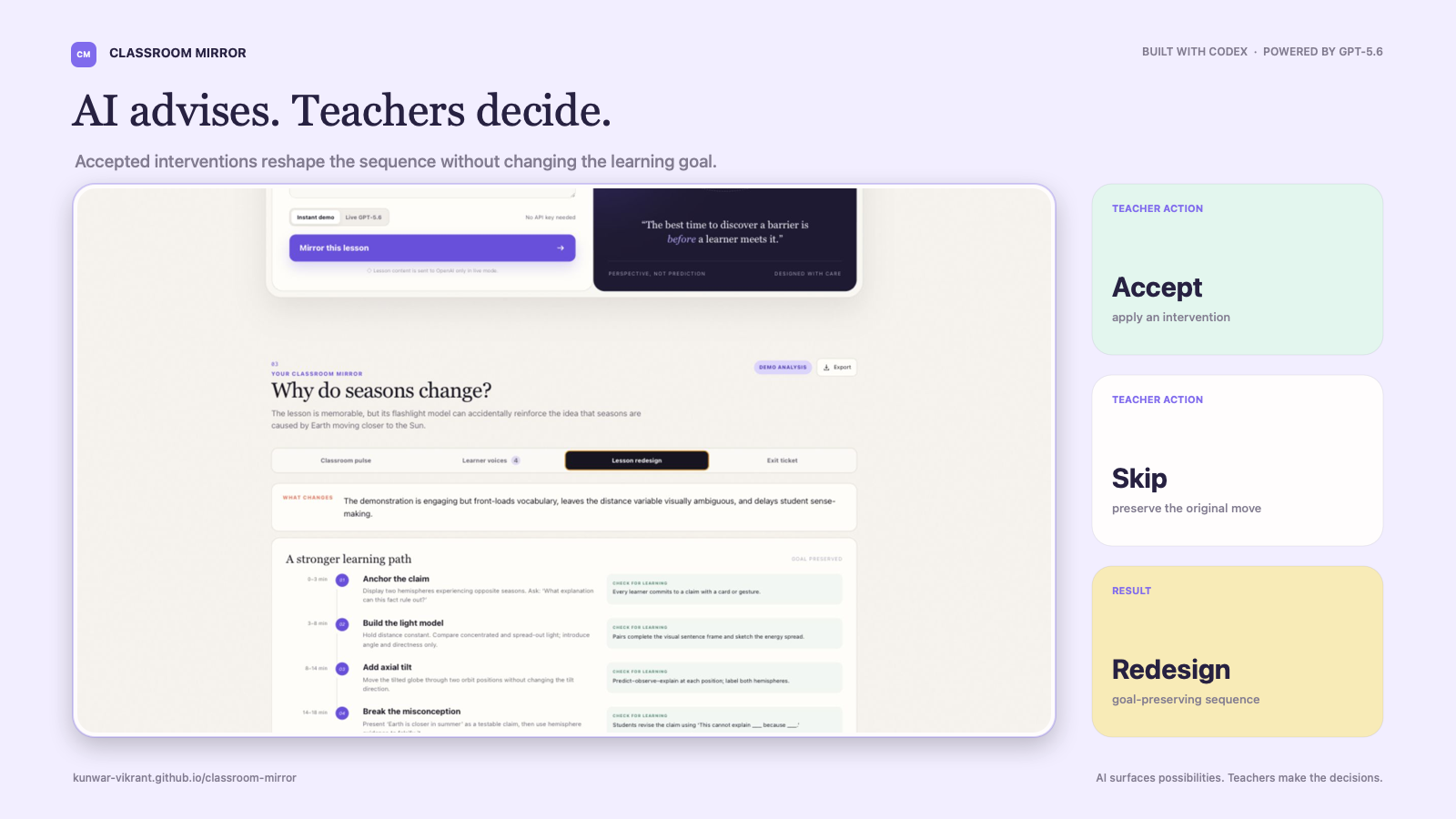
The result is an evidence ledger—not a generic AI score. Teachers review the supporting quote, the instructional risk, the skeptic's counterargument, and the recommended change. They decide which interventions to accept or skip before viewing a redesigned learning sequence.
AI surfaces possibilities; teachers make the decisions.
How we built it
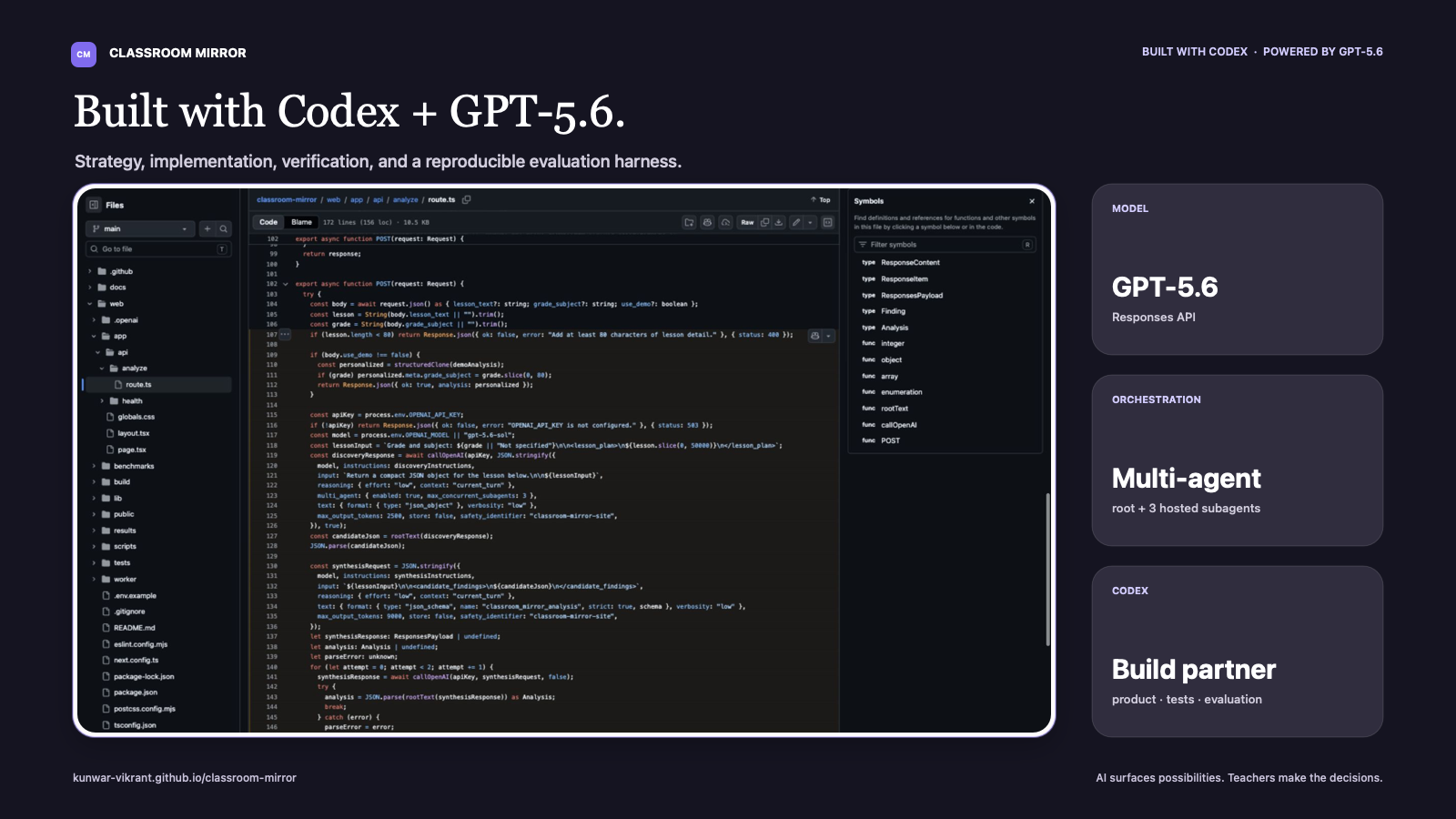
Classroom Mirror uses the OpenAI Responses API with gpt-5.6-sol in two stages.
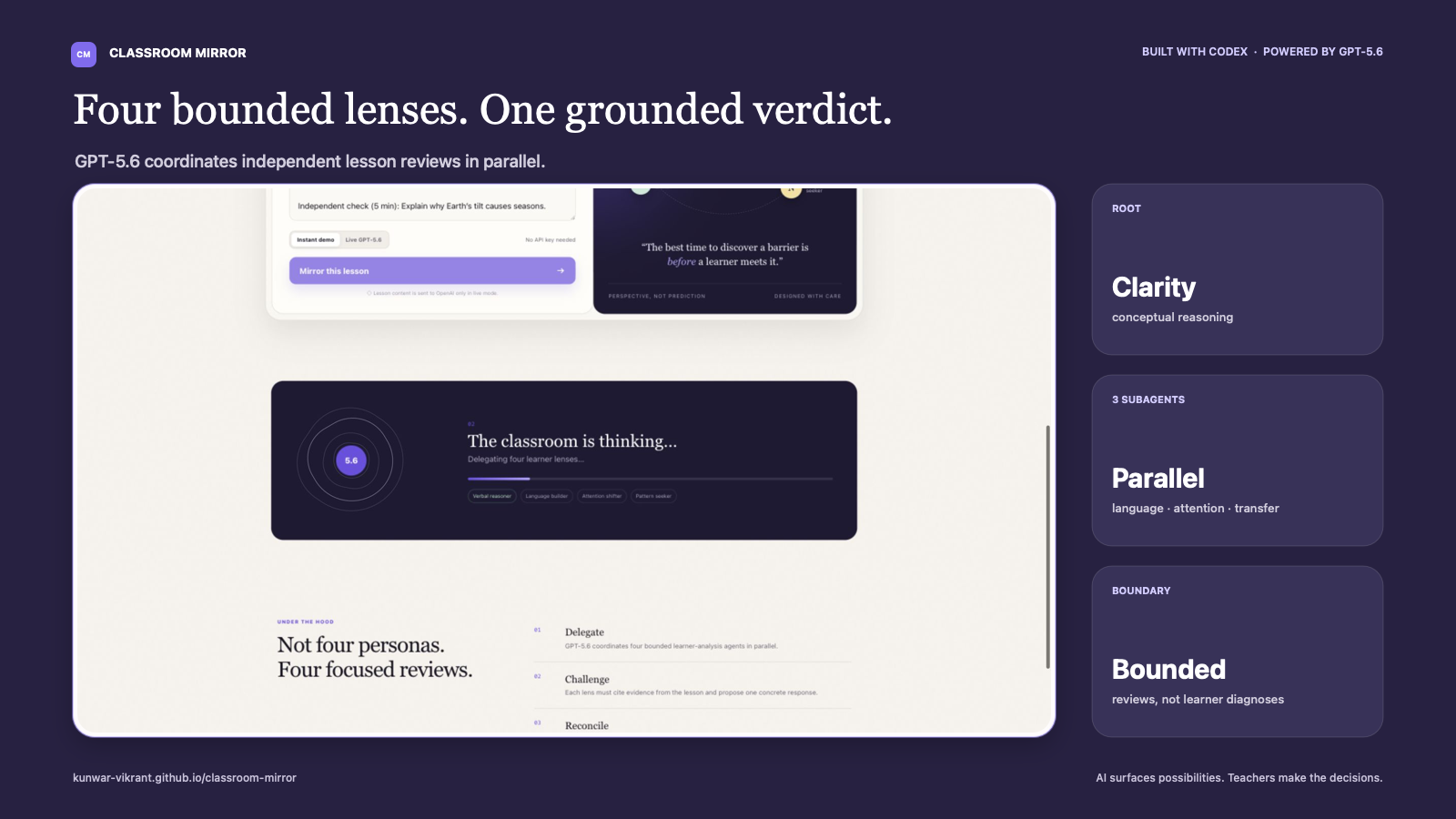
First, GPT-5.6 performs parallel discovery using the hosted Multi-agent capability. The root handles conceptual clarity while three bounded subagents independently examine language, attention and feedback, and transfer.
Second, a direct GPT-5.6 call skeptically verifies the candidates and returns strict structured output. The server then performs another grounding check: if an evidence quote is not a literal substring of the submitted lesson, the finding is removed before reaching the teacher.
The application is built with Next.js, React, TypeScript, and Node.js. It includes:
- A deterministic no-key demo for judges
- Live GPT-5.6 analysis for local testing
- Strict JSON Schema outputs
- Teacher accept/skip controls
- An adversarial benchmark harness
- Contract, safety, accessibility, and production-build tests
The public deployment intentionally uses the deterministic demo so no paid API key is exposed.
Challenges we faced
Making the analysis credible
Our first concept used simulated learner personas. It looked engaging, but it risked pretending that AI could accurately predict individual students. We redesigned the system around bounded instructional-review lenses that identify possibilities without diagnosing learners.
Preventing confident but unsupported findings
Prompt instructions were not enough. We added several trust boundaries: exact evidence requirements, skeptical verification, strict structured output, and application-level substring validation.
Using multiple agents appropriately
The review dimensions are independent, making them suitable for parallel agents. Verification and reconciliation are separate because they require a different role and contract.
Evaluating honestly
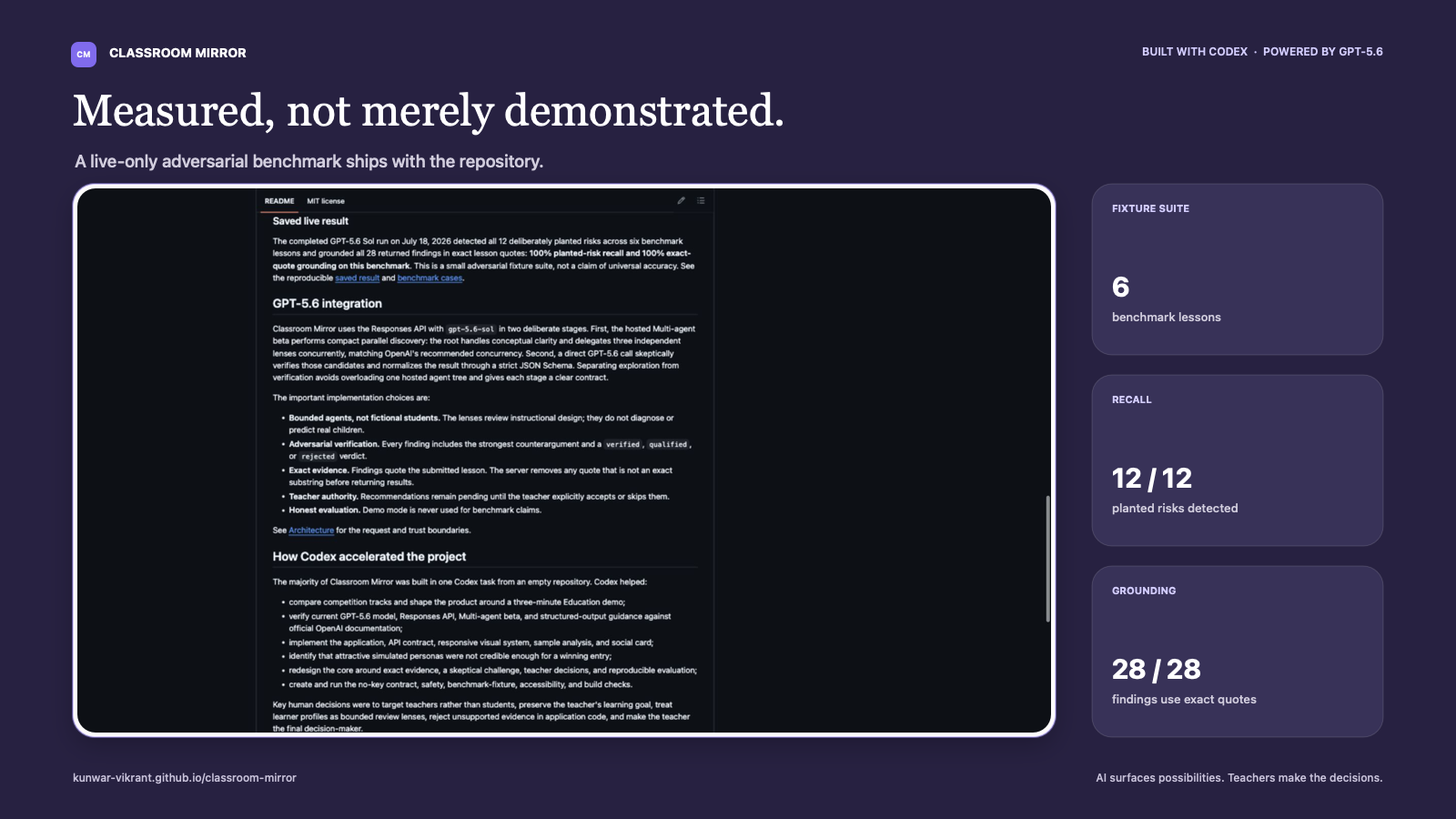
We did not want to present cherry-picked demo output as proof. We created six benchmark lessons containing 12 deliberately planted instructional failures and made the evaluation harness refuse to score deterministic demo data.
Accomplishments we are proud of
In the completed live GPT-5.6 Sol benchmark run, Classroom Mirror:
- Detected all 12 planted instructional risks
- Grounded all 28 returned findings in exact lesson quotes
- Achieved 100% planted-risk recall on this bounded benchmark
- Achieved 100% exact-quote grounding
The benchmark cases and saved result are included in the repository for reproducibility. These results describe this specific adversarial fixture suite, not universal classroom accuracy.
We are also proud that teachers remain the final authority. Classroom Mirror never silently rewrites their work.
What we learned
We learned that trustworthy educational AI is less about generating impressive content and more about showing evidence, exposing uncertainty, and preserving teacher agency.
We also learned that multi-agent systems work best when each agent has a narrow, independent responsibility. Adding more personas did not make the product stronger; bounded analysis, adversarial verification, and deterministic validation did.
How Codex accelerated the project
The majority of Classroom Mirror was built in one Codex task, starting from an empty repository.
Codex helped us:
- Compare competition tracks and shape the Education use case
- Verify the GPT-5.6 Responses API and hosted Multi-agent implementation
- Build the application, API contract, interface, and evaluation harness
- Generate contract, safety, accessibility, and build tests
- Diagnose live API and benchmark failures
- Challenge the original persona-based design
- Prepare the repository, documentation, deployment, and submission
The most important contribution was not code generation. Codex challenged whether the original prototype was credible enough to win. That critique led directly to the evidence ledger, skeptic verification, teacher-decision layer, and reproducible benchmark.
What's next
Next, we want to pilot Classroom Mirror with practicing teachers, expand the benchmark across subjects and grade levels, measure which findings teachers accept or reject, and develop subject-specific review lenses.
The long-term goal is not to automate lesson planning. It is to give every teacher a fast, evidence-grounded second look before the lesson reaches real learners.
Built With
- codex
- gpt-5.6
- openai

Log in or sign up for Devpost to join the conversation.